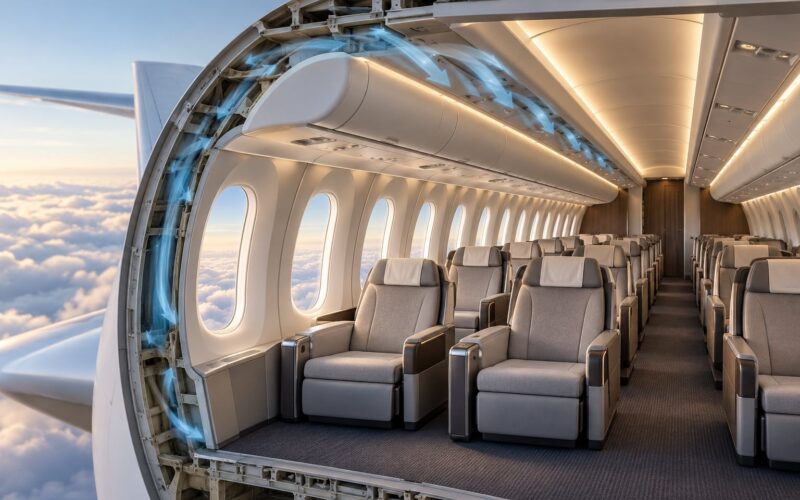
The A380 feels quiet because nothing on it has to work hard. Two enormous high-bypass turbofans produce their thrust at low exhaust velocity, a 79.8 metre wing keeps cruise drag down, and a double-deck fuselage wrapped in heavy acoustic insulation blocks most of what is left. Add a cabin pressurised to roughly 6,000 feet and you have the short version of why the A380 feels so quiet compared with almost every jet before it.
I’ve flown and read enough reports on this aircraft to know the reputation is mostly deserved, with one honest caveat that we’ll come back to: some people find it unnervingly silent, and a few regular upper-deck flyers argue the 747-8 is just as calm.
Table of Contents
- Why the A380 feels so quiet: the short answer
- A380 noise at a glance
- How the A380’s engines reduce cabin noise
- Why the A380 feels so quiet at cruise
- How cabin insulation softens aircraft noise
- Why the A380’s wide cabin changes sound perception
- How seating and cabin layout affect what you hear
- What makes some A380 flights seem louder
- How to choose a quieter A380 seat
- Frequently Asked Questions
- Is the A380 noisy?
- Is the A380 quieter than the A350?
- Does the A380 feel turbulence as strongly as other planes?
- Are noise-cancelling headphones still worth packing on an A380?
- Is the upper deck quieter than the main deck?
- Which widebody has the lowest cabin altitude?
- Conclusion
Why the A380 feels so quiet: the short answer
Seven things do most of the work, and they stack on top of each other:
- Enormous engines turning slowly. A big fan moving a lot of air a little is quieter than a small fan moving it a lot. The Rolls-Royce Trent 900 and Engine Alliance GP7200 both give the A380 far more thrust than it needs on most flights, so the exhaust gas leaves the back of the engine slowly and quietly.
- Engines slung under the wings. Both engines sit well outside the pressure shell. Most of the fan noise radiates forwards and outwards, away from where you sit.
- A wing with a huge amount of area. The A380 carries its weight on an enormous wing at a gentle loading, which keeps cruise drag and the low-frequency rumble that comes with it down.
- A double-deck shell built thick. A two-level fuselage has far more structure and mass than a single-deck one of similar capacity, and mass is a good defence against vibration.
- Dedicated acoustic treatment. Lined panels, fibrous blankets and damped fairings sit between the outside world and the sidewall you lean against.
- A cabin with volume. Two aisles, a full-length upper deck and a high ceiling spread sound out instead of concentrating it.
- A low cabin altitude. Pressurised to about 6,000 feet rather than the 8,000 feet typical on older widebodies, the airframe flexes less and the shell works as a better acoustic barrier.
None of those makes the aircraft silent. It makes the ambient noise floor low enough that other things become the loudest thing in the cabin.
A380 noise at a glance
Perceived quietness on any flight comes from a mix of the aircraft itself and everything happening around you. Here’s how the A380 stacks up on the factors that matter.
| Factor | What it does | Where the A380 sits |
|---|---|---|
| Engine placement | Decides how much fan noise reaches the cabin | Two large engines under the wings, outside the pressure shell |
| Engine loading | Lower relative thrust means lower jet noise | Very low on most flights, higher on short hot ones |
| Cruise altitude and speed | Thin air at altitude changes both airflow and airframe noise | Typical long-haul cruise near 35,000 feet |
| Cabin insulation | Blocks structure-borne and airborne noise from the sidewall | Heavy multi-layer treatment, varies by operator fit-out |
| Cabin width and height | A larger volume spreads the same sound energy further | Wide twin-aisle with a full-length upper deck |
| Seating layout | Distance from engines, galleys and lavatories dominates locally | Varies by airline and by aircraft in the fleet |
| Background conditions | Service activity, cabin crew movement, weather and flight phase | Often louder than the aircraft itself |
Read that bottom row carefully. On two flights five weeks apart, on the same aircraft and the same seat, the difference in cabin noise can be bigger than the difference between two different widebody types.
How the A380’s engines reduce cabin noise
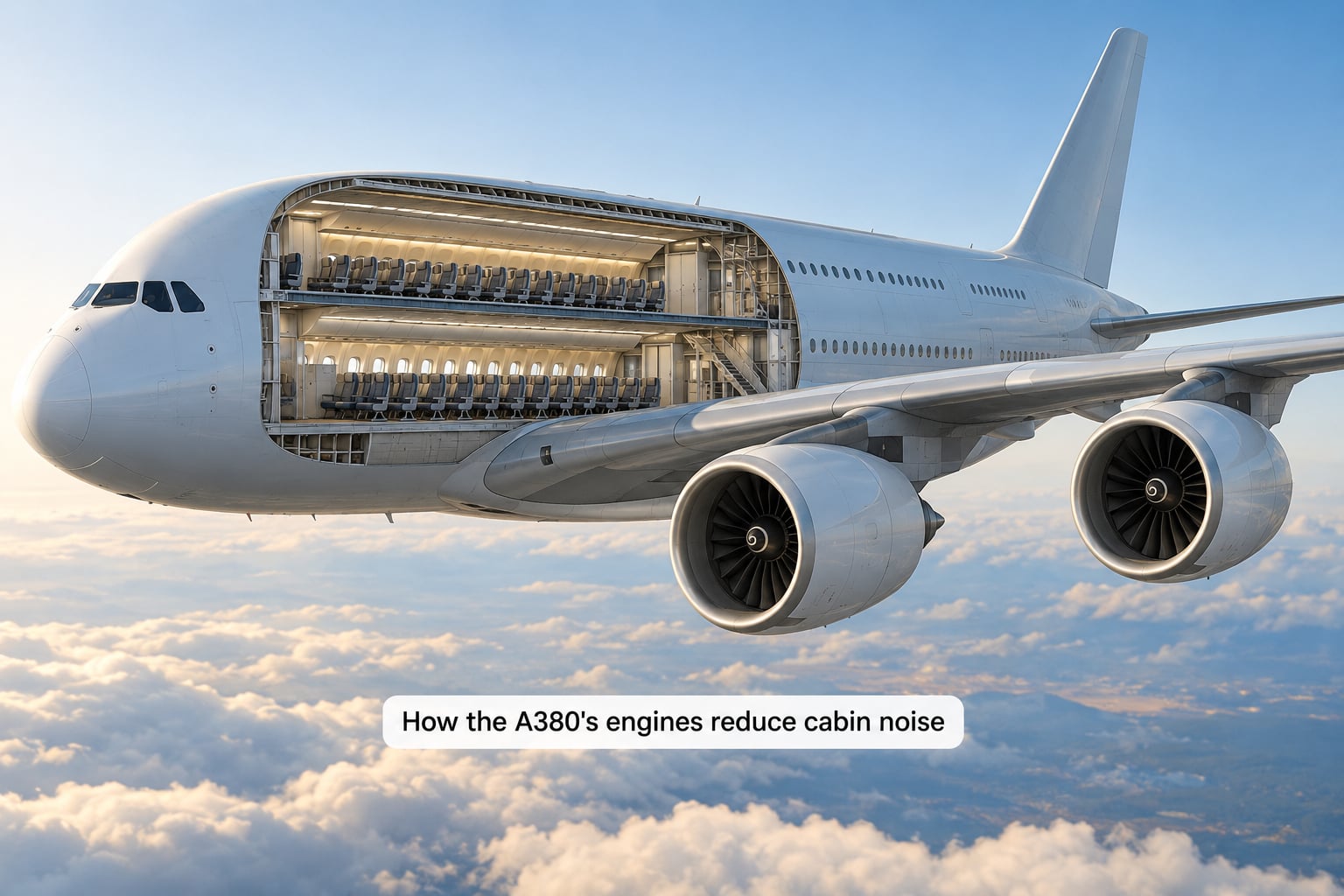
A jet engine makes noise in two main ways. The first is the fan itself: air being accelerated onto the fan blades, which produces a broad rushing roar. The second is the exhaust: hot gas leaving the tail at high speed, which produces the sharp high-frequency whine most people picture when they think of an airliner.
Both get quieter when the engine is big relative to the job. The Trent 900 and GP7200 are enormous, roughly three-metre-class fans, and on a sector where the aircraft weighs maybe 300 tonnes instead of its full 500, they produce the required thrust at a much lower exhaust velocity and a gentler fan pressure ratio. Less energy leaves the back of the engine, and less energy means less noise.
Position matters just as much as size. The engines hang forward and below the wings, well clear of the fuselage wall. Sound radiating from the fan face travels forwards and outboard, away from the cabin. What remains is mostly transmitted through the wing and pylon structure, and the wing’s own aerodynamics shapes what gets past.
Why the A380 feels so quiet at cruise
Cruise is the phase where the A380 sounds best, and there are three reasons. First, the engines are at their most relaxed: a heavy aircraft flying efficiently in thin air needs far less thrust than it does to take off.
Second, altitude cuts through the noise floor. There is very little air left at 35,000 feet, so the airflow noise most people associate with airliners is far lower than it would be a few thousand feet lower. Third, steady cruise means a steady aerofoil, and a wing flying smoothly at a steady angle produces far less buffet and rumble than one being worked.
That last point is why quietness and turbulence get confused so often. The A380 is also widely reported as smooth, and the two are linked, but they are not the same thing. A flight can be quiet and still shake, and a noisy flight can occasionally be glassy. Where the A380 genuinely stands apart is that it is good at both at once.
The caveat: none of this makes the aircraft silent. Takeoff, landing, the initial climb and any high-workload phase will be loud on an A380 just as they are on any other airliner.
How cabin insulation softens aircraft noise
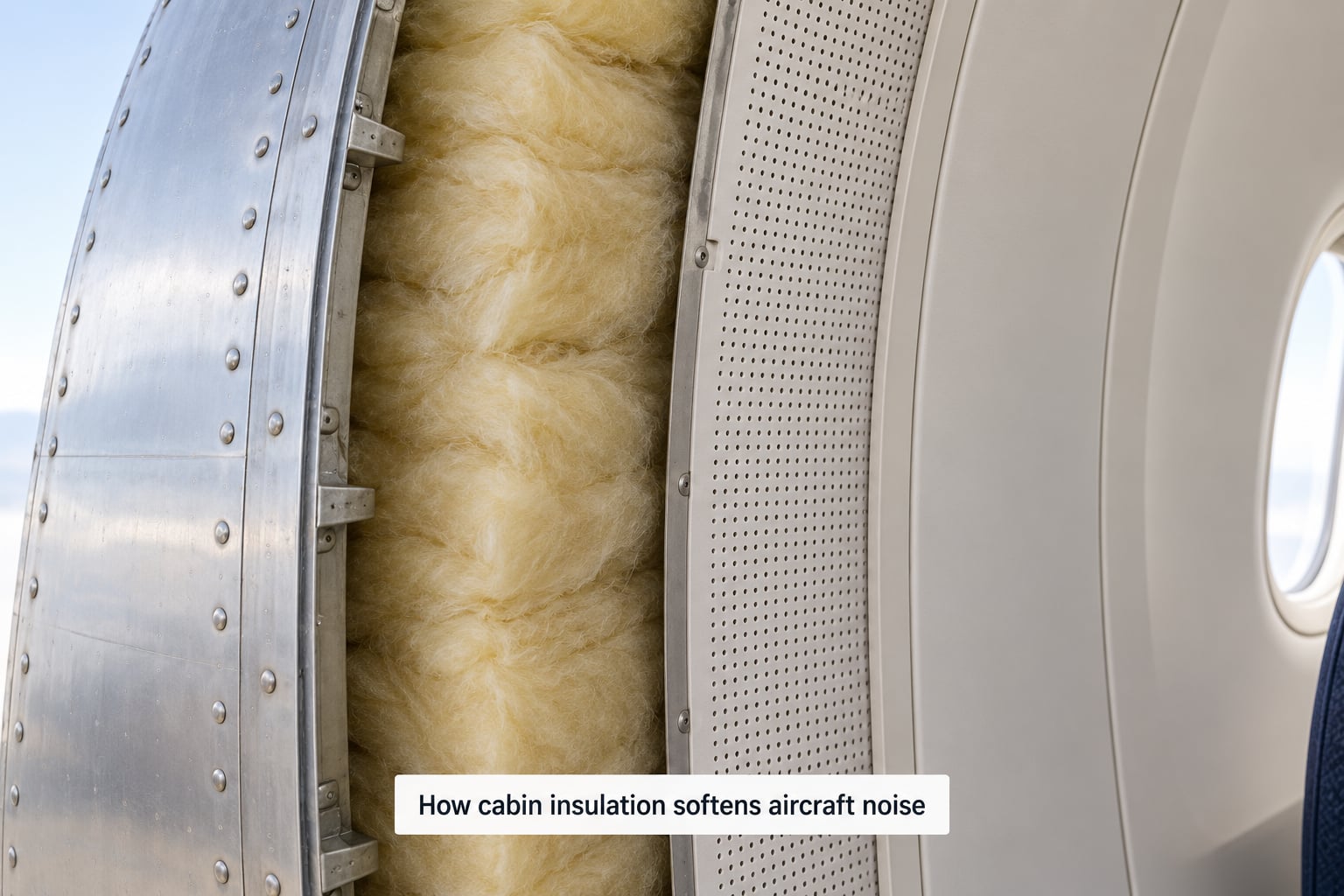
Between the outside of the aircraft and the panel you press your head against there is a stack of layers doing different jobs. The outer shell is structural. Behind it sits a thick fibrous blanket that soaks up vibration rather than reflecting it. Inside that is an acoustic liner, often perforated, which absorbs the low-frequency energy that gets through the blanket. The finished interior panel then closes the gap.
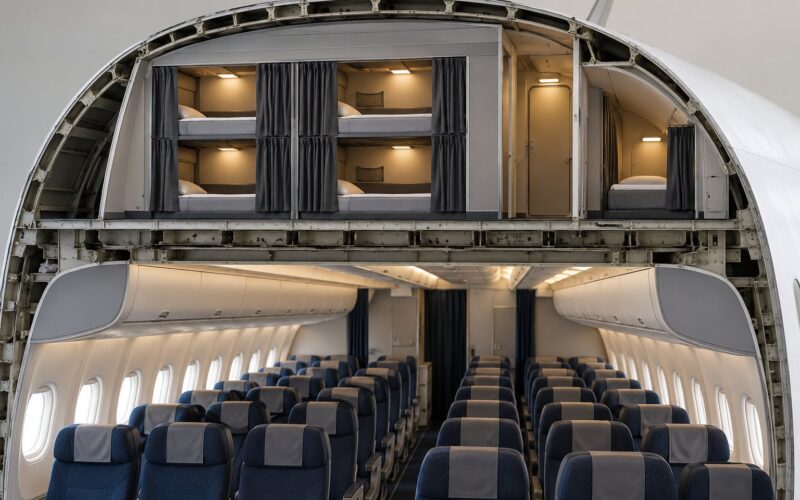
The double-deck arrangement helps here too. Building two full-length cabins means a taller, deeper structure with more material between the interior and the airflow, and a stiffer shell that flexes less as the aircraft manoeuvres.
Details differ between operators and between individual aircraft in the same fleet, so treat any specific claim about an airline’s insulation as a claim about configuration rather than about airframe type. Fit-out matters as much as engineering on this one.
Why the A380’s wide cabin changes sound perception
The single biggest factor is not a sound at all. It is volume, and it works on your brain rather than your ears.
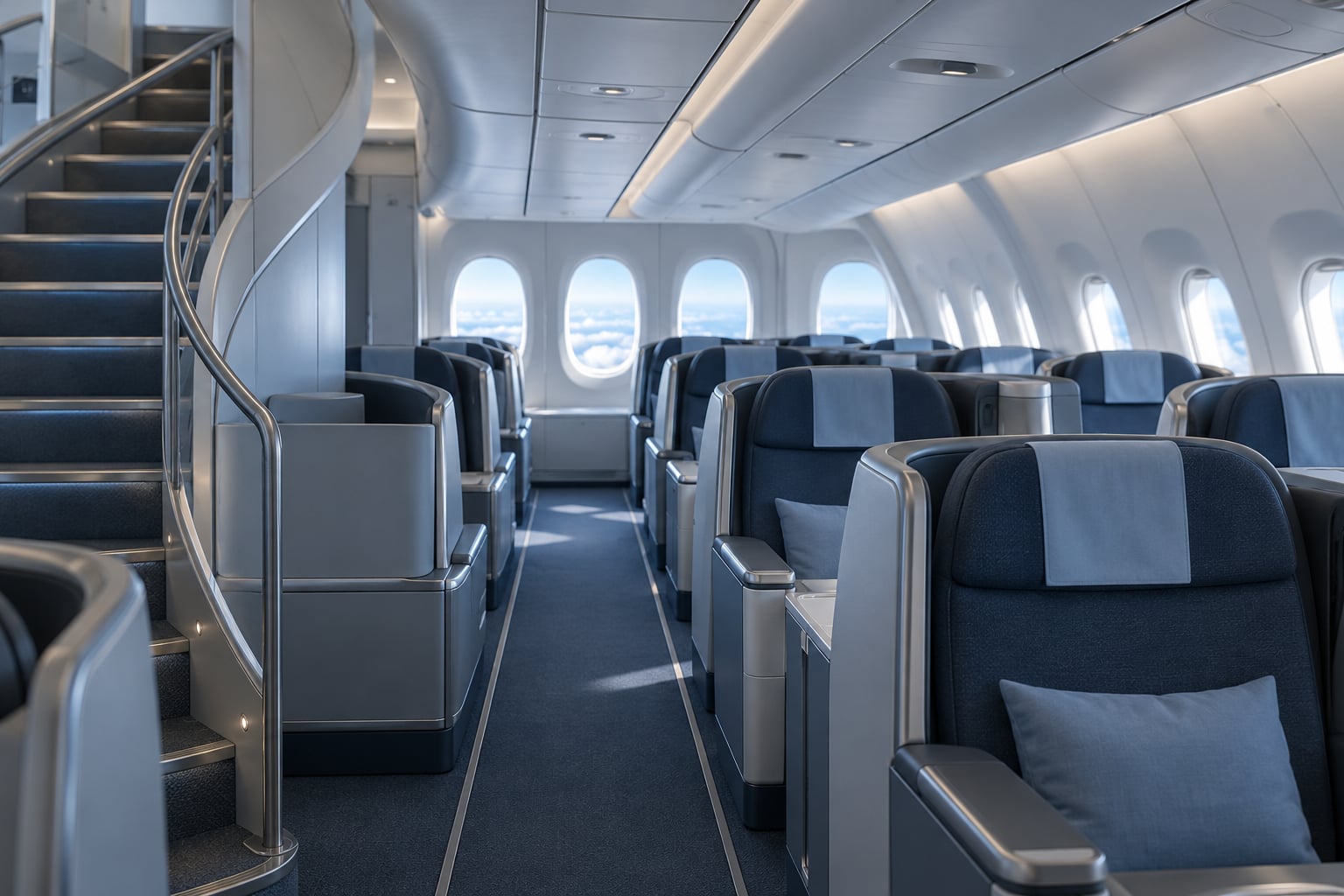
Sound has a fixed energy. Spread through a larger volume of air, the same amount of energy produces a lower level. The A380 has two aisles instead of one, a ceiling nearly twice as tall in the upper deck, and a floor-to-floor volume per passenger that most twin-aisle aircraft cannot approach. The result is that the cabin noise floor sits lower in absolute terms and feels lower still.
Then there is the upper deck. Sitting above the main deck puts you further from the floor, from the galleys and from the bulk of passenger movement, and above the wing root in the middle section. Many flyers describe the upper deck as the calmest place on the aircraft, though it is not uniformly quiet everywhere.
How seating and cabin layout affect what you hear
Locally, seat position beats everything else. Rows close to the engines carry more fan and exhaust noise. Rows over or just behind the wing pick up more structure-borne sound. Seats beside a galley, a lavatory or an exit get door activity, trolley noise and announcements.
Many flyers find the calmest zones in the centre of the main deck and toward the rear of the upper deck, away from service areas. Rows far forward are usually fine for noise and less so for anyone sensitive to galley traffic.
Be honest about the limits of a seat map. It shows you where the galley and lavatories are. It does not show you which aircraft type you are booked onto, how that operator fits out the cabin, or whether the row in front of you is a bulkhead on one aircraft and a normal row on the next.
What makes some A380 flights seem louder
Plenty of A380 flights are not quiet, and the aircraft is rarely the reason. A short hot-and-heavy sector pushes the engines harder. A full cabin moves more during service. Turbulence makes people talk louder, which is the effect most flyers actually notice in rough air.
The air system makes its own noise too, particularly during a temperature change on descent, and cabin crew working a busy galley generate more sound than the engines do at cruise. Noise during takeoff and landing is a completely different sound from noise at 35,000 feet, and comparing the two is like comparing a motorway to a library.
Then there is the private one. In a very quiet cabin, you overhear the couple behind you. FlyerTalk posters who enjoy the silence still mention bringing headphones because a neighbour snoring beats an engine. That is not a flaw. It is the quiet doing its job.
How to choose a quieter A380 seat
If cabin quietness is your priority, work down this list in order:
- Check the aircraft type first. The seat map matters only once you know which airframe you are on. A forward seat on the main deck of a different layout can be quieter than a mid-cabin seat on the aircraft you wanted.
- Avoid the rows directly beside or just aft of the engines. This is the clearest win available and it costs nothing to avoid.
- Keep away from galleys and lavatories. On a full flight those doors open constantly. If you are booking a bulkhead or a row near a galley, weigh that against the noise.
- Look at the upper deck centre section. Many flyers rate it as the calmest cabin on the aircraft, though it narrows in places and the best rows sell out early.
- Consider rows ahead of the wing on the main deck. They are usually well clear of both engine and galley noise on most layouts.
- Decide whether you want silence or calm. A rear upper-deck seat often feels calmer because it is away from the aisle, even if it is not the lowest measured level. People sensitive to motion prioritise different rows than people sensitive to sound.
And bring headphones anyway. They still work on a quiet cabin, there is just less for them to cancel, which mostly means you stop hearing the trolley.
Frequently Asked Questions
Is the A380 noisy?
Not by the standards of an airliner. In cruise, cabin noise on an A380 sits near the quiet end of the widebody range, largely because the engines are enormous and barely working. Takeoff, landing and the climb are still loud, exactly as they are on any jet. And a very low noise floor means nearby conversation can become the thing you notice most.
Is the A380 quieter than the A350?
Both are quiet, and measured differences between them are small and depend on operator fit-out more than airframe. FlyerTalk regulars broadly rank the A380 ahead of the A350, which sits ahead of the 777-300ER and the 787. The A380’s advantage comes from sheer size: bigger engines at lower load and more cabin volume. The A350 is designed to be quiet in its own right.
Does the A380 feel turbulence as strongly as other planes?
It is widely reported as one of the smoothest long-haul aircraft, and its huge low-loaded wing and fly-by-wire flight controls both contribute. But quiet and smooth are separate qualities that travellers constantly mix up. A flight can be quiet and still shake. Judge motion by seat position and by the route, not by how loud the cabin is.
Are noise-cancelling headphones still worth packing on an A380?
Yes, though for a different reason than on a 777. There is less sound for them to cancel, so they work less dramatically, but they still block the airflow, the trolley, the announcements and the neighbour. FlyerTalk posters who like the quiet still bring them. The A380 is quiet enough that human noise becomes the loudest thing in the cabin.
Is the upper deck quieter than the main deck?
Usually, yes. The upper deck sits further from the floor, the galleys and most passenger movement, and much of the middle section is above the wing root. The difference is noticeable but not dramatic, and it varies a lot by row and by operator fit-out. A main-deck seat well clear of the engines and galleys can be perfectly calm.
Which widebody has the lowest cabin altitude?
The A380 is pressurised to roughly 6,000 feet, below the 8,000 feet typical of older widebodies such as the 777 and the 747. The A350 also runs a comparatively low cabin altitude. Lower cabin altitude reduces airframe flexing and helps passengers with sinus and ear discomfort, which is a comfort story rather than a noise story, though the two overlap.
Conclusion
Why the A380 feels so quiet comes down to seven stacked factors: huge engines turning slowly, engines slung well outside the cabin, an enormous gently loaded wing, a thick double-deck shell, layered acoustic treatment, a cabin with real volume, and a lower cabin altitude that keeps the structure rigid. Any one of them helps. Together they put the noise floor where passengers notice everything else instead.
If you want the quietest possible seat, do three things. Confirm the aircraft layout before you trust the seat map, stay away from the engines, the galleys and the lavatories, and pick the upper deck centre section or a main-deck row ahead of the wing if it is available.
And when someone tells you the reputation is marketing, consider the other side of it. In 2026, Emirates spokesman Ed Davidson was quoted saying that on other aircraft the engines drown out the cabin noise, while on the A380 pilots in crew rest sleep with earplugs and the cabin noise goes straight through them. That is a complaint about too much quiet, not too little.