Airplane tray tables are cleaned in three stages: a thorough cabin deep clean when the aircraft is serviced on the ground, a faster wipe-down of high-touch surfaces like tray tables and armrests during each between-flight turnaround, and spot cleaning by cabin crew mid-flight if someone spills something. That combination is why a tray table usually looks clean even when it is not disinfected.
Most people never see any of it happening, because cleaning crews usually work while passengers are still walking down the aisle with bags in hand. That is also why a straight answer to how airplane tray tables are cleaned is worth having before you sit down.
Table of Contents
- What You Touch When You Use an Airplane Tray Table
- When Are Airplane Tray Tables Cleaned?
- How Airplane Tray Tables Are Cleaned on the Ground
- What Happens During an In-Flight Cabin Service
- Routine wiping vs a scheduled cleaning procedure
- What Does the Standard Cleaning Routine Look Like?
- How airplane tray tables are cleaned, step by step
- Who Cleans Airplane Tray Tables?
- Why Can Some Tray Tables Look Unclean Between Flights?
- Do Airlines Follow Rules for Cabin Surface Cleaning?
- What Can Passengers Do for a Cleaner Experience?
- Frequently Asked Questions
- How often are airplane tray tables cleaned during a flight?
- Are airplane tray tables cleaned before every flight?
- Do flight attendants disinfect every seat between passengers?
- What do airlines use to clean airplane tray tables?
- Should I sit at a seat with a visibly dirty tray table?
- Can I use a personal wipe to clean an airplane tray table?
- What to Do First
What You Touch When You Use an Airplane Tray Table
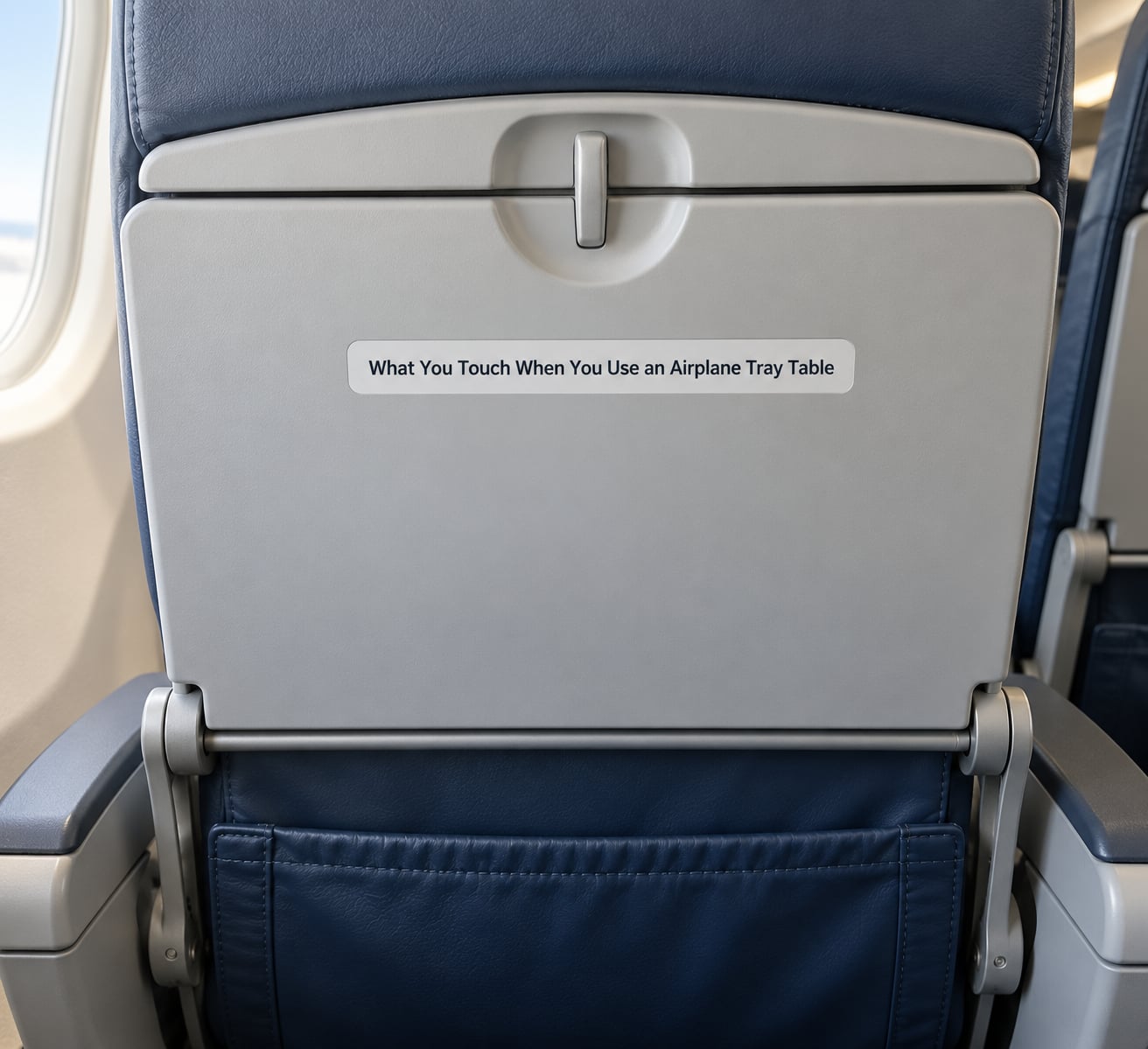
A tray table is a folded plastic panel with a latch at the top edge and a hinge at the bottom. You touch the latch with one hand to release it, the top surface with a forearm or a laptop, and the underside when you fold it back up. Most of the contact happens through the middle of the flight, when people put phones, passports, cups, headphones, and elbows on the surface.
The surface next to it matters just as much. The armrest is shared with a stranger on one side, the seat-back pocket in front of you gets handled by dozens of people before you board, and the seat belt buckle sits within reach of every hand in the row.
Here is the distinction that trips people up: looking clean and being microbiologically clean are different things. A table can be free of crumbs and smears and still carry whatever was transferred onto it hours earlier.
When Are Airplane Tray Tables Cleaned?
Timing matters more than the label. Airlines describe cleaning work in tiers, and the tier that touches your tray table depends on where the aircraft is in its schedule.
| When it happens | Who does it | What the tray table gets |
|---|---|---|
| Between flights (turnaround) | Contracted cabin cleaners, often working alongside deplaning passengers | Visual check and a wipe of visible residue; disinfection of high-touch surfaces depends on the airline and the length of the ground time |
| During the flight | Cabin crew | Spot cleaning of spills and messes as they happen; no scheduled full-cabin disinfection |
| Scheduled ground servicing | Specialist interior cleaning teams, sometimes the airline’s own staff | Top and underside cleaning, stain treatment, mechanism checks, deeper work on seat fabrics, carpets, and galleys |
| Crew rest and heavy maintenance periods | Cabin cleaners and maintenance staff together | Full interior detail including materials that cannot be handled during a short turnaround |
That third row is the one most passengers never experience. A scheduled interior clean is not something that happens on every aircraft on every cycle.
How Airplane Tray Tables Are Cleaned on the Ground
The between-flight reset follows a fairly consistent shape. Crews work away from the passengers and generally from the back or middle of the cabin outward, which keeps them out of the boarding path.
Trash comes out first. Then vacuuming picks up crumbs that fell onto the floor, seat pockets, and around the base of the seat. Hard surfaces get treated next, including tray tables, armrests, seat belt buckles, window shades, and the tops and undersides of seats.
Tray tables get specific attention because they are treated as high-touch surfaces. Both faces get wiped, along with the latch, the hinge line, and the tray edges. Compatible stains get treated separately, and damaged or cracked tables and latches get reported for replacement rather than left in service.
One thing to be careful about: there is no single universal product or contact time. Aviation rules and airline procedures require cleaners to use agents approved for aircraft interiors, but the specific active ingredient and the wet contact time depend on the operator, the jurisdiction, and the material being treated. Treat any blog claiming there is one standard disinfectant and one standard dwell time as a simplification.
What Happens During an In-Flight Cabin Service
Cabin crew are not running a full cabin disinfection at 35,000 feet. They are managing hazards. A spill on a tray table blocks a seat, a spilled drink near a power outlet is an electrical risk, and food on a surface is a customer service problem before it is a hygiene problem.
Travelers report that in-flight messes are usually handled with a paper towel and a splash of water or seltzer from a cabin bottle rather than a full disinfectant protocol, particularly for small spills and crumb messes.
Clearer in-flight procedure exists for bodily fluids. Airlines route those to a special-service or hazardous-materials response, usually handled on the ground at the aircraft’s next destination because it requires trained staff and protective equipment the cabin does not carry.
Routine wiping vs a scheduled cleaning procedure
A routine wipe removes what is visible on a surface people are about to touch. A scheduled cleaning procedure is a defined sequence with defined surfaces, tools, and a documented sign-off. The first takes seconds per seat; the second takes hours across the whole cabin. Cabin crew doing a mid-flight touch-up are doing the first.
What Does the Standard Cleaning Routine Look Like?
After passengers leave, the reset for a single tray table usually runs something close to this. Exact steps vary by operator, so treat it as the shape of the work rather than a fixed procedure.
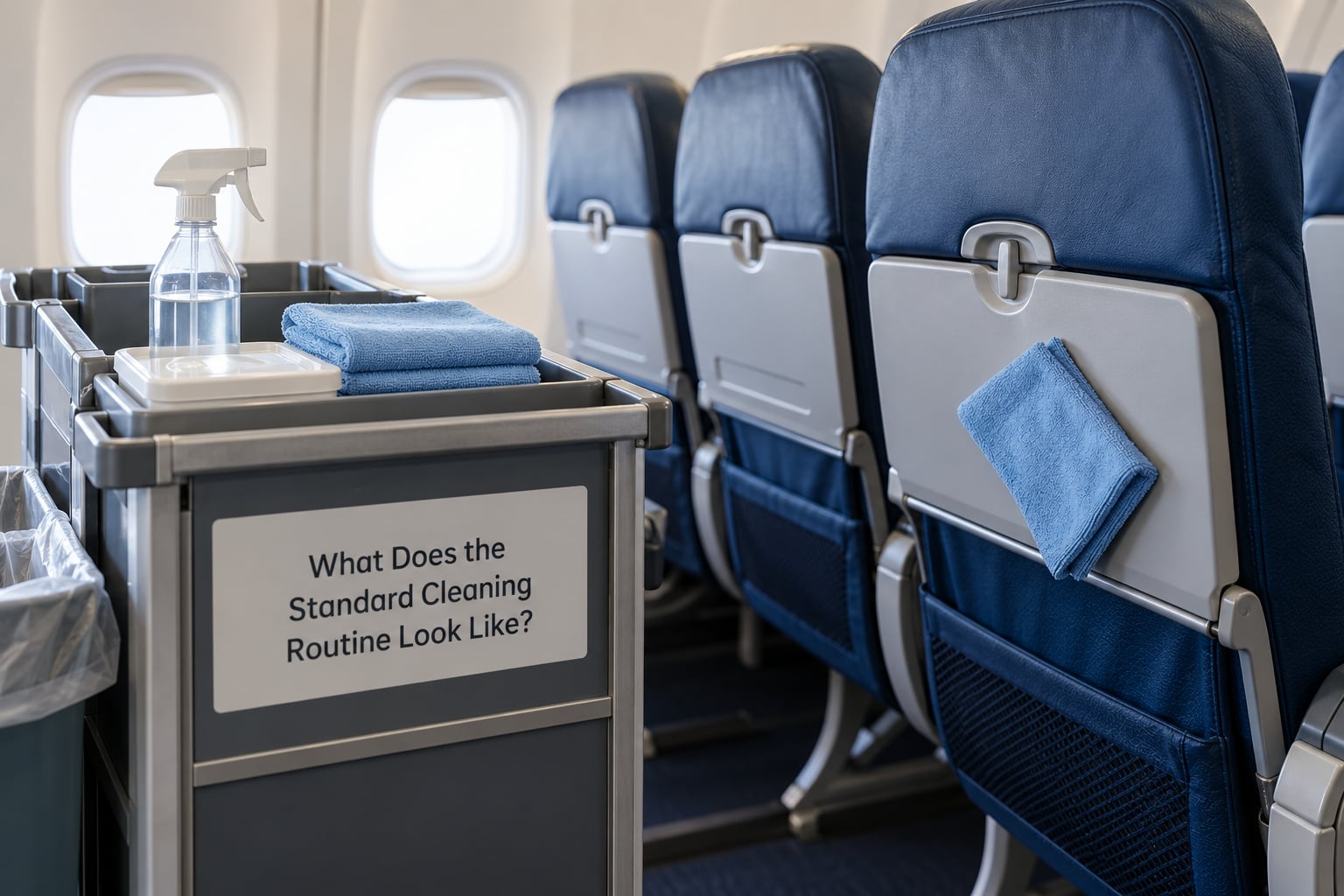
How airplane tray tables are cleaned, step by step
- Empty and clear. The tray is opened, leftover food, cups, and litter are removed, and the seat pocket in front is emptied into the refuse bag.
- Inspect. The top, underside, latch, and hinge are checked for visible residue, stains, and damage such as a cracked panel or a latch that does not hold.
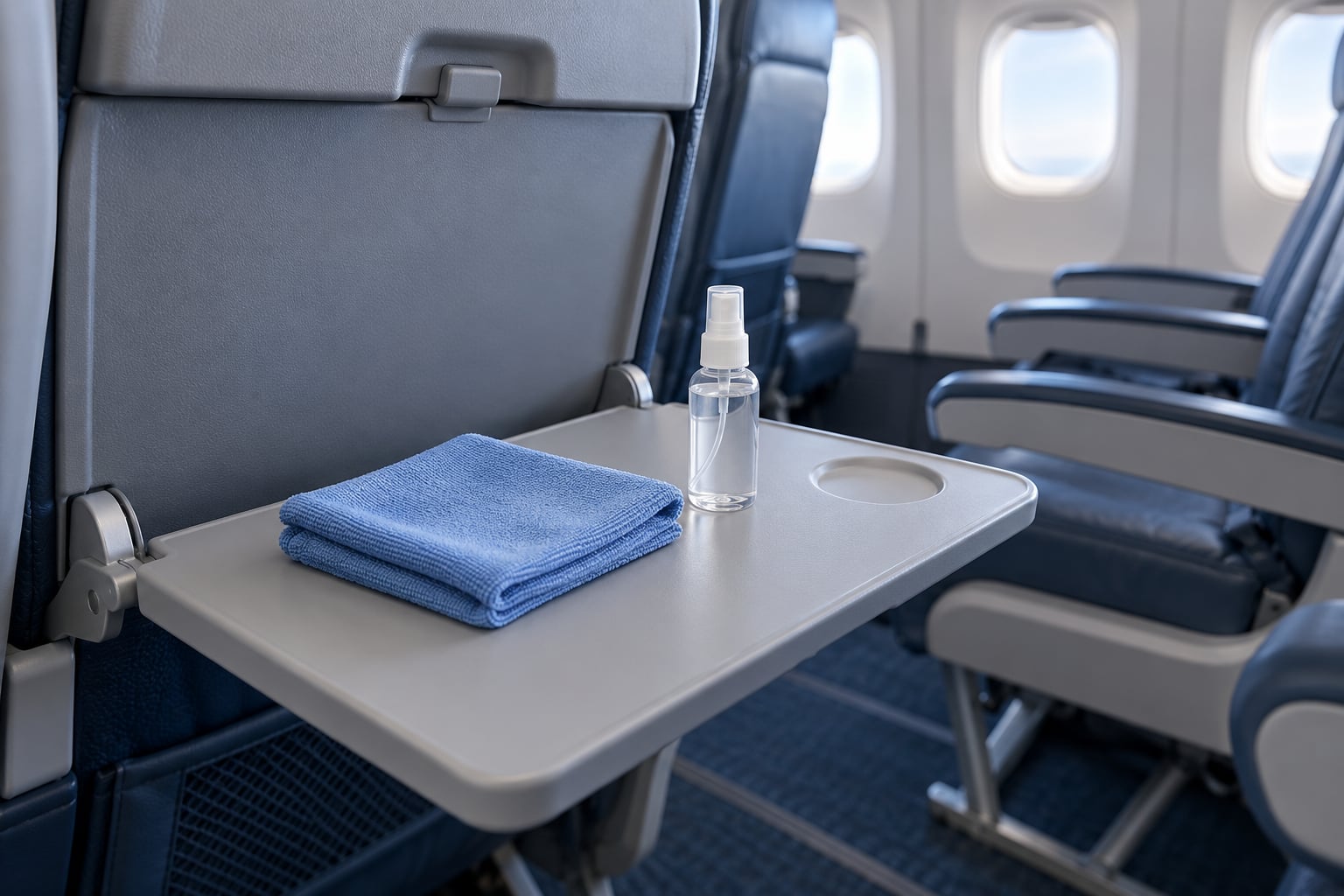
- Wipe the top surface. A microfiber cloth or disposable wipe is dampened with an approved hard-surface cleaner and the entire eating surface is wiped in one direction.
- Wipe the underside and edges. The bottom face and the table’s outer edges get the same treatment, because hands rest there when the tray is stowed or used as a laptop surface.
- Clean the latch and hinge. These are touched by almost every passenger and are frequently skipped in rushed turns.
- Wipe the neighbouring touchpoints. Armrest, seat-back pocket lip, screen bezel, and the seat belt buckle in that row.
- Let the surface stay wet long enough. Disinfectants only work if they remain wet for the contact time on the product label, and that time is measured in minutes, not seconds.
- Check the latch works. The table is folded back and released to confirm it locks upright and drops flat correctly.
Steps three through seven are the ones that get compressed when a turnaround runs late. The table still looks presentable. That is the difference.
Who Cleans Airplane Tray Tables?
It depends on the phase of the trip, and the same person rarely handles every surface. Contracted cabin cleaners usually own the between-flight reset, working row by row with a cart and a set of trays and cloths. Cabin crew handle in-flight spot cleaning and decide what needs a response. Specialist interior cleaning teams take over during scheduled servicing, and maintenance staff own anything mechanical, including a latch mechanism or a table that will not fold.
The assumption that the person cleaning the tray table is the same one who services the lavatory or the galley is worth dropping. Those tasks have separate procedures, separate chemicals, and separate sign-offs, and on a short turnaround they may belong to different teams entirely.
Why Can Some Tray Tables Look Unclean Between Flights?
Turnaround time is the honest answer, and it is short. A narrow-body aircraft is typically on the ground for roughly 30 to 45 minutes between sectors, and much of that window is consumed while the previous passengers are still deplaning. Cabin crew communities describe the practical reality: the work happens in the time left over, not in the full turnaround window.
Crew forums also point out that cleaning supplies are not guaranteed on board. Passengers on r/SouthwestAirlines report being told to bring their own wipes, which is a sign of how thin the in-flight stock has become.
There are other reasons a table can look worse than the rest of the row. A fresh clean may have been completed and then ten minutes of new passengers walked over it. Kids, pets, and bare feet reach tray tables as surfaces, not as food furniture. And worn plastics in older seats trap residue in scratches that a cloth cannot reach.
None of this means every airline follows the same cleaning standard. What it means is that visible cleanliness and verified disinfection are two different claims, and only one of them is something you can see from the aisle.
Do Airlines Follow Rules for Cabin Surface Cleaning?
Yes, in the sense that operators work to written procedures and aviation regulators such as the FAA and EASA set expectations for cabin condition and maintenance. But there is no worldwide rule that says a tray table must be disinfected with a named chemical before every departure.
Cleaning is contracted, and the contract reflects what the airline pays for and what the regulator requires. Aircraft interiors, food preparation areas in the galley, lavatories, and general high-touch surfaces are typically treated as different categories with different methods. Procedures also change over time, often quickly after a period of intense public scrutiny, which is why airline-by-airline cleaning claims age badly.
Southwest Airlines publicly reduced between-flight cleaning in 2020, concentrating disinfection on lavatories and tray tables while dropping the seat belt and armrest wipe-down, a change tied to fast turnarounds. That headline is old news now, but the logic behind it, cost and time pressure on the ground, is not.
What Can Passengers Do for a Cleaner Experience?
A few minutes of attention covers most of the risk.
- Wipe before you place anything. An alcohol-based hand-sanitizer wipe is fine on a hard tray surface. Wipe before you eat, not after, so you are not moving whatever you just cleaned onto your food.
- Use a barrier. A napkin, wrapper, tray liner, or sealed plastic bag between your food and the table removes the contact entirely. Regular flyers already skip seat-back pockets and tray surfaces for passports and headphones for the same reason.
- Fold the tray back. Once you have finished eating, closing it limits what later passengers touch and stops crumbs settling into the latch.
- Clean your hands first. Most transmission on a tray table happens hand to surface to food, not food to surface to hand.
- Report visible residue. If a table has crumbs, a sticky patch, or a spill, tell a crew member. Spills and bodily fluids get a formal response, which is far better than you handling it yourself.
A note on safety. Do not use a wipe that leaves the surface wet, since water near a seat’s electrical connections or a device charger is a real hazard. Never spray cleaner directly onto a table where liquid can run into the hinge or armrest electronics. If a table is cracked, sticky, or will not latch, that is a maintenance report, not a cleaning job.
Frequently Asked Questions
How often are airplane tray tables cleaned during a flight?
Not on a fixed schedule while passengers are aboard. Cabin crew clean up spills and messes as they occur during service rounds, and there is no routine in-flight disinfection of every seat. The systematic work happens on the ground, during the turnaround after passengers leave and during scheduled interior servicing.
Are airplane tray tables cleaned before every flight?
They are checked and reset on most turnarounds, which usually means removing litter and wiping visible residue from high-touch surfaces. Whether the table is actually disinfected depends on the airline, the aircraft type, and how much ground time the schedule allows. Some operators reduced between-flight disinfection after 2020 to keep turnarounds short, so there is no single answer that applies to every carrier.
Do flight attendants disinfect every seat between passengers?
No. A full row-by-row disinfection of every seat, armrest, and tray table between two flights is not realistic within a typical turnaround. Crew focus on visible contamination and the surfaces most likely to be touched next. Any crew member asked about a specific mess will usually deal with it on the spot, and larger bodily fluid incidents are escalated rather than handled casually in the cabin.
What do airlines use to clean airplane tray tables?
Contracted cabin cleaners typically use aviation-approved hard-surface cleaners and disinfectants applied to microfiber cloths or disposable wipes, working on the top, the underside, the latch, and the hinge. Some operators add electrostatic spraying or fogging on a scheduled basis. There is no universal product or contact time, because approved agents and required wet contact times vary by operator and jurisdiction.
Should I sit at a seat with a visibly dirty tray table?
You can ask the crew for a different seat, and they will often move you or clean the table first. Otherwise, wipe the surface yourself with an alcohol-based wipe before you eat, or keep your food in its wrapper or container so nothing touches the table. Tell a crew member about any spill, especially if you are travelling with a child, a pet, or someone with a weakened immune system.
Can I use a personal wipe to clean an airplane tray table?
Yes, and most regular flyers do it because it takes about ten seconds. Use a wipe damp, not dripping, and let the surface dry before you place food, drinks, or electronics on it. Do not spray anything directly onto the table, since liquid can run into the hinge or armrest electronics, and never use a wipe on a seat with visible damage or an electrical fault.
What to Do First
Look at the table before you put anything on it. If it is visibly dirty, wipe it with your own alcohol-based wipe or keep your food in its wrapper, and tell a crew member if there is a spill, sticky residue, or damage to the latch.
That single step closes most of the gap between how airplane tray tables are cleaned in practice and how clean you would like them to be.
This guide was updated for 2026. Airline cleaning procedures change, so check with your airline for the current policy on your specific flight.