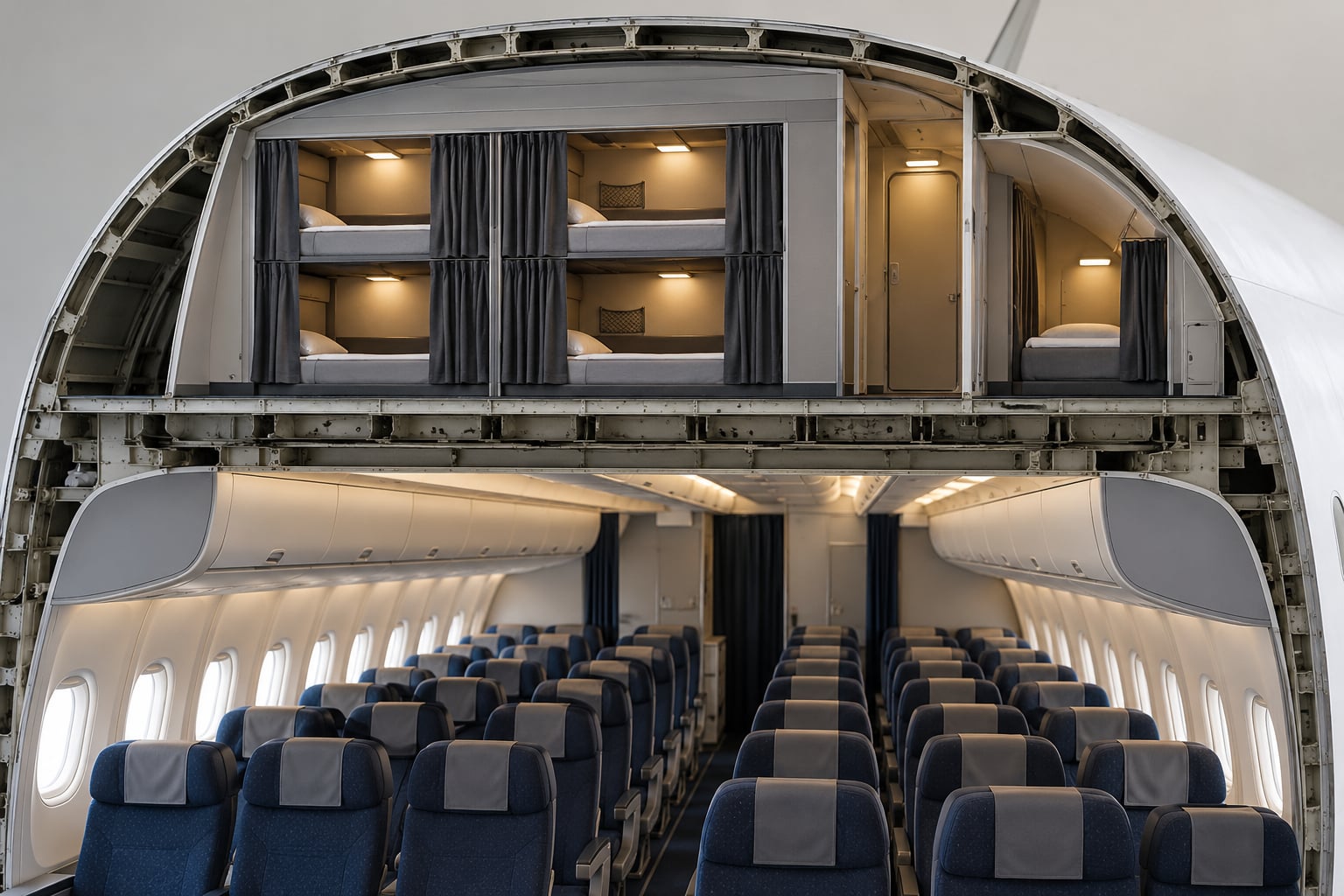
A crew rest area on a plane is a private, enclosed space built into the aircraft, usually above or below the passenger cabin, where pilots and cabin crew sleep and take breaks during long-haul flights. It holds bunk beds, privacy curtains, reading lights and its own ventilation. Passengers cannot use it.
If you have ever wondered what is a crew rest area on a plane, the short version is that it is crew-only sleeping space, not an amenity. Passengers notice it anyway: crew vanish mid-flight, lights change, service gets quieter, and on some aircraft you can hear a door close behind the flight deck.
The defining attributes are consistent enough that they can be listed plainly.
- Purpose: sleep, rest and recovery during scheduled off-duty periods in flight.
- Location: usually in the crown of the fuselage above the cabin, sometimes on the lower deck or behind the cockpit.
- Contents: bunks or reclining crew seats, bedding, reading lights, ventilation, storage, charging points and a door or curtain for privacy.
- Classification: the FAA sorts rest facilities into Class 1, Class 2 and Class 3, from the most to the least separated.
- Access: controlled and crew-only. It may not be occupied during taxi, take-off or landing unless a standard seat is fitted.
- User: qualified crew on the current flight, in staggered rotations so a rested crew stays on duty.
In short: a crew rest area is a private, enclosed onboard sleeping space for pilots and cabin crew on long flights, built into the airframe, restricted to crew, and required as a fatigue safety measure rather than offered as a perk.
Table of Contents
- What Is a Crew Rest Area on a Plane?
- How Crew Rest Areas Differ Across Aircraft
- What Is a Crew Rest Area on a Plane Used For?
- What Is Inside a Typical Crew Rest Area?
- Standard fittings
- Airline-specific extras
- Where Are Crew Rest Areas Located on Aircraft?
- The main positions
- How Do Pilots and Cabin Crew Use the Space?
- Staggered rotation
- Rules that shape the break
- Can Passengers Use a Crew Rest Area?
- Crew Rest Area vs Crew Jumpseat
- Why Is Crew Rest Important on Long Flights?
- What Is a Crew Rest Area on a Plane Compared With an Airline Lounge?
- Frequently Asked Questions
- Can passengers use a crew rest area on a plane?
- Do all passenger aircraft have crew rest areas?
- Do pilots and flight attendants sleep on every flight?
- Where is a crew rest area usually located?
- How long can flight crew rest during a flight?
- Why can passengers hear people moving near a crew rest area?
- Conclusion
What Is a Crew Rest Area on a Plane?
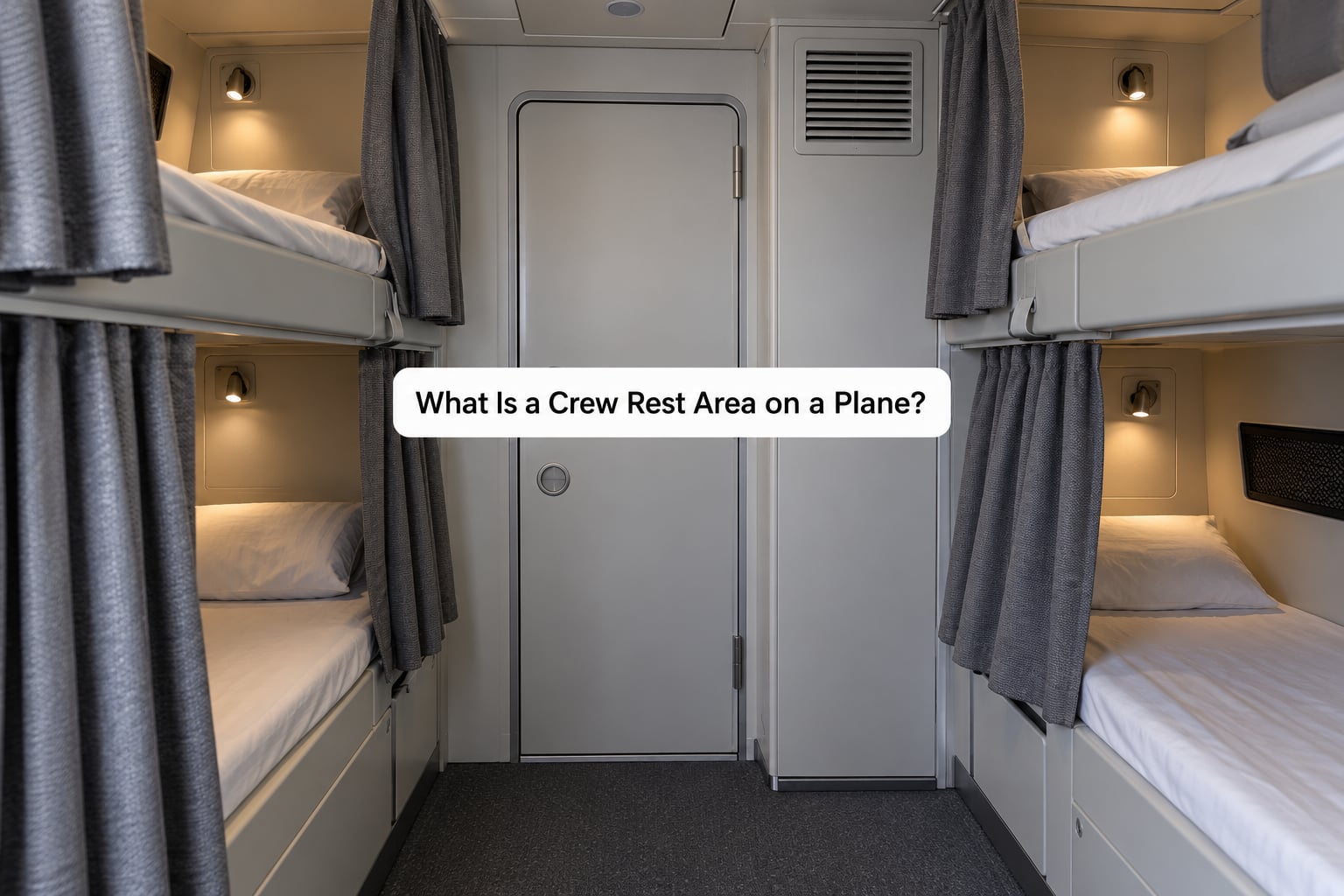
Strip away the social media videos of bunks with curtains and screens, and the definition is plain. The FAA’s own framing, reported when the agency published a draft advisory circular on onboard sleeping areas, is that a rest area is designed for obtaining sleep, stowing personal articles, and changing clothes in privacy for off-duty crew members. That is the whole job description.
The regulatory term is crew rest compartment, and you will hear both names used interchangeably. What it is not is a passenger space, a lounge, or an extra cabin crew can quietly sell you a seat in. The one thing that reliably surprises people is that the compartment is a working part of the aircraft’s safety system, not a comfort feature.
Crew rest exists because a 16-hour duty period is not something a human being performs well on no sleep. Aviation has spent decades formalising that: rules on flight duty time limits, rest requirements between assignments, and fatigue risk management programmes now shape how every long-haul crew is scheduled.
How Crew Rest Areas Differ Across Aircraft
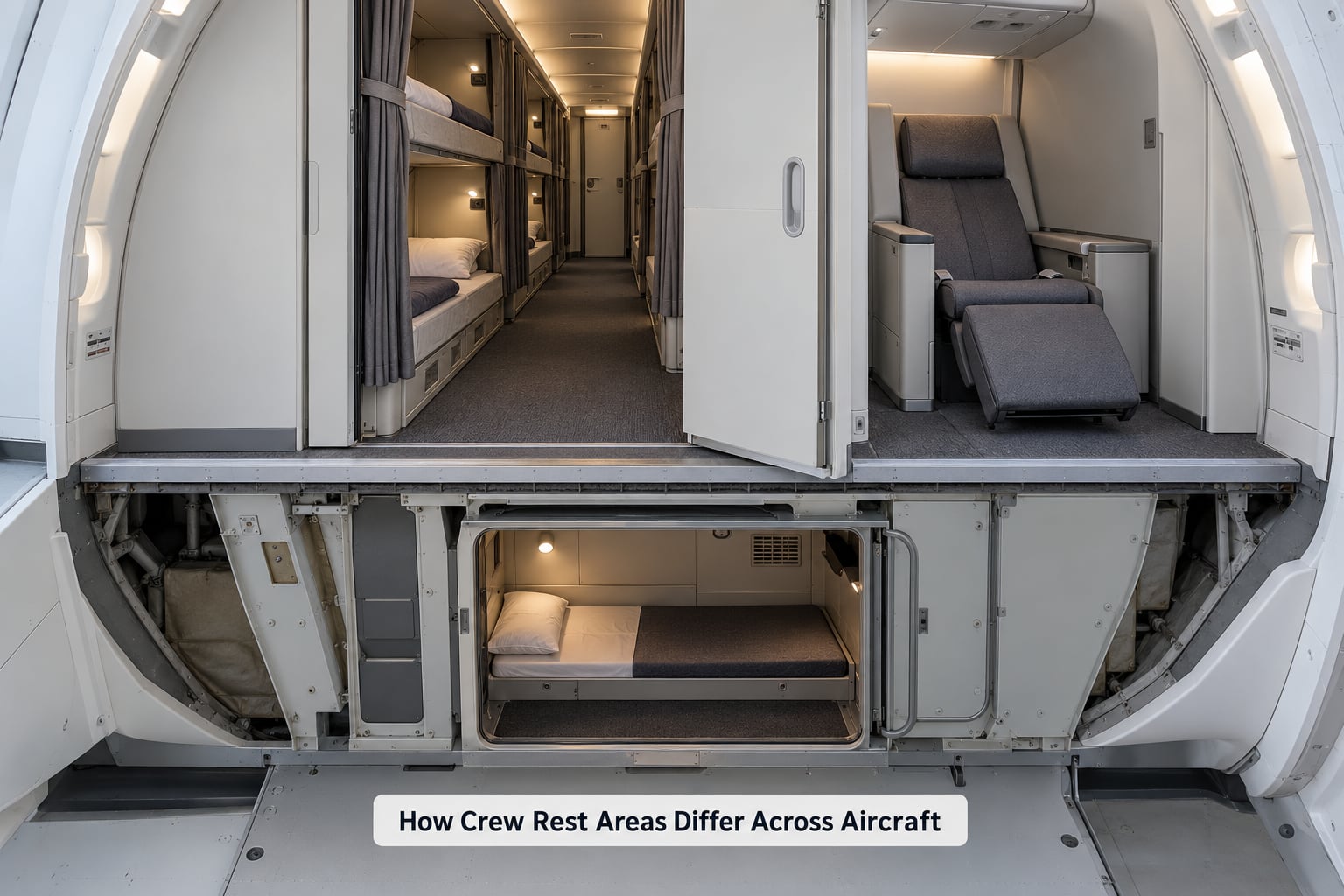
There is no single standard crew rest area. Layout depends on the airframe, where there is structural room, and how many crew the airline needs on board. Five arrangements cover most of what you will find in service today.
| Aircraft type | Where the rest space sits | Typical arrangement |
|---|---|---|
| Boeing 777 and 787 widebodies | Crown of the fuselage, above the main cabin, forward and aft | Dedicated compartments with stacked or side-by-side bunks behind a door |
| Boeing 747-400 | Upper deck behind the flight deck, and crown compartments on the main deck | Separate areas for flight deck crew and cabin crew |
| Airbus A330 and A340 | Lower deck on the LD-MCR design, or crown compartments on later builds | Lower Deck Mobile Crew Rest required its own special conditions approval |
| Airbus A350 and A380 | Crown above the cabin and behind the flight deck | Newer fittings; the A380 crew compartment has been described as having seven or eight beds, a separate bathroom and in-flight entertainment |
| Business jets, for example Gulfstream G550 | Forward of or behind the cabin, in the nose or tail | Compact compartments integrated into the cabin line |
Long-haul aircraft are where the compartment becomes standard. Forum regulars on airliners.net and Reddit’s aviation communities describe the familiar pattern: one rest area in the front and one in the rear, above the cabin. Where a specific airline fits it, and how big it is, is a design choice on that airframe.
Short-haul aircraft generally have no dedicated compartment at all. On a flight of a few hours, crew take turns sitting in jumpseats in the cabin or stepping into the galley during a service lull. That is a very different experience from a bunk, and it explains why the question comes up most on long routes.
What Is a Crew Rest Area on a Plane Used For?
Three things at once: recovery, compliance and coverage. Recovery is the obvious one. Compliance is the legal reason the space exists and must meet a defined standard. Coverage is the scheduling reason: on an ultra-long-haul flight, an airline adds crew so the roster can rotate people through the compartment while a rested, certificated crew remains on duty in the flight deck and the cabin.
Not every break produces sleep. A rest period might be spent reading, eating, decompressing the legs after eight hours in the aisle, or simply lying still with an eye closed before the next call. Trade coverage from 2014 described the reality bluntly: a sprint to see how fast you can throw your body into a horizontal position and slam those eyes shut. Treat the social media ideal as marketing.
What Is Inside a Typical Crew Rest Area?
The core fittings are fairly consistent because the FAA classification and the advisory guidance push design in the same direction. Airline-specific extras are where the variety shows.
Standard fittings
- Bunks or reclining crew seats. Fixed berths with a mattress, or seats that recline far enough to be called a rest position.
- Bedding. A mattress, sheet and blanket, usually airline-supplied, with the berth sized for one person.
- Privacy. A door for the compartment and often a curtain at each bunk.
- Individual reading light and dimmable cabin lighting so a bunk occupant does not wake the whole compartment.
- Ventilation and temperature control. Airflow and heating or cooling separate from the main cabin, because a cabin set for passengers is rarely comfortable for sleeping.
- Storage. A locker or shelf for personal articles, which the FAA guidance treats as part of the facility’s purpose rather than an optional extra.
- Communication. An interphone or call system so a crew member can be reached from the flight deck, plus the ability to reach supplemental oxygen.
Airline-specific extras
Beyond that baseline, fittings vary. Some compartments add charging points, a small monitor or in-flight entertainment screen, a changing area, or a dedicated lavatory. The A380 crew compartment is the example most often raised by aviation enthusiasts and crew on Instagram, described as carrying seven or eight beds with a separate bathroom. Newer widebody installations, including the 787-9, are generally regarded as more comfortable than the older arrangements they replaced.
The gap between a compliant compartment and a good one is where airline spending shows. A crew member’s own posts tend to emphasise the basics: hot, noisy, cramped, and short.
Where Are Crew Rest Areas Located on Aircraft?
Position follows the airframe’s unused space. Passengers usually notice crew rest because of sound or lighting changes rather than sight, because the doors are usually out of view.
The main positions
- In the crown above the cabin. The most common location on modern widebodies, using the space over the passenger ceiling where headroom allows.
- Forward and aft. A single aircraft often has two compartments, one ahead of the wing and one behind it, which lets the crew rotate without a long walk through a working cabin.
- On the lower deck. On the Airbus A330/A340, the Lower Deck Mobile Crew Rest, or LD-MCR, occupies the cargo-area level below the main deck. Because that layout was novel, the Federal Register published special conditions for it in 2005 approving the design.
- Behind the flight deck. A separate compartment for flight deck crew sits behind the cockpit, physically separated from the cabin crew space.
- In the nose or tail on smaller aircraft. Business jets such as the Gulfstream G550 integrate a compact compartment into the forward or aft cabin line.
On an A380 or a 747-400 you may find more than one of these on the same aircraft, because the upper deck and the crown are both available. That is also why “how many crew rest areas are on a plane” has no single answer: it can be one, two, or more, and the count depends on the type and on how the airline configured it.
How Do Pilots and Cabin Crew Use the Space?
Access is controlled, scheduled and time-limited. Nobody wanders in when they feel tired; the rest period is part of the flight plan, and the crew on duty at any moment must remain within limits set by the operator’s fatigue risk management programme.
Staggered rotation
On a long flight, rest periods are staggered rather than shared. A first officer might take a bunk while the captain flies, then they swap, and the cabin crew rotate through their own compartment in a separate cycle. Because a bunk is a fixed private space, the schedule has to be planned before departure, not negotiated at hour nine.
The duration of an in-flight rest period is operational rather than universal. It depends on the route length, the crew complement, the number of bunks, and the limits the regulator and operator apply. A common pattern on very long sectors is one or two hours per person across several rotations, with the balance of the flight covered by the rested crew. Cabin crew also receive smaller breaks between service periods on long domestic flights even when no compartment exists.
Rules that shape the break
- No use during taxi, take-off or landing unless the space includes a standard seat. A flat bunk is not an approved seat for those phases, which is why cabin crew are often seen sitting on their hands or on a jumpseat during take-off.
- Reachable at all times. A resting crew member must be able to be called by the flight deck through the interphone and must be able to reach oxygen equipment.
- Controlled light and noise. Lighting is dimmable and the space is insulated, so one person’s wake-up call is not the whole crew’s problem.
- Physically separated roles. Flight deck crew and cabin crew normally use separate compartments, because their rest rotations and alerting requirements differ.
Can Passengers Use a Crew Rest Area?
No. Passengers cannot enter a crew rest area. The compartment is off limits to anyone who is not qualified crew on that flight, and it is not available for purchase, upgrade or request at the gate, however much time is left in the flight.
What passengers can use is different. Premium cabins on some aircraft include a private suite, which is a passenger product with its own seat, sometimes a bed, and sometimes a small enclosed space. That is a sold ticket, not crew rest, and it looks nothing like the bunk module.
Crew Rest Area vs Crew Jumpseat
The most common misunderstanding is not about the compartment at all. On many domestic aircraft, the last row of the cabin is blocked off because it holds jumpseats: folding crew seats that a flight attendant occupies during take-off, landing and take-off again as needed. Passengers on Reddit’s airline communities regularly assume that blocked row is a crew rest area. It is not.
The distinction is simple. A jumpseat is a seat in the passenger cabin, used in short bursts for safety-critical phases. A crew rest area is an enclosed compartment outside the passenger cabin, used for scheduled off-duty periods. The blocked row gets you nowhere near a bunk.
The second misunderstanding is framing. Crew rest is a regulated safety requirement, not a luxury the airline hands out to a lucky few. The comfort of the space is almost beside the point, which is why the glamorous videos of curtained beds with screens miss the part passengers actually ask about: whether a human being can really rest in there.
Why Is Crew Rest Important on Long Flights?
Fatigue degrades the exact skills a flight depends on. Tired crew react more slowly, communicate less clearly, handle an emergency worse, and manage passengers more poorly. Because the failure modes are rare but unforgiving, aviation treats rest as a systems problem with rules attached rather than a matter of individual toughness.
Requirements come from the aviation authority, the operator’s certificates and the airline’s own fatigue risk management programme, so the specific numbers differ between authorities and between carriers. What is broadly consistent is the shape of the system: limits on how long a crew member can be on duty, limits on consecutive duty periods, and minimum rest between assignments, commonly described in the industry as at least ten hours before the next flight. Anything more than that, and rest in flight becomes part of covering the duty period itself.
That last distinction matters, because it is where most online confusion sits. Rest during a flight and rest before a flight are separate requirements. Sleeping in a bunk at hour 11 does not cancel the rest period the crew member had before reporting for duty, and it does not extend the duty limit either. Both rules apply at once.
For passengers, the visible effect is simple. Crew who have rested handle the back half of a long flight better, which often shows up as steadier service, calmer announcements and fewer irritated passengers. The compartment you never see is doing work on your behalf.
What Is a Crew Rest Area on a Plane Compared With an Airline Lounge?
The two get confused because both sound like places to escape. They differ on every dimension that matters.
| Crew rest area | Airline lounge | |
|---|---|---|
| Location | On board the aircraft, usually above or below the cabin | In the airport terminal, before or after the flight |
| Who uses it | Qualified crew on the current flight | Passengers, often members of a loyalty programme or holding a qualifying ticket |
| Access | Controlled, scheduled, not open to passengers | Open to eligible passengers during terminal opening hours |
| Facilities | Bunks, bedding, curtains, reading light, ventilation, storage | Seating, Wi-Fi, refreshments, sometimes showers and workspaces |
| Food and drink | Typically crew provisions, not a service offering | Buffets and bar service as part of the guest experience |
| Purpose | Fulfilling a scheduled rest period during duty | Comfort and convenience before or after a flight |
An airline lounge is also a different animal from an onboard premium suite. The lounge is a building you visit on the ground; the suite is a seat you buy on the aircraft. The crew rest area belongs to neither category, because it is not sold to anyone and does not exist to make a passenger’s time better.
Frequently Asked Questions
Can passengers use a crew rest area on a plane?
No. A crew rest area is reserved for qualified crew on the current flight and cannot be entered by passengers, purchased, or requested as an upgrade. It is a working part of the aircraft’s fatigue management system, not a passenger amenity. The private suites sold on some premium cabins are a separate passenger product.
Do all passenger aircraft have crew rest areas?
No. Dedicated crew rest compartments are mainly found on long-haul aircraft with room in the fuselage crown or on the lower deck. Short-haul aircraft usually have none, and crew use jumpseats in the cabin and galley breaks instead. Business jets such as the Gulfstream G550 have compact forward or aft compartments.
Do pilots and flight attendants sleep on every flight?
No. In-flight rest only happens where a duty period is long enough and a compartment or crew seat exists. On a short flight, nobody sleeps. On a long-haul flight, crew rest in staggered rotations so a rested, certificated crew stays on duty in the flight deck and cabin while others take their scheduled periods.
Where is a crew rest area usually located?
Most often in the crown of the fuselage above the passenger cabin, with one compartment forward and another aft. Other positions include the lower deck, as on the Airbus A330 and A340 LD-MCR design, behind the flight deck on the 747-400 and similar aircraft, and in the nose or tail of business jets.
How long can flight crew rest during a flight?
The duration is operational rather than a fixed public rule. It depends on route length, crew complement, bunk numbers and the limits set by the operator and the aviation authority. A common pattern on very long sectors is one or two hours per person across several staggered rotations, with the rest of the duty period covered by rested crew.
Why can passengers hear people moving near a crew rest area?
Crew leave and return for scheduled rotations, and the compartments have doors and ladders near the cabin, so movement and occasional noise are normal. Passengers also hear cabin crew going in and out of the blocked back row, which holds jumpseats rather than a rest compartment. A door closing mid-cabin is a crew rest area nearby, not an invitation.
Conclusion
A crew rest area on a plane is a private, enclosed space for pilots and cabin crew to sleep and rest during long-haul flights. It sits in the airframe, usually in the crown above the cabin with one compartment forward and one aft, and it holds bunks, curtains, reading lights and independent ventilation.
Two things settle most of the questions people search for. First, passengers cannot use it, and the blocked back row many travellers assume is a crew rest area is really a set of jumpseats. Second, it exists for safety rather than comfort: crew duty time, in-flight rest periods and minimum rest between assignments are all governed by rules that vary between authorities and airlines, and the compartment is how the in-flight part is satisfied.
Next time a flight attendant disappears for forty minutes and the lights shift, that is a rotation in a bunk doing exactly what the operation requires. It is small, hot and unglamorous, and it is the reason the last six hours of the flight are handled by someone who is not running on caffeine.