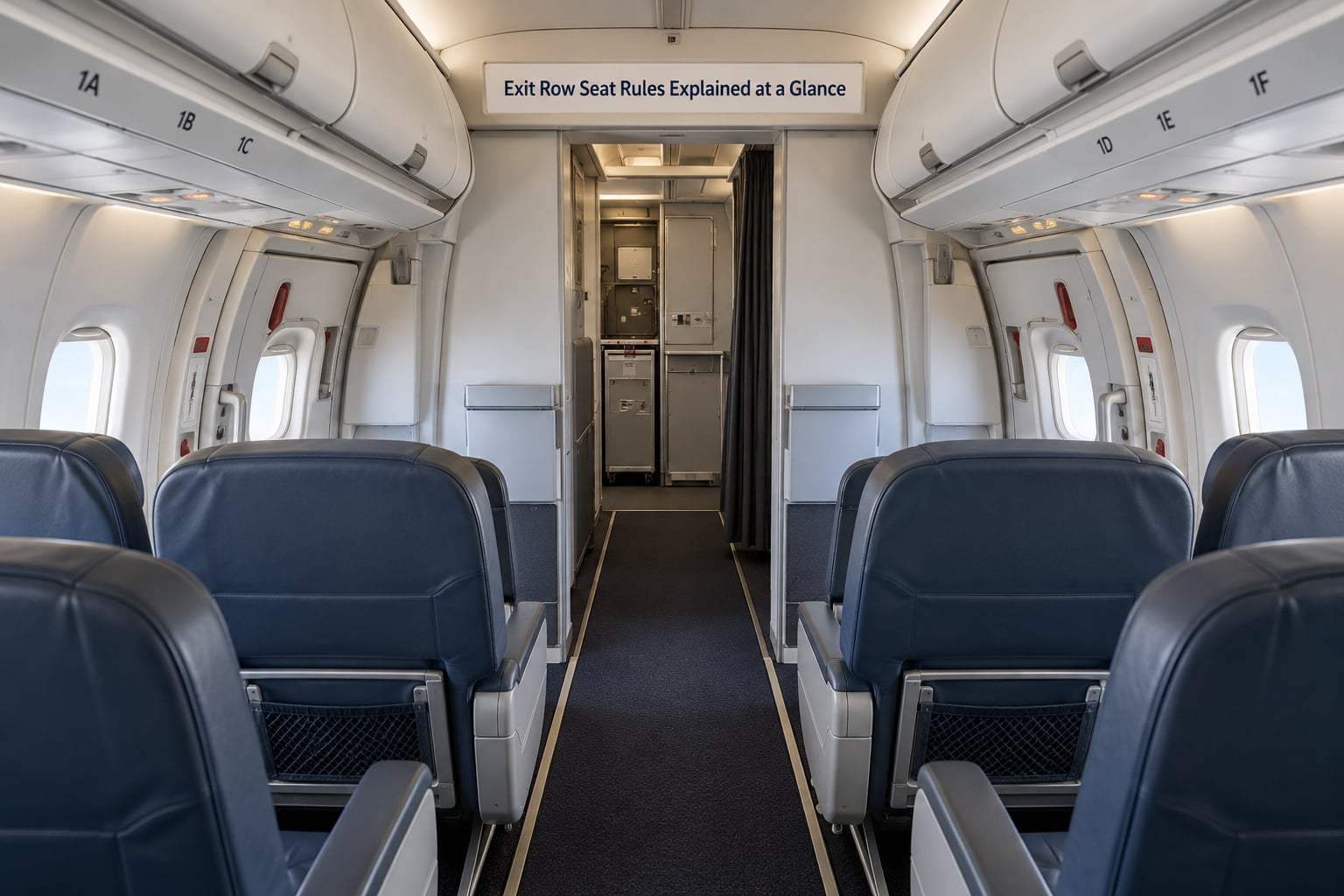
Exit row seat rules explained in one line: an exit row is a row beside an overwing emergency door, and sitting there is a safety role, not a legroom perk. You must meet the airline’s minimum age, understand the safety briefing, and be able to open the exit door and help others during an evacuation. The airline makes the final call, and it can move you after boarding.
That last part surprises people. Plenty of travellers assume the only gatekeeping is a number on the booking screen, then meet a flight attendant in the aisle asking whether they are willing and able to assist in an emergency. I’ve read enough of these threads to know the confusion runs in both directions: capable passengers get moved and feel singled out, and genuinely unsuited passengers slip through because nobody asked.
So here is the whole picture for 2026 — the federal baseline, the airline-specific parts that actually cause arguments, and the practical steps for getting the seat without a last-minute shuffle in the aisle.
Table of Contents
- Exit Row Seat Rules Explained at a Glance
- What Qualifies You to Sit in an Exit Row?
- Opening and checking the exit door
- Understanding the briefing
- Moving through the aisle and helping others
- Where the decision actually lands
- Age, Children and Companion Restrictions
- Minimum age by airline: what is actually published
- Why the whole party can lose the row
- Unaccompanied minors
- Health, Mobility and Accessibility Restrictions
- Reduced mobility and recent surgery
- Pregnancy and cardiac or respiratory conditions
- Assistive devices and the wheelchair question
- Seat belt extenders
- How Exit Row Seat Rules Are Checked at the Airline
- At booking
- During online check-in
- At the check-in counter and the gate
- At the aircraft door
- Does everyone on the reservation have to answer
- Baggage Rules for Exit Row Passengers
- What You Must Do in an Emergency
- How to Request or Change an Exit Row Seat
- Before you book
- After you book
- How to find the exit row on the seat map
- If you get moved at the gate
- If you need an aisle seat but not the exit row
- Airline Variations and Special Cases
- Exit row versus bulkhead row
- Jump seats
- Premium cabins and international flights
- Aircraft with several exit rows
- The myth worth dropping
- Frequently Asked Questions
- Can I move into an exit row after boarding if my assigned seat is elsewhere?
- Are exit row seat rules the same on international flights?
- Does a service animal or mobility aid count as a carry-on item?
- Can I keep a backpack under my seat in an exit row?
- Will the airline move me if I can no longer meet the responsibilities?
- Conclusion
Exit Row Seat Rules Explained at a Glance
| Rule | What the baseline requires | Where the airline decides |
|---|---|---|
| Age | No single federal minimum age is published in the US rule | Each carrier sets its own threshold and can change it |
| Ability | Must be able to perform the emergency duties of the row | Gate agents and crew judge this on the day |
| Children | Infants and small children are generally not placed in an exit row | Carriers also restrict the accompanying adult’s seat |
| Mobility and health | Passengers needing assistance are not assigned there | Medical fit-to-fly and crew assessment apply |
| Language | Must follow instructions given in the safety briefing | Some carriers name a specific language requirement |
| Baggage | The area in front of the seat must stay clear | No under-seat storage, overhead bins only |
| Final authority | Carrier discretion is built into the rule | The operating carrier, not the website you booked through |
Read that table as a map rather than a verdict. Two of the three columns are airline decisions, which is why two people with identical answers can end up in different seats.
What Qualifies You to Sit in an Exit Row?
Qualification comes down to one test: can you carry out the row’s emergency duties without help? US regulations require airlines to seat only passengers who can perform a defined set of evacuation functions, and the Air Carrier Access Act is the piece of law that shapes how that rule interacts with disability and assistive equipment. The practical version is much simpler than the legal text.
Opening and checking the exit door
The window or door beside an exit row is lighter than a normal cabin door and opens in a specific direction with a single motion. You are expected to be able to lift it, hold it, look outside to judge conditions, and either hold it open or close it again on command.
Understanding the briefing
You need to follow instructions delivered in the safety demonstration, whether that is a video, a card, or a crew announcement. This is where the language requirement comes in. Finnair, for example, publishes that a passenger in an exit row must be at least 12 and must speak and understand English or Finnish — a concrete example of a carrier turning the general ability test into a written rule.
Moving through the aisle and helping others
During an evacuation, an exit row passenger is a helper, not a leader. Crew will direct you to open the door, check outside, and direct passengers toward the exit or away from the row. You are not expected to lift anyone or go back for a bag, but you are expected to move down the aisle promptly and follow the crew’s direction.
Where the decision actually lands
Airlines make the final determination, and they do it with discretion rather than a formula. A 63-year-old frequent flyer on a Delta flight described in a r/delta thread was moved out of an exit row despite being fully mobile, and pushed back on the idea that age alone should decide it. Their complaint is the reason so many travellers ask for the citation rather than accepting the answer.
Age, Children and Companion Restrictions
There is an age limit, but it is not a federal one. US rules set the ability requirement and leave the age threshold to the carrier, which is why the number you get depends on who you ask. One passenger reported a flight attendant announcing the cutoff as over 15, while other travellers describe being asked the same question with no age mentioned at all.
What is consistent is that airlines will not place young children in an exit row, and the restriction usually extends to the adult travelling with them.
Minimum age by airline: what is actually published
| Carrier | Published minimum age | Extra condition | How to verify |
|---|---|---|---|
| Finnair | 12 | Must speak and understand English or Finnish | Carrier’s exit row FAQ page |
| US carriers (Delta, United, American, Southwest) | Set by the airline and subject to change; no single published federal figure | Willing and able to perform evacuation duties | Exit row page on the carrier’s own site, or ask at booking |
| Low-cost carriers | Varies by carrier and aircraft | Often stricter, plus language and assistance checks | Airline help centre before you pay for the seat |
I am deliberately not filling in a column of numbers here. Ages get changed, and a confident but stale number is worse than a pointer to the source. The single most useful thing you can do is open the operating carrier’s exit row page before you book, and note the date you read it.
Why the whole party can lose the row
Families with infants and toddlers usually discover at booking that the exit row is off the table for the entire group, not just the child. A parent assigned to a normal aisle seat next to a car seat has a harder time than most, so carriers tend to resolve the conflict early by simply not selling the row to that booking.
Unaccompanied minors
Teens travelling alone are treated inconsistently across carriers. Some allow older teens in an exit row, others place unaccompanied minors in rows away from the exits so a crew member is never far away. If this is your situation, ask the airline directly and get the answer in writing before travel.
Health, Mobility and Accessibility Restrictions
Passengers with reduced mobility, recent surgery, pregnancy, or heart and breathing conditions often ask whether they are disqualified. I am not going to diagnose anything or tell you whether you are fit to fly — ask your doctor or airline medical team for that. What I can tell you is which factors carriers routinely take into account when they decide the row.
Reduced mobility and recent surgery
Limitations on walking the aisle, standing unaided, or lifting a seat belt and door handle are the practical criteria. An older passenger in an American Airlines RJ145, described in an r/americanairlines thread, was in the exit row using a cane to get down the aisle, and the thread focused on how that had been allowed.
Pregnancy and cardiac or respiratory conditions
These come up constantly and get inconsistent answers, which is exactly why they deserve a written reply from the airline rather than a judgement call at the gate. Airlines cannot require a diagnosis, but they can ask about your ability to perform the duties and, in some cases, request medical clearance.
Assistive devices and the wheelchair question
This is the most confused corner of the whole topic. Passengers who use a wheelchair report that needing one to reach the gate appears to end exit row eligibility, even when they intend to walk the cabin. At the same time, flight attendants report in an r/flightattendants thread that there is no written policy covering assistive devices in exit rows, so the answer depends on the person at the door.
Assistive devices are generally not counted against your cabin baggage allowance, and they travel with you rather than in the hold. If you rely on one, raise the exit row question at booking and again at the gate, and ask the specific question: can I sit in the row with my device stowed where the crew can see it? A clear yes or no at booking is worth a lot.
Seat belt extenders
Plus-size passengers report being warned that FAA rules bar exit row seating when an extender is in use. The claim circulates widely, and the practical response is to ask the airline directly what its policy is before you travel, because the answer you get at the counter may differ from the one you get in the air.
How Exit Row Seat Rules Are Checked at the Airline
The check happens in several places, and by the time you reach the aircraft somebody has usually already asked. Knowing where the questions come from makes the process less surprising.
At booking
Many booking flows ask about exit rows as part of seat selection, and some carriers will not show the row at all if the passenger profile includes a child or an assistance request. Booking through a third-party site does not change this: the operating carrier loads the seat, and the operating carrier’s rules apply.
During online check-in
This is the most common checkpoint. Check-in usually includes a yes-or-no question about willingness and able to assist, and answering no reassigns you automatically. If the seat is important, answer before you check in and see what happens rather than finding out at the gate.
At the check-in counter and the gate
Agents at both can move you, and the gate is the more common place. The practical move is to raise it yourself, early: tell the gate agent you have an exit row booking and ask them to confirm, rather than waiting to be asked in the aisle.
At the aircraft door
Boarding is when the question gets asked out loud, in public, in front of the line. Flight attendants do this because they are confirming the answer is still accurate, not because they are looking for someone to move. Several Southwest threads show crew proactively re-seating exit row passengers based on their own assessment on the day.
Does everyone on the reservation have to answer
Yes, in practice. The question is asked per passenger, including adults travelling with children in the same booking. A group that includes an ineligible passenger can lose the row for the whole party.
Baggage Rules for Exit Row Passengers
Baggage rules for the exit row are stricter than the rest of the cabin, and the reason is the same as the seat itself: the floor space in front of you is part of the exit route.
- No under-seat storage. Exit rows usually have no space in front of the seat to slide a bag under, so a standard roller needs to go in the overhead bin.
- Overhead bins only for normal bags. The bin above the exit row is often shallow, and a large roller may not fit. Check the size limits before you fly.
- Nothing on the floor. Bags, shopping, and loose items left in the row or in the doorway area can be moved or removed by crew before takeoff.
- Mobility aids are handled separately. A wheelchair, walker, or other assistive device is not treated as a carry-on and does not use up your baggage allowance.
- Service animals and pets. An emotional support or service animal in the cabin is not a carry-on item, though carriers set their own rules about where it may sit and whether it needs paperwork.
So the short answer to whether you can keep a backpack under your seat in an exit row is usually no. A small day bag that fits entirely on your lap or between your feet is the usual workaround, and it is the reason many travellers bring a smaller personal item for that flight.
What You Must Do in an Emergency
These are the duties you are accepting when you take the seat. Knowing them in advance takes the fear out of it, and it also makes it obvious whether you are the right passenger for the role.
- Listen to the safety briefing. Pay attention to the exit row demonstration, including the door operation.
- Follow crew instructions without argument. The crew is running the evacuation and will direct you specifically.
- Open or close the exit door when directed. You are expected to be able to operate it on command.
- Check outside the aircraft. Look at the conditions on the other side before anyone steps through, and report what you see.
- Direct passengers away from the row and toward the exit. Keep the row and doorway clear so the people behind you can move.
What you are not expected to do matters just as much. You are not lifting passengers, not carrying anyone, not retrieving luggage, and not leading the evacuation. The job is a fast pair of hands and a clear head, not heroics.
How to Request or Change an Exit Row Seat
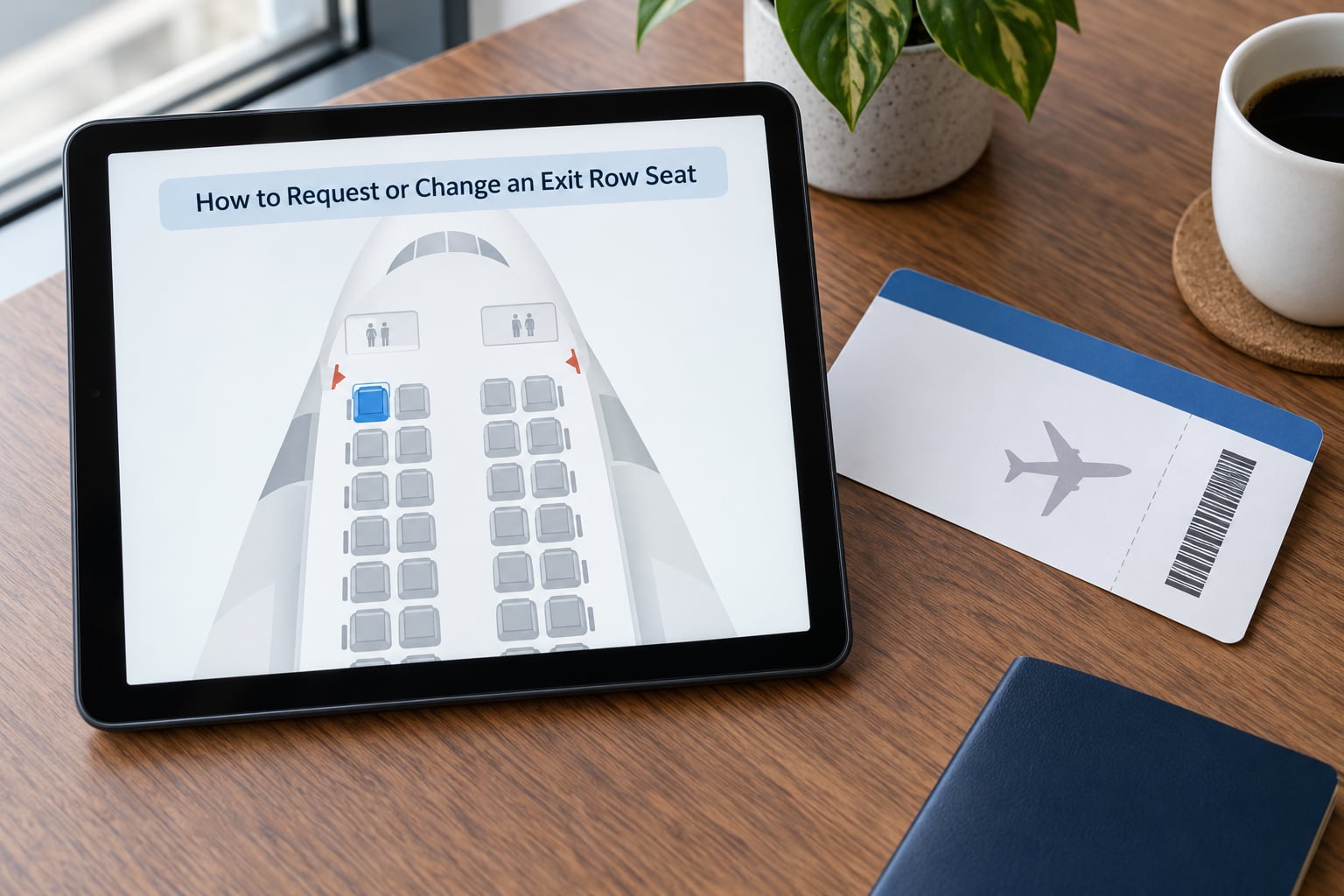
Requesting the seat is simple. Avoiding a move on the day takes a bit more planning.
Before you book
- Open the operating carrier’s own site, not a comparison site, and read their exit row page.
- Check that your passenger profile does not trigger an automatic block, especially with children or assistance requests.
- Note whether the seat is sold separately, and keep the confirmation.
After you book
- Re-select the exit row in the airline’s app or website to confirm it is in your reservation, not just in the seat map you browsed.
- Complete online check-in early and answer the ability question honestly, which avoids a surprise reassignment at the airport.
- Re-check the seat assignment the night before, because equipment changes can shift the row.
How to find the exit row on the seat map
Exit rows sit beside the overwing doors, roughly a third of the way back on a narrow-body aircraft. Row numbers vary by aircraft and airline, which is why seat labels like 11A or 12A come up so often — they are simply the front overwing exit row on many layouts. On a 737 or A320 family jet, expect the exits somewhere around rows 12 to 14. Always read the seat map for your specific flight rather than assuming a number.
If you get moved at the gate
Stay calm and ask for the reason in specific terms: is it my age, my language, my mobility, or my answer on check-in? If it is the check-in answer you did not expect, ask whether answering differently at the counter changes the outcome. Being moved is frustrating, but you are entitled to know which rule applied, and a plain answer usually gets you one.
If you need an aisle seat but not the exit row
Ask for pre-boarding and tell the cabin crew about your needs at the door. Most carriers will note the request and seat you near the aisle close to a crew member, which covers most of what the exit row would have given you without the responsibilities.
Airline Variations and Special Cases
Baseline aviation expectations are the same everywhere: the row exists for evacuation, and the carrier decides who sits there. Everything below the baseline is where the differences live.
Exit row versus bulkhead row
| Feature | Exit row | Bulkhead row | Standard economy |
|---|---|---|---|
| Extra legroom | Yes, large | Yes, smaller | Standard |
| Seat in front | None | Non-reclining seat | Reclines |
| Under-seat storage | Usually none | Often none | Usually yes |
| Emergency duties | Yes | No | No |
| Age and ability check | Yes | No | No |
A bulkhead row gives you a decent amount of space with none of the screening, which is why it is a common substitute. The trade is real: the exit row has more room and a faster walk out, and it also has a role.
Jump seats
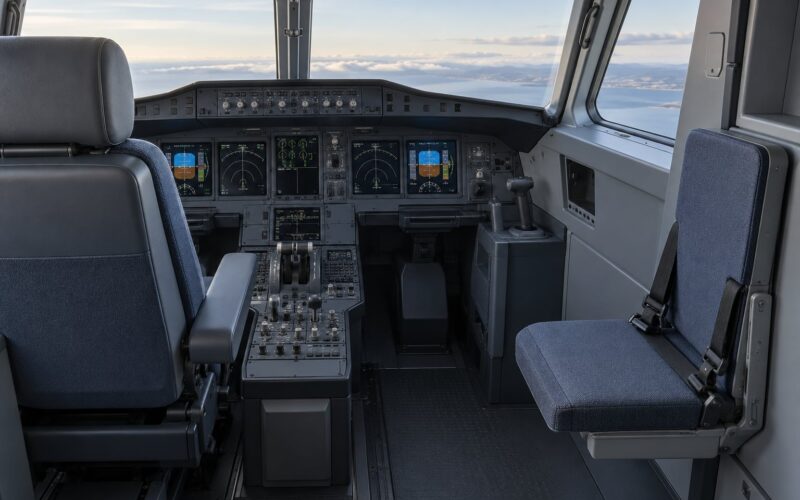
Flight deck jump seats fold out of the bulkhead and are assigned by the crew, not sold as passenger seats. They are subject to the same ability expectations, and the crew makes the call on the day.
Premium cabins and international flights
Business and first class exit rows follow the same principles with fewer age disputes, since most passengers in those cabins are adults. On international flights, the operating carrier’s policy governs, and the language expectation is more likely to be stated explicitly. Codeshares are the classic trap: your ticket may show one airline while a partner operates the aircraft, so check the operating carrier.
Aircraft with several exit rows
Larger aircraft have more than one pair of overwing exits, which means more rows carry the same responsibilities. In practice the answer is the same for every one of them, so there is no advantage in picking the second over the first.
The myth worth dropping
The exit row is not the safest seat. It is not statistically safer, and being near a door does not protect you better in a crash. It is a role with extra obligations attached, and thinking of it as a premium safety position is what makes the reassignment conversation feel so strange to passengers.
Frequently Asked Questions
Can I move into an exit row after boarding if my assigned seat is elsewhere?
Almost certainly not. Once seated, the crew manages the cabin, and moving passengers around mid-flight is a safety decision rather than a service one. If the front rows look empty and the crew does not object, the situation changes, but do not count on it. If you need the row, request it at booking or select it during check-in instead.
Are exit row seat rules the same on international flights?
The baseline is the same: the operating carrier decides, and the ability requirement applies regardless of where the aircraft flies. What changes is the language expectation and the airline’s own age threshold, which tend to be stated more explicitly on international carriers. Always check the operating carrier rather than the airline on your ticket, especially on codeshares.
Does a service animal or mobility aid count as a carry-on item?
No. Assistive devices such as wheelchairs, walkers, and service animals are not counted against your cabin baggage allowance and are handled separately from normal luggage. Policies on where the animal or device sits, and what documentation is needed, vary by carrier. Raise it at booking so the crew knows in advance rather than at the door.
Can I keep a backpack under my seat in an exit row?
Usually not. Exit rows generally have no under-seat storage because the floor space in front of the seat is part of the evacuation route. Overhead bins are the normal option, and the bin above an exit row is often shallower than elsewhere in the cabin. A small day bag that stays on your lap is the most reliable choice for that flight.
Will the airline move me if I can no longer meet the responsibilities?
Yes, and they will do it at the gate or at the aircraft door if they have to. Crew assess on the day, which is why an answer given weeks earlier does not bind them. If you know your situation has changed, tell the airline before you travel so you can be reseated without the awkward aisle conversation on boarding day.
Conclusion
Exit row seat rules explained comes down to three things: meet the airline’s minimum age, be able to perform the row’s emergency duties, and travel without an infant, an assistance requirement, or equipment that occupies the space in front of you.
Here is what to do first. Read the operating carrier’s exit row page before you book, confirm the row appears in your reservation after booking, and complete check-in early so the ability question is answered in front of a screen rather than in an aisle. If you are unsure whether you or a child qualifies, contact the airline before you travel and get the answer in writing. If you are moved on the day, ask which rule applied, and ask about your seat fee at the same time.