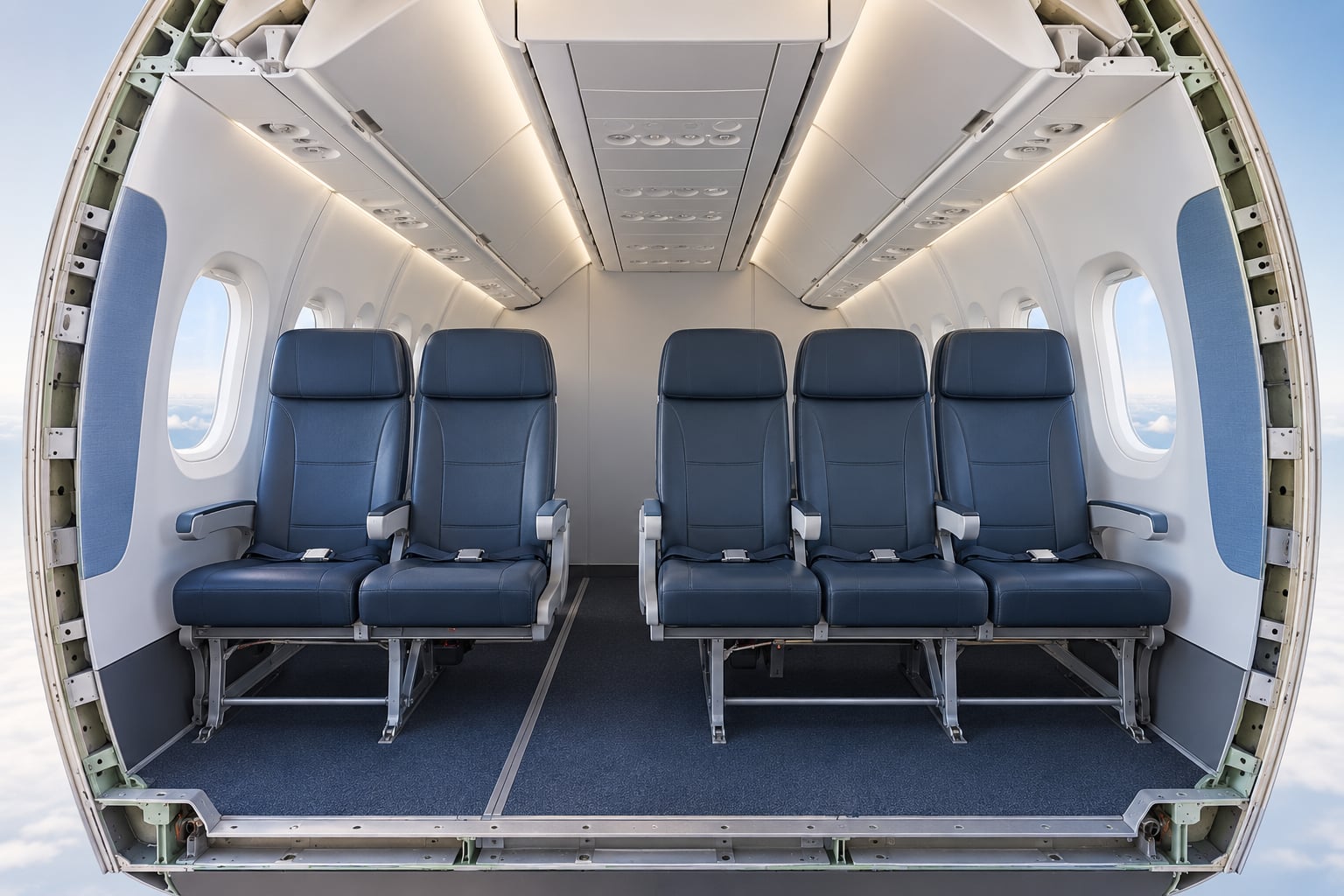
What makes the A220 cabin feel wider? It is a clean-sheet fuselage rather than a shrink of an older jet, a 2-3 seating layout that puts roughly 80 percent of passengers at an aisle or window, straight sidewalls instead of a curved taper, economy seats that are 18.5 inches wide, and the largest windows fitted to any single-aisle aircraft. Add a low cabin altitude and it adds up.
That headline number matters because every narrowbody is sold on a handful of inches of cabin width, and the inches are nearly identical across the industry. Yet walk down the aisle of an A220 and it reads as a different class of aircraft. This guide separates the parts you can measure from the parts your eyes fill in, because the honest answer to the question involves both.
Key reasons at a glance
- Clean-sheet design. The A220 grew from the Bombardier CSeries programme, not from a 1960s cross-section. It was drawn around a 2-3 cabin instead of being stretched from a 3-3 one.
- A 129-inch cabin. That is a few inches wider at the shoulder than the mainstream narrowbody tubes, and extra inches show up in seat width, aisle width or both.
- A 2-3 layout. About 80 percent of seats touch an aisle or a window, against roughly two thirds on a 3-3 jet.
- 18.5-inch economy seats. Wide enough that a 737 MAX slimline seat is a visible downgrade.
- Straight sidewalls and big windows. Vertical walls stop the cabin tapering inward, and the window aperture is the largest in the single-aisle category.
- Low cabin altitude and quietness. You notice a cramped cabin more when you are also cold and tired.
Table of Contents
- What physical dimensions make the A220 cabin feel wider?
- A220 variants and how long they feel
- How does the A220 seat layout affect the feeling of space?
- Why do the A220 windows, lighting, and ceiling make the cabin feel roomier?
- How wide is the A220 compared with other narrow-body jets?
- Which A220 cabin features help passengers feel less cramped?
- Overhead bins and sidewall storage
- Seatback storage and power
- Lighting
- Lavatories and cabin zoning
- The refreshed Airspace cabin
- How to pick a seat on an A220
- What makes the A220 cabin feel wider than its measurements suggest?
- Frequently Asked Questions
- Are A220 seats wider than other planes?
- What is the seating layout of an Airbus A220-300?
- Which seats on an A220 are considered the best?
- Is the A220 really wider than the 737 MAX?
- Why is the A220 cabin so quiet?
- Can an Airbus A220 fly across the Atlantic?
What physical dimensions make the A220 cabin feel wider?
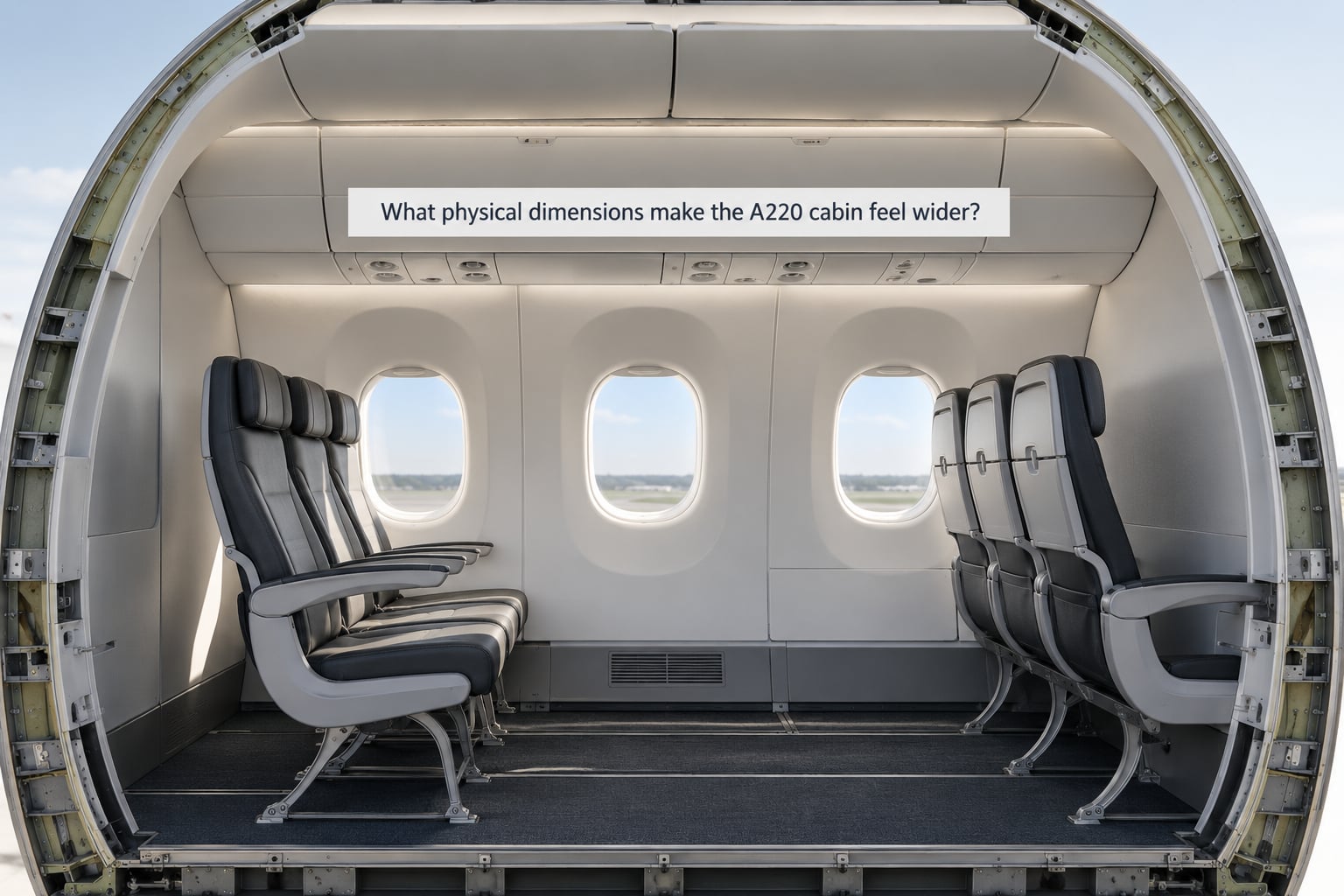
The single most useful number is the A220’s cabin width: 129 inches, quoted in pilot forums and trade coverage alike. That is the usable width of the cabin interior, and it is wider than the tube you get on an A320neo or a 737 MAX.
The important detail is how that width is distributed. Width is not one flat number, it is a shape. The fuselage curves inward towards the floor and towards the ceiling, so the width at seat cushion level is narrower than the width at shoulder level. Seat makers design against that narrowest point, which means a cabin with more total width can still deliver pinched shoulder room if the sidewall drops away too early.
The A220 keeps its sidewalls close to vertical for longer than the competing tubes. Look down an A220 aisle and the walls read as flat planes rather than as curves pulling away from you. That vertical face is what your eye uses to judge the room, and a flat plane always looks bigger than a curve of the same nominal width.
Vertical height reinforces it. The A220’s cabin ceiling sits above the seat line with more usable clearance than most narrowbodies, so when you stand up you are not ducking into the ceiling line. Headroom is not width, but passengers experience them together as one sense of space.
A220 variants and how long they feel
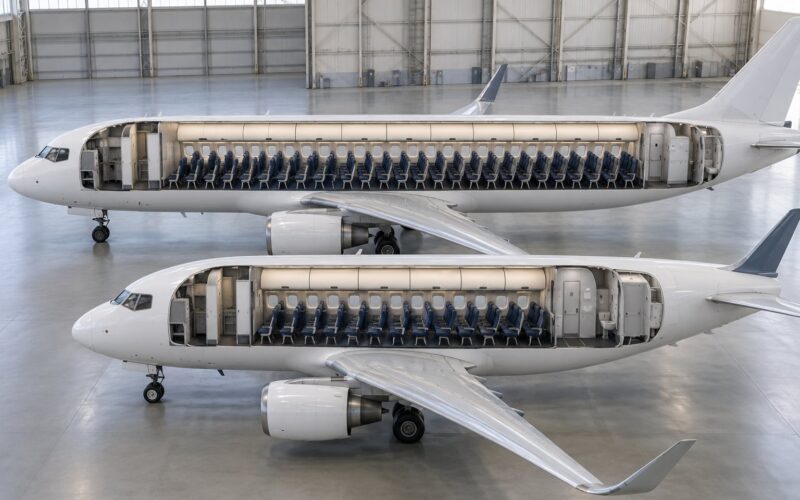
The cabin width does not change between versions. What changes is how far that width stretches, and how many people are packed into it.
| Variant | Typical two-class layout | Max seats | What it feels like |
|---|---|---|---|
| A220-100 | Around 110 seats | 135 | Short and wide. The width advantage is most obvious because the cabin is only a few rows longer than a regional jet. |
| A220-300 | Around 140-150 seats | 260 | The volume seller. Same width, more rows, so the impression of space depends more on the load factor. |
| A220-500 | Longer stretch of the -300 | Not yet in widespread service | Adds length rather than width, so it should feel like the -300 with a longer middle. |
The -100 is the argument that proves the point. It is roughly the length of a big regional jet, yet its passengers get 129 inches of cabin and 18.5-inch seats. Regional jets of that length are usually 76 or 90 seats wide with much narrower chairs. The A220 simply is not in that category, whatever its size suggests.
How does the A220 seat layout affect the feeling of space?
The layout does more for the sense of room than the width figure does. In a 3-3 narrowbody the centre seat sits between two strangers, so a third of passengers face a neighbour on both sides and a centre armrest they never asked for. On the A220, the middle row is 2-2, so the single centre seat has an armrest and a sidewall-adjacent position in the other half of the cabin.
Here is how that breaks down:
- 2-3 layout. Two seats on the left of the aisle, three on the right. The middle seat in the three is the only centre seat on the aircraft.
- About 80 percent aisle-or-window. Six seats in each three-seat block, four of them with direct aisle or window access.
- About 20 percent still middle. The layout improves your odds, it does not eliminate the bad seat. On a fully booked flight you can still draw it.
- 18.5-inch economy seats. Standard A220 economy width, and wider than the slimline seats fitted to many 737 MAX cabins.
- Five-inch centre armrest. That figure, cited on pilot forums, is what turns the middle seat into a seat rather than a penalty.
Armrest width deserves more attention than it gets. On a 3-3 jet the centre armrest is shared and narrow, so two people fight over a strip of plastic the whole flight. Five inches is wide enough to rest a forearm and a drink on, which changes the calculation for anyone over six feet.
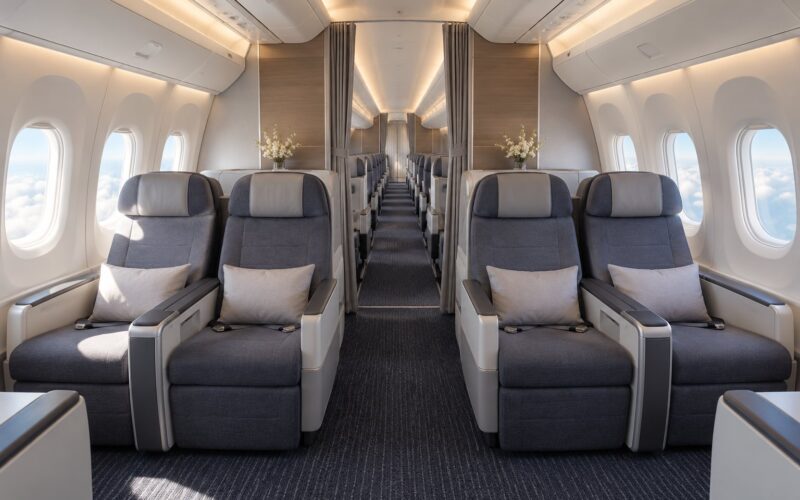
Two more layout details matter in practice. Seat pitch is not dramatically longer than competing narrowbodies, so the A220’s advantage is lateral rather than fore-and-aft. And airlines choose the seat map, so a high-density installation can undo much of the good with a 17-inch slimline seat or a dense 3-3 business arrangement at the front.
Why do the A220 windows, lighting, and ceiling make the cabin feel roomier?
The windows are the biggest surprise after the seat width. The A220 has the largest window aperture of any single-aisle aircraft, and it is not a marginal difference. The window on a 737 MAX is tall but visibly narrow, while the A220’s aperture is closer to a square with generous corners.
Why does that matter? Because your eyes read window size as a proxy for aircraft size, and they are usually right. A large window pulls the sidewall outward visually and floods the seat with daylight. Daylight is the cheapest way to make an interior look bigger, because the eye stops registering the sidewall as a barrier and starts reading it as a frame around a view.
Ceiling contours work the same way. A smooth, continuous ceiling with recessed lighting has no visible structure to break the eye into smaller compartments. Where a ceiling drops into a service unit or a lighting strip at an awkward height, the cabin looks chopped up. The A220’s ceiling panels and their integrated lighting were designed to keep those lines clean.
Overhead bins follow the same logic. Bin volume is a capacity number, but it also controls whether the bin or the sidewall dominates your view when seated. A cabin with shallower bins exposes more of the painted sidewall above the seats, and that exposed flat area is width you can see. Airbus Airspace XL-style shelf bins on the A220 keep the bin line higher and the visible sidewall larger.
Then there is the secondary layer: cabin altitude and noise. The A220 is pressurised to a lower cabin altitude than older jets, and it is one of the quietest single-aisle aircraft in service. A rounder cabin is easier to sit in, and a cabin where you can hear the person next to you reads as smaller and more enclosed than the same cabin on a louder aeroplane.
How wide is the A220 compared with other narrow-body jets?
This is where the marketing claims get sorted. Published widths for the mainstream narrowbodies cluster within a few inches of each other, so look past the cabin width column and at layout, seat width and window size together.
| Aircraft | Cabin width | Economy layout | Seat width | Windows |
|---|---|---|---|---|
| Airbus A220 | 129 inches | 2-3, about 80 percent aisle or window | 18.5 inches standard | Largest single-aisle aperture |
| Airbus A320neo | About 126 inches | 3-3 | Around 18 inches | Large for the class |
| Airbus A321neo | About 126 inches | 3-3, sometimes 3-3 with a blocked middle seat | Around 18 inches | Large for the class |
| Boeing 737 MAX | About 126 inches | 3-3, with slimline seats on most MAX-8s | 17 inches on slimline | Tall but narrow aperture |
Three inches sounds trivial. In practice it does not disappear, because cabin width is spent somewhere. On the A220 it was spent on seat width and on armrests, and on the 737 MAX it was not, so the narrow-body’s available space is thinner.
The A321neo comparison is worth a note, since a longer aircraft can feel smaller. Stretching a fuselage does not widen it, and extra length usually arrives as extra rows. A321neo passengers frequently get blocked middle seats, which improves the middle-seat experience without touching width. If someone tells you the A220 feels roomier than an A321neo, the width and layout are the reason, not the length.
Caveats worth keeping in your head: seat width, pitch and layout are airline decisions within a certified cabin envelope, and retrofit generations differ. Two A220s operated by different carriers can look nothing alike inside.
Which A220 cabin features help passengers feel less cramped?
Beyond the shell, a handful of fit-out details do real work.
Overhead bins and sidewall storage
Larger bins mean fewer bags checked at the gate, which means fewer passengers reaching for the floor. Cabin floors that stay clear are the cheapest width in the aircraft, because a bag between your feet physically narrows the space you were already given.
Seatback storage and power
Seatback pockets that keep a phone, a passport and a water bottle take pressure off the overhead bin and off your lap. In-seat power at every seat means less time spent twisted toward the wall looking for an outlet.
Lighting
Under-bin LED lighting washes the sidewall instead of the face, so the cabin is lit without the overhead glare that makes people squint and hunch. Airspace cabins push this further with mood lighting across a wide colour range.
Lavatories and cabin zoning
Reconfigurable lavatories let an airline reposition them along the fuselage instead of fixing them forward, which changes how much of the cabin is a single open space. Cabin length, cabin volume and cabin layout are different numbers, and only the third one drives the walk-down-the-aisle impression.
The refreshed Airspace cabin
Airbus has updated the A220 cabin with an 18.5-inch five-abreast economy layout, straight sidewalls for spaciousness, the large windows, Airspace XL bins and reconfigurable lavatories, with Air Canada among the first operators of the refreshed cabin. Capacity plans point to A220-300s configured for 160 passengers in a single class from 2027, which is a useful reminder that a wide cabin and a dense cabin can exist in the same airframe.
How to pick a seat on an A220
If you want the width advantage rather than the seat-map lottery:
- Pick a window seat in the two-seat block. You get a sidewall and a large window on your side instead of an aisle on the other.
- Pick an aisle seat in the two-seat block. Same width, quicker access, and the aisle edge means nobody shuffles past you.
- Avoid the two-seat block if the middle-seat fee is your trigger. In a 2-2 row there is no third seat to be stuck between.
- Check the seat map before paying. Retrofit generations and airline layouts vary, so read the actual seat map rather than the aircraft type.
- Sit forward. On a full flight, load factor changes the feel more than cabin geometry does.
What makes the A220 cabin feel wider than its measurements suggest?
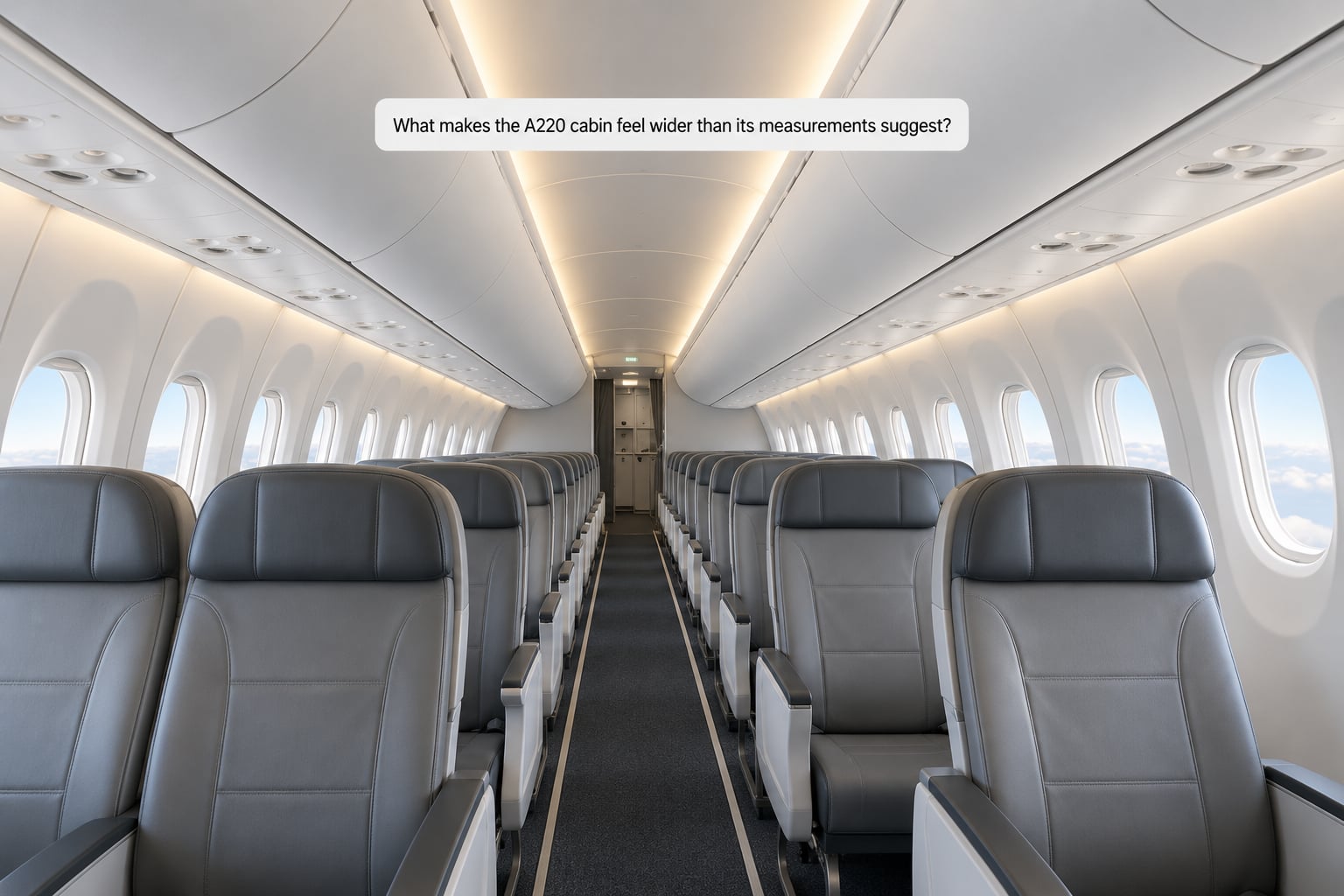
Physical width explains the smaller half of the answer. The A220 is genuinely wider at 129 inches, and it spends that width on seat and armrest width rather than hiding it in a wider aisle, so the extra inches arrive where you feel them.
The larger half is perception. Straight sidewalls do not taper in front of you. A 2-3 layout means you are rarely boxed in by a neighbour. Large windows flood the seats with light and frame the sidewall as a view rather than a wall. A continuous ceiling, generous bins and a low, quiet cabin remove the pressure points that make a space feel small.
Compare that with a 737 MAX in a 3-3 layout with slimline seats, and the difference stops being subtle. Same industry, same class of aircraft, same boarding queue. One gives you a wall at your shoulder and a view out of it, the other gives you a stranger’s elbow and a narrow vertical window between seat backs.
The gap between measurement and perception is not marketing fluff, it is design. And it is also why an A220 retrofitted with dense seats by one airline can disappoint, while the same aircraft in a careful fit-out is genuinely comfortable.
Frequently Asked Questions
Are A220 seats wider than other planes?
Standard A220 economy seats are 18.5 inches wide, which is wider than the slimline seats common on the 737 MAX and a little wider than typical A320neo and A321neo economy seats. The cabin itself is 129 inches across against roughly 126 inches for those jets. Seat width is still an airline decision inside a certified envelope, so a dense retrofit can narrow it.
What is the seating layout of an Airbus A220-300?
The A220-300 uses a 2-3 economy layout: two seats on one side of the aisle and three on the other. That puts about 80 percent of passengers at an aisle or window seat. Roughly 20 percent of the cabin is still middle seats, and premium cabins commonly use 2-2. Layouts vary by operator, so check the seat map for your flight.
Which seats on an A220 are considered the best?
The two-seat block is the most sought-after part of the cabin, because the only middle seat sits in the three-seat block. Most flyers pick a window seat for the large windows and the sidewall, or an aisle seat in the same row for quick access and fewer crossings. Rows near exits are wide, and rows ahead of galleys and doors vary a lot between operators.
Is the A220 really wider than the 737 MAX?
Yes, though only by a few inches. The A220 cabin is about 129 inches wide against roughly 126 inches on the 737 MAX. The gap matters less for its own sake than for how the width is spent: the A220 puts it into 18.5-inch seats and wider armrests, while many MAX cabins carry narrower slimline seats and a 3-3 layout.
Why is the A220 cabin so quiet?
The A220 combines newer engines with good sound insulation and a cabin pressurised to a relatively low altitude. Pilots and passengers on forums consistently rate it among the quietest single-aisle jets in service. The effect on comfort is bigger than it sounds, because noise and thin air are what make an enclosed cabin feel tiring rather than merely compact.
Can an Airbus A220 fly across the Atlantic?
No. The A220’s range is designed for short and medium-haul routes, and even the stretched -300 does not carry enough fuel to cross the Atlantic with a realistic payload and reserve. Transatlantic passengers on these routes are usually moved to a larger aircraft. The type shows up on North American and European city pairs rather than ocean crossings.
If you fly this type regularly, the short version is: the width is real at 129 inches, but the reason it feels generous is the 2-3 layout, the straight sidewalls and the windows. If you are picking a seat, choose the two-seat block and check the operator’s seat map, because that is where the difference between a good A220 flight and a disappointing one usually comes from.