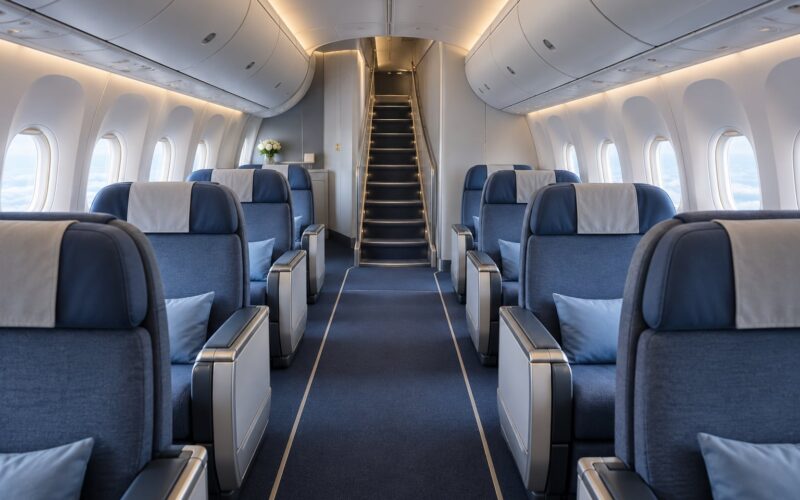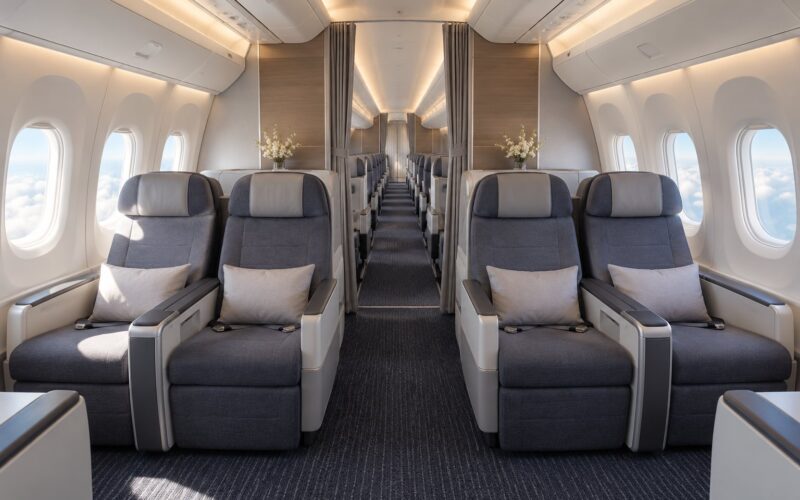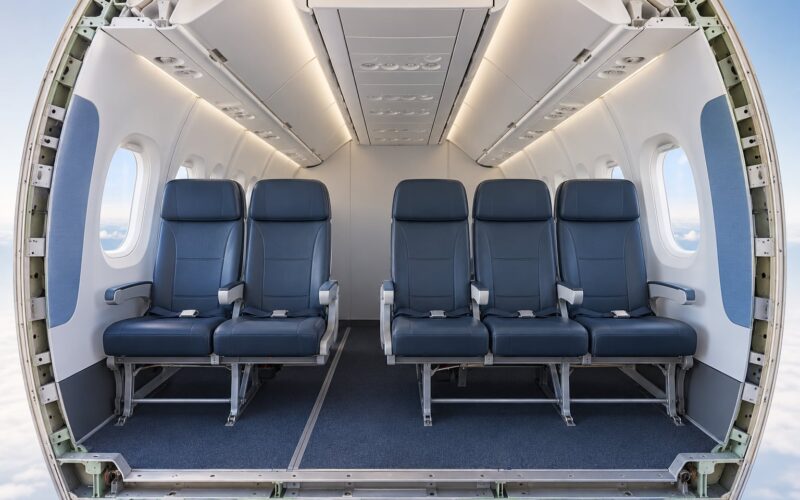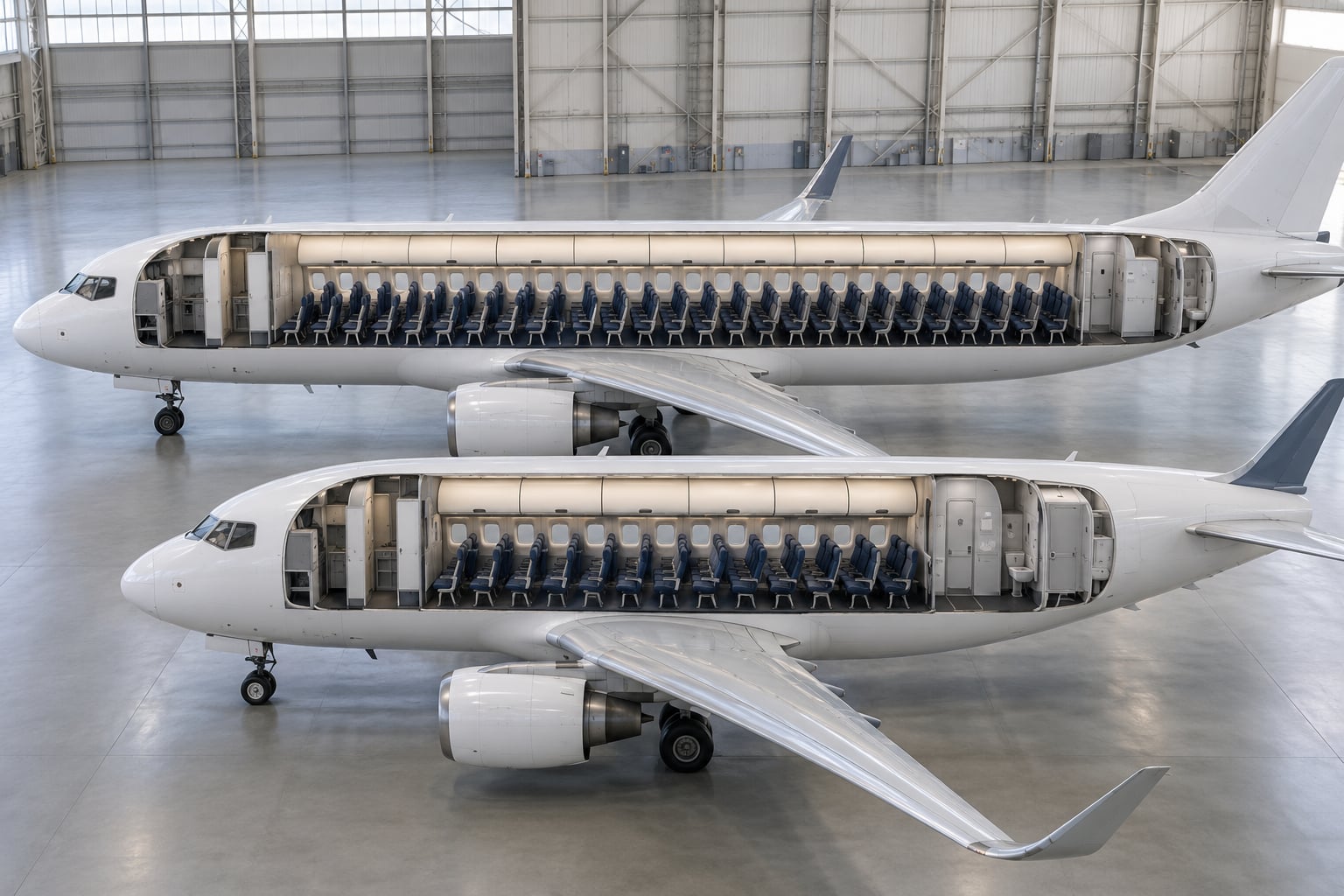
If you have wondered whether the A321 is the roomier aircraft, the honest answer is that it is longer, not wider. The A321 is a stretched A320, sharing the same 3.70 m cabin width, the same economy seat width and the same cockpit, but adding roughly 6.9 m of fuselage. That extra length becomes more rows, more lavatories and sometimes a larger business cabin. It does not become elbow room.
This guide breaks down how the A320 and A321 cabins differ in the ways a passenger can actually notice, from the walk down the aisle to where the toilets sit and which rows qualify as exit rows. It also flags where the aircraft model stops mattering and your airline’s seat map takes over.
Table of Contents
- How the A320 and A321 Cabins Differ at a Glance
- How Aircraft Size Changes the Cabin
- Seating Layouts and Seat Comfort
- How to tell an A320 from an A321 before you sit down
- Lavatories, Galleys, and Cabin Storage
- Noise, Vibration, and Passenger Comfort
- Which Should You Choose?
- Frequently Asked Questions
- Is the A321 always more comfortable than the A320?
- Why does the A321 sometimes have more seats than the A320?
- Does the A321 have more legroom?
- How many lavatories are usually on an A320 or A321?
- Can I tell whether my flight uses an A320 or A321?
- Which aircraft is better for a window seat?
- Conclusion
How the A320 and A321 Cabins Differ at a Glance
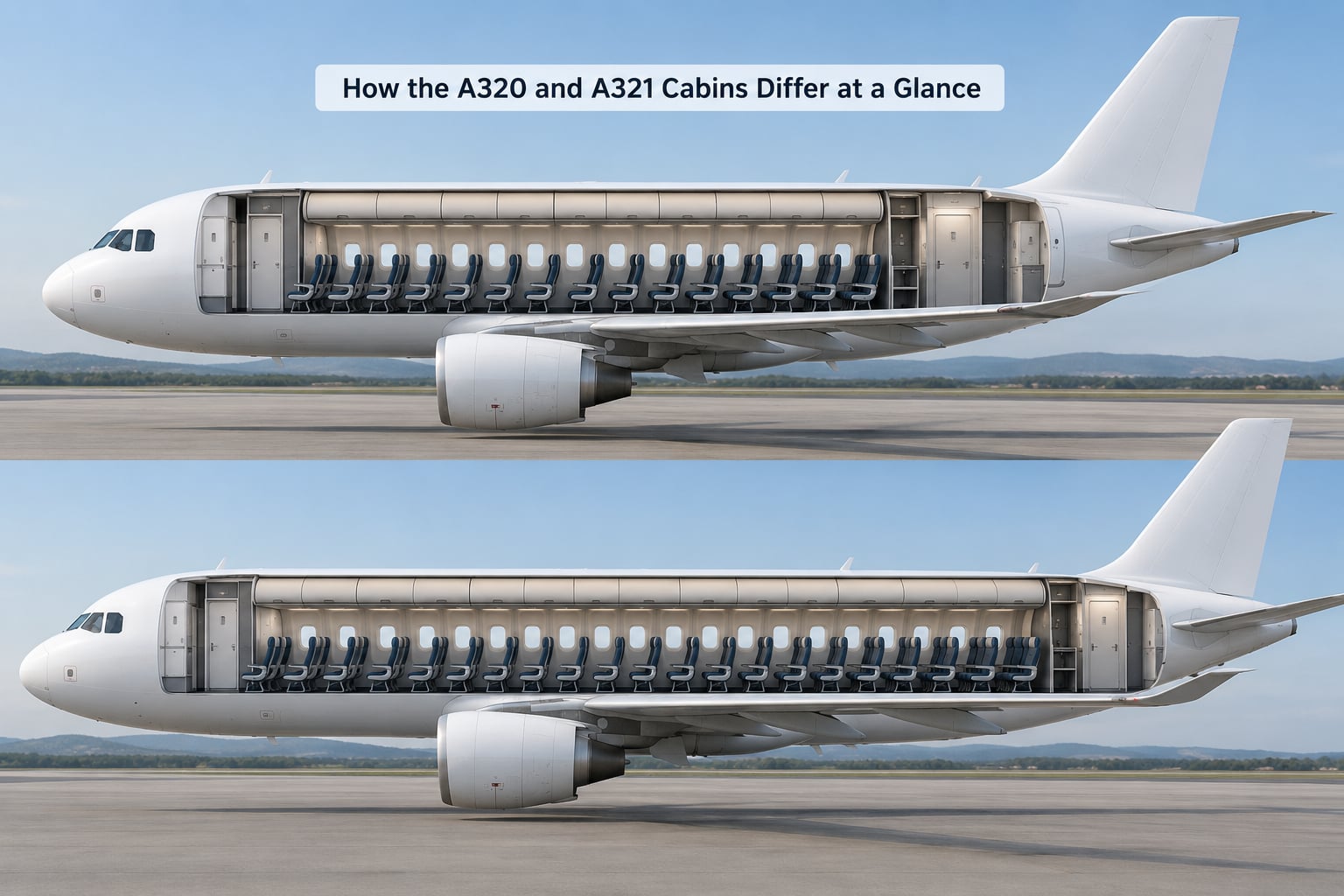
Every row below is a structural or typical-configuration fact. Airline fit-out changes some of the numbers, which the table notes where it matters.
| Feature | Airbus A320 | Airbus A321 |
|---|---|---|
| Fuselage length | About 37.6 m | About 44.5 m, roughly 6.9 m longer |
| Cabin width | 3.70 m | 3.70 m, identical |
| Typical two-class seats | Roughly 150 to 180 | Roughly 170 to 200 |
| Maximum certified seats | 180 | 220, or 244 on the A321neo with Cabin Flex |
| Full-size doors | Two per side | Four per side |
| Overwing emergency exits | Two small exits per side | None |
| Economy seat width | Commonly 17.5 to 18 inches | Commonly 17.5 to 18 inches |
| Typical economy pitch | About 30 to 32 inches | About 30 to 32 inches |
| Lavatories | Usually three or four | Usually five or six |
| Best fit | Short sectors, quick turns, smaller stands | Busy routes, longer sectors, more premium cabin |
The British Airways fleet gives a useful real-world anchor that stays on the conservative side of those ranges: BA’s A321s seat up to 188 passengers in maximum configuration while its A320s seat around 160. A long-running FlyerTalk thread on the British Airways club forum put it simply: the A321 is a stretched A320, about seven metres longer.
How Aircraft Size Changes the Cabin
The A321 is the A320’s fuselage with 6.9 m of extra length inserted ahead of the wing, and the same cross-section kept everywhere else. Because the width is untouched, seat width, aisle width and window size are the same on both types.
What the stretch does change is the shape of the journey through the cabin. Cabin zones get distributed differently. On a two-class A320 the business cabin often runs four rows and economy roughly 25 to 30; the same airline’s A321 commonly runs four to six business rows and 30 to 36 economy rows.
Because the exit and door layout had to change to serve a longer cabin, the A321 is not simply a longer copy of the same experience. Passengers walking to the rear cover more ground, boarding takes a little longer, and the quietest seats sit further from the wing than they would on an A320.
Seating Layouts and Seat Comfort
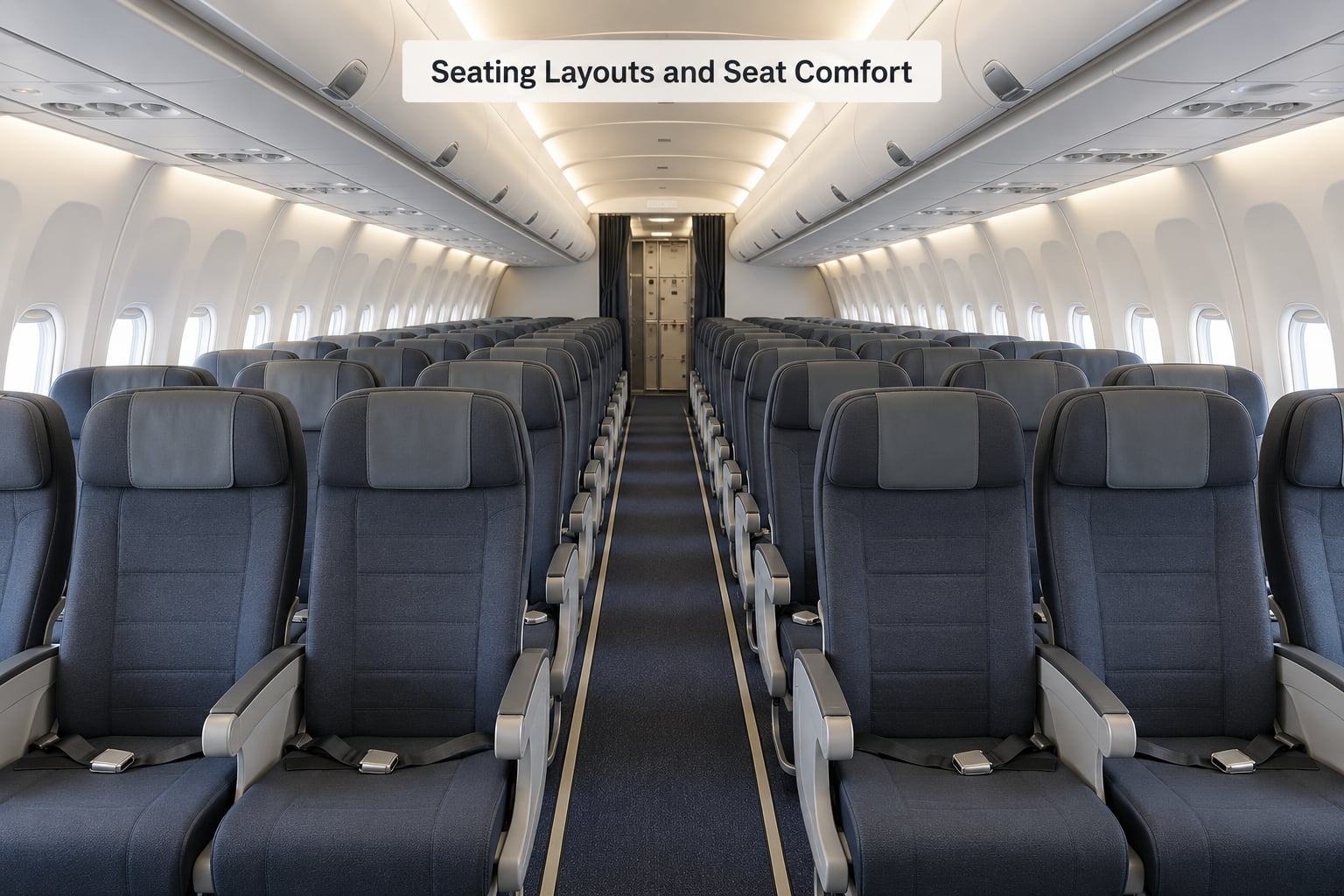
Both aircraft sit five abreast in a 3-3 economy layout, and the seat itself is effectively the same product across the family. That is why a passenger swapping from an A320 to an A321 feels more rows than more room.
Pitch is set by the airline, not by the airframe. You will see roughly 30 to 32 inches in main economy on short-haul European carriers and closer to 31 to 34 inches on transatlantic-configured narrowbodies, on both aircraft types. A user on r/fearofflying put this well, preferring the newer aircraft but attributing the comfort to the legroom their airline chose rather than to the aircraft generation.
How to tell an A320 from an A321 before you sit down
Run these checks in order while boarding, and you will have your answer in about a minute:
- Count the full-size doors on your side. Two large pairs means A320. Four means A321.
- Look for a pair of small overwing exits. Present means A320. Their absence is the single clearest A321 tell, noted repeatedly in pilot and enthusiast discussion of the family.
- Check whether the small exits have a row directly in front of them. On an A320 the overwing exit row has no pitch advantage. On an A321 the extra legroom rows sit at the full-size doors.
- Count rows from the front to the rear. Past the mid-30s in economy and you are almost certainly on an A321.
- Compare the bins. A321neo and A321LR cabins often use the larger Airspace XL bins, which open further and close more slowly than older A320 bins.
- Check your boarding pass or the booking flow. Many airlines now show the exact aircraft type and sometimes the seat map before check-in.
One caveat from r/aviation: a seat pocket card on a single trip named two different aircraft, so the paperwork is not always reliable. Trust the cabin over the card.
Lavatories, Galleys, and Cabin Storage
The extra 6.9 m of A321 length is commonly spent on more service space: an extra lavatory module at the back, an additional forward galley, and larger storage for onboard sales items. That is the quiet reason lavatory queues on an A321 can be shorter even on a busier flight.
On an A320, toilets usually sit in two modules, one forward of the doors near the front and one in the middle or rear of the cabin. On an A321 you will typically find a third position, which is why “the toilets are at the back” advice that fits one aircraft is wrong on the other.
Galley and lavatory counts vary with density and with the airline’s service model, so treat these as typical rather than fixed. A high-density A320 with a full-service galley out front can carry four lavatories, and an A321 configured for a long sector can carry six or more.
Storage is the other quiet difference. Newer A321neo and A321LR cabins tend to get the Airspace bin design with a lower door sill and a wider opening, so a standard cabin bag that will not go in an older A320 bin often will fit an A321neo.
Noise, Vibration, and Passenger Comfort
Neither type is reliably quieter than the other, but the differences are real and depend on where you sit. The A321’s engines are larger and, on older ceo variants, louder per seat because more people are spread across a longer cabin; a single lavatory flush and a full service trolley are also more noticeable in a longer space.
Seat density is the bigger factor. A high-density A320 at 180 seats feels tighter than an A321 at 180, because the same cabin service load is spread further. Position matters more than type: a middle seat two rows from a lavatory will hear it, on either aircraft.
Cabin altitude and pressurisation are effectively the same for the family, since the pressurisation system is shared. Some flyers report ears feeling less blocked on Airbus narrowbodies than on comparably aged Boeing jets, but that difference is generational rather than A320-versus-A321, and plenty of A321ceo cabins predate the pressurisation improvements people enjoy in newer metal.
On ride feel, the longer A321 has a slightly different motion character and takes marginally longer to settle after takeoff. On short sectors the A320’s shorter boarding and turn time usually matters far more to how the trip feels than any ride difference.
Which Should You Choose?
Choose the A321 when you want more options: a real premium cabin, a seat near a full-size exit, a shorter lavatory walk, or simply a higher chance of a spare seat next to you on a busy route. Choose the A320 when you are on a short hop, want the fastest boarding and deplaning, or are flying from a smaller stand where a shorter aircraft turns the ground schedule around faster.
If legroom is your top priority, neither type wins on its own. Look for the airline that fits a bulkhead row or a reclinable seat, and check the seat map for that specific flight rather than picking a flight by aircraft code.
Frequently Asked Questions
Is the A321 always more comfortable than the A320?
No. Both have the same 3.70 m cabin width and effectively the same economy seat, so comfort comes down to pitch, density and where you sit rather than the aircraft. The A321 tends to feel more spacious because it has fewer rows per cabin section and a larger premium cabin, not because any individual seat is wider.
Why does the A321 sometimes have more seats than the A320?
Because the A321 is roughly 6.9 m longer, and airlines spend that length differently. One carrier may add six economy rows, another may add a bigger business cabin, a third may add lavatories and galley space instead. British Airways, for example, seats up to 188 on its A321 against around 160 on its A320.
Does the A321 have more legroom?
Not row for row. Seat pitch is chosen by the airline and is normally within the same 30 to 32 inch range on both types. What the A321 adds is more rows to pick from, more full-size exit rows with extra space in front, and sometimes wider bins, so you have a better chance of finding an acceptable seat.
How many lavatories are usually on an A320 or A321?
A typical two-class A320 has three or four lavatories, usually in two modules. An A321 usually has five or six because the extra length adds a third module. Counts vary with seat density and service style, so an A320 configured with a full-service galley can carry as many as a lighter-fitted A321.
Can I tell whether my flight uses an A320 or A321?
Usually yes, and quickly. Count the full-size doors on your side: two pairs means an A320, four means an A321. Two small overwing exits mean an A320, since the A321 has none. Counting past the mid-30s in economy is a further clue, and many airlines show the aircraft type in the booking flow before you travel.
Which aircraft is better for a window seat?
Neither is inherently better, but the A321 gives you a wider choice of window positions, and its later rows are further from the wing than an A320’s. A window seat mid-cabin on an A321 is often calmer than the same spot on an A320. What matters more is the seat map, since some airlines block or deprioritise window rows.
Conclusion
The A321 and the A320 share a cabin almost completely in width, seat and cockpit. The A321 simply adds about 6.9 m, which airlines turn into extra rows, extra lavatories or a bigger business cabin, and which removes the overwing exits and adds two more full-size doors. Your practical move is to check the seat map for the specific flight, pick an exit row or bulkhead if that is what you want, and use the door count in the aisle to know which aircraft you are in.