Short answer: an A350 cabin is more humid than the older aluminium-fuselage jets it replaced, because it is pressurised to roughly 6,000 feet instead of 8,000 feet and denser air holds more moisture. Even so, the real gain over a 777 or A330 is modest, and the widely quoted 20-25% figure rarely matches what passengers actually feel in the cabin.
That gap between the marketing number and the lived experience is the interesting part of this comparison, and the reason “how the A350 cabin humidity compares” comes up so often on aviation forums. Below I break down the A350 against the 787, the 777, the A330, the A380 and older narrowbodies, then explain what you can practically do about it.
Table of Contents
- How the A350 Cabin Humidity Compares at a Glance
- What cabin humidity means on the A350
- How the A350 compares with older narrowbody aircraft
- How the A350 compares with conventional widebody aircraft
- Why the A350 may feel less dry than some aircraft
- Humidity, condensation, and eye or nose comfort
- Which A350 seat or cabin feels most comfortable?
- Which Should You Choose?
- Frequently Asked Questions
- Is the A350 cabin always more humid than an older aircraft?
- What is the normal humidity inside an A350?
- Does the A350 have better air filtration than older planes?
- Why do A350 windows sometimes fog or develop condensation?
- Do aisle seats get more ventilation than window seats?
- How can I stay comfortable during a long A350 flight if I get dry eyes?
- Conclusion
How the A350 Cabin Humidity Compares at a Glance
Figures vary between sources and between flights, so treat these as ranges rather than absolutes.
| Aircraft | Typical cabin altitude | Reported cabin relative humidity | Cabin air system |
|---|---|---|---|
| Airbus A350-900 and A350-1000 | Around 6,000 ft | Low to mid teens in many conditions, often reported nearer 5-10% in practice | Bleed air from the engine compressors |
| Boeing 787 family | Around 6,000 ft | Quoted near 15%, with a commonly cited comparison figure of about 4% for older jets | Bleedless, with outside-air inlets and electric cabin air compressors |
| Boeing 777-300ER | Around 8,000 ft | Often quoted in the low single digits | Bleed air |
| Airbus A330 and A330neo | Around 8,000 ft on many airlines | Low, similar to the 777 | Bleed air |
| Airbus A380 | Low cabin altitude on later builds | Comparable in character to the A350 on some flights | Bleed air |
| Older narrowbodies such as 737 and A320 family | Around 8,000 ft | Very low, and a short flight is over before most people notice | Bleed air, high recirculation |
The single biggest dividing line in that table is cabin altitude, not filtration or cabin design. A cabin held at 6,000 feet has roughly 20% more air in it than the same volume held at 8,000 feet, and that extra air carries extra water.
What cabin humidity means on the A350
Relative humidity is the share of water the air can hold at its current temperature that it is actually holding. Warm air can hold a lot of water. Cold air cannot hold much at all.
That is the whole story of aircraft cabins. Outside air at 35,000 feet is bone dry, and when it is brought inside and warmed to cabin temperature it stays at that low moisture content unless something actively adds water. Passenger breathing adds some, and service adds more, but no airliner humidifies its cabin on purpose.
So why does an A350 beat a 777? Because the A350’s carbon composite fuselage tolerates a higher pressure differential, which lets the pressurisation system hold the cabin lower, around 6,000 feet. At that altitude the air inside is denser, so the same amount of water represents a higher relative humidity reading.
Humidity, temperature, airflow and pressure are separate things that get confused constantly. Cabin temperature is managed zone by zone. Airflow is handled by ceiling diffusers that push air along the cabin and down over the seats. Pressure sets how much water the air can hold. Only the last of those is what a humidity meter reads.
How the A350 compares with older narrowbody aircraft
Against a 737 or A320, the A350 wins on almost every axis, and the difference is rarely close. Narrowbodies sit at the traditional 8,000 ft cabin altitude, recirculate a large share of their air, and move a lot of passengers through a small volume.
On a two-hour hop that hardly matters. A 737 flight is over before most people reach for eye drops, and the low humidity is an irritation rather than a problem. On a long narrowbody sector, typically four to six hours, the dry air starts to show up in dry eyes, a blocked nose and cracked lips.
The A350 also has more air per passenger simply because the cabin is larger and wider than a single aisle tube. Seating density on older narrowbodies concentrates both passengers and their exhaled moisture into a smaller volume, which is one reason the air can feel closer in a full coach cabin.
Filtration on newer narrowbodies is respectable, and both major manufacturers use HEPA-grade filters as standard. Fresh air rates on an A350 are still higher per seat than on an older narrowbody, though the difference matters far less over two hours than over sixteen.
How the A350 compares with conventional widebody aircraft
Versus the 777 and the A330, the A350 is the newer generation with the lower cabin altitude, and that is where the humidity advantage comes from. Widebodies from the 1990s and 2000s were designed around an 8,000 ft target because that was an easy number to pressurise to safely with the airframes available.
The 787 is the fair comparison point, and it is closer than most marketing suggests. The 787 also runs around 6,000 feet, which puts it in the same humidity territory as the A350. The two aircraft differ in how the air arrives: the 787 uses a bleedless architecture with dedicated inlets ahead of the wings feeding electric cabin air compressors, while the A350 draws bleed air from the engine compressors.
That architectural difference matters more for noise and fuel burn than for humidity. Neither aircraft humidifies on purpose, so both land in the same low-to-mid-teens band under favourable conditions and lower in ordinary ones.
Cabin volume and seating density are worth separating out. The A350-1000 stretches the fuselage and holds more passengers in a longer, taller cabin, so the per-seat volume and air distribution can feel different from the -900 even though the pressurisation philosophy is identical.
The A380 sits in an odd middle ground. It has an enormous volume and some builds ran a lower cabin altitude, yet passengers often report it as a dry aircraft, which is a useful reminder that air volume by itself does not control humidity.
Why the A350 may feel less dry than some aircraft
Here is the honest part. Passengers on FlyerTalk threads about Delta A350 services largely agreed that, without dedicated humidification equipment, the A350 and the 787 get a passive improvement of roughly 1-2% rather than the jump the brochures imply.
Several things can nudge the number in either direction on a given flight:
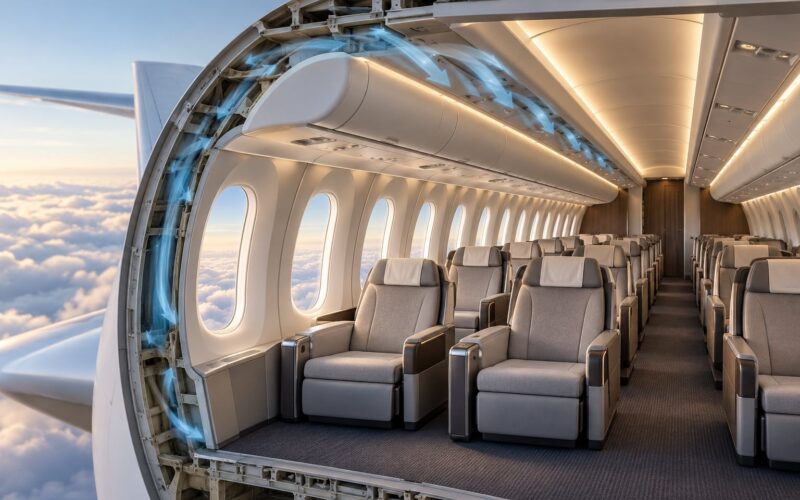
- Fresh air distribution. The A350 pushes conditioned air along the cabin from the ceiling diffusers, so a seat near a strong diffuser can feel different from one tucked behind a seatback.
- Filtration. HEPA-type filters remove particulates, not water vapour, so filtration improves perceived air quality without raising humidity.
- Cabin zoning. The cockpit, galleys and lavatories are managed separately from the passenger zones, and galley and service activity adds moisture at the front and rear of the aircraft.
- Passenger load. More passengers breathing in a full cabin means slightly more water in the air, though the effect is modest.
- Cabin altitude set point. Airlines and crew can operate to different targets on the same type, and a higher set point means drier air.
On the 787 there is a further wrinkle that has been discussed at length on the PPRuNe Tech Log: the cabin system takes a passenger count from the cabin attendant panel, and entering an inflated figure gives the cabin air compressors more surge margin. Posts there describe that margin workaround as a further drying effect, and dispute the fuel-saving explanation that circulates alongside it.
None of this means anyone is deliberately making your cabin dry. It means humidity on any aircraft is an output, not a setting, and it varies from sector to sector.
Humidity, condensation, and eye or nose comfort
Low humidity pulls water out of the surfaces that hold it. That is why eyes sting and feel gritty after a few hours, noses crust, lips crack and skin tightens, and contact lens wearers suffer more than anyone else.
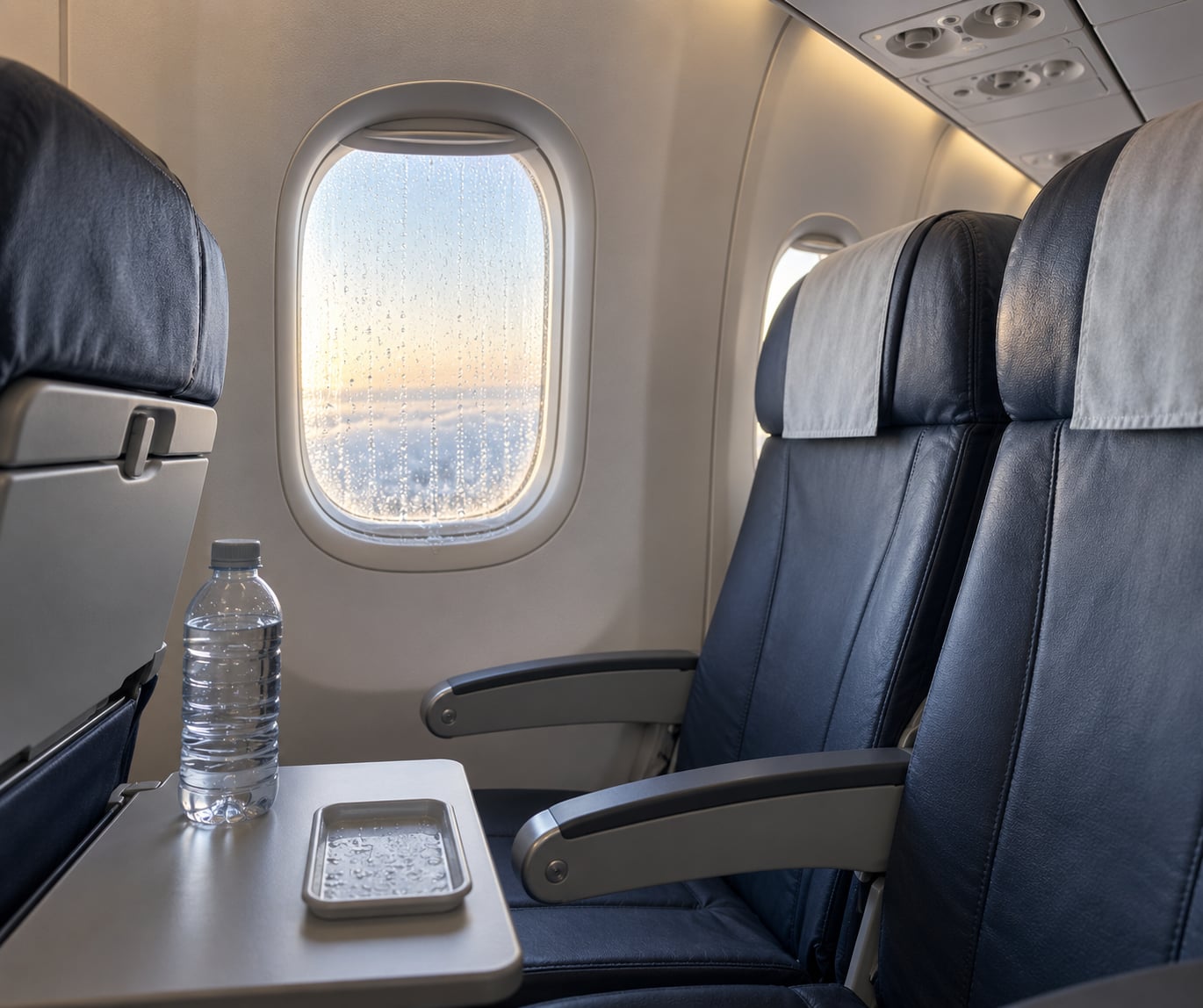
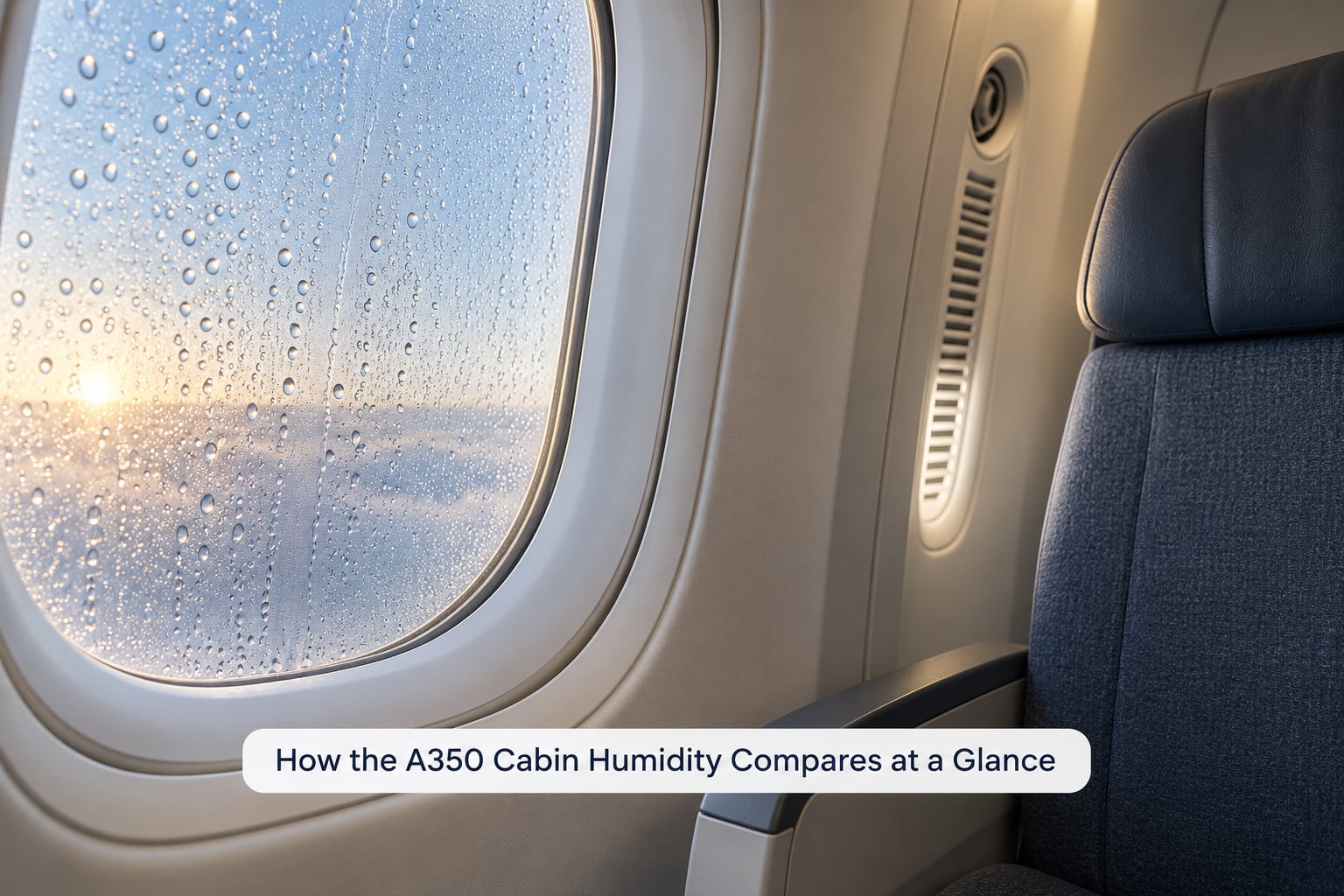
The same physics works in reverse on a cold surface. When cabin air touches a window pane chilled below the dew point, the water in it condenses, which is the fog you see on some A350 windows during the climb and descent. Pilots use window shades for a reason.
A few practical measures help. Preservative-free lubricating eye drops are the single most useful item for a long sector. Saline nasal spray keeps the nose from crusting and helps with the sinus pressure that comes with a 6,000 ft cabin altitude, and drinking water steadily beats downing a litre at once. Avoid alcohol, which works against you on both hydration and sleep, and skip the sugary coffee option if you are already uncomfortable.
For anyone with a diagnosed dry eye condition, a pharmacist or eye-care professional can advise on drops safe for regular use. Anything beyond general comfort, such as persistent pain or vision changes, deserves a clinician rather than a forum thread.
Which A350 seat or cabin feels most comfortable?
Window versus aisle makes a bigger difference to perceived air movement than most people expect. Aisle seats sit in the path of the ceiling air that circulates down the cabin, and passengers often report feeling cooler and less dry there. Window seats benefit from the cooler perimeter airflow but can sit in a slightly calmer pocket.
Avoid the extreme ends if airflow is your concern. Rows immediately behind a bulkhead or right at a door can feel draftier or more stagnant depending on the airflow pattern, and seats just forward of a galley deal with service noise plus a warmer, busier atmosphere.
Cabin class changes the answer too. Premium economy and business on an A350 have more air per seat and more ceiling diffuser coverage above each seat, so a seat nearer the middle of a premium cabin often feels better ventilated than a seat at the tail of the main cabin.
Aisle or window, front or back, the honest summary is that airflow differs across the cabin and the difference is real but modest compared with the gap between an A350 and a 777.
Which Should You Choose?
If you are picking aircraft rather than simply taking what is available, an A350 suits travellers who notice dry eyes and sinus pressure, anyone on a genuinely long sector, and passengers who are sensitive to cabin altitude because of a heart or lung condition. The lower cabin altitude and denser air are the substantive advantages, not the humidity headline.
Choose a 777 or A330 when route availability is the deciding factor, when a nonstop you can sleep through beats a slightly newer cabin with a connection, or when the fare difference buys you a lie-flat seat instead.
Choose the 787 when you want the same low cabin altitude in a different air system and the airline flies the route well. It is not a downgrade on humidity.
For sensitive travellers on any aircraft, the fix list does not change: lubricating eye drops, saline spray, steady water intake, alcohol avoided, and a seat with reasonable airflow. Check the aircraft type and seat map before you book, since a route can be flown by different types on different days.
Frequently Asked Questions
Is the A350 cabin always more humid than an older aircraft?
Usually, though not on every flight. The A350 holds a cabin altitude near 6,000 feet, which keeps the air denser and more humid than an 8,000 foot 777 or A330. But the improvement reported by passengers on forum threads is only around 1-2%, and a higher set point or a very full cabin can narrow or erase the gap on any given flight.
What is the normal humidity inside an A350?
There is no single normal figure, which is the honest answer. Sources range from a low single-digit percentage in dry conditions to the mid teens under favourable conditions, and manufacturer marketing sometimes quotes 20-25%. A mid-range expectation for an A350 is roughly 8-15% relative humidity, with noticeably lower readings in humid ground conditions and higher ones near service activity.
Does the A350 have better air filtration than older planes?
Yes, in the sense that HEPA-type filtration and higher fresh air rates per seat are standard on the A350, and the filtration removes particles rather than moisture. That improves perceived air quality for people with allergies, but it does not raise humidity. If your issue is a dry nose rather than dust or odours, filtration is not the lever that will change how the flight feels.
Why do A350 windows sometimes fog or develop condensation?
Because the pane is colder than the air touching it. During climb and descent, and sometimes in cruise where the window is cold-bridged, cabin air cools against the glass and drops below its dew point, so the water in it turns into visible droplets. Keeping the shade up during climb speeds things along, and the fog usually clears once the pane warms back up.
Do aisle seats get more ventilation than window seats?
Aisle seats usually catch more of the conditioned air moving along the cabin and down from the ceiling diffusers, and passengers often report feeling cooler and less dry there. Window seats sit in a slightly calmer perimeter zone and may feel warmer. The difference is noticeable but modest, so it rarely outweighs aisle or window preference for legroom and access.
How can I stay comfortable during a long A350 flight if I get dry eyes?
Carry preservative-free lubricating eye drops and use them before the cabin gets dry rather than after it stings. Remove contact lenses for long sectors if you can, keep water within reach and drink steadily, and avoid alcohol. Saline nasal spray helps with nasal dryness and sinus pressure. If symptoms persist after a flight, an eye-care professional can advise on a longer-term plan.
Conclusion
The A350 holds a cabin altitude near 6,000 feet against the 8,000 feet of older narrowbodies and conventional widebodies, and that lower, denser air is why A350 cabin humidity reads higher. The improvement is real but modest, closer to 1-2% in passenger reports than the marketing figures suggest.
Before you book, check which aircraft type your route is actually flown on, since it can change day to day. Then pick a seat with reasonable airflow, keep lubricating eye drops and saline spray in your bag, drink water steadily, and leave the alcohol for the arrival lounge.