The 787 has dimming windows because Boeing made its windows large, and a pull-down shade no longer fits the opening. Each pane instead carries an electrochromic layer that darkens when you press a button. That single swap explains both the glare control you notice and the complaints you read about online.
Most people only notice this feature because it is strange. On every other airliner, the window blind moves. On the Dreamliner, the glass itself changes colour. Here is what is actually happening, who holds the controls, and what to do when a dimmer quits halfway through the flight.
Table of Contents
- Why the 787 Has Dimming Windows
- How Do the 787’s Dimming Windows Work?
- How 787 Window Dimming Works, Step by Step
- How Does Window Dimming Improve Cabin Comfort?
- Are 787 Windows Fully Blackout Windows?
- How Does 787 Window Dimming Compare With a Window Shade?
- What Should Passengers Know Before Choosing a Window Seat?
- Frequently Asked Questions
- Are Boeing 787 windows electronic?
- Can you make 787 windows completely dark?
- Why are 787 windows better at reducing glare?
- Do 787 dimming windows help passengers sleep?
- Can you still use the window shade on a 787?
- Conclusion
Why the 787 Has Dimming Windows
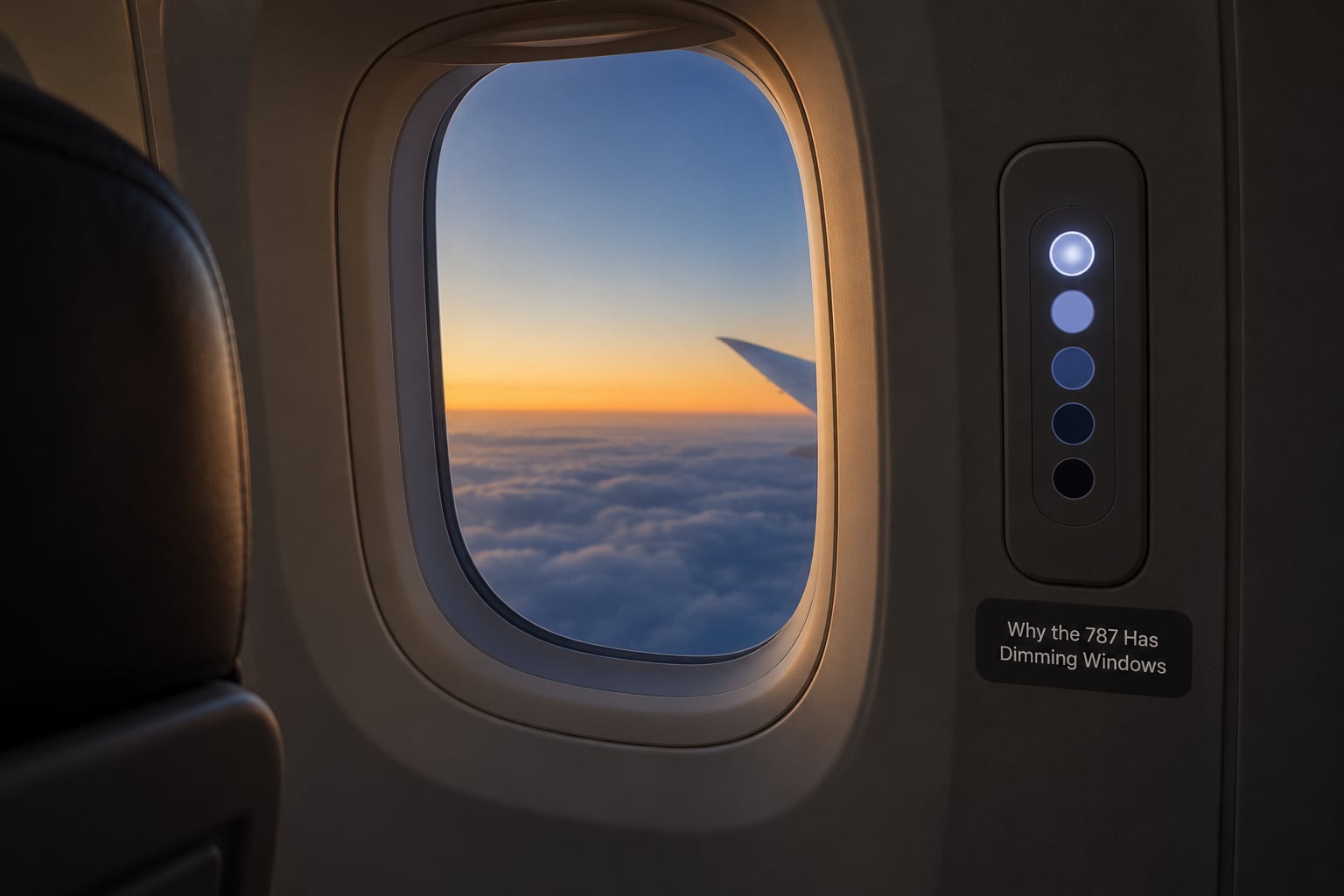
Boeing wanted bigger windows on the 787 than any airliner before it, and they got them. The Dreamliner panes are roughly 20 percent larger in height than a standard airline window, which is part of why the cabin feels brighter and why window-seat views get so much praise.
Here is the part most explanations skip: a bigger window is what made a shade impossible. The blind needs space above the opening to roll up, and once the aperture was enlarged the only way to fit one would have been to shrink the view. Boeing chose the view.
The trade ran the other way too. A widebody carries every kilogram across tens of thousands of cycles, and roughly 130 mechanical shade sets per aircraft came with hardware, cables, rollers, maintenance and a small but real catalogue of jam complaints. Powered glass has no moving parts at all.
The lighting design was rebuilt around the decision too, so the cabin brightness reads correctly with the windows clear. That is why the feature feels integrated rather than like an add-on.
How Do the 787’s Dimming Windows Work?
Between the two panes of each window sits a transparent gel with electrochromic properties. Push a small electric current through it and its optical state shifts, darkening the glass. Reverse the current and it clears again.
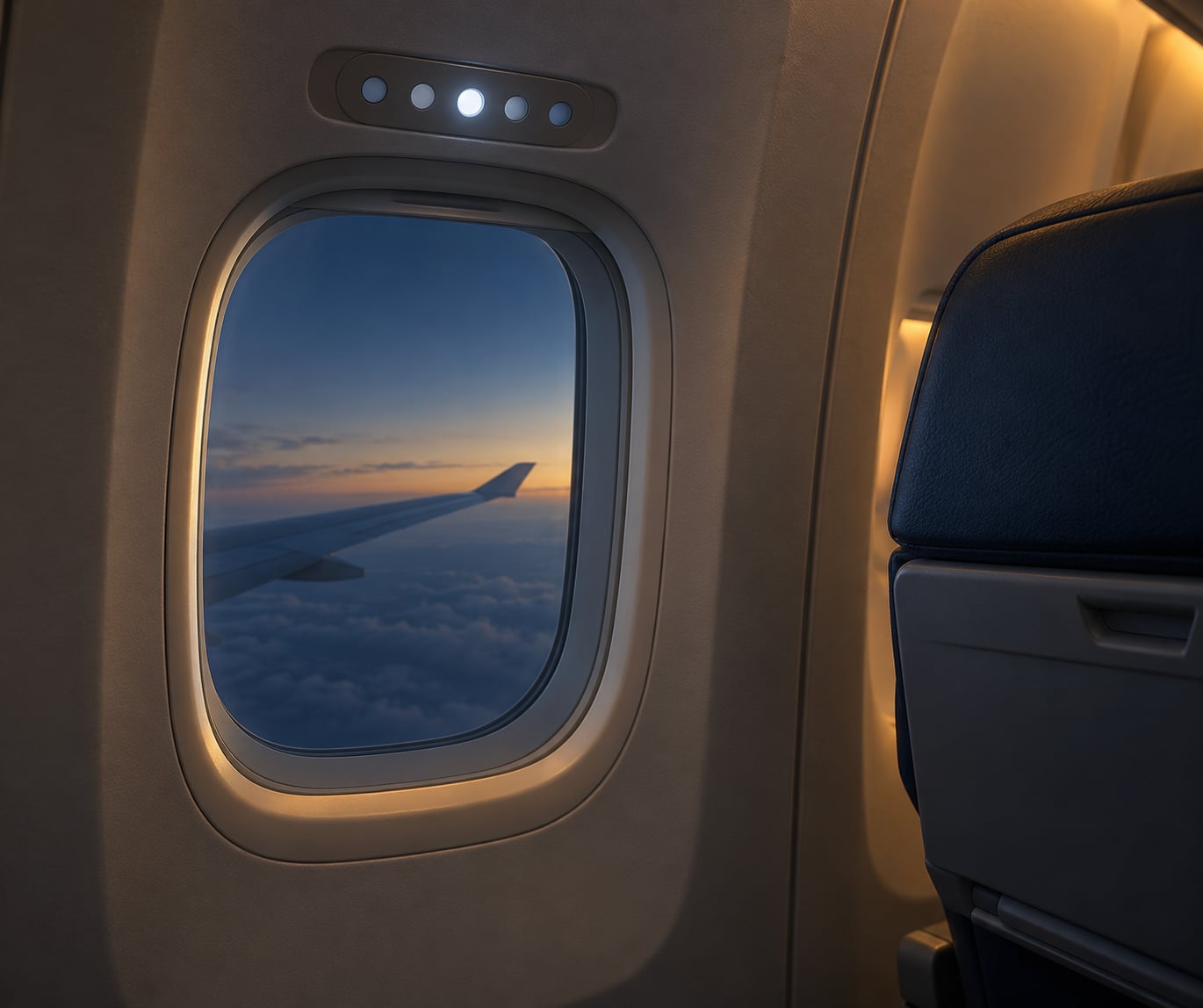
On most 787s you get a five-step button above the window, rather than a single on-off. Passengers press repeatedly to step through the levels, which is why some travellers think the button is broken. The glass takes several seconds to settle at each setting, because the change is a chemical migration rather than a switch.
How 787 Window Dimming Works, Step by Step
- You press the dimming button above your window once per level.
- A small signal travels to the window’s control unit.
- The unit applies a voltage across the electrochromic layer.
- The layer darkens and light transmission drops continuously.
- Press again, or have crew dim from the cabin panel, and the glass reverses back toward clear.
How Does Window Dimming Improve Cabin Comfort?
Glare is the headline benefit. On a daytime flight you often want light in the cabin without a white-hot pane two inches from your face, and the dimmer gives you that middle setting a shade cannot.
You also keep a usable view. A shade ends the view entirely; tinted glass lowers brightness and leaves the outline of the landscape, clouds or city lights outside. Regular window-seat flyers pick the 787 for exactly this reason.
For airlines there is a running cost angle. Less solar energy coming through the glass means less cabin heat to remove, so the air-conditioning packs work less hard in flight. Gentex, the supplier behind these electronically dimmable windows, also points to weight savings, acoustic attenuation and fail-clear design that keeps a failed pane transparent rather than black.
On a long flight, control granularity matters more than it sounds. Moving from clear to dark in five steps beats a blind that snaps from full view to full darkness, because most of us want something in between.
Are 787 Windows Fully Blackout Windows?
No, and no amount of button pressing will change that. The darkest setting on a 787 reduces light transmission substantially but does not make the pane opaque, so a lit cabin and the sun outside still leak through.
ANA made this point publicly in 2012, shortly after the Dreamliner entered service, saying the windows did not get dark enough for passengers who wanted genuine darkness to sleep. It was an early criticism of an otherwise well-received cabin, and it has never fully gone away.
For most passengers this is a fair trade. If you sleep with an eye mask, the residual light does not matter. If you are someone who needs total darkness to fall asleep, treat a 787 as a bright cabin and pack accordingly.
How Does 787 Window Dimming Compare With a Window Shade?
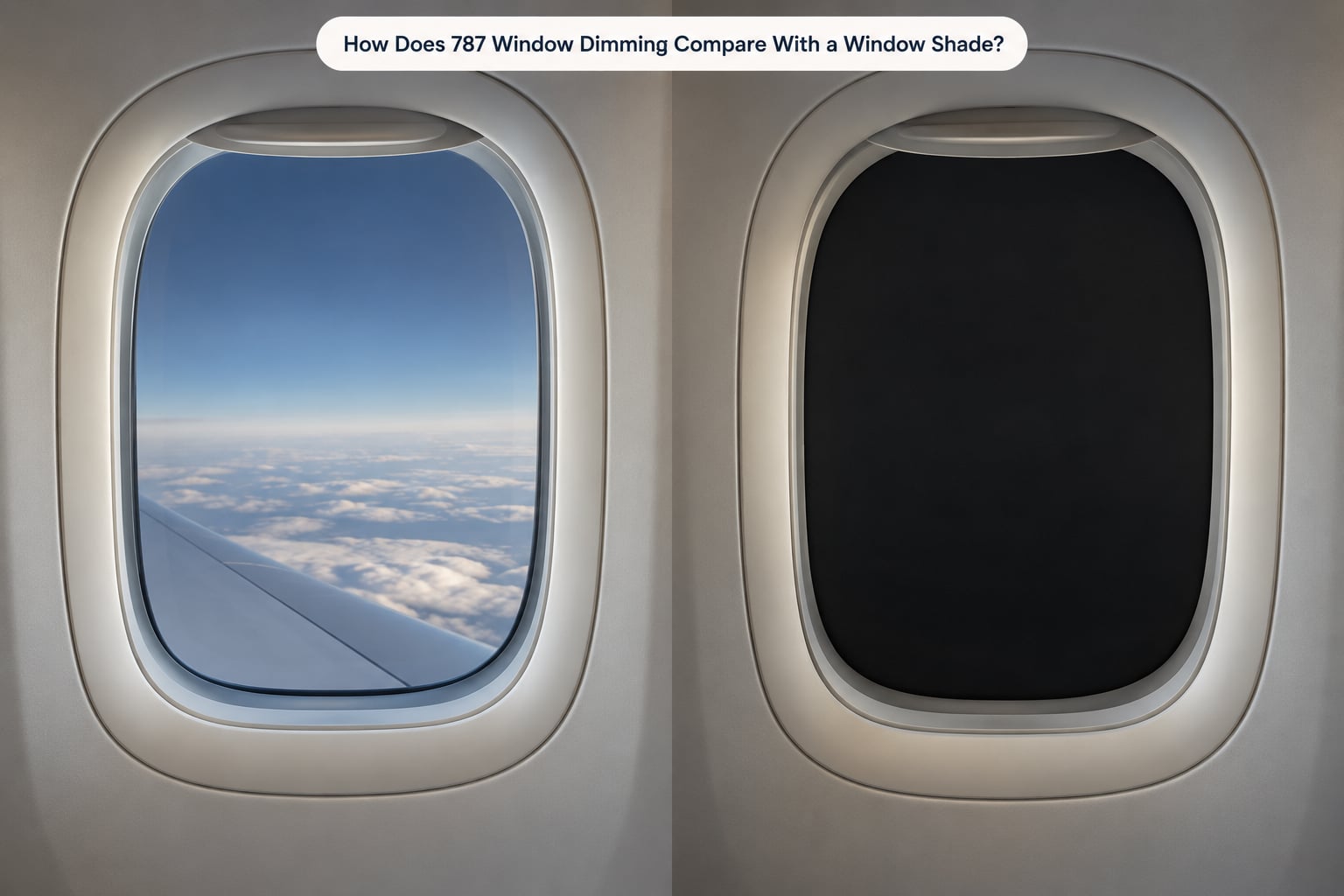
Control is the clearest difference. A shade is yours alone and moves instantly. A 787 dimmer can also be moved by the cabin crew from their panel, which many passengers love on a red-eye and many more resent on a sightseeing flight.
Adjustment is the second difference. A shade gives you two states, open or closed. Glass gives you a continuous range between them, so you can cut glare without losing the view.
A shade still wins in a few situations: when you want the cabin pitch dark for a few hours, when the dimmer fails, and when you simply do not want to think about a button. Nothing on the 787 replaces that shade, which is exactly the complaint British Airways passengers raised when dimmers failed on long-haul sectors and crews improvised with tray liners, tape and safety cards instead.
What Should Passengers Know Before Choosing a Window Seat?
Pack an eye mask. That single item handles the darkness gap better than anything else you can carry, and it also covers the window that has been dimmed from the cabin side while you were asleep.
Think about direction and time of day before you book. A seat on the sunward side of a morning east-west flight is where dimming earns its keep. A night flight over city lights is where the glass gives you something a shade cannot.
Expect the crew to act on the whole cabin, not just your pane. Red-eyes in particular are usually flown with windows dimmed for most of the trip so passengers can sleep. If you booked that seat for the view, sit near the aisle or plan to check the window when the lights come up.
If a dimmer stops working, tell a flight attendant early rather than after two hours of glare. Crew can reset the window unit and, if it will not take, they will look for a workaround. You have no personal override, so the conversation is the only route.
Frequently Asked Questions
Are Boeing 787 windows electronic?
Yes. The 787 was the first airliner to ship with electronically dimmable windows as standard. Each pane holds an electrochromic gel layer between two glass sheets, and an electric current changes how much light it transmits. A button above the window gives you five brightness levels, and the cabin crew can also dim the pane remotely.
Can you make 787 windows completely dark?
No. The darkest setting cuts light transmission sharply but the pane never becomes fully opaque, so daylight and cabin lighting still show through. ANA publicly complained in 2012 that early 787 windows were not dark enough for light sleepers. If you need real darkness, bring an eye mask rather than relying on the dimmer.
Why are 787 windows better at reducing glare?
A mechanical shade only offers full open or full closed. The 787 glass moves continuously between clear and dark, so you can dial down the brightness that causes eye strain without losing the view outside. The panes are also roughly 20 percent larger than standard, which lets in more light overall, and less solar energy through the glass means less cabin heat for the air conditioning to remove.
Do 787 dimming windows help passengers sleep?
Partly. On overnight flights the crew can dim the cabin windows, which removes direct sunlight and helps most passengers settle. Because the glass never goes fully opaque, though, it is not a blackout curtain, and red-eye passengers who are sensitive to light still need an eye mask. Frequent flyers rate the feature positively for glare but mixed for sleep.
Can you still use the window shade on a 787?
There is no mechanical window shade on a 787, only the dimming button and the crew’s cabin panel. That is also why a dimmer failure is a genuine problem, since passengers have no manual fallback. Documented British Airways failures on long-haul flights left crews improvising with tray liners, tape and safety cards until the system could be reset.
Conclusion
Why the 787 has dimming windows? Because Boeing chose the biggest windows it could and had no space left for a blind, so powered glass became the only way to control light without giving up the view. You get five brightness levels, glare control with the view intact, and no shade to jam.
What to do first: press the button and find the level that suits you, then keep an eye mask in your bag. If the dimmer fails, tell a flight attendant early, because there is no manual backup and crew are your only route to a fix.