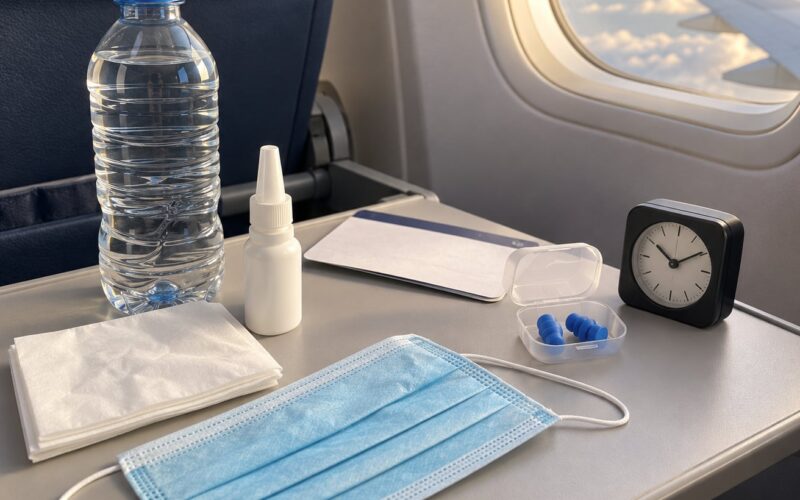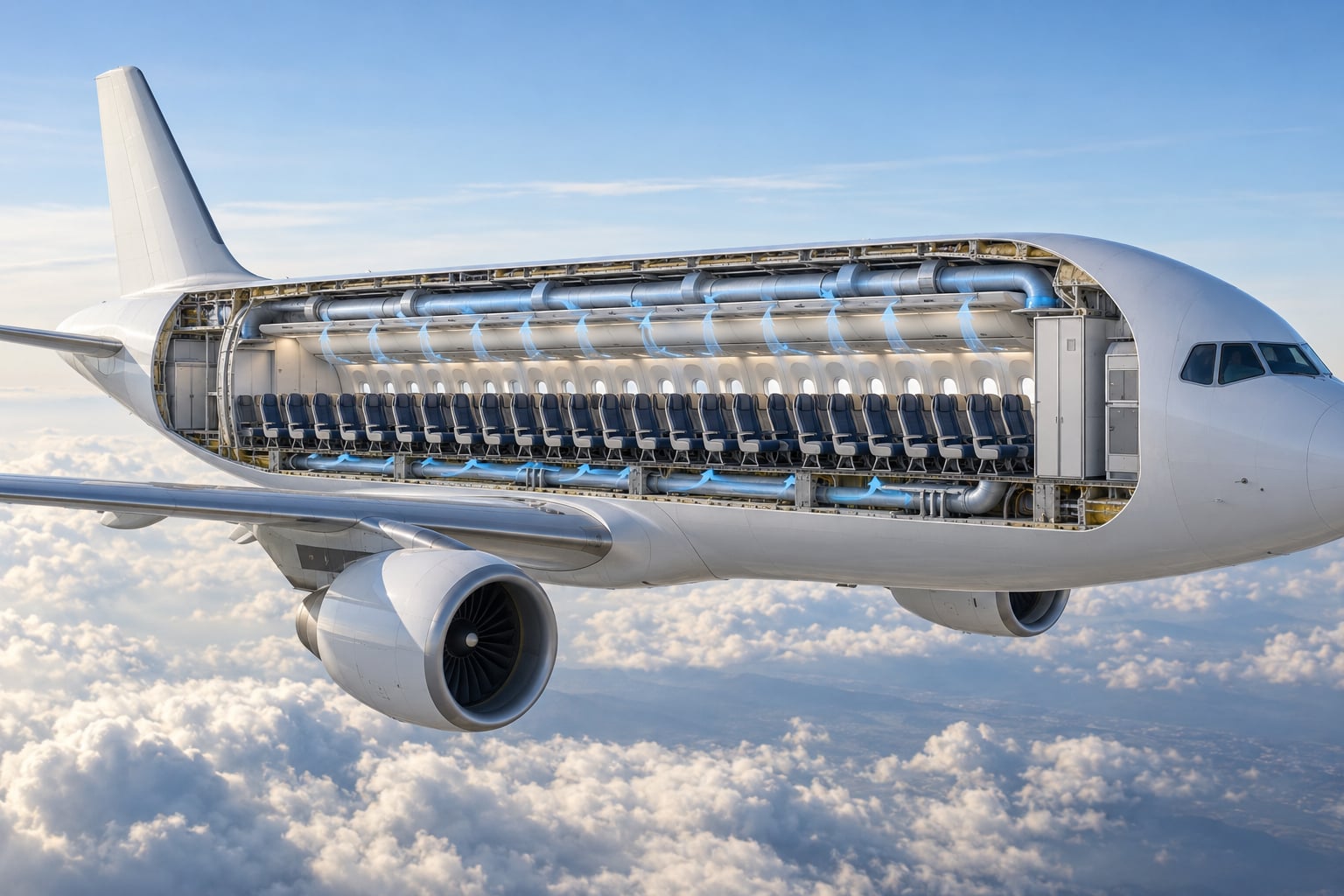
Airplanes are kept cold because the cabin has to be pressurized, and pressurizing it means pumping in outside air that is well below freezing at cruising altitude. On top of that, a cooler cabin is deliberately chosen so passengers feel alert and less likely to faint at reduced cabin altitude. Everything else, from the vents above your head to the way a window seat feels colder than an aisle seat, follows from those two facts.
If you have ever sat in shorts at the gate in July and reached for a blanket somewhere over Nebraska, this explains it. The short version is that cold is not a cost-cutting trick or an airline tradition. It is a by-product of the ventilation system, and the crew has very little say in it.
Table of Contents
- Why Airplanes Are Kept So Cold
- How Airplane Pressurization and Temperature Control Work
- The Main Reasons Airplanes Are Kept So Cold
- Why Airplanes Are Kept So Cold: Humidity and Air Quality
- Does a Cold Cabin Help Save Fuel
- Why Some Flights Feel Colder Than Others
- What Passengers Can Do to Stay Comfortable
- Frequently Asked Questions
- Are airplane cabins always kept colder than normal rooms?
- Why does an airplane feel especially cold near a window?
- Can passengers change the cabin temperature during a flight?
- Is low cabin humidity safe for children and older travelers?
- Why do some airplane seats receive more ventilation than others?
- Does wearing warm clothes make a cold airplane flight safer?
- What to Do First
Why Airplanes Are Kept So Cold
Airplanes are kept so cold for two connected reasons. At 35,000 to 40,000 feet the outside air is roughly minus 40 to minus 70 degrees Fahrenheit, and that air has to be drawn into the cabin to keep the pressure survivable. Cooler cabin air also helps passengers stay comfortable and alert at a reduced cabin altitude, where the lower air pressure leaves slightly less oxygen available to the body.
The popular explanation you see repeated everywhere is that cold air prevents fainting and reduces motion sickness. That is partly true, but it is the comfort setting on top of the engineering, not the engineering itself. Crew cannot simply turn the cabin warmer on request; the temperature set point sits with the pilots in the flight deck.
A useful number to hold on to: the cabin is usually held near 64 to 72 degrees Fahrenheit, which sounds mild until you remember it is blowing directly at your head for six hours.
How Airplane Pressurization and Temperature Control Work
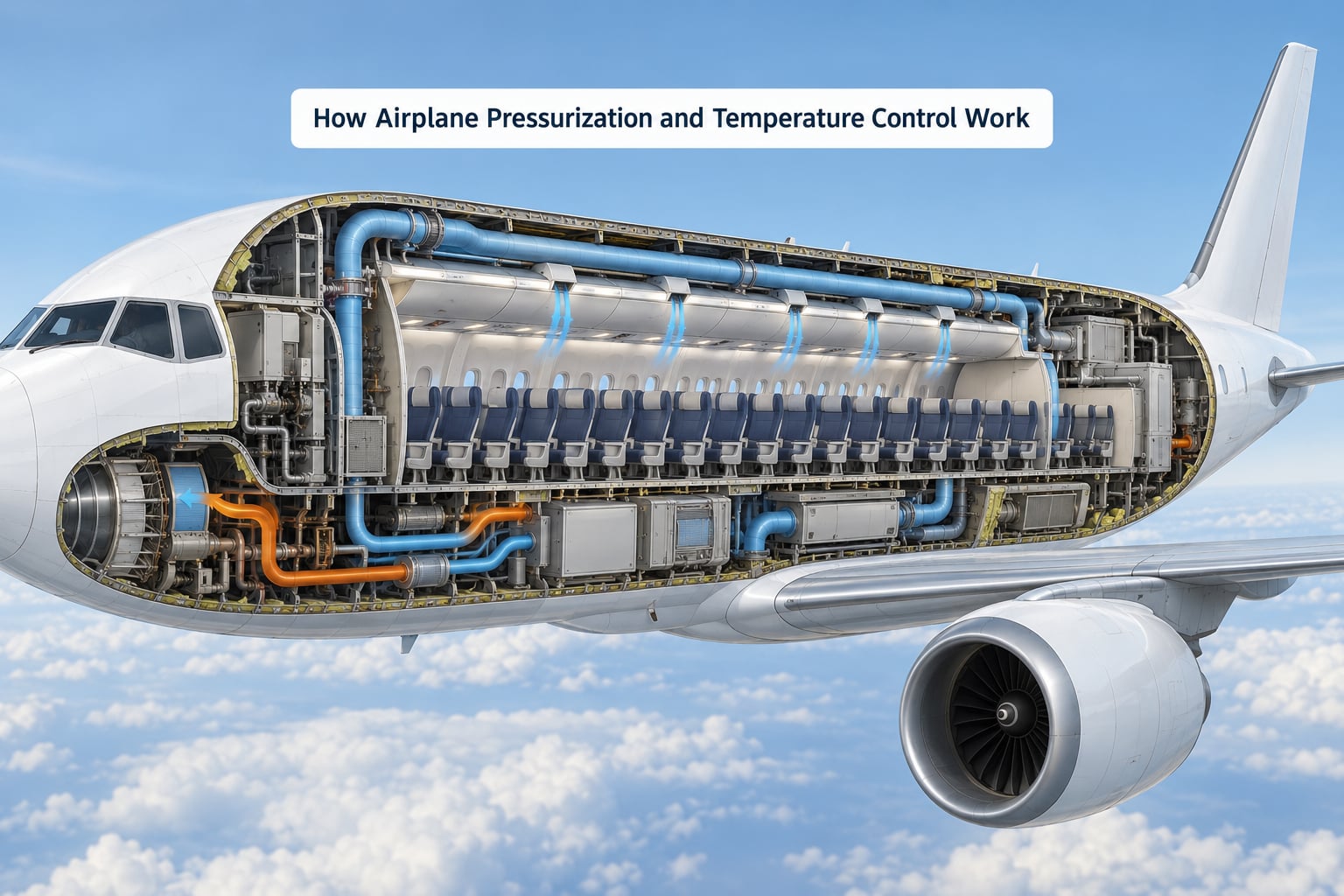
Air at altitude does not work the way it does on the ground. It thins out as you climb, dropping about 3.5 degrees Fahrenheit for every 1,000 feet gained. At cruise the outside air would be lethal to breathe, which is why the cabin is a sealed, pressurized space with its own supply of air.
The supply comes from the engines. A jet engine produces enormous amounts of compressed air as a side effect of making thrust, and the aircraft taps that hot, pressurized stream and sends it to the cabin. Engineers call it bleed air. It is mixed with cold outside air, run through a heat exchanger to bring it to a usable temperature, and pushed into the cabin by a pack flow controller, which sets how much air moves through the ducts.
Most of that cabin air is then recirculated rather than replaced, because constantly heating fresh air from minus 60 degrees Fahrenheit would be absurdly wasteful. Fresh air is added at a controlled rate and the rest is filtered and reused.
That fresh outside air is the part passengers notice. It is added cold and mixed with warm recirculated air, and the resulting stream arrives at your seat through the perforated outlets above the overhead bins. Floor-level outlets underneath the seats supply warmer air. So the cabin has at least two air streams at different temperatures at the same time, which is part of why the same flight can feel freezing in one row and fine in the next.
| Cabin condition | Typical value |
|---|---|
| Aircraft cruising altitude | 35,000 to 40,000 ft |
| Outside air temperature at cruise | Minus 40 to minus 70 F |
| Cabin altitude (what your body experiences) | 6,000 to 8,000 ft |
| Cabin temperature set point | About 64 to 72 F |
| Cabin relative humidity | Roughly 10 to 20 percent |
The Main Reasons Airplanes Are Kept So Cold
Six things drive the decision, and only one of them is really about your comfort.
1. Outside air has to come in. Pressurization requires fresh air drawn in from outside, and at cruise that air arrives extremely cold. Heating it is necessary, but the mix is deliberately set on the cool side.
2. Cabin altitude reduces available oxygen. Pressurization does not give you sea-level conditions. The cabin sits at the equivalent of roughly 6,000 to 8,000 feet, so the partial pressure of oxygen is lower than at ground level. Cooler air keeps many people feeling more alert and less vasodilated and flushed, which matters when a little dizziness can turn into a faint.
3. Warm cabins make turbulence worse. People who feel warm and slightly overconfident handle bumps poorly. A cooler cabin tempers enthusiasm, which is why turbulence complaints tend to cluster on flights where the cabin was running warm.
4. Humidity is the real enemy of a comfortable cabin. Sealing a cabin and filling it with people raises humidity fast, and a humid cabin is miserable to sit in and hard to cool. Running colder and drier is the simplest way to hold humidity down.
5. Cold air slows airborne transmission. Lower humidity and cooler temperatures make it harder for many respiratory viruses to survive and spread, which is a genuine public-health argument for not running a warm, humid cabin.
6. Your body heat is part of the load. A full cabin generates a surprising amount of heat, plus every seatback screen, galley oven and lighting system adds more. Keeping the set point down keeps the total cooling demand manageable across a fleet.
Why Airplanes Are Kept So Cold: Humidity and Air Quality
Ground-level humidity outdoors runs somewhere around 30 to 70 percent depending on the climate. Inside a pressurized cabin it commonly drops to 10 or 20 percent, which is drier than most desert air. That is a direct consequence of feeding cold, dry outside air into a sealed space.
Dry air explains the specific complaints: a dry nose, a sore throat, cracked lips and tired eyes after a long flight. Dry air also makes a given temperature feel colder than the thermometer suggests, because moisture on your skin evaporates faster and pulls heat away from you.
Humidity that is too high is a different problem. Condensation forms on cold surfaces first, and in an aircraft that means windows, wall panels, overhead bins and floor plates. Standing water between the floor plates and ceiling panels is a corrosion, wiring and microbial-growth risk, so crews are trained to report condensation early. Keeping the cabin cooler is part of how airlines stay ahead of it.
Does a Cold Cabin Help Save Fuel
Some, though the effect is smaller than most passengers assume. The bigger lever is the pressurization system itself, not the last few degrees of the set point. A colder cabin means less energy spent removing heat, and cooling packs do consume aircraft power, but aircraft have large residual power margins anyway.
Where fuel matters more is the air you are breathing in versus the air the aircraft is carrying as weight. A cabin that is not over-conditioned means a lighter environmental control workload, and anything the aircraft does not have to do is fuel it does not burn.
| Flight phase | Cabin altitude | Cabin temperature |
|---|---|---|
| On the ground, doors open | Ground level, unpressurized | Often cool, from ground air conditioning |
| Takeoff and initial climb | Rising quickly | Cool, often felt as coldest |
| Cruise | 6,000 to 8,000 ft | Held at set point, typically 64 to 72 F |
| Descent and landing | Falling back toward ground level | Often warms slightly as the aircraft descends |
That last row surprises people who expect the cold to build all flight. It usually peaks during climb, when the aircraft is working hardest and the cabin set point has not yet fully settled.
None of this means every airline runs the same set point on the same route. Aircraft type, load, airline policy and even the crew’s judgment all shift it a little. Frequent flyers comparing carriers on identical routes do notice real differences between them.
Why Some Flights Feel Colder Than Others
When two people on the same aircraft disagree about the temperature, the cabin is usually right and the conversation is subjective. Still, some differences are real and physical.
| Seat location | What you tend to notice |
|---|---|
| Under an overhead vent | Direct stream of cool air on your head and shoulders |
| Window row | Wall surface stays cold, and the glass radiates chill in winter |
| Aisle row | More movement and warmer air from the aisle |
| Front rows near the galley | Strong air movement from crew and service traffic |
| Rear cabin | Usually the warmest, since less of the cool supply stream reaches it |
| Floor level beneath the seat | Warmer air enters low, warming legs and feet |
Aircraft design matters too. Newer models tend to have better insulation, larger window panes with insulating layers and more even air distribution. Older narrow-body aircraft with single-layer windows leak cabin heat to the outside continuously, so the system has to keep working harder to hold the set point.
Flight length changes the experience more than people expect. On a short hop the aircraft may sit on the ground with the auxiliary power unit running and ground air conditioning cooling the cabin before boarding and after landing. That ground time is genuinely cold, and it is why short regional flights draw so many complaints.
Personal factors are real too. Women generally report feeling colder at the same temperature, and older passengers and anyone with reduced circulation often notice the chill sooner. Add fatigue, and a temperature that was mildly cool at the start of the flight becomes genuinely uncomfortable by hour eight.
Nobody is exaggerating when they say the air feels thinner and colder. Passengers do report breathlessness and dizziness traced to the overhead vent blast, and the crew will always bring a warm drink or a blanket if someone asks.
What Passengers Can Do to Stay Comfortable
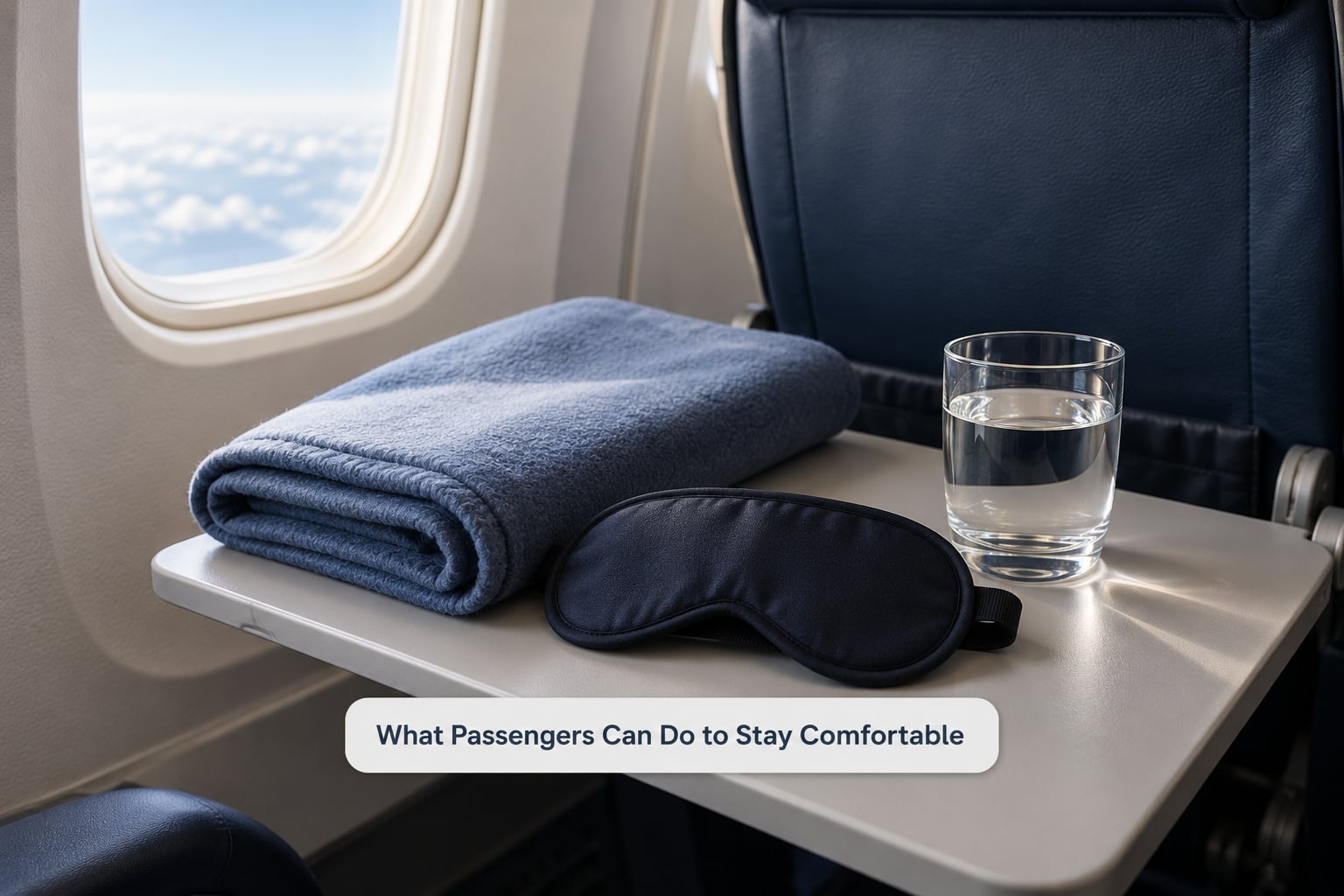
Since the set point is not yours to change, you change how the air reaches you instead.
Dress in layers, not one heavy piece. A sweater over a long-sleeve shirt that you can peel off beats a single thick top. Layering also survives the temperature swings between a cold climb and a warm descent.
Bring your own blanket. The blankets many airlines hand out are thin and are handed out later than people expect. A compact fleece or travel blanket in your carry-on solves the problem permanently, and it is the single most repeated fix in traveler forums.
Manage the vent instead of ignoring it. The overhead dial above your seat is yours. Pointing it away from your head while leaving it open for the people behind you is the polite version, and turning it down entirely is the version that will make the row behind you cross the aisle to complain.
Ask for a blanket early. Crew would rather hand one out at boarding than after someone has already been shivering for two hours. Cabin crew genuinely cannot change the set point, but blankets are within their control.
Stay hydrated and skip the alcohol. Dry cabin air plus alcohol is a poor combination. Water and a warm drink do more for how you feel than any clothing change.
Wear socks. Floor-level outlets push warm air upward, and cold feet ruin a flight faster than a cold face does.
Air-activated hand warmers are permitted in carry-on baggage and are a reasonable addition for winter routes or anyone who feels the cold severely.
Worth knowing: a few carriers still offer blankets on request, and business or first class usually has them waiting for you. That difference is part of why the same route can feel like two different aircraft.
Frequently Asked Questions
Are airplane cabins always kept colder than normal rooms?
Most cabins are held around 64 to 72 F, which is cooler than many people keep their homes. It can feel colder than the reading because the air is very dry and blows directly from overhead vents. Short flights on the ground before boarding can be the coldest part of the whole trip.
Why does an airplane feel especially cold near a window?
The window area loses heat continuously through the glazing, and the cold glass surface pulls warmth from your shoulder and arm. A single-pane window on an older aircraft loses far more than an insulated one on a newer jet. Choose a seat further in if the wall-side cold bothers you, or bring a layer that covers your shoulders.
Can passengers change the cabin temperature during a flight?
No. The temperature set point is selected by the pilots in the flight deck, not by the cabin crew, and it is usually only adjustable within a limited range to keep the pressurization system working properly. Crew can absolutely bring blankets, adjust the individual vent above your seat and check on you if you feel unwell.
Is low cabin humidity safe for children and older travelers?
Yes, low humidity is not dangerous, though it is uncomfortable. Children with asthma and older passengers with respiratory conditions may notice irritation more, and drinking water and avoiding alcohol helps. Anyone with a serious heart or lung condition should talk to their doctor before flying.
Why do some airplane seats receive more ventilation than others?
Cabins have cool air entering from overhead outlets and warmer air entering at floor level, and the flow is not perfectly even. Seats directly under an outlet get a stronger stream, while seats toward the rear often get less of it. Galley areas add extra air movement, so front rows can feel draftier than middle rows.
Does wearing warm clothes make a cold airplane flight safer?
It is not a safety requirement, but it is sensible. Staying warm helps you stay comfortable and relaxed, and comfort makes turbulence and motion sickness easier to manage. Loose layers and socks also let you adjust quickly when the cabin warms on descent.
What to Do First
The cold is a consequence of pressurization, not a decision made to annoy you. Outside air at 35,000 feet is around minus 60 degrees Fahrenheit, it has to come into the cabin to keep the pressure survivable, and the pilots choose a cool set point on top of that for comfort at reduced cabin altitude.
So pack a light layer you can add or remove, bring your own blanket rather than waiting for one, and turn the vent above your seat away from your head. That is the whole fix, and it is updated for 2026.