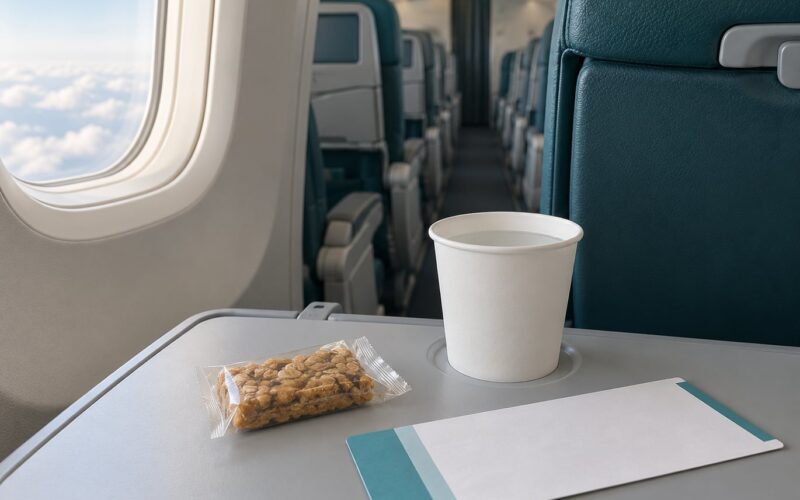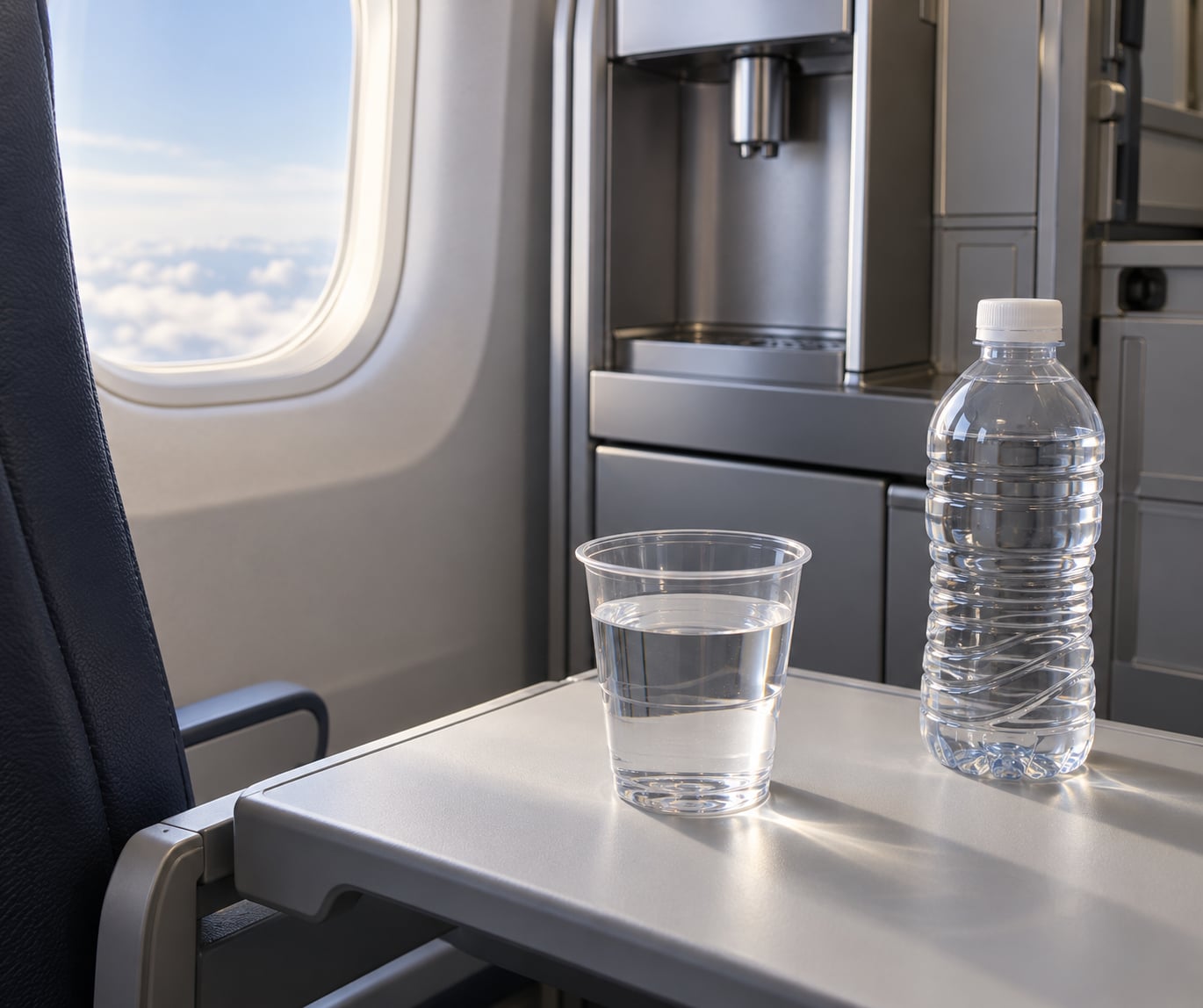
Is airplane tap water safe to drink? Usually yes for most healthy adults, and the CDC has never reported a waterborne illness outbreak traced to airline water. But that water is loaded at the gate, the testing record varies a lot by carrier, and a minority of airlines scored poorly in a recent review of federal data.
So the honest answer is closer to “it depends on the flight than you’re told, and it depends on your stomach than most articles admit.” Here’s what the regulators, the studies and the people who actually fly say.
- The short verdict: potable, regulated water that is not guaranteed sterile on every flight. Most travelers can drink it without worry.
- Where the risk sits: not usually the tank itself, but the ground service vehicle that fills it at the gate.
- What the CDC says: no reported waterborne illness outbreaks from aircraft drinking water.
- What the data shows: a 2026 review of 35,674 sample points graded carriers from A to F, and the spread is wide.
- Who should skip it: pregnant travelers, immunocompromised passengers, anyone preparing infant formula, and people with a sensitive gut.
Table of Contents
- Why Airplane Water Is Restricted
- Is airplane tap water safe to drink on every flight?
- Where the contamination actually comes from
- What Health Authorities Say About Airplane Tap Water
- What the airline scores show
- Is It Safe If the Water Looks Clear?
- When You Should Choose Bottled or Boiled Water
- If you already drank it
- Safer Alternatives During the Flight
- The use-by-use verdict
- Frequently Asked Questions
- Can you brush your teeth with airplane bathroom water?
- Is airplane water drinkable?
- What is worse, E. coli or coliform?
- Is it safe to drink water with coliform?
- Can we carry drinking water in flight?
- How often are aircraft water tanks cleaned?
- The Safest Choice for Most Travelers
Why Airplane Water Is Restricted
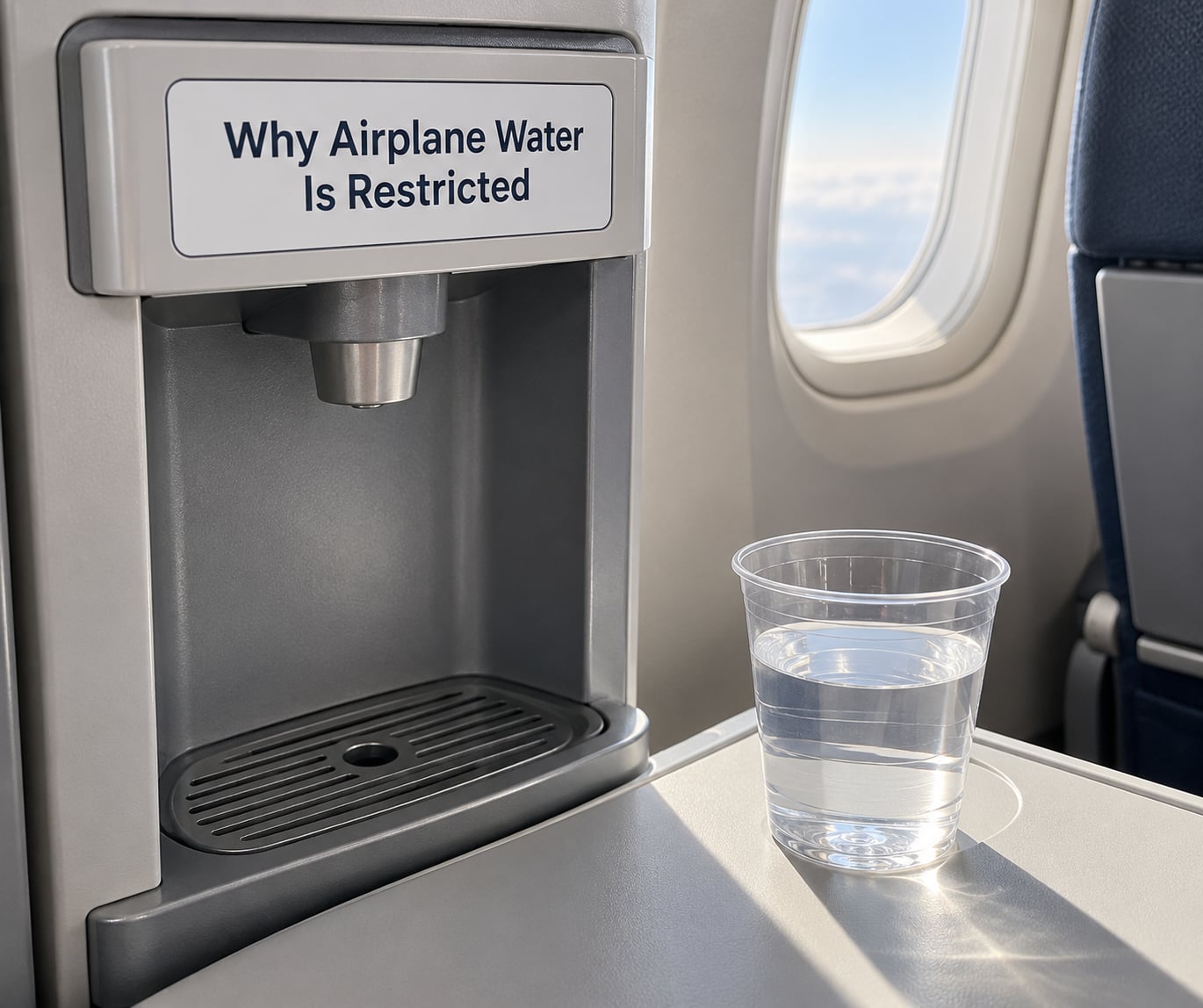
The reason isn’t mystery poison. It’s plumbing physics and paperwork.
Is airplane tap water safe to drink on every flight?
Aircraft tap water is ordinary potable water held in tanks under the cabin floor, loaded by a tanker truck at the gate and stored between flights. It must meet the same safety standards as tap water in a city. Some airlines restrict it because testing compliance is uneven, and because the same water feeds the galley tap, the coffee urn and the bathroom sink, so one decision covers most onboard water exposure.
The EPA’s 2011 Aircraft Drinking Water Rule treats aircraft water as a special case. The tank is small, sits in a warm environment, and gets touched by ground crews on every turn, so routine rules designed for municipal systems don’t fit it neatly. Instead of continuous monitoring, the rule leans on scheduled disinfection and a sampling plan.
Where the contamination actually comes from
A 2015 peer-reviewed study pointed at the handoff point rather than the aircraft. Water service vehicles, the bowser trucks that top up tanks at the gate, carry their own bacterial load. In testing, the bacterial count in water taken from those vehicles was roughly 200 times higher than at the aircraft’s own outlet.
That reframes the whole question. When a flight serves unappealing water, the more likely explanation is a rushed ground crew or a hose left sitting on the apron overnight, not an airline with a filthy fleet.
On top of that, the water sits in a tank at low pressure in a pressurized fuselage for hours. Stagnation lets any organisms already present multiply quietly, which is why a flush before drinking is cheap insurance.
What Health Authorities Say About Airplane Tap Water
Two separate things get confused here: the standard for the water, and the evidence that anyone has actually been made ill by it.
The CDC has historically reported no waterborne illness outbreaks linked to aircraft drinking water. That is genuinely reassuring, and it is also a statement about documented outbreaks rather than about every stomachache that happens in a week when someone ate undercooked hotel chicken. Gastroenterologists quoted in health coverage have pushed back on the scarier framing, noting that onboard water is rarely the most likely explanation for travel-related gut upset.
The WHO publishes a Guide to Hygiene and Sanitation in Aviation that covers potable water supply, storage and the siting of drinking water points in aircraft. Its guidance is written for water systems with known supply chains. Aircraft washrooms are deliberately not treated as drinking water points, which is why the fixtures there are tiny and the galley tap is the one meant for drinking.
The EPA requires carriers to disinfect and flush aircraft potable water systems at least four times a year. The alternative path is once a year, plus monthly E. coli testing. A positive total coliform result triggers retesting. A positive E. coli sample is more serious: it counts as a Maximum Contaminant Level violation, and the airline must shut off public access to that water within 24 hours and disinfect the system.
Four times a year works out to roughly every three months, which is a low bar for a system that gets handled constantly. That gap between the rule and the risk is the honest core of the debate.
What the airline scores show
A 2026 study from the Center for Food as Medicine and Longevity, led by Charles Platkin, PhD, reviewed 35,674 sample locations from October 2022 through September 2025 and built a Water Safety Score from zero to five, graded A through F. A score of 3.5 or higher counted as safe water.
| Airline | Water Safety Score | Grade |
|---|---|---|
| Delta | 5.00 | A |
| Frontier | 4.80 | A |
| Alaska | 3.85 | B |
| GoJet | 3.85 | B |
| American | 1.75 | D |
| Mesa | 1.35 | F |
The score weighs violations per aircraft, E. coli Maximum Contaminant Level violations, indicator-positive sample rates, public notices and disinfection frequency. The spread between an A and an F on the same day, in the same country, under the same federal rule, is the most useful thing in the dataset.
Two caveats matter. It is a nonprofit analysis of US regulatory filings, not a government audit, and the sample skews toward carriers with the most aircraft. Outside the US, the regulator and the sampling plan differ: India follows public health rules that predate the EPA framework, and European carriers operate under aligned European rules rather than this one. Read the grade as a US-specific signal, not a global ranking.
Is It Safe If the Water Looks Clear?
No. Clarity is a physical property, not a health certificate. Plenty of things you would rather not swallow are perfectly transparent, and cloudiness can just as easily be mineral or filter sediment.
Taste and smell are equally unreliable. A plastic or metallic note usually points to the tank and the seals rather than to bacteria, and a perfectly clean cup of water can carry a coliform count that would fail a municipal test. You cannot see or taste total coliform, and neither can a flight attendant.
Two terms do the real work here, and they are not the same thing.
- Total coliform is a broad indicator group. Finding it means something got in, usually from the environment or from a surface. It is a warning sign, not a diagnosis of illness.
- E. coli is the specific organism tied to fecal contamination, and a positive sample is treated as a Maximum Contaminant Level violation. This is the finding that forces a 24-hour shutoff.
In practice, coliform positives are far more common than E. coli positives. One widely cited analysis found roughly 2.66 percent of samples coliform-positive. That is the number that makes people uneasy, and it is also the number that should be read alongside the E. coli rate, which is much lower.
Taste is no guide either. If the water tastes fine and you have no reason to worry about your health, drinking it is a reasonable choice. If you are making water for a six-month-old, appearance is irrelevant.
When You Should Choose Bottled or Boiled Water
Some passengers have less room for error, and no test result overrides that. I’m not a clinician and this isn’t medical advice; if you have a specific condition, ask your doctor what is right for you.
- Pregnant travelers. A common precaution is to skip raw and untreated water sources entirely until you are back home.
- Immunocompromised passengers. Anyone on immunosuppressants, with an autoimmune condition, or receiving chemotherapy should treat untreated water as a real exposure and ask their care team in advance.
- Infants and formula. Prepared formula is the one thing where there is no sensible compromise. Use sealed water, and skip onboard water entirely.
- Older travelers. Dehydration and stomach upset hit harder on a long-haul, and the flight is a bad time to find out how your gut responds.
- Sensitive stomachs and IBS. If a bad stomach day would derail your trip, the inconvenience of a sealed bottle is cheaper than the gamble.
On short flights the exposure is small and the stakes are small. On a twelve-hour route with a connection, you are drinking the same tank water for half a day and your body is already under stress from disrupted sleep and time zones.
If you already drank it
This is the question people actually search for, and the answer is usually reassuring. A single glass of potable water from an aircraft is very unlikely to make a healthy adult seriously ill, and no outbreak has ever been attributed to it. The realistic downside is a mildly unsettled stomach within a day or two, not anything dramatic.
Seek medical care if you develop persistent vomiting, signs of dehydration, bloody stool, or a fever that lasts more than a day, and get advice sooner if you fall into one of the higher-risk groups above. For everyone else: drink water, keep drinking it, and don’t spiral about a cup of coffee.
Safer Alternatives During the Flight
None of this requires spending much or planning a lot. It mostly comes down to knowing which tap does what.
The use-by-use verdict
| Use | Verdict | Why |
|---|---|---|
| Sealed bottled water | Yes | Never left the sealed container |
| Hot tea or coffee from the galley urn | Generally fine | Heating kills most vegetative bacteria |
| Galley cup water after a short flush | Caution | Same tank, no treatment at the tap |
| Ice cubes in your drink | Caution | Often made from the same tank water |
| Brushing teeth with lavatory water | Caution | Splashing ingestion is avoidable |
| Washing hands at the lavatory tap | Yes | Soap and the sink handle do the work |
| Drinking straight from the lavatory tap | No | Not a drinking water point by design |
The galley tap and the lavatory tap are fed by the same tank on most aircraft, which is the part that surprises people. The difference is intent: the galley tap is the drinking water point, the lavatory tap is a handwashing fixture with a spray head built to discourage mouth contact.
That is also why some newer aircraft no longer carry a “not drinking water” placard in the bathroom. Forum threads on Reddit and Travel StackExchange have a lot of theories about what that sign change means. The simpler reading is that signage shifted while the underlying water source and the EPA rule did not. A missing sign is not a safety certificate.
On hot drinks, the honest version of the debate: galley urns do get hot enough to kill most vegetative bacteria, which is why tea and coffee are usually the lower-risk choice. What the urns do not do is boil the water first, so it is not equivalent to water you’ve boiled yourself at home. It’s a meaningful improvement over cold tank water, not a guarantee.
A few small habits do most of the work. Carry an empty bottle through the checkpoint and fill it at a fountain past security, where the supply is municipal rather than tank water. Let the galley tap run for about thirty seconds before filling anything, which flushes stagnant water sitting in the line. And keep drinking water ahead of coffee and alcohol, because cabin dryness and caffeine make dehydration the more reliable way to ruin a flight.
On a carrier where cup water is the only free option, that tap water is not dangerous. It is just the least controlled thing you consume all day, and on a long-haul that includes a stop in a country where the local water would never pass for drinkable.
Worth saying plainly: the in-flight environment is where most of the risk lives anyway. Close quarters, recirculated air, shared surfaces and disrupted sleep are far more likely to be behind a rough day than a cup of potable water from a regulated supply chain.
Frequently Asked Questions
Can you brush your teeth with airplane bathroom water?
Most travelers do it without any problem, because the tap is fed by the same regulated potable system as the galley. It is not a designated drinking water point, though, and the spray head is built to discourage mouth contact. If you want to be careful, bring a sealed bottle to the sink, or use water you have boiled. Avoid it entirely if you are brushing with a baby or toddler, since swallowing is far more likely.
Is airplane water drinkable?
For most healthy adults, yes. Aircraft tap water is potable water held in a tank under the cabin floor, loaded at the gate and required to meet federal standards under the EPA’s Aircraft Drinking Water Rule. The CDC has never reported a waterborne illness outbreak traced to it. The caveat is that compliance is tested periodically rather than continuously, and records vary by airline, so a sealed bottle is a reasonable choice if you prefer one.
What is worse, E. coli or coliform?
E. coli is the more serious of the two. Total coliform is a broad indicator group that signals something entered the water, usually from the environment, and it triggers retesting rather than an automatic shutdown. E. coli is tied to fecal contamination and counts as a Maximum Contaminant Level violation, which requires the airline to shut off public access within 24 hours and disinfect the system. Coliform positives are also far more common.
Is it safe to drink water with coliform?
It depends on whether E. coli is present too. A total coliform positive alone is a warning that the system needs retesting, not proof that anyone will get sick, and coliform shows up in a few percent of samples. An E. coli positive is a different matter and triggers an immediate requirement to stop serving the water. If you are healthy, one glass is very unlikely to cause illness. Pregnant, immunocompromised and elderly passengers should skip it.
Can we carry drinking water in flight?
You can carry a full bottle through the checkpoint in most countries, but you will usually be asked to empty it at security, and in the US the limit is 3.4 ounces or less. The simple workaround is an empty reusable bottle, which passes through fine. Fill it at a water fountain after security, where the supply comes from the airport’s municipal system rather than from an aircraft tank.
How often are aircraft water tanks cleaned?
Under the EPA’s Aircraft Drinking Water Rule, carriers must disinfect and flush the potable water system at least four times a year, roughly every three months. The alternative is one disinfection a year plus monthly E. coli testing. A positive total coliform result triggers retesting, and a positive E. coli sample requires shutting off public access within 24 hours. The key thing to check before drinking: flush the tap for about thirty seconds first.
Last reviewed for 2026. This guide covers general public-health information from the EPA, CDC and WHO, and findings published in the aviation and public-health literature. It is not medical advice. For guidance about your own health, talk to your doctor or pharmacist.
The Safest Choice for Most Travelers
If you are a healthy adult on a short or medium flight, drink the water when it is offered and you feel like it. It is regulated, tested, and has never been linked to an outbreak.
Start with the tank, not the brand. If you are flying pregnant, immunocompromised, feeding a baby, or simply know a stomach upset would wreck your day, carry an empty bottle and fill it after security. It takes ten seconds and removes the question entirely.
And whatever you do, keep drinking water on the flight. Cabin dryness, coffee and alcohol will cost you more than the tap ever will.