Airplane cabins are dry because the outside air drawn in at cruise altitude carries almost no moisture, and the aircraft’s environmental control system heats and chills that air before it ever reaches your seat. The result is a cabin sitting at roughly 10-20% relative humidity — desert-like, and well below the comfort floor in ASHRAE Standard 55. Updated for 2026, here is what actually causes it and what you can do about it.
Table of Contents
- Why Airplane Cabins Are So Dry
- How Cabin Altitude and Ventilation Make the Air Dryer
- Cabin altitude is not the same as flight altitude
- How Dry Is an Airplane Cabin?
- Humidity varies by aircraft type and cabin class
- What Does Dry Cabin Air Do to Your Body?
- Skin
- Nose and sinuses
- Eyes and contact lenses
- Mouth and throat
- Smell, taste and immunity
- How to Stay Comfortable on a Dry Flight
- Does Hydration Alone Prevent Dry Cabin Discomfort?
- When Dry Air Symptoms Need Attention
- Frequently Asked Questions
- How dry are airplane cabins compared with the ground?
- Do airplane cabins have enough humidity to prevent dry skin?
- Can low cabin humidity cause a headache or stuffy nose?
- Should I use a humidifier or saline spray during a flight?
- What is the humidity inside a Boeing 787 cabin?
- What should I do if I feel unwell from airplane cabin air?
- Conclusion
Why Airplane Cabins Are So Dry
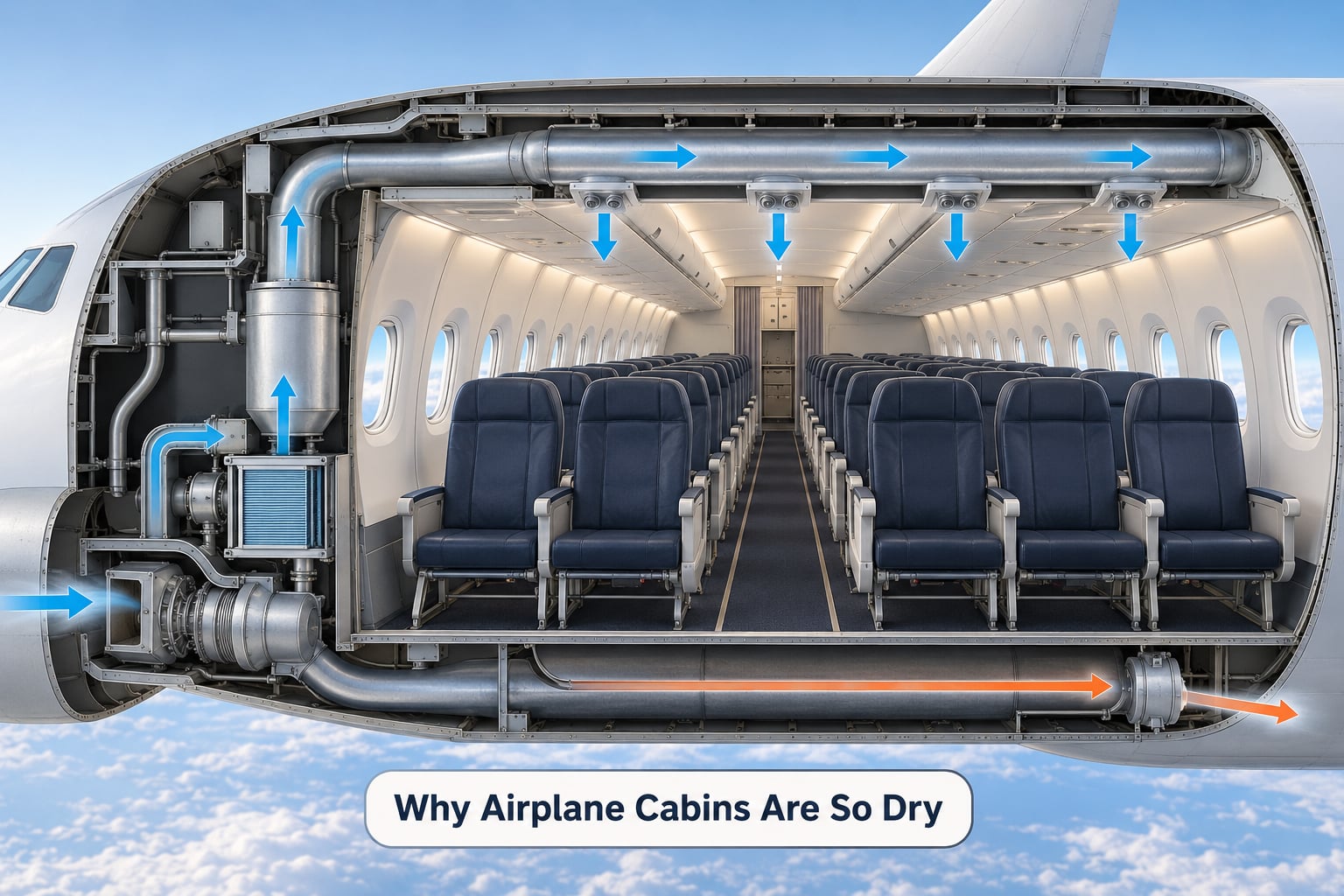
Airplane cabins are so dry because they are supplied with outside air that has been compressed, heated to very high temperatures and then chilled again, and every one of those steps removes moisture the air was carrying. A pressurised cabin still has very little water in it.
At 35,000 feet the outside air is thin and contains almost no water vapour at all. Whatever moisture it did hold is squeezed out of it before it reaches the cabin. Four things happen in sequence, and it is the combination that produces the famously parched cabin air.
- Altitude removes the moisture first. Cold high-altitude air holds very little water vapour, so there is simply not much to begin with.
- Compression and heating strip more of it. Air bled from the engines is compressed and spun through hot turbines, and hot air holds less relative moisture than cool air.
- The air-cycle machine chills it without adding water back. The cooling stage pulls moisture out as condensation, which drains away instead of entering the cabin.
- Most of the cabin air is reused. Roughly half the supply is recirculated cabin air rather than fresh outside air, so the small amount of moisture passengers generate is the main humidity source.
That last point is worth pausing on. Passengers breathe out water continuously, so the cabin is not sealed against moisture forever — it is simply that the air being supplied is so much drier than the air being exhaled that it never builds up.
How Cabin Altitude and Ventilation Make the Air Dryer
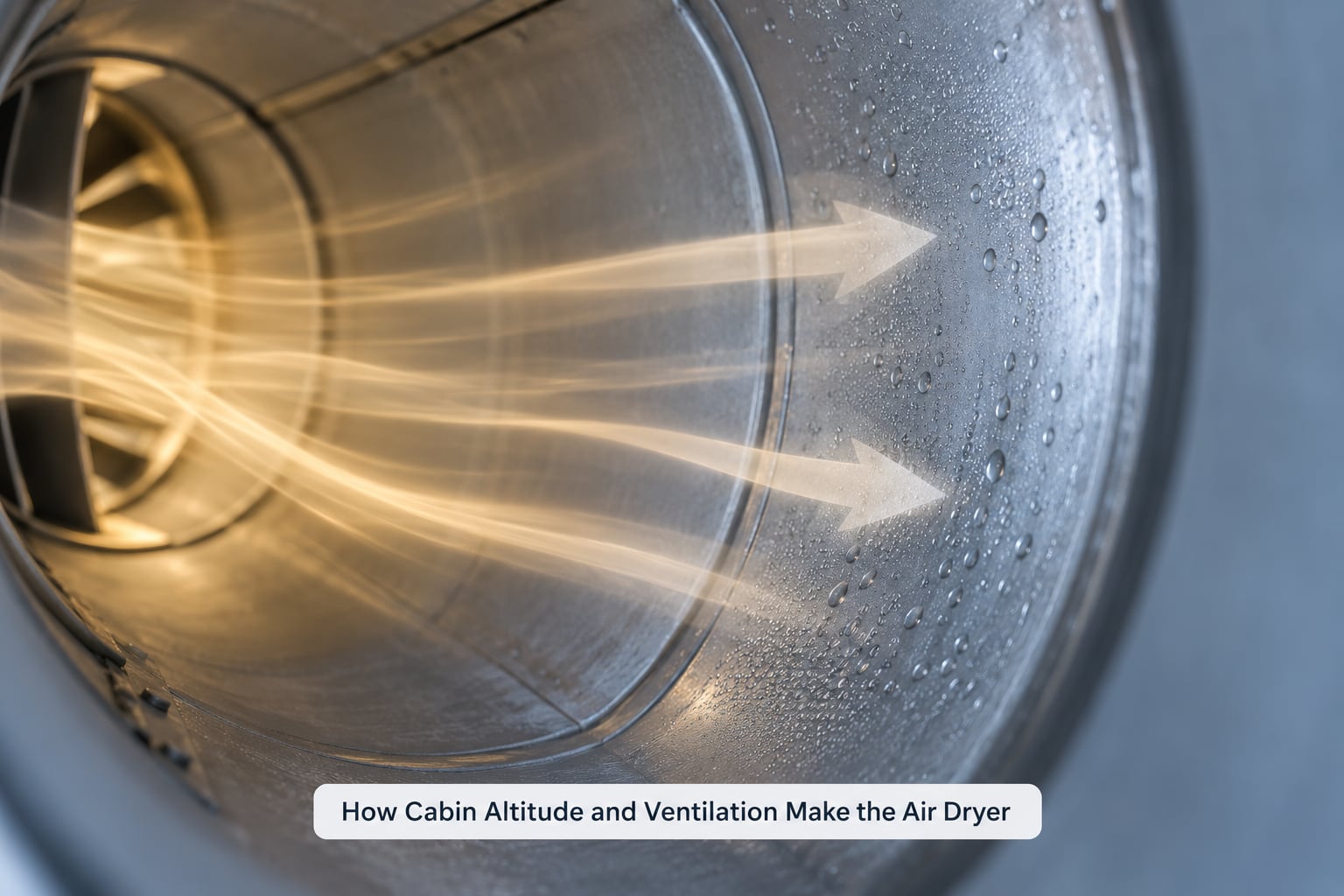
Pressurisation keeps the cabin safe, but it does not make the air humid, and the ventilation design makes the dryness worse rather than better.
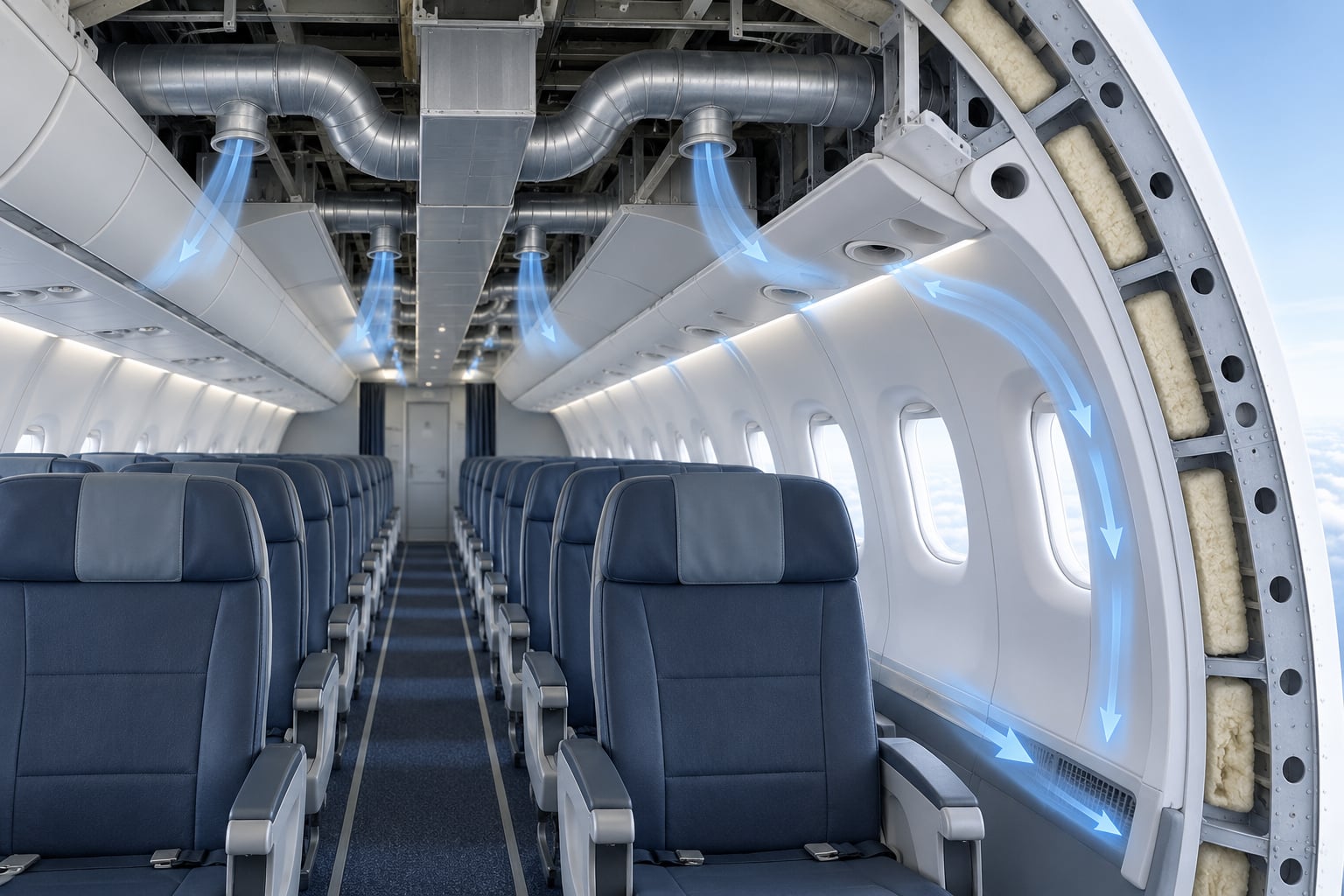
Older aircraft and many turboprops draw their supply from the engines. Bleed air is siphoned off the hot core of the engine, pushed through a turbine that compresses it hard, then routed through a heat exchanger and an air-cycle refrigeration machine. Cold, dry supply air is what finally reaches the cabin ceiling and the sidewall outlets, and the condensation that forms on the way is discarded.
Newer widebodies such as the Boeing 787 and the Airbus A350 use electric compressors and more efficient cycle machines rather than bleed air. That gives a modest humidity gain, but the supply air is still conditioned in much the same way, so the cabin remains well below normal room humidity.
Cabin altitude is not the same as flight altitude
The aircraft cruises at roughly 35,000 feet, while the cabin is held at a pressure equivalent to somewhere around 6,000 to 8,000 feet. That pressurisation protects passengers from hypoxia and is the reason nobody feels the altitude, but the cabin is still a high-altitude environment in pressure terms.
Lower cabin pressure and low humidity are two separate things that happen at the same time. Low pressure dulls your sense of smell and taste by up to around 30%, which is why food can taste flat and why dry mouth feels worse than the actual air would explain. Low humidity does the physical work on your skin and airways.
Cabin conditions also shift during the flight. Humidity tends to be lowest during the climb and around cruise, and can climb during service on certain routes or in older aircraft without modern cycle machines. Boarding and taxi on the ground are often the driest stretch, because the air conditioning is running hard against the hot apron air before takeoff.
How Dry Is an Airplane Cabin?
Aircraft cabins typically run at 10-20% relative humidity at cruise, against a 40-60% band that most people describe as comfortable indoors. Treat these as ranges rather than fixed numbers, since humidity varies with the aircraft type, the route, the weather and where in the cabin you sit.
| Environment | Approximate relative humidity | What it feels like |
|---|---|---|
| Sea-level outdoor air on a normal day | 40-70% | Neutral to damp |
| Comfortable home or office | 40-60% | Comfortable |
| ASHRAE Standard 55 winter comfort floor | about 20-30% | Lower limit of acceptable |
| Dry desert air | about 5-20% | Noticeably dry |
| Airplane cabin at cruise | 10-20% | Dry to the point of discomfort |
Humidity varies by aircraft type and cabin class
The Boeing 787 is the most commonly cited example because it runs wetter than older types, topping out around 15% relative humidity — roughly three times a conventional narrowbody. Even that is drier than desert air and about a third of a comfortable room. Business jets vary widely because cabin altitude requirements and equipment choices differ between models.
| Aircraft type | Typical cabin relative humidity | Notes |
|---|---|---|
| Conventional narrowbody | often below 10-15% | Driest of the mainstream fleet |
| Widebody on older-generation systems | roughly 10-20% | Bleed-air cycle machines |
| Boeing 787 and similar newer types | up to about 15% | More efficient cycle machines |
| Business jet | highly variable | Depends on pressurisation and fit-out |
Cabin class does not change the humidity much on a given aircraft. The air is mixed in the ducts before it reaches any section, so the difference between a window seat in economy and one in business is about airflow strength and noise rather than moisture content.
What Does Dry Cabin Air Do to Your Body?
At 10-20% relative humidity, water leaves your body faster than it is replaced. That mainly shows up in the parts of you that are normally wet: skin, eyes, nose, mouth and airways.
Skin
Dry air pulls water out of the outer layer of skin faster than it can migrate up from below, so skin feels tight and flaky and can start flaking around the nose and mouth. This is the effect commonly called airplane skin. It is uncomfortable rather than dangerous, and it usually clears within a day or two of landing.
Nose and sinuses
The nasal passages are the body’s first line of humidifying and filtering incoming air. When they dry out, the delicate tissue can feel raw or crusted, and small capillaries under the thin skin of the nostrils can crack. That is the source of most in-flight nosebleeds, which are common and usually harmless but alarming.
Eyes and contact lenses
A soft contact lens depends on a fluid layer under it to stay comfortable. Dry cabin air speeds up evaporation from that layer, which is why lens wearers report scratchy, red or gritty eyes partway through a long flight. People who do not wear lenses often notice their eyes watering instead, which is a reflex response to a dry surface.
Mouth and throat
Saliva production falls when you breathe through your mouth, and dry air encourages exactly that. A dry mouth, a scratchy throat and a stale taste after a long flight usually come from the combination of low humidity, low cabin pressure dulling taste, and caffeine or alcohol working on you at the same time.
Smell, taste and immunity
Reduced cabin pressure affects smell and taste as well, which is a separate mechanism from dryness and often gets blamed on the air. Low humidity also dries the mucous membranes that trap and neutralise pathogens, which is one reason researchers have looked at humidity as a factor in respiratory infection risk. Much of that work predates the pandemic framing and concerns ordinary respiratory infections rather than any one disease.
How to Stay Comfortable on a Dry Flight
You cannot change the cabin air, but you can change how much of yourself is exposed to it. Ranked roughly by how much difference each one makes.
- Turn the vent away from your face. A personal vent blowing directly at you is the single biggest local cause of a dry nose and dry eyes. Aim it at your lap or the aisle instead. The air is the same air, just at a different speed.
- Use a saline nasal spray before the cabin air gets to you. A plain sterile saline mist or gel-based nasal barrier keeps the nostrils from cracking and is a widely used remedy among flight attendants.
- Apply moisturiser at the right time. Put a plain, fragrance-free cream or ointment on before boarding and reapply during the flight, after the cabin has already dried your skin. Layering it on at the gate is what makes the difference.
- Drop preservative-free lubricating eye drops if you wear lenses. Take them with you and use them before discomfort starts rather than after your eyes are already gritty.
- Keep water with you and drink at your normal rate. Steady sipping keeps saliva flowing and mouth comfort reasonable, though it will not change the air.
- Limit alcohol, and moderate caffeine. Alcohol dries the mouth and disrupts sleep, and caffeine adds to mild fluid loss. Cutting back makes a long flight feel better without touching the humidity.
- Avoid irritants and fragrance during the flight. Skincare acids, retinoids and heavily fragranced products sting more on tightened, dry skin, and strong scents in a recirculated cabin are harder to tolerate.
Skip the full-size gadget humidifiers and anything you would have to check at the gate. They are awkward to pack, they spill, and the effect of a small personal unit in a cabin moving several air changes an hour is modest compared with the airflow measures above.
Does Hydration Alone Prevent Dry Cabin Discomfort?
No. Water keeps your body hydrated, but it cannot raise cabin humidity or put moisture back into your skin, and drinking more than usual does not fix a cracked nostril or a scratchy contact lens.
Dry air and dehydration are separate problems that people constantly merge. Dry air is a condition of the environment around you. Dehydration is a condition of your body’s fluid balance, and most passengers on a normal flight are not clinically dehydrated in the first place.
Drinking normally still matters. A dry mouth makes you feel thirsty, frequent flyers sip steadily through long flights, and staying on top of fluids is sensible during a red-eye. But if your discomfort is concentrated in your nose, eyes or skin, the useful measures are the ones in the previous section rather than another bottle of water.
When Dry Air Symptoms Need Attention
Most in-flight dryness is ordinary and clears after landing. A few symptoms are not, and they deserve attention rather than a larger water bottle.
Ask a flight attendant immediately if you develop chest pain, trouble breathing, faintness or severe dizziness during a flight. Cabin crew carry medical kits and oxygen and can contact ground medical support. Anyone with a significant heart or lung condition should speak with their clinician before flying rather than waiting to see how they feel at 35,000 feet.
Talk to a doctor after the flight if dry mouth, recurrent nosebleeds, persistent sinus pain, cracked skin or contact lens intolerance keep happening flight after flight. That pattern suggests an underlying issue, or a reaction to a product you are using, rather than cabin air alone.
The general rule I would apply: a symptom that arrives on the plane and disappears the next day is a cabin problem, and one that keeps coming back is worth looking into with someone qualified to examine you.
Frequently Asked Questions
How dry are airplane cabins compared with the ground?
Cabins typically hold 10-20% relative humidity at cruise, against roughly 40-60% in a comfortable home or office and a 40-70% range for ordinary sea-level outdoor air. That puts a cabin below the 20-30% winter comfort floor described in ASHRAE Standard 55, and in the same band as desert air. Figures vary by aircraft, route, weather and where you sit in the cabin.
Do airplane cabins have enough humidity to prevent dry skin?
No. At 10-20% relative humidity, water leaves the outer layer of skin faster than it is replaced, which produces the tight, flaking look people call airplane skin. Newer aircraft such as the Boeing 787 run wetter than older types but still sit far below normal indoor humidity, so no airliner delivers enough moisture to prevent it. Barrier cream applied before boarding is more effective than anything you can do to the cabin air.
Can low cabin humidity cause a headache or stuffy nose?
Low humidity dries the lining of the nose and airways, which can leave nostrils raw, crusted or mildly congested, and that irritation often shows up as a frontal headache. Low cabin pressure dulls smell and taste by up to around 30% at the same time, which adds to the feeling of being unwell. Persistent pain, or pain that does not settle after landing, is worth raising with a clinician rather than treating as cabin dryness.
Should I use a humidifier or saline spray during a flight?
A saline nasal spray or gel-based nasal barrier is the practical pick. It travels within liquid limits, has no spill risk and keeps nostrils from cracking, which is the most common complaint. Personal humidifier devices are bulky, leak, and make a modest difference in a cabin moving several air changes an hour. Lubricating eye drops do more good than a humidifier if you wear contact lenses.
What is the humidity inside a Boeing 787 cabin?
A Boeing 787 typically reaches around 15% relative humidity, close to three times the level in a conventional narrowbody airliner. It uses electric compressors and more efficient cycle machines rather than engine bleed air, so the supply air reaches the cabin wetter. Even so, 15% is drier than desert air and roughly a third of a comfortable indoor room, so symptoms change in degree rather than disappearing.
What should I do if I feel unwell from airplane cabin air?
Tell a flight attendant. Chest pain, breathing difficulty, faintness or severe dizziness need oxygen and cabin crew support straight away, since the crew can respond and contact ground medical services. Less urgent complaints are usually easier to manage: aim the vent away from your face, use saline spray or lubricating eye drops, and sip water steadily. Tell your doctor afterwards if the same symptoms return on every flight.
Conclusion
Airplane cabins are dry for one reason: the air supply is compressed, heated and chilled at altitude, and every stage takes moisture out of it, leaving the cabin at roughly 10-20% relative humidity.
Your first useful step is free — aim the overhead vent away from your face and use a saline spray or a plain barrier cream before the cabin gets to you. Drink at your normal rate, treat dry eyes early if you wear lenses, and ask a flight attendant straight away if you feel genuinely unwell rather than merely uncomfortable.