How to adjust to a time zone after a long flight comes down to moving the cues your body clock uses to tell time: light, food, activity and sleep. Most people need about one day for every hour of time difference, and travel east is harder than travel west. Start the shift before you board if you can.
Jet lag is not the tiredness that comes from spending a night in a narrow seat. It is your circadian rhythm, the roughly 24-hour rhythm that runs your sleep and alertness, still running on home time while the destination has moved on. You feel exhausted when the local evening is young, and wide awake at 3am.
The plan below covers the whole trip: the days before departure, the flight itself, and the first two or three days on the ground.
Table of Contents
- What You Need
- Step-by-Step
- Prepare Your Sleep Schedule Before Departure
- Shift Meals and Hydration to Destination Time
- Use Light to Move Your Body Clock
- Sleep Strategically During the Flight
- Set Your First Day Around Local Time
- Protect the Next Night’s Sleep
- Reassess After Two or Three Days
- Common Mistakes
- Quick Tips for Faster Adjustment
- Frequently Asked Questions
- How long does jet lag last after a long flight?
- Should I sleep during a long flight to my destination?
- Is jet lag worse when traveling east or west?
- What should I do if I cannot sleep after landing?
- Can caffeine make jet lag worse?
- How do I adjust to a new time zone in one day?
- Conclusion: What to Do First
What You Need
You need less than most people pack. Get these sorted and the rest of the plan is just timing.
- Your destination time and your arrival time. Write both down before you fly. Every decision that follows depends on knowing what hour it will be when you touch down.
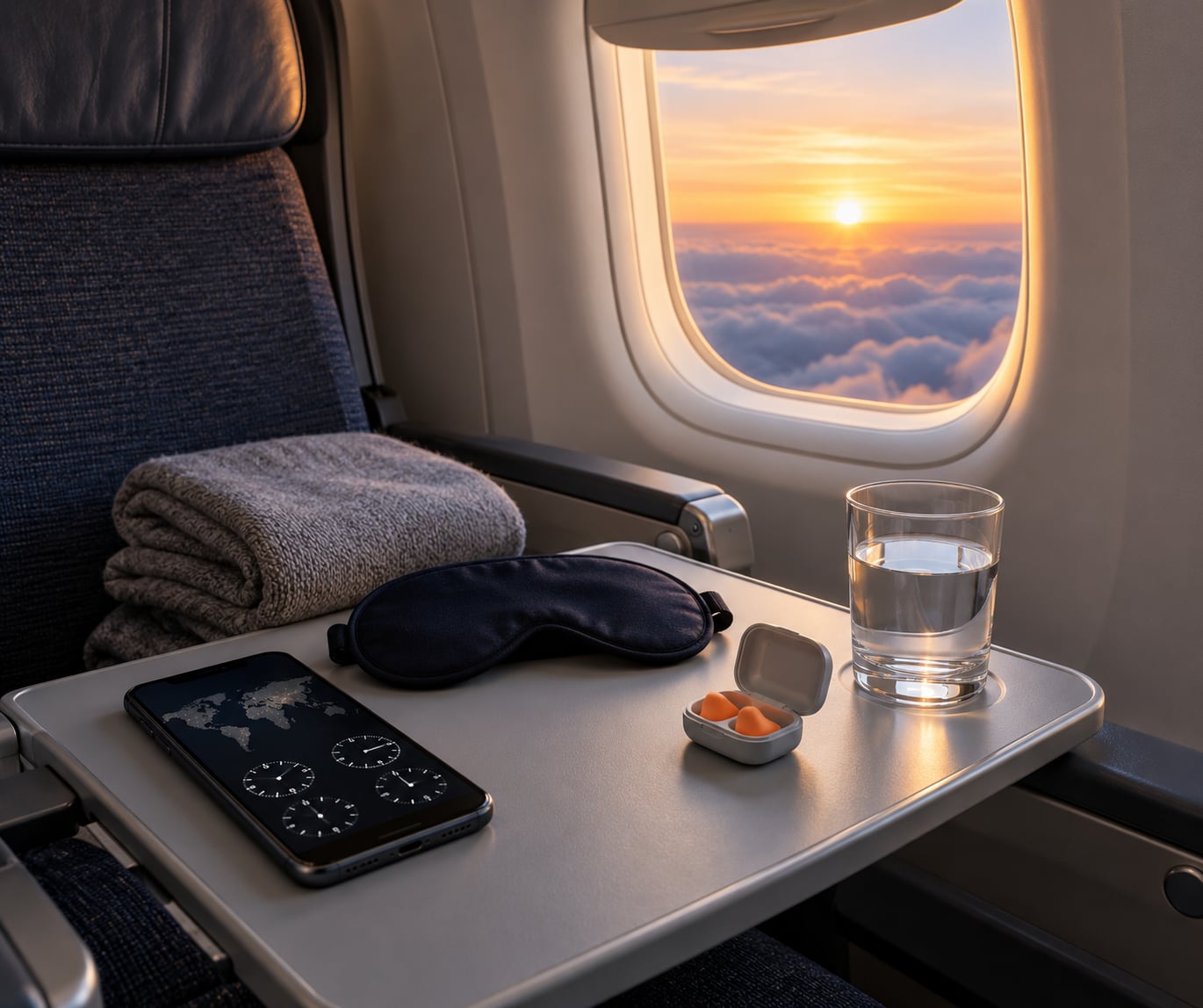
- A phone or watch that shows a second time zone. Most devices already do this in the clock app. Move it to destination time the moment you land, then stop checking home time.
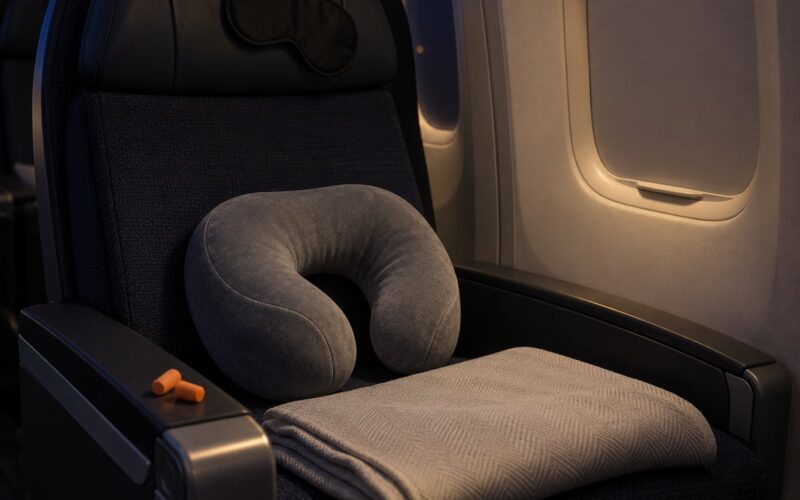
- An eye mask and foam or silicone earplugs. The cheapest way to block cabin light and engine noise during the hours you plan to sleep.
- A refillable bottle. Airplane cabins run dry, and a dry body makes the first night harder.
- One layer that suits the local weather. You will want it for an outdoor walk in local daylight, and being too warm or too cold makes sleep harder.
- A plan for the first evening. A booked dinner, a walk, or a call with someone at home bedtime. Something that keeps you awake without relying on willpower.
On supplements: this plan does not recommend melatonin or any other sleep product. Those calls belong with a doctor or pharmacist, particularly if you take prescription medicines or live with a condition such as epilepsy. Plenty of travelers adjust well without them.
Step-by-Step
Prepare Your Sleep Schedule Before Departure
Begin by moving your bedtime and wake time about an hour a day toward destination time, starting three to five days out. Moving west, go to bed an hour later each night and get up an hour later. Moving east, shift both an hour earlier each day until you reach your new normal.
Keep the shift small and boring rather than dramatic, and skip any version that leaves you wrecked at home the night before the trip. If one night during the shift goes badly, hold the schedule you already set instead of snapping back to your old times.
You will know it is working when you fall asleep within a few minutes of the new bedtime and still wake without an alarm.
Shift Meals and Hydration to Destination Time
Move your meals toward destination time in the days before departure: breakfast at what will be mid-morning where you are going, dinner at what will be early evening there. Travelers who do this usually report an easier first day than those eating on home time right up to boarding.
On the flight, drink water steadily rather than forcing liters down. The aim is to avoid dehydration, not to hit a number, and drinking well past what your body wants does not speed up adjustment.
Skip the heavy nightcap and the six-cup coffee run. Alcohol fragments sleep in the second half of the night, which is exactly the deep sleep you need on arrival, and caffeine has a long tail that can still be working when your destination bedtime arrives.
Use Light to Move Your Body Clock

Light is the strongest signal your body has. Twenty minutes outdoors within an hour of waking does more for adjustment than anything else here, because it tells your clock which hours are day at your destination. When I land somewhere unfamiliar, the first thing I check is the local sunrise and sunset time, so I know what evening actually looks like.
Traveling east, you are trying to move your clock earlier. Seek bright light as early in your local morning as you can, then keep the two or three hours before your destination bedtime dim: overhead lights off, phone brightness down, curtains closed in your room.
Traveling west and the pattern flips. Try to avoid bright light in the early evening until your new bedtime, and let daylight into the morning. Evening light pushes the clock later, which is the direction you already need to go when you fly west.
You will know it is working when tiredness starts arriving near local bedtime instead of at your old hour.
Sleep Strategically During the Flight
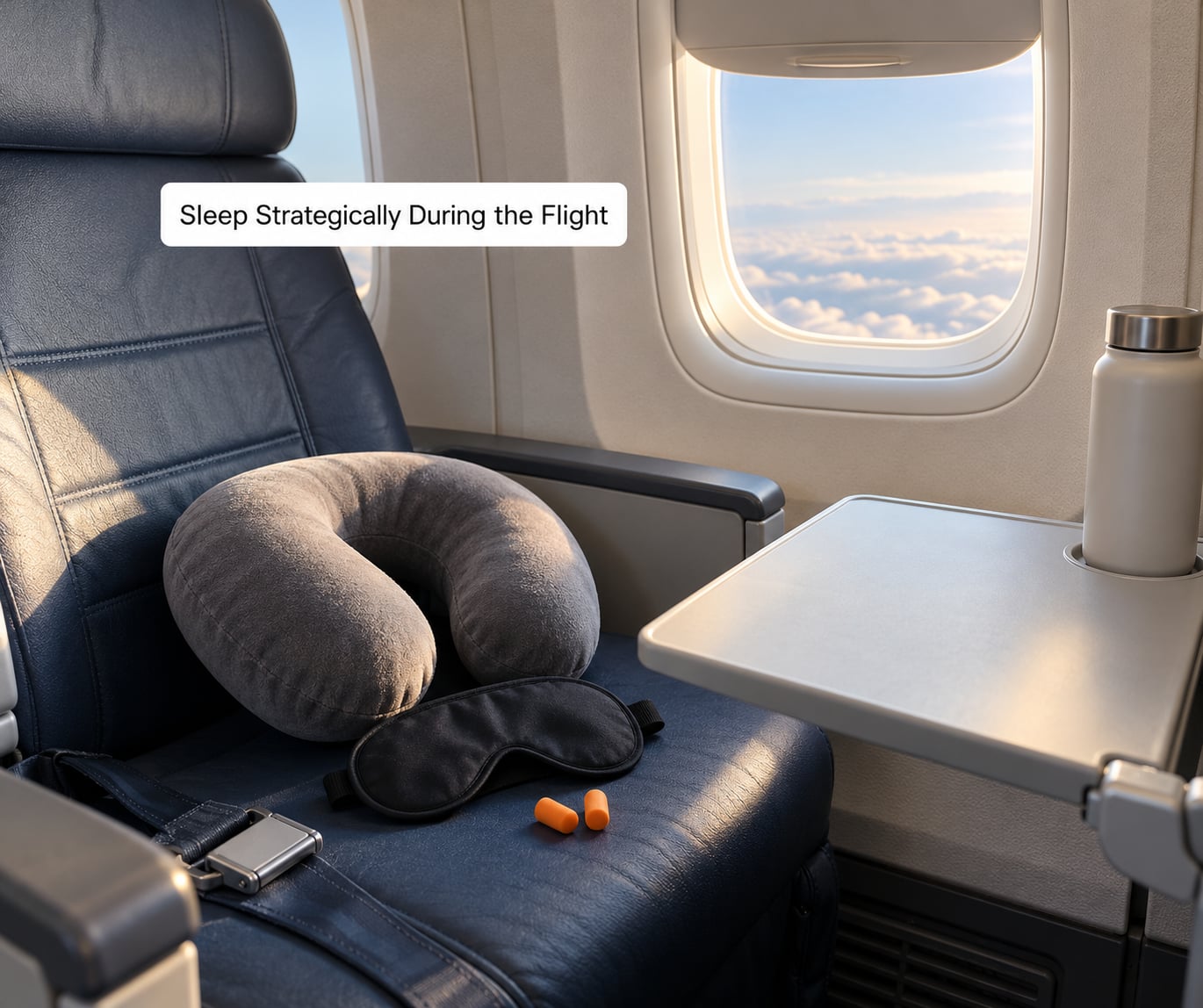
One question decides the whole in-flight plan: what hour will it be when you land?
Land in the morning or the afternoon and stay awake for most of the flight. Sleeping eight hours and then landing exhausted at 6am leaves you awake with nothing to do until your body says it cannot go on.
Land in the evening and protect the hours that match destination night. That usually means one defined sleep block of four to five hours rather than scattered dozing, with the eye mask and earplugs if they are comfortable for you.
If you cannot sleep on planes at all, stop fighting it. Read, walk the aisle when it is safe to do so, drink water, and accept that you will land tired. Plan a quiet first day instead of pretending you will not be.
Set Your First Day Around Local Time
Wake near your destination’s usual morning time and get outside within the hour, even if that is only a walk to breakfast. Keep meals on local meal periods instead of whatever hour your stomach is expecting from home.
The hardest version is landing early with nowhere to be. Eat something light, shower, walk, and stay in good light until your local evening. Do not crawl into bed at four in the afternoon even if you could: sleeping at the wrong body-clock hour is what makes the coming night fall apart.
If you nap, cap it at 20 or 30 minutes and set an alarm. Short naps end before deep sleep starts, so you wake groggy but usable. A two-hour nap does the opposite.
Protect the Next Night’s Sleep
Your first night on the ground is where the reset either holds or breaks. Keep the room dark and cool, use blackout curtains if the room has them and an eye mask if it does not, and stay in dim light through the wind-down.
Set a caffeine cutoff about eight hours before destination bedtime so a mid-afternoon coffee does not follow you to 3am. Do something calm in the final hour, and keep tomorrow’s wake time fixed even after a broken night.
Feeling sleepy at four in the afternoon on arrival day is normal. It is not a sign that the plan failed, and it is not a reason to abandon the evening you planned.
Reassess After Two or Three Days
Most travelers are close to aligned by day three and settled within a week, with eastbound trips taking longer than westbound ones. If you are still off after a few days, keep light, meals and wake time anchored to local time. Your clock keeps moving for as long as you keep exposing it.
Some people carry a stubborn rhythm, including frequent flyers who hop zones every week and older travelers, who often recover more slowly. Children usually bounce back fast. If symptoms are severe, persist beyond a week, or you arrived unwell, talk to a doctor rather than pushing a stricter version of this plan.
Common Mistakes
Staying on home time. Keeping your phone on home time to read the news feels familiar, and it keeps your clock exactly where it was. Change it at the gate.
Sleeping through the whole first day. It feels justified after a red-eye, and it wrecks the next night. Cap the nap and use daylight and caffeine instead.
Using alcohol to force sleep on the plane. You get drowsy, then wake repeatedly in the second half of the flight and land more tired than you boarded.
Chasing sleep too early. Trying to be asleep by 9pm on day one usually fails and trains your bed to feel awake. Stay up until your local bedtime, even when it costs you a long evening.
Changing light exposure at the wrong time. Morning light while traveling east helps; a bright screen at midnight and dim mornings set you back. Check the direction of travel before following any generic advice.
Expecting an exact number of days. One day per hour of time change is a useful average, not a schedule. Age, health and how much you actually slept on the plane all move the number.
Quick Tips for Faster Adjustment
- Take a window seat when a morning departure offers early light, because that light arrives before you do.
- Set every clock you own to destination time as the doors open.
- Book something outdoors for the first morning, even a walk around the block at local breakfast time.
- Keep first-day meals simple, since heavy food at the wrong hour leaves you awake longer.
- Set an alarm for local wake time on your first two mornings, especially after a bad night.
- Move every couple of hours in flight. Walking, stretching and calf circles beat sitting still all the way.
- Build a realistic first day. A meeting-heavy evening at local 9pm undoes a good day of daylight.
- If the trip is one or two nights, consider staying on home time for the whole stop rather than adjusting at all.
Frequently Asked Questions
How long does jet lag last after a long flight?
Most people need about one day for every hour of time difference, so crossing eight zones usually takes close to a week to clear. Eastbound trips take longer than westbound ones. A deliberate light, meal and sleep schedule shortens it, and a trip of one or two nights is often easier to handle by staying on home time the whole way.
Should I sleep during a long flight to my destination?
It depends on the hour you land. Arrive in the morning or afternoon and stay mostly awake, so you are tired at local bedtime. Arrive in the evening and protect the hours that match destination night, usually one sleep block of four to five hours. Short dozes beat a full eight-hour sleep before a morning arrival.
Is jet lag worse when traveling east or west?
Eastbound is harder. Moving your clock earlier means fighting the natural afternoon dip and getting bright light at the wrong hours, so you want morning light and dim evenings. Going west is gentler, because a later bedtime and evening light push your clock in the direction you are already travelling.
What should I do if I cannot sleep after landing?
Stop trying. Get up and sit in dim light with something calm for twenty minutes. If you are still awake after that, a 20 to 30 minute nap before 3pm local is the safer fallback, not a full night of tossing. Keep your wake time fixed and get daylight early the next morning even after a poor night.
Can caffeine make jet lag worse?
It can, mostly because of timing rather than the caffeine itself. Coffee at 4pm local may still have you awake at midnight. Cutting off around eight hours before destination bedtime keeps the useful part without losing the night. Used inside that window, caffeine reliably carries you through the late afternoon.
How do I adjust to a new time zone in one day?
You can get close, but not fully reset. On arrival day: switch every clock, eat on local meal times, get daylight early, keep the evening dim, nap only 20 to 30 minutes, and hold your local bedtime. Doing the first two nights properly matters more than having a perfect first day.
Conclusion: What to Do First
Set your phone to destination time before you board, write down the hour you will land, and decide now whether you will sleep on the plane or stay awake. On the ground, get into daylight within an hour of waking and keep the two hours before local bedtime dim.
That is the plan: light first, meals second, sleep third, and give it two or three days. Travelers who move those three on purpose usually do better than the ones waiting for the tiredness to wear off.