Most people recover from jet lag at roughly one day per time zone crossed, so a six-hour shift usually takes about six days to clear and a long-haul trip across 10 to 12 zones can take closer to two weeks. Symptoms usually peak on days two and three, then fade as your internal clock re-syncs with local time.
The reason it feels so strange is that your body clock is still running on home time. You land, it is 2 p.m. local, and every system in you — sleepiness, hunger, alertness — is shouting bedtime. That mismatch between your internal time and destination time is what produces the daytime exhaustion, the 3 a.m. wake-ups and the general fog that so many travelers describe.
Knowing the expected duration matters more than most guides admit. If you know you will be slow for five days, you can schedule the meetings, the drive and the family dinner accordingly. If you think it clears in one, you plan badly and blame yourself.
Table of Contents
- How Long Does Jet Lag Last? Typical Recovery Timelines
- How Long Does Jet Lag Last for Most Travelers?
- How Long Can Jet Lag Last After a Long Trip?
- Why Does Jet Lag Happen After Flying?
- Does the Direction of Travel Change Recovery Time?
- How Do the Number of Time Zones and Trip Length Affect Jet Lag?
- Can You Reduce Jet Lag Before You Fly?
- How Can You Adjust Your Sleep After Landing?
- When Should You Seek Medical Advice for Jet Lag?
- Frequently Asked Questions
- Can jet lag last longer than one week?
- Does jet lag happen on short flights?
- Why do some people recover from jet lag immediately?
- Do sleep supplements or melatonin cure jet lag?
- How can I manage jet lag on a return flight?
- What To Do First When You Land
How Long Does Jet Lag Last? Typical Recovery Timelines
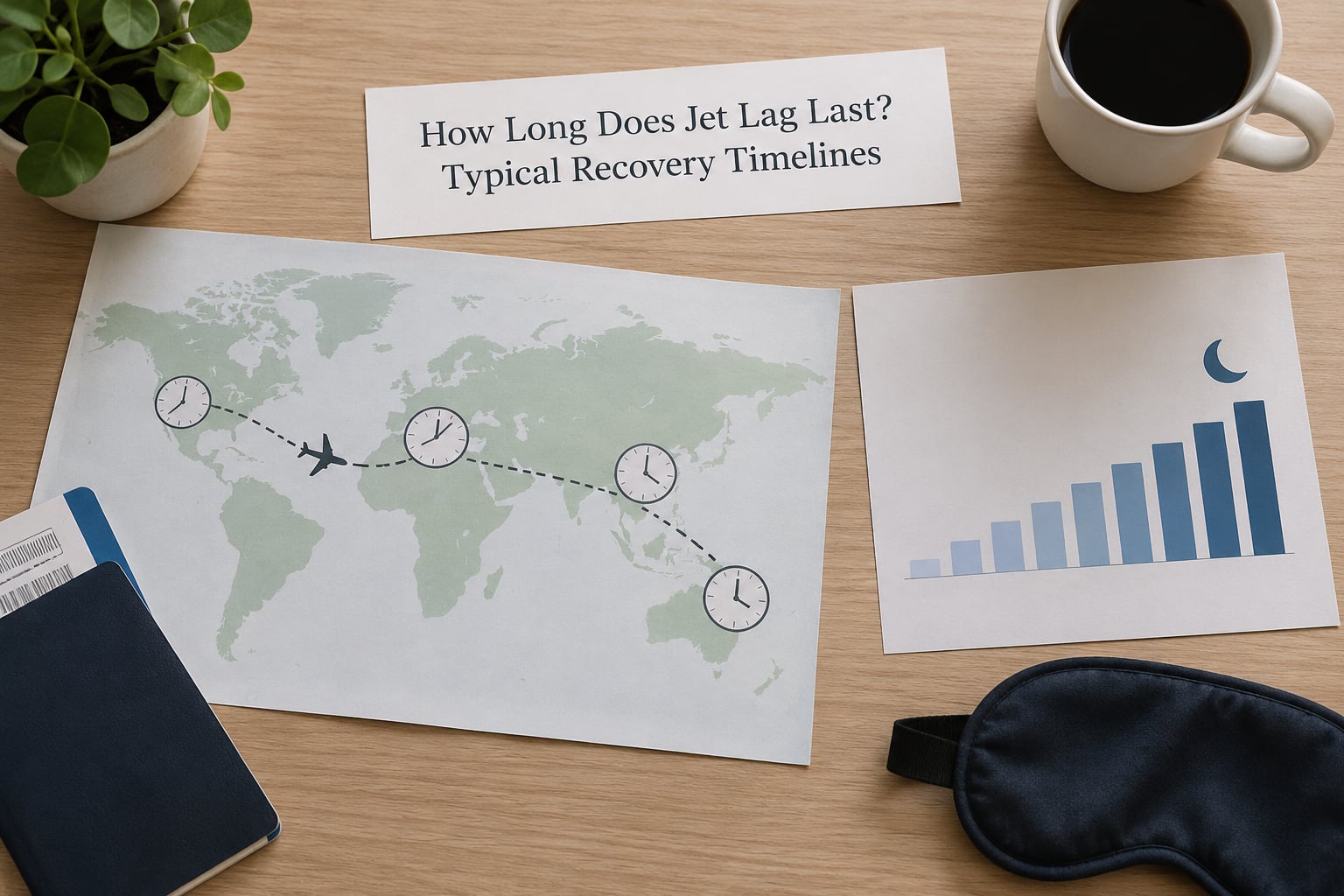
Here is the short answer, then the detail. Jet lag lasts about one day for every time zone you cross, most people feel the worst of it in the first 48 to 72 hours, and eastbound trips run roughly a day longer than westbound ones of the same distance.
Based on what frequent flyers and sleep researchers tend to report, these are the ranges most people fall into:
| Time zones crossed | Typical recovery | What it feels like |
|---|---|---|
| 1 to 2 zones | Less than a day to 1 day | Mild grogginess on day one, barely noticeable |
| 3 to 5 zones | 3 to 5 days | Two rough nights, then a steady climb back |
| 6 to 9 zones | 5 to 8 days | Day two or three is the low point |
| 10 to 12 zones | 8 to 14 days | Full reset is slow, especially eastbound |
Several things push a recovery past the simple one-day-per-zone estimate. Sleeping badly for a few nights before the flight adds to the debt you carry in. A red-eye flight where you never really sleep is harder to recover from than a daytime flight where you do. Eastbound routes add roughly a day at the same zone count. And an arrival in the early morning, when you are expected to be awake until bedtime, tends to be harder than an evening arrival that lets you go to bed almost straight away.
How Long Does Jet Lag Last for Most Travelers?
For a typical traveler on a short or medium trip, expect three to five days and nothing more complicated than that. A New York to Paris flight crosses six zones, and the typical recovery runs five to eight days, with the first two nights being the worst of it.
It is worth separating jet lag from ordinary travel tiredness, because people often blame the wrong thing. A long day of sightseeing, an overnight delay and a bad hotel bed leave you tired, but your sleep still lines up with local night. Jet lag is different: you are exhausted all day and then wide awake at 3 a.m. with no reason to be. If that pattern is there, it is the time zone, not the itinerary.
Short trips of two or three days often show almost no recovery at all, because you fly home before the clock would have caught up. That is not a free pass, though. Symptoms you skip on the outbound leg usually show up on the return.
How Long Can Jet Lag Last After a Long Trip?
A two-week itinerary across 12 zones can realistically take the better part of two weeks to fully clear, and a couple of extra days on top of that is not unusual. Business travelers doing monthly Asia-to-US trips describe a cumulative tiredness that never fully resets between trips.
Still feeling jet lagged after four days is normal if you crossed four or more zones, and more likely if you flew east or arrived early in the morning. It is worth a conversation with your doctor if the pattern persists well past the expected window, or if it comes with other symptoms that do not fit the usual picture.
Why Does Jet Lag Happen After Flying?
Your body runs on a circadian rhythm, an internal roughly 24-hour cycle that governs when you feel sleepy, when you feel alert, when you get hungry and when your temperature rises and falls. The master clock behind it sits in a part of the brain called the suprachiasmatic nucleus, and its single strongest input is light.
Think of it like a clock that can only be nudged along, not set. It shifts by roughly an hour per day, which is exactly where the one-day-per-time-zone rule comes from. When you cross six zones, your clock is six hours off and it needs about six days of daylight and darkness at the new schedule to catch up.
Light is the reset lever, but other signals reinforce it or work against it. Meals on local time help pull the clock forward. Caffeine taken too late in the local day keeps you awake at the wrong hour. Darkness in the evening, by contrast, tells your system bedtime has arrived even when your body thinks it is mid-afternoon.
Does the Direction of Travel Change Recovery Time?
Yes, and it is one of the more reliable patterns in all of this. Flying east — losing hours — is consistently harder than flying west, which is why a return leg from Europe to the US usually feels worse than the outbound flight did.
The reason is that your natural clock runs marginally longer than 24 hours, roughly 24.2 hours on average. That drift makes stretching the day longer, which is exactly what westward travel demands, while eastward travel asks you to compress it.
| Zones crossed | Flying west | Flying east |
|---|---|---|
| 3 zones | 2 to 3 days | 3 to 4 days |
| 6 zones | 5 to 6 days | 6 to 8 days |
| 9 zones | 7 to 8 days | 9 to 11 days |
| 12 zones | 10 to 12 days | 12 to 14 days |
Individual responses vary a lot. Early birds tend to find westward trips harder because they are being asked to stay up later, and night owls find eastward trips harder for the mirror-image reason. Your chronotype matters as much as the arrow on the map.
How Do the Number of Time Zones and Trip Length Affect Jet Lag?
Distance sets the ceiling, but the shape of the trip decides how hard the days are. A red-eye flight arrives with you already sleep-deprived, so you start the destination day behind rather than merely misaligned. An overnight itinerary that eats and sleeps at odd hours gives your clock no consistent signal to lock onto.
Arrival timing matters just as much as distance. Landing in the evening means a normal bedtime soon after, which is the gentlest possible introduction to the new schedule. Landing at 6 a.m. means fighting through a full day to reach a bedtime your body does not yet believe in, and forum discussions about early-morning arrivals are full of exactly that complaint.
Trip length works the same way. Four days abroad is long enough for the clock to start shifting and short enough that you fly home mid-adjustment, so the return leg is where you feel it. A week or more gives you time to adapt before travelling back, though the eastward return still lands you in a worse position than the outbound flight did.
Can You Reduce Jet Lag Before You Fly?
You cannot switch your body clock overnight, but you can shorten the adjustment instead of doing it entirely at the destination. Shift your sleep and wake times by 30 to 60 minutes in the direction of travel for several days beforehand, and go to bed a little earlier each night rather than all at once.
A few other things help. Get into decent sleep before you fly rather than starting a 14-hour trip already tired. Stay hydrated on the long flight, since dehydration amplifies the headache and fog that people read as jet lag itself. Skip the alcohol, which fragments sleep badly, and keep caffeine to the morning rather than the afternoon.
If you are considering melatonin or anything else to shift your sleep, talk it through with your doctor or a travel health clinic first, especially if you take other medicines, are pregnant, or have a condition that affects sleep. Timing matters more than the product, and getting it wrong can leave you groggy at the wrong hour of the destination day.
How Can You Adjust Your Sleep After Landing?
Light is the tool with the most leverage. Travelling east, get outside in the morning light as soon as you can and keep the late evening dim. Travelling west, do the opposite: seek light in the late afternoon and evening, and block bright light early in the morning with an eye mask.
Then protect the first night. Naps are the most common mistake, because a two-hour nap at 4 p.m. guarantees you will be staring at the ceiling at 2 a.m. If you need one, keep it to 20 minutes and set an alarm, and stay well away from your normal bedtime.
Move your meals to local time right away, since your appetite clock responds to meal timing and helps pull the rest of the system along. Keep your last caffeine at least six hours before local bedtime. And pick a seat and sleep setup that give you a real chance at rest, whether that is an eye mask, earplugs or simply a window you can lean against.
A caffeine cut-off about six hours before bed is the most commonly cited trick from people who fly these routes regularly, and it works because it uses alertness to push your bedtime back rather than fighting the clock.
When Should You Seek Medical Advice for Jet Lag?
Ordinary jet lag follows a shape: it starts on arrival day, peaks around day two or three, and eases steadily. Anything that does not follow that shape deserves a second look.
Speak with a doctor if symptoms persist well past the expected recovery window for the number of zones you crossed, if they are getting worse rather than better, or if you also have symptoms that do not fit the usual picture, such as fever, chest pain, confusion or ongoing insomnia long after the trip. Travelers who notice jet lag consistently knocking them over may have a pre-existing sleep disorder worth checking.
This article is general information, not diagnosis or treatment. Anything about your own health is a conversation to have with a doctor or pharmacist who knows your history.
Frequently Asked Questions
Can jet lag last longer than one week?
Yes, and it is not unusual at all if you crossed 10 or more time zones or flew eastbound. Twelve-zone trips routinely take 10 to 14 days, and the clock may still not be fully synced when you get home. Shorter trips of 3 to 5 zones rarely run past a week.
Does jet lag happen on short flights?
It can, though you may barely notice. Crossing one or two zones often produces a day of mild grogginess rather than anything dramatic. Short trips also hide the problem, because you fly home before the clock would have caught up and the real symptoms show up on the return leg instead.
Why do some people recover from jet lag immediately?
Some people genuinely do, and a few barely register it. A well-rested early riser with a flexible schedule, an easy daytime flight and a short zone difference has little to recover from. Others are simply lucky with their chronotype and how quickly their clock responds to light.
Do sleep supplements or melatonin cure jet lag?
Nothing cures it outright. Melatonin is widely used to shift sleep timing and can shorten the adjustment, but the timing matters more than the dose and getting it wrong leaves you drowsy during the local day. Talk to your doctor or pharmacist before using it, especially alongside other medication.
How can I manage jet lag on a return flight?
Set your watch to destination time as soon as you board, sleep when destination night falls, and eat meals on the new schedule rather than yours. Stay awake through the local daylight you land in, limit caffeine in the second half of the flight, and expect the eastward return to be harder than the outbound trip.
What To Do First When You Land
So, how long does jet lag last? Count about a day per time zone crossed, then add a buffer if you flew east or arrived early in the morning. On arrival, get into the local daylight appropriate to your direction of travel, keep your meals on local time, protect that first night from a long nap, and hold caffeine to the first half of the day.
If you have a meeting or a long drive in the first 48 hours, schedule it for later rather than earlier. That single planning choice does more for you than most of the advice on this page.