To prevent blood clots on long flights, walk the aisle every two to three hours, stay hydrated, and do seated leg exercises. Those three habits do most of the work, and they cost nothing. This guide lays out the rest of the plan: choosing the right seat, wearing compression socks properly, handling a five-hour layover, and knowing when your personal risk means you should see a doctor before you book.
Travel-related blood clots are real but uncommon. That combination surprises most people, who tend to picture a nine-hour economy flight as dangerous and a two-hour hop as safe. The arithmetic is less dramatic than the feeling. Still worth planning for, because every measure that reduces the risk is either free or nearly free, and the failure mode is a clot that forms quietly and shows up days later, far from the plane.
This is general information, not medical advice. If you have had a blood clot, are pregnant, recently had surgery, or take a blood thinner, get individual guidance from your doctor before a long-haul trip rather than working from a checklist.
Table of Contents
- What You Need
- How to Avoid Blood Clots on Long Flights
- How common are blood clots on long flights?
- Which risk factors call for more attention?
- Step-by-Step: Before You Board
- How to Move Regularly During the Flight
- Stay Hydrated and Make Seating Work for You
- Know When to Ask a Doctor
- Common Mistakes
- Frequently Asked Questions
- How common are blood clots on long flights?
- How often should I walk around during a long flight?
- What exercises can you do on a plane to prevent blood clots?
- Do compression socks really prevent DVT on flights?
- Does taking aspirin before a flight prevent blood clots?
- What blood clot symptoms after a flight need urgent medical attention?
- Conclusion
What You Need
Nothing exotic. Most of the preparation happens at home the night before or at the check-in desk an hour before boarding.
- Loose clothing that does not sit tight at the waist, thigh or calf. Jeans with a buttoned waistband are the usual culprit.
- A watch or phone timer, so movement happens on an interval rather than when you happen to remember.
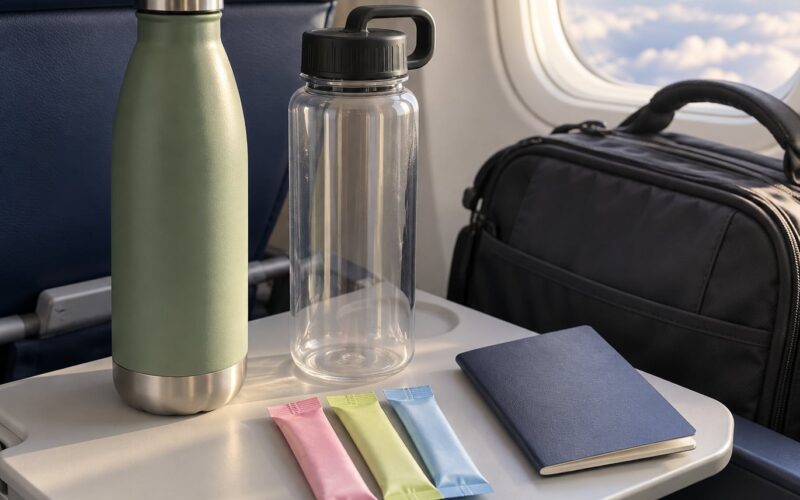
- A refillable water bottle filled after security. Cabin water is expensive and small.
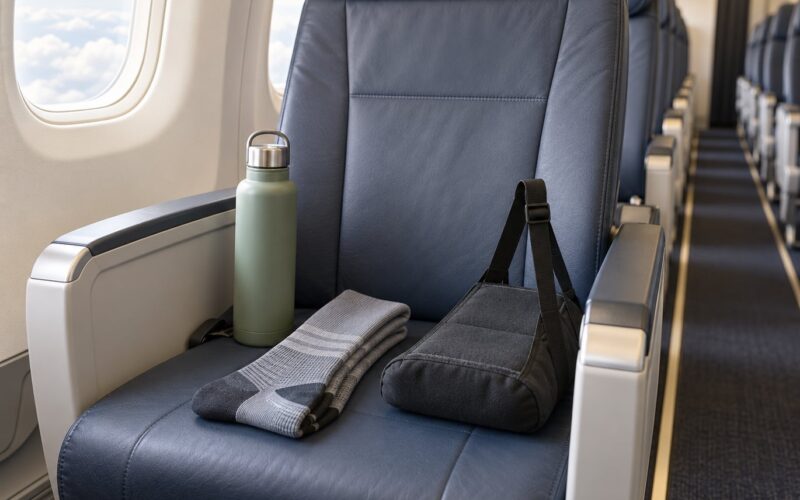
- Compression socks if your flight runs four hours or more. Fifteen to twenty mmHg is the usual level for a healthy traveller; put them on before you leave the house.
- A clear floor space under the seat in front of you, which you usually have to ask about.
- A rough sense of your own risk, using the list further down, so you know whether this trip is a normal precaution or a conversation with your doctor.
How to Avoid Blood Clots on Long Flights
First, the terminology. The clot you are worried about is deep vein thrombosis, or DVT, a clot that forms in a deep vein, usually in the calf or thigh. It can be entirely symptomless. If a piece of it breaks loose and travels to the lungs, it becomes a pulmonary embolism, or PE, which is the dangerous version and the reason this topic deserves attention at all. Both together are called venous thromboembolism, VTE. The informal name, economy class syndrome, is misleading, since it happens in business class too. The variable is not the cabin, it is the hours spent sitting still.
The mechanism is straightforward. Sitting for hours without moving lets blood pool and stagnate in the deep veins of the lower legs. Stagnant blood lets clotting factors accumulate. Your calf muscles normally act as a pump when you walk, squeezing the veins and pushing blood back toward the heart. Sit still for six hours and that pump switches off.
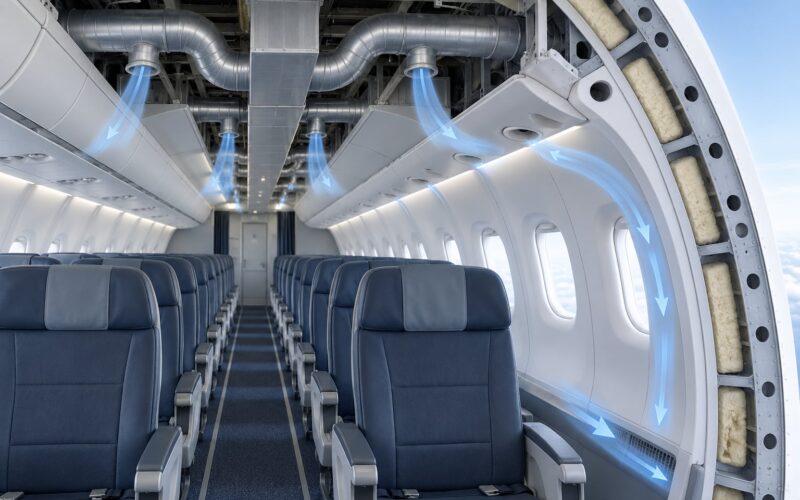
Two common culprits get overplayed. Low cabin pressure is not a direct cause; cabin altitude is equivalent to roughly 6,000 to 8,000 feet, which is not enough on its own to trigger clotting. What matters is immobility, cramped legroom, dehydration, and sitting with legs crossed or bent into awkward angles.
How common are blood clots on long flights?
Rare, and lower than most travellers assume. The CDC notes that absolute risk for flights over four hours is roughly one in 4,656 person-flights; other research puts it near one in 6,000. Risk climbs for flights of eight hours or more, and for people carrying risk factors. Those numbers describe flights where a clot formed at all. Most of them are asymptomatic and go unnoticed.
| Flight length | What it means for risk | What to do |
|---|---|---|
| Under 4 hours | Very low, usually not discussed in guidelines | Normal comfort measures, get up once for the lavatory |
| 4 to 8 hours | Where the published risk estimates start to apply | Walk the aisle every 2 to 3 hours, seated exercises hourly, hydrate, compression socks worth considering |
| 8 hours and over | Elevated; the 8 to 10 hour band is where DVT is most commonly seen | All of the above, plus talk to a doctor first if you carry any risk factor |
The other side of that table matters too. Risk is not calculated per flight in isolation. Several shorter flights stacked across a few days, a long airport transfer before each one, and a red-eye you sleep through without moving add up to something larger than any single leg.
Which risk factors call for more attention?
The CDC and the American Society of Hematology both publish similar lists. Being over 40 raises risk, and it climbs further after 60. Also higher risk: overweight or obesity, pregnancy, use of estrogen-containing contraceptives or hormone therapy, recent surgery or injury, an active cancer, smoking, a personal or family history of blood clots, a known clotting disorder, diabetes, high blood pressure, and high cholesterol.
Cross a couple of those and the free measures become the baseline rather than the whole answer. That is a conversation for a clinician, not a travel guide.
Step-by-Step: Before You Board
Ten minutes of setup makes the next ten hours easier. Work through it the night before or while waiting at the gate.
- Dress for movement. Loose trousers or a skirt that lets you bend and cross your legs freely. Avoid anything cinched at the calf or waist.
- Pick your seat with movement in mind. An aisle seat is worth the money on a long haul because you can stand without asking anyone to move. A bulkhead row or emergency exit row gives legroom, though exit rows carry a fixed responsibility to help with the safety briefing.
- Clear your floor space. Ask the person in front of you politely, or simply shift your bag into the space when they stand to use the lavatory. A footrest or a folded jacket under the ankles helps.
- Fill your bottle after the security queue, and plan to drink steadily rather than in one go at the gate.
- Put compression socks on at home if you are wearing them, before boarding, so you do not have to tug them over shoes in a cramped galley.
- Set a timer for every two to three hours. That is the interval that does the work.
- Skip the sedating nap pill if you can. Six hours of immobile, drug-assisted sleep is the worst-case version of this problem.
- Walk the terminal on long connections rather than sitting at the gate. Risk accumulates across the whole travel day, not just the airborne part.
- Check the symptoms list below before you leave, so you know what to watch for and are not guessing after landing.
- Have your medications and doctor’s contact details accessible, particularly if you are on a blood thinner with travel-specific instructions.
How to Move Regularly During the Flight
Get up and walk the aisle every two to three hours. That is the single most useful habit, and it is the one most people abandon after the first hour when the novelty wears off. Ten minutes of standing in the galley queue counts.
Between those walks, run a short seated routine once an hour or two. Reps are guidance, not a target to hit precisely:
- Ankle circles — 20 in each direction, both ankles.
- Foot pumps — flex the foot toward you, then point it away, 20 to 30 times each foot.
- Heel and toe raises — lift the heels off the floor, then the toes, alternating, 20 times each.
- Seated knee lifts — raise one knee toward your chest, hold a second, lower, 10 times per side.
- Seated forward bends — reach toward your toes and hold for five seconds, 10 times.
- Ankle flexion against resistance — push your toes into a footrest or the bulkhead if there is one.
Keep legs uncrossed and change position often. A window seat makes this harder, not impossible; the seated routine above covers the gap, and the aisle is two rows away at worst.
Stay Hydrated and Make Seating Work for You
Hydration matters for comfort, alertness and circulation, though it does not by itself prevent a clot. Drink steadily across the flight rather than trying to catch up at the end. Water and sparkling water both work.
Alcohol is the one to cut back. It is a mild diuretic, so it works against you, and it sedates, which makes you less likely to move. Caffeine in moderation is fine; it is not the villain some posts claim. Skip large amounts of sugary and heavily carbonated drinks, since they fill the bladder without adding useful fluid, and a queue for the lavatory is a decent accidental movement break, but a poor plan.
On seating, the trade-off is real. An aisle seat means easy movement and a higher chance of being disturbed by a neighbour asking to pass. A window seat means fewer interruptions and the wall to lean on during sleep. On flights of eight hours or more, movement wins. On a four-hour hop, either is fine.
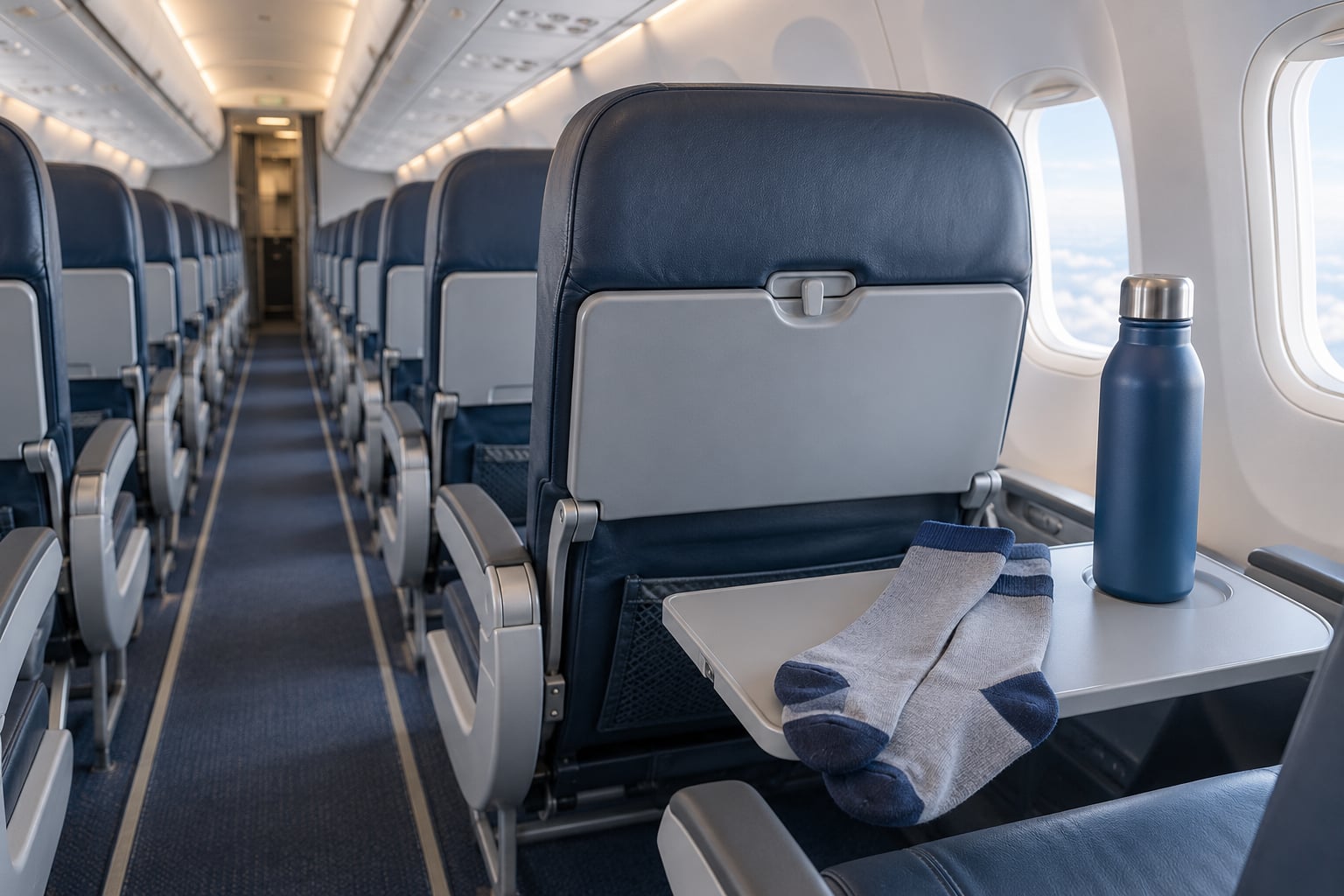
Compression socks deserve more detail than most pages give, since they are recommended almost universally and explained almost nowhere. Graduated compression is strongest at the ankle and decreases up the leg, which pushes blood back toward the heart rather than letting it pool. Fifteen to twenty mmHg is the level usually suggested for travellers without risk factors; a doctor may recommend more for specific conditions. Knee-high socks cover the calf, which is where clots start, and are the usual pick. Crew-length socks still help the ankle and lower calf and are a reasonable compromise if knee-highs feel unbearably hot, a complaint that comes up constantly in travel forums. Wear them from the start of the trip and take them off at the end of it, unless a clinician has told you otherwise.
Know When to Ask a Doctor
If any of the risk factors above apply to you, book the appointment before you book the flight. Bring the dates, the flight durations and the connection times. A doctor can decide whether graduated compression at a higher pressure is right for you, whether a long-haul flight is safe at all in your circumstances, and whether anything about your existing medications needs adjusting around travel.
Aspirin comes up constantly and deserves a clear answer. There is not enough evidence that aspirin taken before a flight prevents travel-related DVT in otherwise healthy passengers, which is why major guidance does not recommend it routinely. It may still be appropriate for someone with a specific medical reason to take it, and only a clinician should make that call. Do not start a blood thinner, including aspirin, on your own before a long trip. The same goes for prescription anticoagulants such as rivaroxaban, which are prescribed for particular indications and timed by a prescribing clinician, never as a routine travel precaution.
Watch for symptoms in the days after you land, not just during the flight. DVT typically shows up in one leg: swelling, a deep aching or cramping pain that starts in the calf or thigh rather than the chest, warmth, tenderness to touch, and red or discoloured skin. One-sided involvement is the key signal, and the discomfort feels different from the general puffiness that comes with a long flight. Get same-day medical advice for a swollen, painful calf.
A pulmonary embolism is the emergency. Sudden breathlessness, chest pain that worsens when you breathe in, coughing, a fast heartbeat, or coughing up blood need emergency care immediately, not a booking. The clot may have formed days earlier, long after you landed, so stay alert for a couple of weeks if you are higher risk.
Common Mistakes
- Sitting motionless for the whole flight. This is the mistake the article exists to prevent. Set a timer, and get up whether or not you feel like it.
- Treating alcohol as a sleep aid. It shortens the trip subjectively and lengthens the risk. Alcohol dehydrates and sedates.
- Wearing restrictive clothing. A tight waistband, belt, or boot blocks the flow you are trying to protect.
- Spending a four-hour layover sitting at the gate. The travel day counts, not just the flying. Walk the terminal, get a coffee, see the concourse.
- Assuming symptoms are normal post-flight fatigue. One swollen, warm, painful calf is not ordinary tiredness. Get it checked.
- Self-medicating with aspirin. Aspirin has its own bleeding risks and is not established for this purpose. Ask a doctor.
- Buying compression socks without checking the pressure. Socks that say nothing about mmHg may be doing very little.
- Waiting for a symptom to appear before doing anything. Many travel clots are symptomless. Prevention is the point.
A handful of beliefs circulate widely and are worth dismissing in plain terms:
| Common belief | What the evidence points to |
|---|---|
| Only economy class is affected | Cabin class is not the variable; hours of immobility is. Business class passengers who sit still are still at risk. |
| Low cabin pressure causes clots | Not on its own. Immobility, cramped space and dehydration are the drivers. |
| Crossing your legs causes clots | It is not a direct cause, but it limits circulation and makes deep venous flow worse. |
| Wiggling your toes is enough | Toe movement alone is marginal. Ankle rotations, calf pumps and standing up are what move blood out of the calves. |
| Drinking water prevents blood clots | Hydration supports comfort and circulation. It is one part of a plan, not the plan. |
Frequently Asked Questions
How common are blood clots on long flights?
Less common than most travellers assume. The CDC puts absolute risk for flights longer than four hours at about one in 4,656 person-flights, and other research estimates roughly one in 6,000. Risk rises for flights of eight hours or more and for people with risk factors such as age over 40, pregnancy, recent surgery, cancer, smoking or a personal or family history. Most travel clots cause no symptoms at all.
How often should I walk around during a long flight?
Every two to three hours is the standard advice from the CDC and most travel medicine guidance. Ten minutes in the aisle is enough. Between walks, run a short seated routine once an hour or two: ankle circles, foot pumps, heel and toe raises, and seated knee lifts. If you have a risk factor, talk to a doctor before the flight rather than relying on the aisle alone.
What exercises can you do on a plane to prevent blood clots?
Five moves cover it: ankle circles, 20 each way; foot pumps flexing and pointing, 20 to 30 times each foot; alternating heel and toe raises, 20 each; seated knee lifts toward the chest, 10 per side; and seated forward bends held for five seconds, 10 times. Run the set once an hour or two, keep your legs uncrossed, and change position regularly between repetitions.
Do compression socks really prevent DVT on flights?
They reduce the risk of symptomless DVT, which is what the Cochrane review evidence supports. They also cut down on leg swelling and the heavy, tired feeling many people get after a long flight. Fifteen to twenty mmHg is the level most travellers use. Put them on before you leave the house rather than in the aircraft, and take them off after landing unless a clinician has said otherwise.
Does taking aspirin before a flight prevent blood clots?
There is not enough evidence to recommend it. Aspirin is not routinely advised for healthy travellers because travel-related DVT is not prevented in a way that outweighs its bleeding risks. Aspirin or a stronger anticoagulant may still be right for you for an unrelated medical reason, and a clot survivor may be managed differently. Only your doctor should make that call, so do not start taking aspirin before flying on your own.
What blood clot symptoms after a flight need urgent medical attention?
A swollen, warm, painful calf on one side, sometimes with red or discoloured skin and tenderness to touch, deserves same-day medical advice. Emergency care is needed for sudden breathlessness, chest pain that worsens when you breathe in, a rapid heartbeat, coughing, or coughing up blood, because those suggest a pulmonary embolism. Clots can appear days after landing, so stay alert for a couple of weeks, especially if you carry risk factors.
Conclusion
Start with three things: set a timer for every two to three hours and walk the aisle, keep a bottle of water within reach, and do the seated routine once an hour or two between walks. Choose an aisle seat when the flight runs past four hours, wear loose clothing, and put compression socks on at home if you have decided to use them.
Then think past the aircraft. A walking layover beats four hours parked at a gate, and the days after you land matter as much as the flight itself. If any risk factor applies to you, or you have had a clot before, that appointment with your doctor comes before the booking, not after the symptoms. Nothing here is medical advice, and nothing replaces advice written for your own history.