To beat jet lag flying east, shift your sleep, meals and light exposure toward destination time in the three days before you fly, then live entirely on local time once you land. Eastbound travel is harder because your destination day is shorter than the one your body is used to, so your internal clock has to move forward rather than back, and it does that at roughly one hour a day.
That one hour a day is the number worth holding on to. It means a five or six zone flight to Europe costs about five or six days unless you pre-shift and protect your arrival nights, which is exactly the part most itineraries hand you with nothing to do but wait for your body to catch up.
Table of Contents
- What You Need
- How to Beat Jet Lag Flying East Before You Go
- Step-by-Step
- How to Beat Jet Lag Flying East by Gradually Shifting Sleep
- Use Light Timing to Move Your Body Clock
- Plan Meals, Caffeine, and Hydration Around the Flight
- Sleep Strategically During the Flight
- Set Your Body Clock at the Destination
- Common Mistakes
- Quick Tips for Different Flight Lengths
- Frequently Asked Questions
- Should I stay awake during an eastbound flight to avoid jet lag?
- Does melatonin help with jet lag when flying east?
- How long does jet last after flying east?
- What is the best sleep schedule before an eastward flight?
- Should I avoid sunlight during an eastbound flight?
- Can drinking lots of water prevent jet lag?
- Start Three Days Before, Not After Landing
What You Need
None of this needs equipment beyond a watch and a plan, but the plan only works if you fill in a few numbers first.
- Your local arrival time. Not the departure time. Whether you land at 7am or 7pm in the destination decides almost every decision that follows, so check the arrival airport’s clock, not your origin’s.
- Sunrise and sunset at the destination for the days you will be there. Sunrise tells you when to get outside; sunset tells you when to start dimming lights.
- Your current bed and wake times, written down. You cannot shift a schedule you have not looked at.
- A three-day shifting plan in the calendar, 30 to 60 minutes earlier per day.
- An in-flight sleep kit: eye mask, earplugs or noise-cancelling earbuds, a neck pillow, and a layer for the cabin. If you plan to sleep, the shade and ear protection matter more than the pillow.
- A melatonin plan, if you use it, with a dose and a clock time decided before you leave home rather than decided at 2am over the Atlantic.
Skip all of this for a flight of two time zones or fewer. You will get travel tiredness, not real jet lag, and a heavy protocol is wasted effort.
How to Beat Jet Lag Flying East Before You Go
Eastbound travel asks your circadian rhythm to phase advance: the clock in your brain has to slide earlier relative to when you actually sleep and wake. Westbound travel asks for a phase delay, which is the easier direction because you can always stay up a bit later than you want to. Eastbound asks you to fall asleep earlier than your body would like, fight off an evening that arrives too soon, and get up through what feels like the middle of the night.
| Factor | Flying east | Flying west |
|---|---|---|
| Effect on your body clock | Phase advance, the clock moves earlier | Phase delay, the clock moves later |
| Local daylight during your usual sleep | Daylight arrives while you should be sleeping | Darkness arrives while you should be sleeping |
| Pre-trip shift | Go to bed and wake 30 to 60 minutes earlier each day | Go to bed and wake later, if you shift at all |
| In-flight sleep | Easier: sleep when it is night where you board, wake near destination breakfast | Harder: local bedtime lands in the middle of your flight |
| Arrival rule | Stay up to an early local bedtime, get morning daylight | Try to sleep through to a local morning, avoid evening light |
| Typical recovery | Roughly one day per time zone crossed | Roughly two-thirds of a day per zone |
The rule of thumb on recovery is one day east, a little under a day west. Here is roughly what that looks like in practice, on a good pre-shift and arrival plan.
| Time zones crossed east | Typical route | Days to feel roughly normal |
|---|---|---|
| 3 | US Central to the UK | 2 to 3 |
| 5 to 6 | US East Coast to Western Europe | 4 to 6 |
| 8 to 9 | US East Coast to Central Europe, or Europe to East Asia | 6 to 8 |
| 11 or more | Europe to Australia, US West Coast to Asia | 8 to 10 or more |
Any doctor or pharmacist will tell you the same baseline the CDC Travelers’ Health guidance does: adjust light and sleep timing before and during travel, avoid alcohol, eat sensibly, and use caffeine strategically rather than continuously.
Step-by-Step
How to Beat Jet Lag Flying East by Gradually Shifting Sleep
Shift earlier, and shift in small steps. Moving your bedtime by a full hour on day one and then three hours the next night is how people end up lying awake at 9pm staring at the ceiling.
- Three days out: go to bed 30 minutes earlier and wake 30 minutes earlier than usual.
- Two days out: add another 30 to 60 minutes earlier on both ends. Keep breakfast close to your new wake time rather than your old one.
- Day before: hold the new schedule. Skip the long lie-in and resist a late night, because the flight will test the schedule.
- On the day: eat breakfast at your shifted time, not at your old time.
This works best if you can hold the shifted times for three to five days before departure. It does not suit shift workers, parents of young children, or anyone already sleeping badly, since forcing an earlier bedtime when you are not sleepy produces an hour of staring at the ceiling every night. If that is you, protect light and meal timing instead and let sleep land where it lands.
For a very long crossing, shift a little more and start sooner. Eight or nine zones needs more lead time than three does.
Use Light Timing to Move Your Body Clock
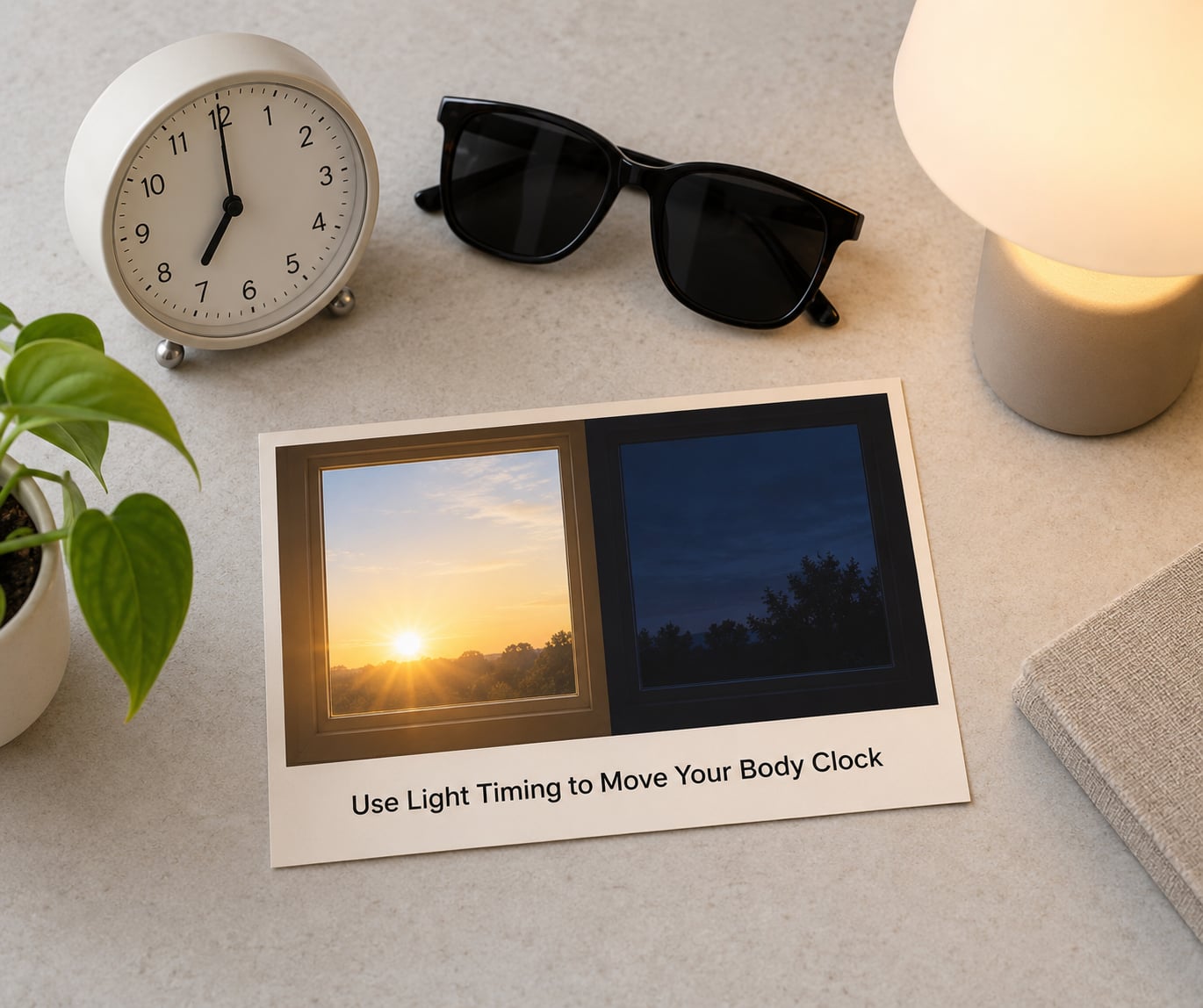
Light is the strongest signal your body uses to set its clock, stronger than caffeine, meals or alarm clocks. Getting this right does more work than any supplement, and online advice contradicts itself because the answer depends on direction.
For eastbound travel the rule is simple: seek bright light early in your destination day, avoid bright light in your destination evening, and protect darkness during the hours your body thinks are night.
- Get outside within an hour of waking on destination mornings, even if it is overcast. A walk in daylight is the cheapest and most reliable timing cue you have.
- Dim the evening. Lower lamp brightness, keep screens dim, and skip the brightest overhead lighting in the last two hours before your target bedtime.
- Wear sunglasses for the part of the flight that is bright daylight back home but should be night where you are going, usually late in the flight. Keep them on through daylight if you plan to sleep.
- Block the sunrise with a window shade or eye mask if you land before dawn, so a bright cabin window does not deliver a full morning of light to eyes that want night.
None of that means sitting in a dark room all day or driving at dusk with heavy glasses. Keep it ordinary, and if you have an eye condition or take medication affected by light, ask your doctor before making a habit of it.
Plan Meals, Caffeine, and Hydration Around the Flight
Eat on destination meal times, not on the airline’s schedule. That single change does more than any fasting protocol people write about, though the fasting version has its fans.
Before an evening departure from the US East Coast, travelers on East Coast to Europe routes commonly report eating a carb-forward meal in the early afternoon, then switching to water only for the rest of the flight. It is not medically required and it is not pleasant for everyone, but it does line your digestion up with destination time. If you skip it, at least skip the airline meal that lands at your 3am destination body time.
Caffeine gets a cutoff. Last coffee at local noon, then nothing caffeinated, so the drug is clearing your system by destination bedtime. Alcohol gets none at all: it fragments sleep, and CDC guidance specifically advises avoiding it in flight.
On hydration, ordinary amounts and nothing heroic. Cabin air is dry and dehydration makes symptoms feel worse, so drink water steadily through the flight. Guzzling litres of water in the last hour before landing means waking up at 4am local needing the bathroom, which is the one symptom of eastbound travel you can absolutely choose not to have.
Sleep Strategically During the Flight
Whether to sleep on the plane comes down to one fact: what time is it where you are landing.
- Landing before 10am local: stay awake. Sleep in small chunks earlier in the flight if you must, set an alarm for the last two hours, and eat a light meal before landing so you are not running on empty at 7am.
- Landing between 10am and 4pm local: this is the best case. Sleep through the night portion back home, wake for breakfast near your destination’s breakfast, and be functional on arrival.
- Landing after 6pm local: sleep on the flight. Blocking light with a mask and earplugs puts your sleep in the right window, and staying awake just to arrive wrecked.
When you do sleep, the kit list matters. An eye mask that blocks light, earplugs or earbuds, a neck pillow, and loose layers that let you move without waking. If you plan to stay awake, do it with movement and low-stimulation tasks, and keep naps to 20 minutes or less.
On melatonin, published guidance uses low doses and earlier timing: roughly 0.5 to 3 mg taken a few hours before your destination bedtime, for several nights rather than once. Check the rules where you are, since it is over-the-counter in the US and prescription-only in much of Europe, and ask a pharmacist or doctor before use if you take other medications, are pregnant, or have a health condition.
Set Your Body Clock at the Destination

The first 48 hours decide how long the whole trip feels. Eat on local times, sleep on local times, and treat the first night as the one worth protecting.
- Daylight first thing. Step outside for 20 to 30 minutes after breakfast. If you land before sunrise and have no hotel yet, that is the hard case: a bright cafe or a walk beats a dark room, and it keeps you from falling asleep at 4pm.
- Cap naps at 20 to 30 minutes and never past 3pm local. One short nap is a rescue; a three-hour nap is the single most common way people turn mild jet lag into a ruined trip.
- Eat local meals on local time, including a real breakfast the morning after you land.
- Caffeine until local noon, then stop. An afternoon coffee is a direct route to a 3am wake-up.
- Stay up to an early local bedtime. Expect to be exhausted by 8 or 9pm, and expect that first night to be long and shallow. That is normal, and it passes.
If you have a meeting on arrival morning, protect the plan the same way: bright light within an hour of waking, no nap or a 20-minute one, and a hard caffeine cutoff after lunch.
Days two and three are the ones people get blindsided by. You feel roughly functional on day one, then hit the wall mid-afternoon on day two as the sleep debt lands. Knowing that in advance turns a bad afternoon into an expected one.
Common Mistakes
- Staying on home time. The fix: switch your watch to destination time the moment you board and never look back.
- Napping three or four hours on arrival. The fix: 20 to 30 minutes, and never after 3pm local.
- Overhydrating. The fix: steady water through the flight, then stop before you land.
- Coffee in the destination afternoon. The fix: last cup at local noon.
- Using alcohol to sleep on the plane. The fix: eye mask and earplugs instead. Alcohol suppresses the second half of sleep and deepens the landing crash.
- Checking home time. The fix: your old clock is gone. Checking it repeatedly keeps pulling your clock backward.
- Falling asleep at 7pm local and waking at 3am. The fix: push the first night to 9 or 10pm if you possibly can, even if you are tired enough to drop.
- Trusting an app to do the work. Jet lag calculators and light-scheduling apps give you a schedule; they do not make you follow it.
Quick Tips for Different Flight Lengths
Short flights, three hours or under. Two time zones or fewer, and this is travel fatigue rather than jet lag. Stay on local time, sleep at local bedtime, and skip the whole protocol.
Medium flights, five to eight hours. Three to five zones. The three-day pre-shift and the arrival-day rules earn their keep here. This is the classic US-to-Europe hop where the routine decides whether day one is usable.
Long flights, ten hours or more. Six zones or more. Start shifting five days ahead, branch your in-flight sleep on arrival time, and plan for six to eight days of adjustment rather than three. If you only have two or three days at the destination, shifting hard before you fly matters more than anything you do after landing.
One more thing frequent flyers mention: airline staff sometimes dim the cabin and wake passengers an hour out, which wrecks a carefully planned sleep window. If that happens, use the last hour for a meal and a short conversation rather than trying to force sleep into whatever time is left.
Frequently Asked Questions
Should I stay awake during an eastbound flight to avoid jet lag?
It depends entirely on what time you land. If you touch down before 10am local, staying awake is the right call, because sleeping then means waking at 4am with your body still on home time. If you land after 6pm local, sleep on the plane so your sleep happens during destination night. For arrivals between 10am and 4pm, sleep through the home night portion of the flight and wake near destination breakfast.
Does melatonin help with jet lag when flying east?
Melatonin is the best-evidenced supplement for eastward travel, and low doses work better than large ones. Published guidance typically uses roughly 0.5 to 3 mg taken a few hours before destination bedtime, on several nights rather than once. It is over-the-counter in the US and prescription-only in much of Europe. Ask a pharmacist or doctor first if you take other medications or have a health condition.
How long does jet last after flying east?
Roughly one day per time zone crossed, which is why eastbound feels slower than westbound. A three-zone crossing usually clears in two to three days, five to six zones to Western Europe in four to six days, and eight or more zones in a week or more. Starting the pre-shift three days early and protecting light and sleep on arrival reliably shortens that.
What is the best sleep schedule before an eastward flight?
Go to bed and wake up 30 to 60 minutes earlier each day for three days before departure, and hold that schedule on the day of the flight, including an early breakfast. Skipping the shift is fine if you are already sleeping badly or caring for small children; protecting morning light and destination mealtimes still helps. Do not attempt a five-hour jump in one night.
Should I avoid sunlight during an eastbound flight?
Only during the wrong hours. For eastbound travel you want bright light early in the destination day and dim light in the destination evening, so sunglasses make sense during the daylight stretch late in a flight while your body thinks it should be night. Blocking the sunrise with a shade or eye mask helps when you land before dawn. Normal morning daylight once you are awake at your destination is what you want.
Can drinking lots of water prevent jet lag?
No, and it can make things worse. Cabin air is dry and dehydration makes headache and sluggishness feel heavier, so steady water through the flight is sensible. But overhydrating in the hour before landing means waking at 4am local needing the bathroom, which is exactly the symptom you are trying to avoid. Water supports the plan; light and sleep timing do the real work.
Start Three Days Before, Not After Landing
Jet lag east is a clock problem, and clocks respond to light and timing rather than to anything you swallow. Start the 30-to-60-minute-earlier shift three days out, branch your in-flight sleep on your local arrival time, then live on destination meals, a noon caffeine cutoff and daylight in the morning.
If you do only one thing, make it the morning walk on arrival day. Everything else on this list makes that easier, and almost nothing makes it unnecessary.