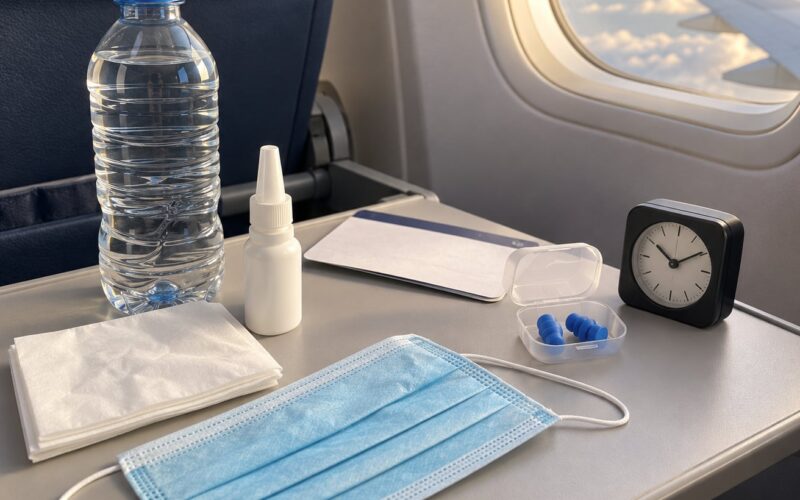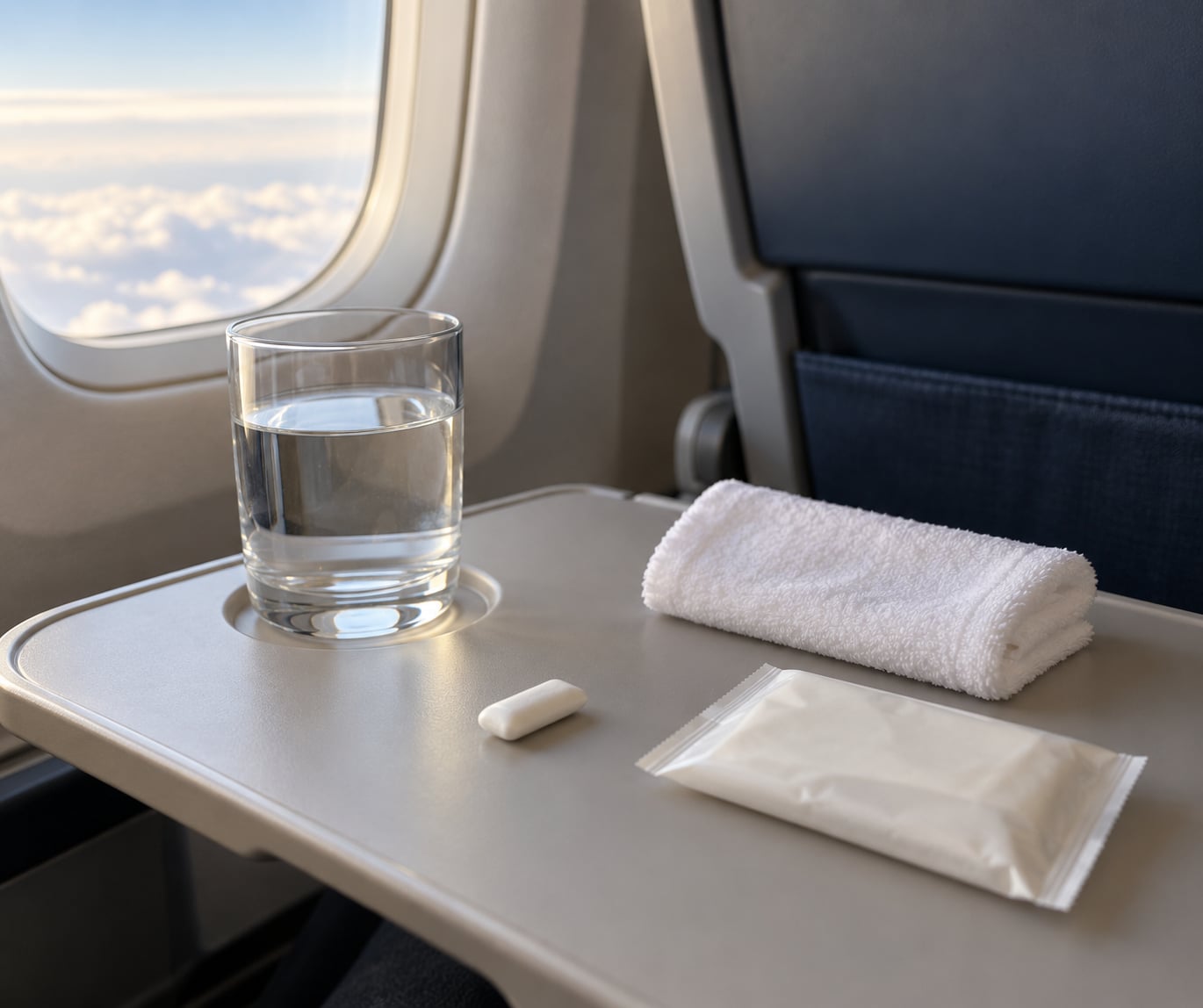
Blocked ears after a flight come down to one thing: the pressure in your middle ear no longer matches the pressure outside, and the little canal that fixes that has not opened yet. To pop your ears after a flight, start with swallowing and yawning, then move to gentle nose-blowing, then warmth and humidity. Most blocked ears clear within minutes to a few hours of landing, and an ear that stays muffled past a day or two is worth a call to a clinician.
That is more or less the whole story, and it is good news: this is one of the most common post-flight complaints there is, and it is usually boring rather than dangerous. The mechanics are worth ten seconds, though, because once you know what the Eustachian tube is doing, the techniques stop being random tricks.
Here is the calm version of the advice. I am not a clinician, and nothing below replaces a diagnosis, so if you have ear tubes, recent ear surgery, a perforated eardrum, or a diagnosed sinus condition, ask your own doctor before trying the pressure techniques.
Table of Contents
- What You Need
- Step-by-Step: How to Pop Your Ears After a Flight
- Step 1: Swallow or Yawn to Equalize Pressure
- Step 2: Gentle Nose-Blowing to Pop Ears That Will Not Clear
- Step 3: Use Warmth or a Humidified Space
- Step 4: Avoid Forceful or Repeated Attempts and Know When to Stop
- Common Mistakes
- Frequently Asked Questions
- How long does it take for ears to pop after a flight?
- Why is the Valsalva maneuver not working on one of my ears?
- Is muffled hearing after a flight actual hearing loss?
- How do I help a baby or toddler whose ears will not pop?
- Should I take a decongestant after flying?
- When should I see a doctor about ears after a flight?
- Conclusion: Start With Gentle Pressure Relief
What You Need
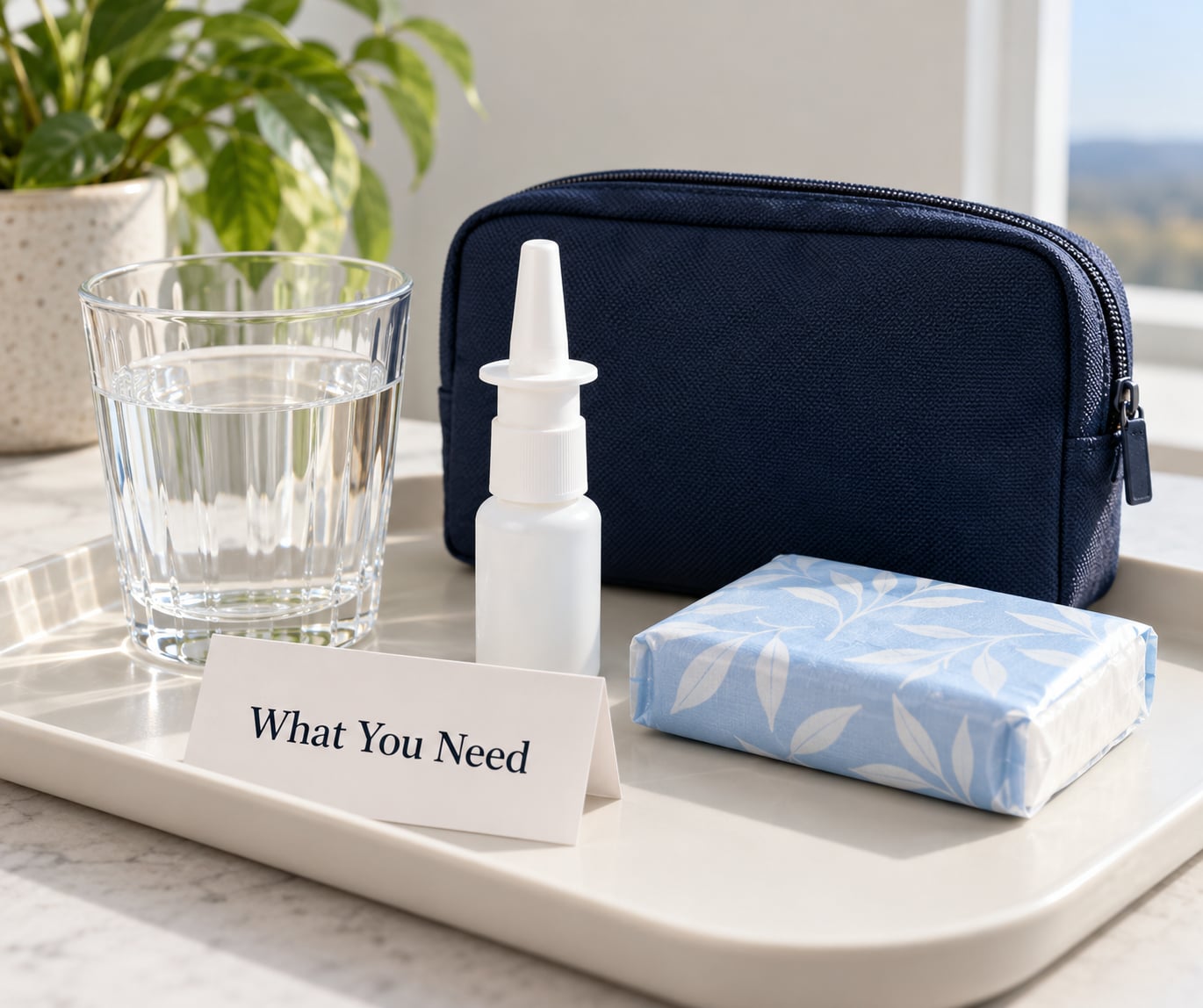
None of this needs a pharmacy or a prescription. You need a few ordinary things within arm’s reach, plus somewhere comfortable to sit for five quiet minutes. Rushing the ladder is what turns a mild annoyance into a sore ear.
- Water. Sips work better than a full glass because swallowing is the muscle movement you are after.
- Something to chew or suck on. Gum, a chewy sweet, or a hard candy keeps your jaw moving, which keeps your swallowing reflex firing.
- A warm cloth or compress. A clean towel run under warm water, wrung out and held over the ear, is enough.
- A quiet, upright seat. Lying flat right after landing makes fluid and pressure sit differently. Sitting up and walking a little helps.
- Time, roughly ten minutes. Set a timer so you are not re-running techniques for an hour and making the ear angrier.
Nasal spray is worth a mention, with a caveat. A saline spray is simply salt water and helps rinse the nose, which is useful if the flight started with a stuffy nose. Medicated sprays and oral decongestants are a different category entirely: they are medicines with real side effects and interactions, and what is right for you depends on your health history and other medications. Ask a pharmacist rather than reading a forum thread, and read the Mayo Clinic or NHS guidance on ear barotrauma before you take anything.
Step-by-Step: How to Pop Your Ears After a Flight
Work down this list in order and stop as soon as the ear clears. Each step adds a little more force or a little more time than the one before it, which is exactly why the order matters.
Step 1: Swallow or Yawn to Equalize Pressure
Your middle ear is sealed off from the outside world by the eardrum and connected to the back of your nose and throat by a narrow canal called the Eustachian tube. During takeoff and descent, cabin pressure changes faster than your middle ear can follow, and that mismatch is what airplane ear, or ear barotrauma, actually is.
Swallowing and yawning fire the throat and jaw muscles that pull that tube open. Air moves through, the two sides of the eardrum match again, and you hear a pop or a soft click. Chewing and sucking do the same job, which is why gum, chewy sweets, and a sip of water all sit in the same category rather than being separate remedies.
You will know it worked by the sudden clarity: the muffled thump lifts, sounds get sharper, and the pressure sensation drops away within seconds of the pop. Try a slow deliberate yawn, several times, with a swallow right after. A yawn you have to force does not work nearly as well as one you let build, so take your time rather than clamping your jaw and hauling.
One timing note that helps most people: descent is harder on ears than takeoff. The cabin pressurises slowly on the way up, and that gives your tube time to open. Coming down, the pressure change is quicker and more likely to arrive before your tube can respond. That is also why the people who hurt most on a flight usually hurt most in the last thirty minutes before landing.
If you are still blocked after several yawns, do not go straight to blowing. The next step adds pressure; it needs a tube that is already partway open to work with.
Step 2: Gentle Nose-Blowing to Pop Ears That Will Not Clear
This is the nose-pinch-and-blow method most people half-remember, called the Valsalva maneuver. Close your mouth, pinch your nostrils shut, and blow gently into your cheeks, as though you are slowly inflating them. You are not blowing to clear your nose. You are pushing air at the back of your nose, where the Eustachian tube opens, so pressure transfers to your middle ear.
Light is the operative word. Feels silly, sounds even sillier, and it should feel like very little more than a slow, steady push. Stop the moment you feel the pop, because continuing after the pop is how people injure themselves.
There is a second version worth knowing, called the Toynbee maneuver. Pinch your nostrils shut and swallow with your mouth closed. This time you are using suction rather than pressure, which some people find easier and gentler. It is a good alternative if blowing feels uncomfortable or if you have just had nose or ear surgery.
The trick most pages miss is combining them. Gentle blow, then swallow, then gentle blow again, repeated slowly. Blowing alone pushes; swallowing pulls the tube open; doing both in sequence gets more movement out of the same low effort. If one ear is still doing nothing after three or four honest attempts, move on rather than escalating. Repeating a maneuver that is not working does not improve it.
Step 3: Use Warmth or a Humidified Space
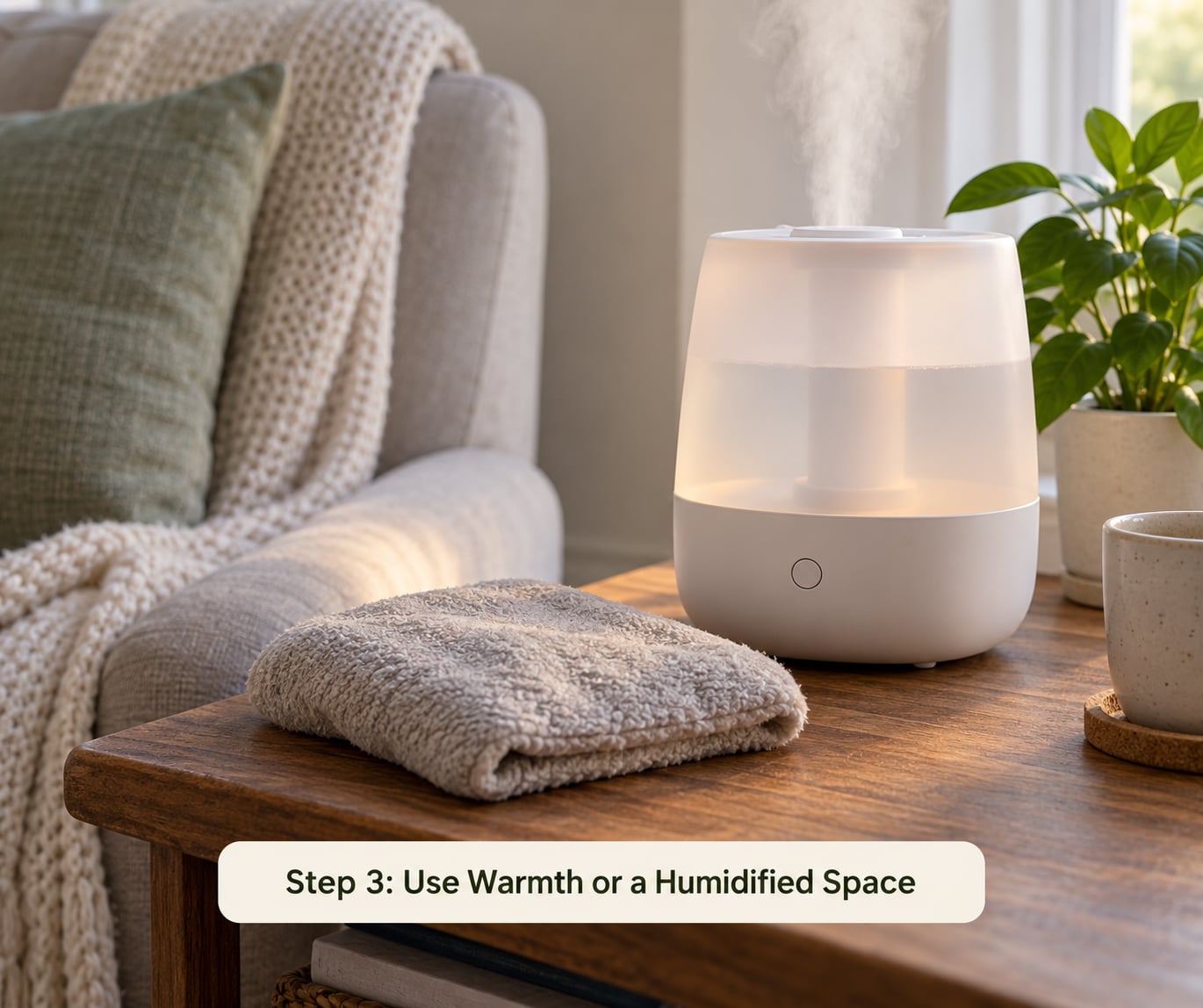
Warmth relaxes the small muscles around the tube and gets things moving again. Hold a clean warm compress over the closed ear for five to ten minutes, or stand in the steam from a hot shower for a few minutes. A humidifier in a stuffy room does the same gentler version of the job, and inhaling steam with a bowl and a towel is the version most people already know from cold season.
Drinking water steadily matters more than it sounds. Thin mucus drains better than thick mucus, and hydration supports that. Staying upright and moving around the room helps as well; if you are stuck at an airport for an hour after landing, walking off the plane instead of sitting at the gate is a cheap intervention that people skip.
None of this unblocks an ear on its own, and I want to be straight about that. Warmth and humidity are comfort and recovery support, not a cure for a tube that is genuinely swollen shut. They also give you a couple of minutes to try swallowing again, which is where the actual relief usually comes from.
Step 4: Avoid Forceful or Repeated Attempts and Know When to Stop
Blowing hard is the most common way people make ear pressure worse. Forceful pressure can injure the eardrum, and the pain of doing that is not a price worth paying for a pop. Same with cotton swabs, hairpins, and anything else you might be tempted to put in the ear canal. Nothing gets inserted into the ear here, ever.
Stop the whole sequence and stop worrying if you notice sharp or increasing pain, bleeding or fluid draining from the ear canal, ringing in the ear, dizziness or vertigo, or a headache that arrives with the ear symptoms. Those are the signals that something beyond ordinary blockage is going on.
The timing threshold matters more than the symptoms list, because most post-flight ears never get near it. Mild fullness and muffling that clears within a few hours of landing is common and expected. If you are still blocked, still in pain, or still muffled more than 24 to 48 hours after the flight, book an appointment with a primary care clinician or an ENT specialist. Fluid sitting in the middle ear can take weeks to clear on its own, and an ear that stays blocked for weeks is worth looking at properly. Frequent flyers on FlyerTalk threads often describe exactly this pattern, ears popping repeatedly during descent and then feeling full for days afterwards, and it is the weeks-long version that deserves a doctor’s appointment rather than more yawning.
One more case worth naming, because almost nothing online addresses it: the Valsalva maneuver working on one ear and doing absolutely nothing on the other. That usually means partial blockage rather than a total seal. The tube on that side is swollen, not shut, so the low-pressure moves usually win. Try Toynbee, warm compress, and a few slow sips of water, and give it more time than the ear that cleared instantly. If the one-sided blockage runs past a couple of days, that asymmetry is itself a reason to see someone.
Common Mistakes
Almost every bad outcome with blocked ears comes down to one of four habits. Each has a straightforward swap.
Blowing as hard as you can. The reflex to blow harder when nothing happens is the whole problem. The pop you are chasing comes from slow, gentle pressure through an already-partly-open tube, not from power. If blowing is making the ear hurt, you are past the useful end of this technique. Swap it for a warm compress and a few slow swallows, or wait an hour and try again gently.
Putting something in the ear to get it to pop. A cotton swab, a fingertip, a hairpin, even a rolled-up tissue pressed into the canal. This pushes material against the eardrum and can scratch the delicate lining of the ear canal, which is how a temporary annoyance turns into a genuine infection. Nothing goes in the ear. Pressure is fixed from the front of the nose, not from the ear canal.
Waiting out symptoms that are getting worse. Mild fullness that slowly improves over a few hours is fine to wait on. Pain that ramps up, or blockage that spreads to both ears, or a fever alongside ear pain, is not a wait-and-see situation. The honest version: relief techniques cover pressure, and they do not cover an infection or an injury. If the trend is downward instead of upward, stop treating it yourself.
Assuming any blocked ear means an infection. Antibiotics are a specific answer to a specific problem, and a pressure-equalisation block is not it. The quickest tell between the two is the timeline. Barotrauma blockage shows up in the last part of a flight or right after landing and eases over hours. An infection tends to build over a day or two after the flight, often with sharper pain and sometimes a fever. If you are unsure which one you have, that is a reasonable thing to ask a pharmacist or a doctor about rather than guess.
Two smaller habits do more good than people expect. Staying awake through the descent, or at least waking up for it, is the single most effective prevention habit; sleeping through the fastest pressure change is why so many people wake up landed and blocked. And staying upright for a while after landing beats sitting slumped in the gate lounge while the pressure settles.
Frequently Asked Questions
How long does it take for ears to pop after a flight?
Most ears clear within minutes to a few hours of landing, and yawning, swallowing, or gentle nose-blowing usually starts the process. Ears that stay muffled past 24 to 48 hours are past the normal window. That does not mean something is permanently damaged, but it does mean the pressure problem has become a middle ear fluid or inflammation issue that a clinician should look at.
Why is the Valsalva maneuver not working on one of my ears?
One-sided failure usually means partial blockage, not a complete seal. The tube on that side is swollen rather than closed, so strong pressure has nothing to push through. Low-pressure moves work better: pinch your nose and swallow (the Toynbee maneuver), use a warm compress, and take slow sips of water. If only one ear stays blocked for more than a couple of days, that asymmetry is worth having checked.
Is muffled hearing after a flight actual hearing loss?
Almost always it is not. Blocked ears dull every sound because the eardrum cannot move freely while the pressure on either side of it is wrong, which reads as muffled or underwater hearing. Real sensorineural hearing loss is a different mechanism and does not appear in the hour after landing. Hearing that stays muffled or reduced for more than a couple of days deserves a professional hearing assessment.
How do I help a baby or toddler whose ears will not pop?
Children have narrower, straighter Eustachian tubes, so they block more easily and cannot yawn or swallow on command. Feed or nurse them during descent, offer a drink or chewable snack afterward, let them suck on a pacifier, or hold them upright and walk. Do not blow into a baby’s nose and do not give adult medication. If a child is in real pain, tugging at the ear, or has a fever, call their own doctor.
Should I take a decongestant after flying?
That is a question for a pharmacist or your doctor, not a forum thread. Oral decongestants and medicated nasal sprays can raise blood pressure and interact with other medicines, so they are not safe for everyone and they stop working quickly when used often. A saline spray is the low-risk option. A pharmacist can tell you what is appropriate for your health history and what to avoid.
When should I see a doctor about ears after a flight?
See someone if blockage or pain lasts more than 24 to 48 hours after the flight, or sooner if you have sharp or worsening pain, fluid or blood draining from the canal, ringing in the ear, dizziness, hearing loss, or a fever. Fluid in the middle ear can linger for weeks and usually clears with time or simple treatment, but it should be confirmed rather than assumed. A primary care clinician or ENT specialist can check it quickly.
Conclusion: Start With Gentle Pressure Relief
Start with the free stuff. Swallow, yawn, chew, take a few sips of water, and give it a few minutes. If that does not do it, add gentle nose-blowing, then a swallow, then another gentle blow, and only lightly. Warmth, steam, and a humid room make the recovery more comfortable, and staying upright helps.
Stop there if the pain is sharp, if you feel dizzy, if anything is draining from your ear, or if the ear is simply not moving after a few gentle attempts. More force is not the missing ingredient. The honest expectation is that most post-flight ears feel normal again within hours, and anything still blocked, painful, or muffled past a day or two is a doctor conversation rather than a technique problem.
This article is general information, not medical advice. If you have ear tubes, recent ear surgery, a perforated eardrum, or a known sinus condition, ask your own clinician which of these steps are right for you before you try them.