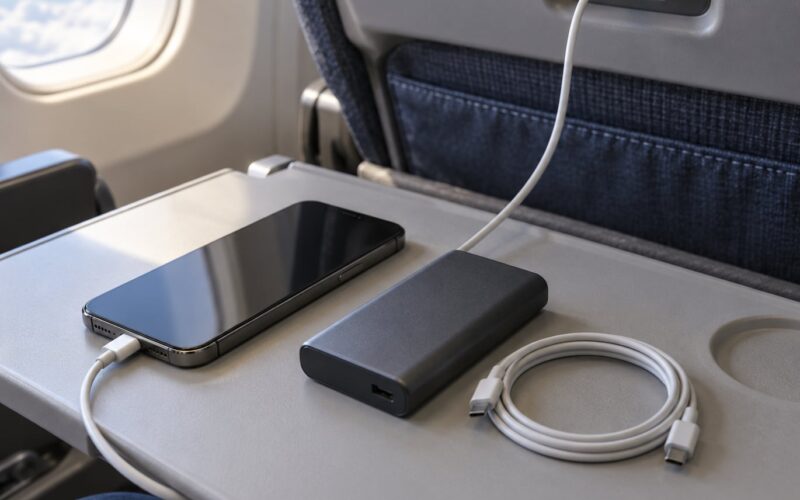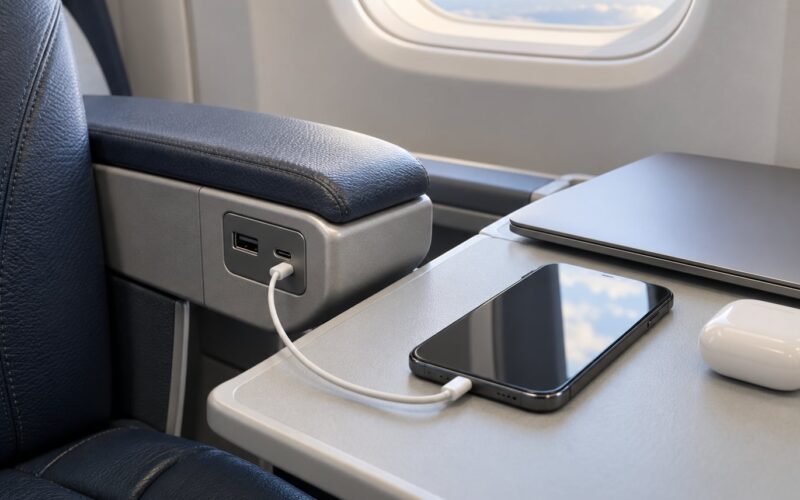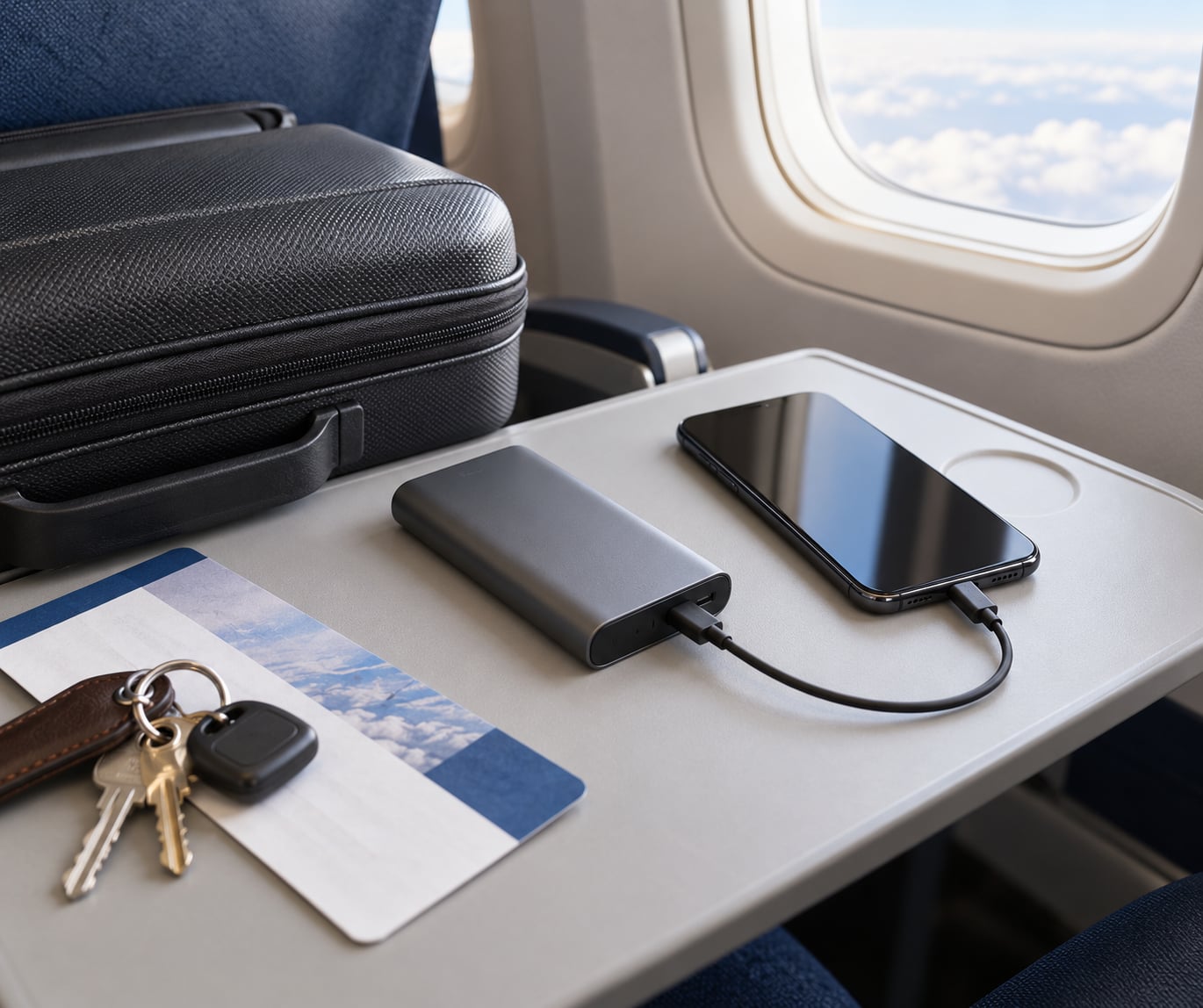
Yes, you can use a power bank on a plane. Keep it in your carry-on bag rather than checked luggage, stay under 100 watt-hours unless your airline approves it in advance, and only plug in if the crew allows it. Carrying a battery on board is a regulatory question. Using it once you are in your seat is an airline decision, and those two things are not the same rule.
The quick version, if you are boarding soon:
- Carry-on or personal item only. Never in checked luggage.
- Under 100Wh needs no approval. Between 101Wh and 160Wh needs written airline approval in advance. Over 160Wh cannot travel in the cabin at all.
- Terminals covered or the bank inside a bag or case so it cannot short-circuit against loose keys, coins or pens.
- Many carriers now want it in the seat-back pocket or under the seat rather than the overhead bin.
- Some airlines permit carrying it but not using it. That is a real rule at Emirates and British Airways, not a grey area.
Everything below is checked against 2026 guidance from the FAA, TSA and the major carriers. Rules have moved repeatedly in the last couple of years, so treat your own airline’s page as the final word.
Table of Contents
- Can You Use a Power Bank on a Plane?
- What Are the Current Power Bank Rules?
- Carry-on only
- The watt-hour ceiling
- Spare batteries, not devices
- Short circuit protection
- International variation
- How Do I Calculate a Power Bank’s Watt-Hours?
- Where to find the number on your own bank
- Why the mAh number on the box is not the number that matters
- Can You Charge a Phone With a Power Bank on a Plane?
- Can you use a power bank on a plane during takeoff and landing?
- Can you charge the power bank itself from the seat outlet?
- Where to keep it once you are seated
- Keep it visible while it charges
- Can You Put a Power Bank in Checked Luggage?
- What if your carry-on gets gate-checked?
- What about other spare batteries?
- Do Airlines Have Their Own Power Bank Limits?
- Regional quirks worth knowing before you book
- Why these rules tightened
- How to Use a Power Bank Safely on a Plane
- What Can You Do If Your Power Bank Is Rejected?
- Frequently Asked Questions
- Can I use a power bank on a plane?
- Are power banks allowed in checked luggage?
- What size power bank can I bring on a plane?
- Can I charge my phone with a power bank during a flight?
- Why was my power bank rejected at airport security?
- Do international airlines allow power banks on flights?
- Conclusion
Can You Use a Power Bank on a Plane?
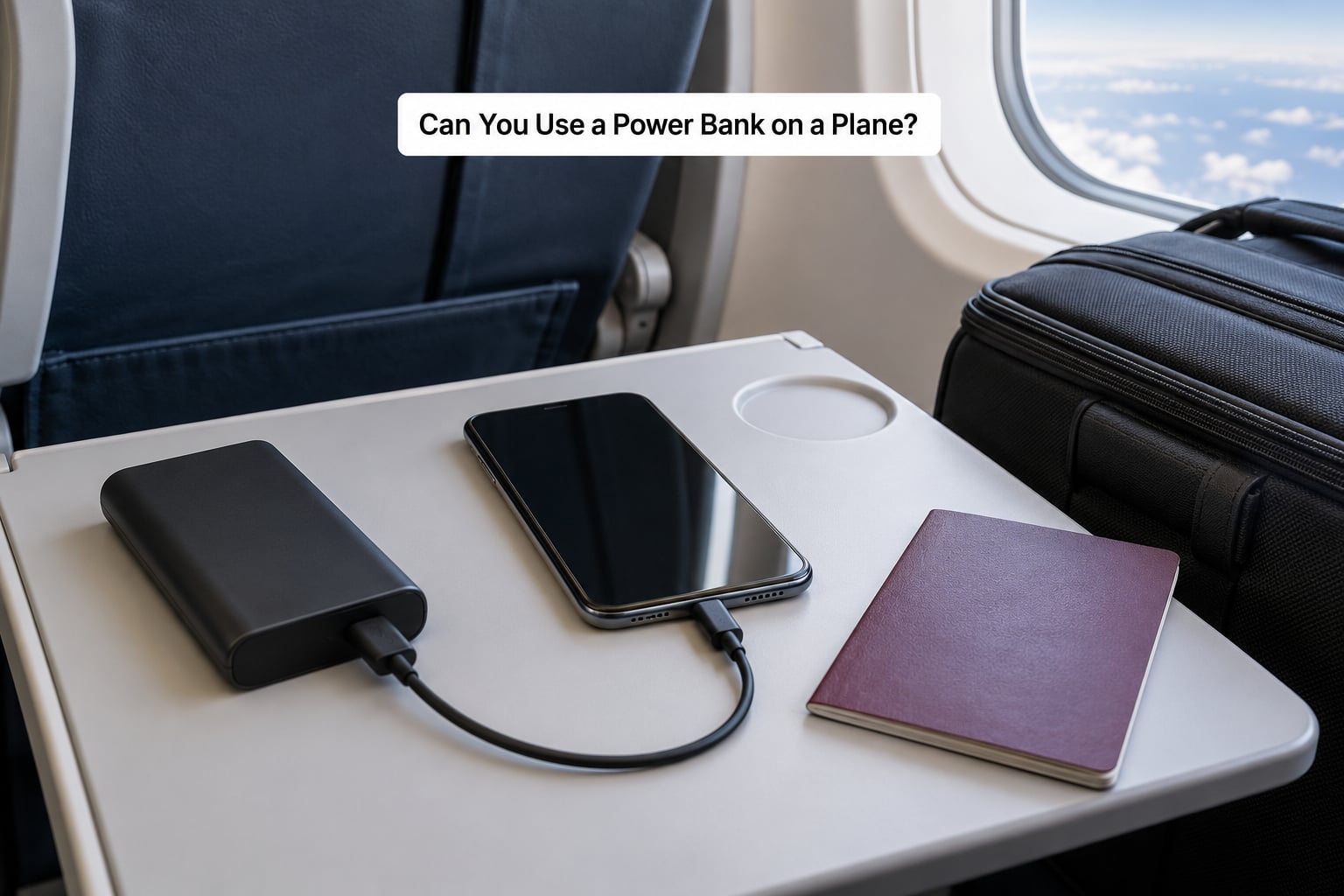
You can use one in flight as long as you carry it in your cabin bag, it stays at or below 100Wh without approval, and your airline permits charging on board. Plenty of travelers assume the first condition covers all three. It does not.
Aviation authorities treat a power bank as a spare lithium-ion battery, which is why it sits in the same regulatory category as the spare batteries for your camera and laptop. Your phone and laptop get a pass because they are installed devices. A power bank is loose energy, and loose energy is the part that regulators watch.
Then the airline adds its own layer on top. Some carriers allow a power bank in the cabin but tell you not to use it. A few have quietly stopped allowing overhead-bin stowage after in-flight battery incidents. And if your bank is between 101Wh and 160Wh, the airline has to say yes in writing before you fly, not at the gate.
So the answer depends on which question you mean. Can you bring a power bank on a plane? Usually yes. Can you use a power bank on a plane? Often yes, but check your carrier, because that is the half of the answer the internet keeps skipping.
What Are the Current Power Bank Rules?
Power banks are allowed in cabin baggage with three conditions attached: the battery stays within the watt-hour limit, its terminals are protected against short circuit, and the airline has not written a stricter rule of its own.
Carry-on only
Both the FAA in the United States and IATA guidance worldwide put spare lithium batteries and power banks in the cabin, not in the hold. Checked baggage goes into a cargo space where a developing fire cannot be reached in time, and that is the whole reason for the ban. A fire in an overhead bin is bad. A fire in the unpressurised hold is worse.
The watt-hour ceiling
Under 100Wh is permitted with no approval. Between 101Wh and 160Wh is permitted with airline approval, and no more than two batteries may fall in that band per passenger. Above 160Wh is not permitted in cabin baggage at all. A small number of powered wheelchairs and scooters are authorised with far larger batteries, but that exception does not extend to portable chargers.
| Capacity band | Cabin status | What you have to do |
|---|---|---|
| 100Wh or less | Allowed | No approval needed. Protect the terminals and keep it in your cabin bag. |
| 101Wh to 160Wh | Allowed with approval | Get written airline approval before you fly. Maximum two per passenger. |
| Over 160Wh | Not permitted in the cabin | Only authorised mobility devices exceed this limit. Do not attempt to carry a portable charger. |
Spare batteries, not devices
Your phone’s built-in battery travels as part of the device and clears screening without comment. A loose lithium battery does not get that treatment. Security officers are looking for exactly this: a power bank that has been sitting loose in a bag with metal items around it.
Short circuit protection
Cover the terminals, or put the whole bank in a bag, a zip case or a sleeve. This is a hard requirement rather than advice. A bank with exposed contacts can short against a keyring, and short circuit is what turns a damaged cell into a genuine incident.
International variation
Outside the United States, the underlying IATA rules are similar but national aviation authorities add their own layer. India, China, the UK and the EU all have requirements that catch travelers out, and I have covered them in the airline section below.
How Do I Calculate a Power Bank’s Watt-Hours?
Multiply the milliampere-hour rating on the case by the cell’s nominal voltage, then divide by 1,000. Almost every portable charger uses a lithium-ion cell rated at 3.7 volts, so the formula in practice is: mAh multiplied by 3.7, divided by 1,000.
A 20,000mAh bank gives you 20,000 times 3.7, which is 74,000, divided by 1,000 for 74Wh. Well inside the limit. A 26,800mAh bank comes to 99.2Wh, which is the practical ceiling most travelers hit, and it explains why that number keeps appearing on compliant travel chargers.
| Capacity on the case | Watt-hours at 3.7V | Verdict for a cabin bag |
|---|---|---|
| 5,000mAh | 18.5Wh | Allowed, no approval needed |
| 10,000mAh | 37Wh | Allowed, no approval needed |
| 20,000mAh | 74Wh | Allowed, no approval needed |
| 26,800mAh | 99.2Wh | Allowed, no approval needed. The practical ceiling. |
| 27,000mAh | 99.9Wh | Allowed, no approval needed |
| 30,000mAh | 111Wh | Approval required before you fly |
| 50,000mAh | 185Wh | Over the limit. Cannot travel in the cabin. |
| 100,000mAh | 370Wh | Over the limit. Cannot travel in the cabin. |
Where to find the number on your own bank
Turn the charger over and read the fine print on the back or the underside, usually under a barcode. You are looking for something like 3.7V, 20000mAh, 74Wh. If the watt-hour rating is printed at all, use that figure rather than doing the math yourself, because some manufacturers rate conservatively and others do not.
If the watt-hour rating is missing entirely, treat it as unknown rather than assuming it is fine. That missing number is one of the most common reasons a bank gets pulled aside at the checkpoint.
Why the mAh number on the box is not the number that matters
mAh measures charge, watt-hours measure energy. A bank with more mAh at a lower voltage can carry less energy than a smaller number at higher voltage, so comparing two chargers by mAh alone tells you nothing about whether either one is legal. Every airline and every regulator asks about watt-hours.
Can You Charge a Phone With a Power Bank on a Plane?
On most carriers you can. Bring your phone back from the back of the seat, plug the cable in, and carry on. The crew may ask you to stop if your airline does not permit it, and that is the end of the conversation. The rule is about the carrier, not about what the battery can technically do.
Can you use a power bank on a plane during takeoff and landing?
Technically yes, nothing in the rules restricts charging to a particular phase of flight. In practice cabin crew will ask you to put cables and loose devices away before the seatbelt signs come on, and a power bank in your hand during that window is a device in your hand. Stow it in the seat pocket, keep the cable with you, and plug in after takeoff.
Can you charge the power bank itself from the seat outlet?
Most airlines would rather you did not. A bank plugged into the aircraft’s own supply while also feeding a phone runs two cells in series with a charge path that was certified for one, which is exactly the combination that produces a swelling cell. British Airways and Emirates both state the point explicitly, and other carriers discourage it even where it is not a written ban. Charge your devices from the bank and recharge the bank on the ground.
Where to keep it once you are seated
- Seat-back pocket. The safest spot, and the one Emirates and British Airways specify.
- Under the seat in your personal item. A good default, and where most crews would rather you put it.
- On your person. Never in a jacket pocket or a bag wedged under a heavy seat.
- Overhead bin. Permitted in many rulebooks and discouraged by an increasing number of carriers after recent incidents. If the airline says no, that is not worth arguing about.
Keep it visible while it charges
If it is charging, it should be somewhere you can see it and reach it quickly. A bank that disappears into a bag under the seat is a bank nobody notices when it starts to smell. If a bank ever gets hot, swells, smells odd or has a damaged casing, stop using it and tell a crew member.
Can You Put a Power Bank in Checked Luggage?
No. Spare lithium-ion and lithium-polymer batteries, including power banks, are prohibited in checked baggage. This is a hard rule rather than a guideline, and it applies to domestic US flights and international ones alike under IATA guidance.
The reasoning is simple. Checked bags sit in an environment where nobody can see them, sometimes for hours, and a lithium-ion cell that enters thermal runaway cannot be contained by a passenger or a crew member in a cabin. The same battery in a cabin bag sits three rows away from a person who can raise the alarm.
What if your carry-on gets gate-checked?
Some routes with small planes or tight bins push cabin bags into the hold at the last moment, and that is how power banks accidentally end up in prohibited baggage. If your bag is being gate-checked, pull the power bank out, put it in your personal item or jacket, and carry it on. Gate agents sometimes hand back a loose battery to passengers; not always, which is why you ask before the bag goes down.
What about other spare batteries?
Camera batteries, laptop batteries, handheld game batteries and vape devices all follow the same rule. Cabin bag, terminals protected, within the watt-hour limit. USB cables on their own are not batteries and carry no restriction.
Do Airlines Have Their Own Power Bank Limits?
Yes, and their rules sit on top of the international baseline rather than replacing it. A carrier can be stricter than 100Wh, can limit how many you bring, can require approval in a form the airline has to countersign, and can permit carrying while prohibiting use. This is the part people get wrong, because the FAA and IATA rulebooks do not tell you what Emirates will let you do at seat 14A.
Here is how the major carriers describe their own policies. Read your airline’s current page before you book, because several of these changed within the last couple of years.
| Airline | Carrying it in the cabin | Using it in flight |
|---|---|---|
| Emirates | One per passenger, under 100Wh, protected terminals | Not permitted. Seat-back pocket or under seat, cable stowed. |
| American Airlines | Carry-on only, up to 100Wh without approval | Permitted, keep it with you or under the seat |
| Delta Air Lines | Carry-on only, up to 100Wh without approval | Permitted, overhead bins discouraged |
| United Airlines | Carry-on only, up to 100Wh without approval | Permitted, keep it visible while charging |
| Southwest Airlines | Carry-on only, capacity limits apply | Permitted, stow under the seat where possible |
| British Airways | Hand baggage, protected terminals, up to 100Wh | Not permitted. Do not charge the bank from the seat supply either. |
| Lufthansa | Carry-on, up to 100Wh without approval | Permitted, follow crew instructions on stowage |
| Ryanair | Hand baggage only, protected terminals, no loose batteries | Restricted. Check the current policy before travel. |
| easyJet | Carry-on, capacity limits apply | Restricted. Check the current policy before travel. |
| Turkish Airlines | Carry-on, up to 100Wh without approval | Permitted, follow crew instructions |
| IndiGo | Carry-on, under 100Wh | In-flight use discouraged under Indian DGCA guidance |
| Iberia and Vueling | Carry-on, capacity limits apply | Follow crew instructions |
| Wizz Air | Hand baggage, protected terminals, quantity limits | Often restricted. Frequent flyer reports describe refusals. |
| Air China and China Southern | Carry-on, CCC-marked batteries only on domestic services | Unmarked batteries are refused at the gate |
Regional quirks worth knowing before you book
India. The DGCA has advised against passengers using power banks during flight, and Indian carriers have tightened as a result. If you fly IndiGo, Air India or Vistara domestically, expect to be told to stow it.
China. On domestic Chinese flights, power banks must carry the CCC mark, the Chinese national certification introduced in the mid-2020s. A bank you bought in another country can be refused at the gate with no warning, which is a genuinely expensive lesson to learn on the way to a connection. Check before you leave home, not at the counter.
UK and EU. A widely used practical ceiling sits around 25,600mAh, roughly 95Wh, because airlines prefer a margin under the 100Wh line. Anything at or above 30,000mAh needs approval on these routes as well as US ones.
Why these rules tightened
Rules across the industry hardened after a cluster of in-flight battery events, including a South Korean aircraft fire, a diversion to Rome after a power bank was found charging in luggage, and a carrier banning power banks outright following a fire risk report. Most of that tightening is about stowage and visibility rather than the right to carry one at all.
How to Use a Power Bank Safely on a Plane
A minute of preparation removes almost every chance of a problem at the checkpoint or a hassle on board.
- Check the airline first. Search your carrier plus the words power bank. You are looking for two answers: the capacity limit and whether use in flight is permitted.
- Read the watt-hour rating. It should be printed on the case. If it is not, replace the bank or keep it at home rather than guessing.
- Protect the terminals. A dedicated pouch, a zip bag, or tape over the contacts. No loose keys or coins in the same pocket.
- Keep it in your cabin bag from the start. Repacking it at the gate is how batteries end up in the hold.
- Decide where it lives on board. Seat-back pocket or under the seat beats the overhead bin at most carriers right now.
- Bring a spare cable. The most common in-flight problem is a cable that broke at home, not a battery rule.
- Watch it while it charges. Heat, swelling or an odd smell means stop and tell a crew member immediately.
- Skip damaged or recalled units. A bank with a dented casing, a torn wrapper or a bulging profile should not travel at all.
What Can You Do If Your Power Bank Is Rejected?
It usually happens at the security checkpoint, and it is usually one of three things: no watt-hour label, a capacity above the permitted band, or a bank that shows physical damage.
First, stay calm and ask what the specific issue is. If the label is missing and you can prove the rating from the manufacturer’s specifications on your phone, that is often enough. If it is a capacity problem, you cannot argue your way past 160Wh, and no airline will approve that band for a portable charger.
Second, split your bag. Move the battery to your personal item or jacket so it can still travel with you, then have the rest of the bag screened. Do not put it back and hope the officer does not look twice.
If your carry-on is being gate-checked, take the power bank out of it and carry it in your hand. That one step prevents the most common confiscation scenario of all.
Third, ask about disposal. Most airports do not take returned batteries back at the checkpoint, but some airport shops and recycling points do. If nobody can take it, do not put it in a bin and do not carry it in your checked bag. Leave it, or take it home and drop it at a household battery collection point.
A confiscated bank is almost never returned. Treat it as gone the moment an officer takes it, and plan a second charging option for the trip.
Frequently Asked Questions
Can I use a power bank on a plane?
Yes, on most airlines you can charge your phone from a power bank during flight, provided the bank travels in your cabin bag, stays at or under 100 watt-hours without prior approval, and your carrier permits use on board. Emirates and British Airways allow carrying but not using. India advises against in-flight use entirely. Always check your own airline before you fly.
Are power banks allowed in checked luggage?
No. Spare lithium-ion and lithium-polymer batteries, which includes every portable charger, are prohibited in checked baggage under FAA and IATA rules. A battery in the hold cannot be reached if it overheats, which is the reason for the ban. If your cabin bag gets gate-checked, pull the power bank out and carry it in your hand or personal item.
What size power bank can I bring on a plane?
Anything at or under 100Wh is allowed with no approval, which works out to about 26,800mAh at the standard 3.7V cell voltage. Between 101Wh and 160Wh needs written airline approval before you fly, with a maximum of two per passenger. Anything above 160Wh cannot travel in the cabin, which rules out most 50,000mAh and larger laptop banks.
Can I charge my phone with a power bank during a flight?
Yes on most carriers, once you are seated and after takeoff. Crew can ask you to stop if your airline prohibits in-flight charging, so check your carrier’s policy rather than assuming. Do not charge the power bank itself from the aircraft seat supply at the same time, since airlines discourage running a cell in series with its own charge path.
Why was my power bank rejected at airport security?
The usual reasons are a missing or unreadable watt-hour label, a rating above the permitted band, or visible physical damage such as a swollen or dented casing. Officers rarely measure capacity directly, but they do read the printed label and ask about it when it is absent. If the rating is printed and under 100Wh, a replacement label and the manufacturer’s specification page often resolve it.
Do international airlines allow power banks on flights?
Most follow the IATA baseline of carry-on only, under 100Wh without approval and protected terminals. Some add stricter conditions: Emirates permits one under-100Wh bank but bans use, British Airways bans use as well, and Chinese domestic flights require a CCC mark that banks bought abroad often lack. Indian carriers discourage in-flight use under DGCA guidance.
Conclusion
Check your airline and your destination rules before anything else, confirm the watt-hour rating printed on your power bank is at or under 100, and keep it in your carry-on in protective packaging the whole way. Whether you are allowed to plug in once you are seated is a second, separate question that only your carrier can answer.
Rules last checked against 2026 guidance. Airline policies change often, so give the carrier a quick search the day before you fly.