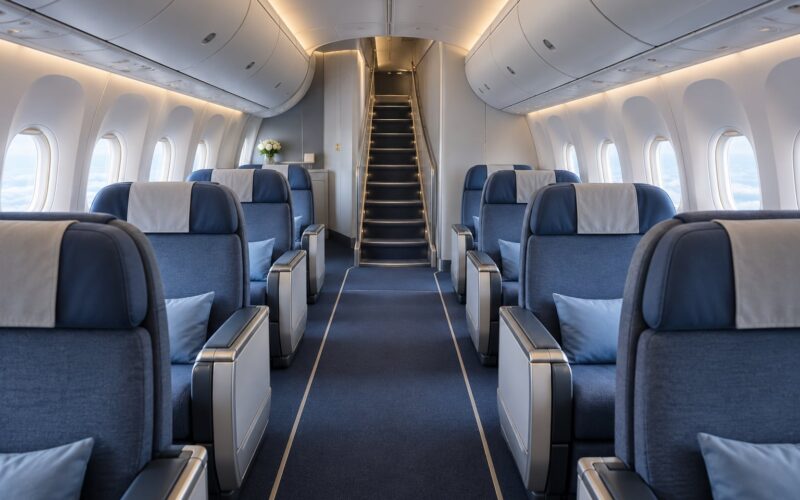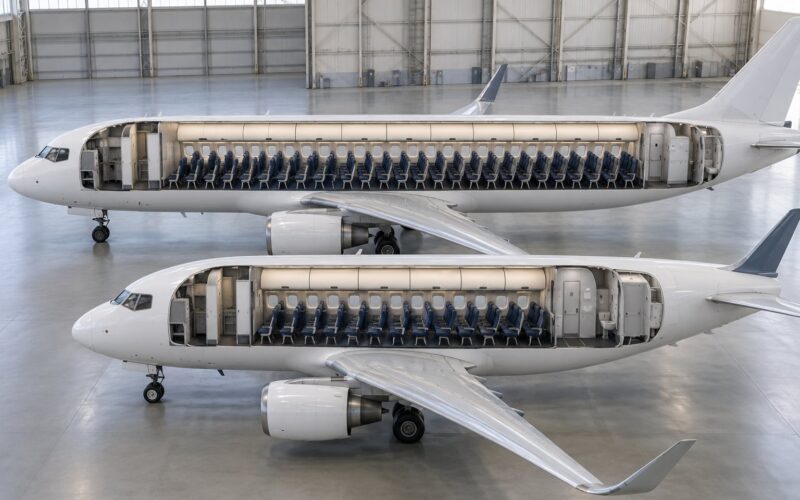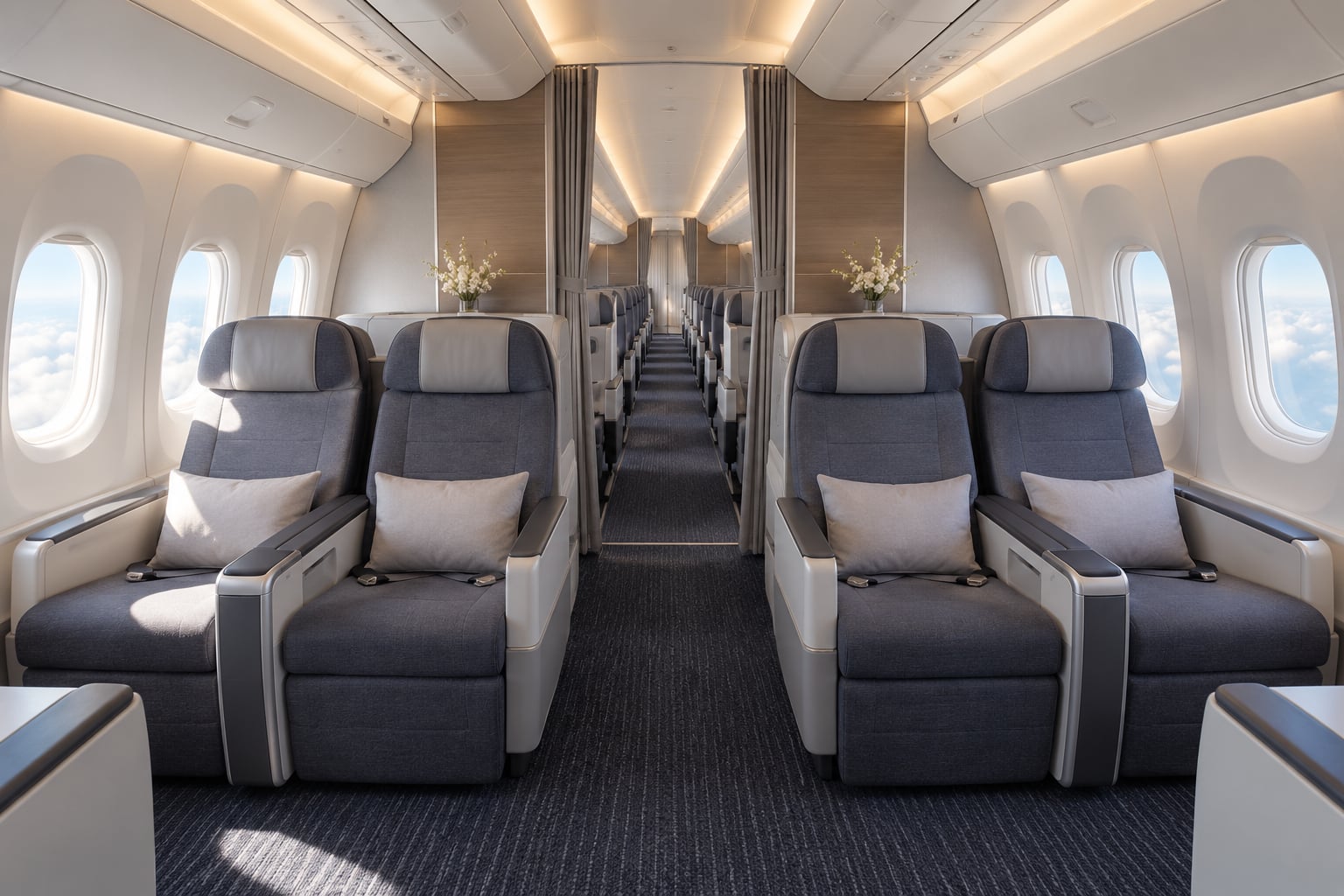
The best seats on an Airbus A330 are usually mid-cabin window seats in the two-seat side pairs, picked for how far they sit from the nearest galley and lavatory rather than for being nearest the front of the plane. Rows just ahead of or behind the mid-cabin service block give you a side wall to lean on, a window that lines up with the seat, and fewer people walking past. A front bulkhead buys you leg space; an exit row buys you the most stretch of any economy seat on the aircraft.
Which one is right for you depends entirely on the trip. A red-eye sleeper wants a wall and quiet. A parent wants a row where a child can move without an aisle footfall. Someone six foot three wants the row with the deepest pitch, not the row with the best view. This guide breaks the A330 into ten seat choices that regularly work, explains the trade-off behind each one, and tells you how to confirm the exact layout before you pay for anything.
One warning up front. Airlines fly several A330 variants, and seat numbers move between them. The same airline, same route, same seat letter can be a bulkhead on one aircraft and a cramped standard row on another. Check the seat map on your booking, then check it again within 48 hours of departure, because aircraft swaps are routine and they silently invalidate every row number you researched.
Last reviewed for October 2026. Seat configurations change with fleet refits, so treat row numbers as guidance and your booking’s seat map as the fact.
Table of Contents
- Best Seats on an Airbus A330 at a Glance
- 1. Bulkhead or First Rows for Extra Legroom
- Why the first row is not always the best
- When to pick it anyway
- 2. Twin-Aisle Window Seats Away From the Galley
- Wall alignment matters more than most guides admit
- How far from the galley
- 3. Aisle Seats in Standard Rows
- What you trade for that convenience
- Who should still take one
- 4. Quiet Seats Near the Front of the Cabin
- The two caveats
- 5. Seats Away From Lavatories and Galleys
- How to find it on the seat map
- How bad is lavatory noise really
- 6. Seats With Extra Legroom in Economy
- Verify the extra space is real
- Order of preference for a tall traveller
- 7. Window Seats Beside the Wing
- The trade-offs are real but manageable
- 8. Sun-Side Window Seats for Views
- Working out which side that is
- Glare, heat and screens
- 9. Middle Rows With Adjacent Seat Availability
- For families with children
- What the airline does not guarantee
- 10. Accessible and Easy-Access Seats
- Where these seats sit
- How to request it
- Frequently Asked Questions
- Are all Airbus A330 seats different?
- What is the best seat on an Airbus A330 for sleeping?
- Which side of an Airbus A330 has the best view?
- Are the best seats on an Airbus A330 worth paying for?
- Which exit-row seat is best?
- How do I find the best seat on my A330 flight?
- Conclusion
Best Seats on an Airbus A330 at a Glance
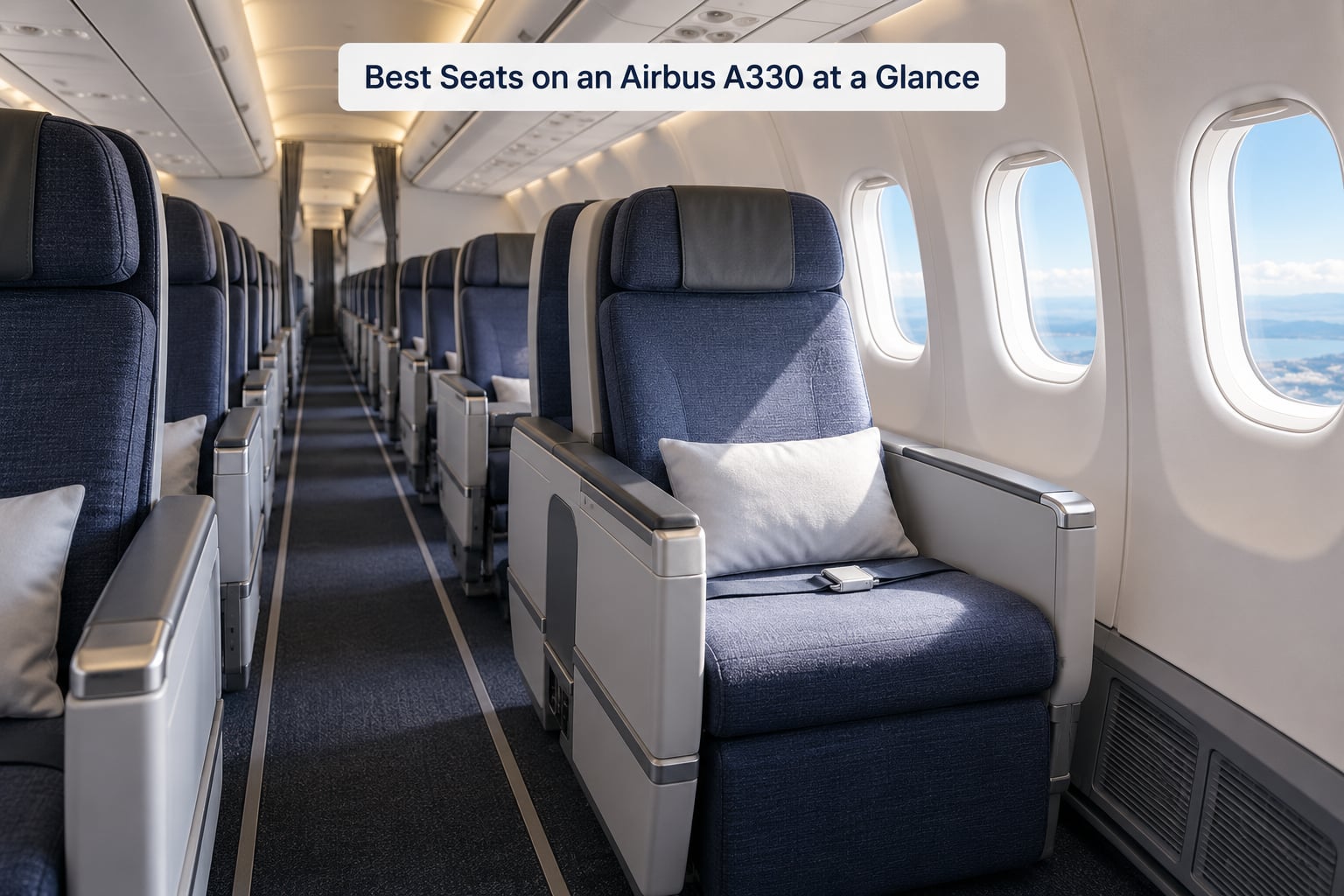
| Seat choice | Best for | Legroom | Noise level | Watch out for |
|---|---|---|---|---|
| Front bulkhead row | Tall travellers, space to stretch | Above average, often asymmetric | Moderate, near forward galley | Fixed armrests, no tray table, bassinets mounted nearby |
| Exit row | Maximum stretch, quick aisle entry | Best in economy, roughly 44 inches or more | Moderate, door and announcements | Rigid armrests, tray table in the arm, door can intrude |
| Window seat, mid-cabin | Sleeping, reading, watching films | Standard economy pitch | Low, if clear of service points | Cabin night lighting spills onto the wall side |
| Aisle seat, mid-cabin | Frequent stretching, quick lavatory trips | Standard, with direct aisle access | Higher, people pass all flight | Service carts and trolleys, no wall to lean on |
| Front-of-zone row behind a premium cabin | Quiet work, fewer interruptions | Standard or exit-row level | Low foot traffic | Announcements and the forward galley |
| Row beside the wing | A defined sleep area with a view | Standard | Low to moderate, airflow noise | Engine and airflow sound, less open view |
| Sun-side window | Daytime views, photography | Standard | Standard | Heat, glare, sun on screens |
| Side pair with an open neighbour | Couples and families | Standard, effectively doubled | Standard | Adjacent seat is not guaranteed |
| Lavatory or galley adjacent row | Very few travellers | Often good pitch | High, queues and light spill | Night foot traffic, door swings |
| Final row of a cabin | Nobody behind you | Often reduced | Variable | Little or no recline on many aircraft |
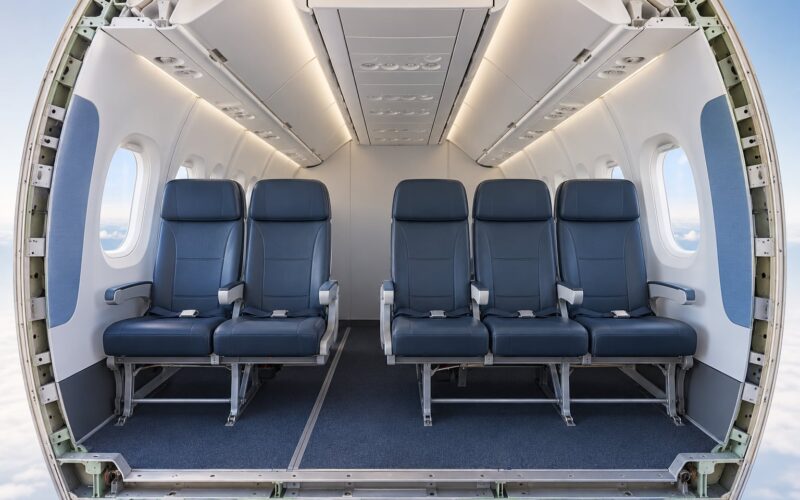
The A330 is not one aircraft. Three variants cover almost all long-haul flying: the A330-200, the A330-300, and the newer A330-900neo. The -200 is the shortest and usually carries fewer rows, the -300 is the classic long-range version, and the neo has newer windows, quieter cabins and larger displays. Cabin layouts differ by airline too. Economy on many A330s runs 2-4-2, meaning eight seats across in four groups, with two-seat pairs against each window and a four-seat middle block. Some carriers squeeze three-seat groups in at the sides, which loses that window-pair advantage entirely.
Economy seat width on a typical A330 runs about 18 to 19 inches across, wider than the 17-inch seats common on older narrowbody-style products. Pitch in a mainstream economy cabin usually sits between 31 and 33 inches. Those numbers vary by airline and by how many rows a carrier fits, so read them as a range rather than a promise.
1. Bulkhead or First Rows for Extra Legroom
A bulkhead row is the first row after a wall or partition, so there is no seat in front to take your knee space. On an A330 that can be worth five inches or more of pitch, which is a genuine difference on a nine-hour sector.
Why the first row is not always the best
Bulkhead legroom varies more than any other seat type on this aircraft. Where the partition is asymmetric, or where the seat is mounted tight against the wall, the extra space can be misleading. FlyerTalk threads on Air Canada’s A330-300 keep surfacing the same complaint: bulkhead legroom on this type is not uniform, and some rows are tighter than the standard row behind them.
Three trade-offs come with the row. Armrests are often fixed, which takes away the freedom to move them and slightly narrows usable width. Tray tables on many bulkhead seats are mounted in the armrest, so the space you gain in front is space you give up at the sides. And bassinets are frequently fitted at bulkhead positions, so you may be sitting next to a family with an infant for the entire flight.
Recline is the other variable. A row with a wall behind it cannot always tip back as far as a standard seat.
When to pick it anyway
Choose a front-row window seat for a long overnight flight when legroom matters more than recline angle, particularly if you are tall or you sleep curled up. It is also a sensible pick on a daytime sector where nobody will recline, because then the armrest and recline limits cost you nothing and the extra floor space is pure gain.
One more practical note. Sit near the wing in the first row of a cabin and you inherit the noise of the row behind the partition. Sit near the nose and you are inside the forward galley radius.
2. Twin-Aisle Window Seats Away From the Galley
The wall-side window seat in the two-seat side pair is the most reliably comfortable seat on an economy A330, and it wins for anyone whose goal is sleep. In a 2-4-2 cabin the window seat has a side wall to lean against, a window that sits at roughly head height when you recline, and only one neighbour instead of two.
Wall alignment matters more than most guides admit
A window that lines up with your shoulder gives you a defined sleeping surface and a clear place to rest your head. A window that sits forward of the seat means you are looking over the seatback to see it, and your neck bends awkwardly at the exact point where you want support. Most A330 windows sit slightly aft of the seat centre in some cabins and slightly forward in others, which is why two seats in the same row can feel completely different against the fuselage.
How far from the galley
Read the seat map and find the galley and lavatory icons before you click. Two to three rows clear of either is usually enough to sleep through. Immediately adjacent is a different experience: carts, service calls, conversation and light from the doorway at night.
Take the aisle side of the same window pair if you expect to get up often. Travellers on Rick Steves forum, flying A330s with two-seat side rows, chose the middle of the forward section specifically to stay within a short walk of restrooms, and that is a reasonable compromise for an older passenger or anyone with a bladder.
3. Aisle Seats in Standard Rows
Aisle seats are the most practical seat on the aircraft for anyone who values movement over scenery. You can stand and stretch without negotiating past a stranger, you reach the lavatory in seconds, and boarding and deplaning is fast because nobody has to climb over you.
What you trade for that convenience
Aisle traffic is the cost. Every passenger in your row and both neighbouring rows passes you during the flight, and every service trolley parks nearby. On an overnight, that means repeated shin contact and light spilling across your face from the cabin floor lighting.
You also lose the wall. Without a fuselage curve to lean into, the seat reclines into open space and the person behind you can recline whenever they like. Most A330 economy seatbacks are designed so the recline of the row behind is the constraint, and aisle passengers absorb the whole angle.
Who should still take one
Long flights with a mobility condition, a tall traveller who wants to stand and stretch every hour, and anyone travelling with a toddler all benefit more from the aisle than from the view. If you fly red-eye and sleep in a chemical eye mask, the aisle’s disadvantages largely disappear.
Pick a mid-cabin aisle seat rather than a front one. You gain distance from the forward galley, and you avoid the boarding crush where two aisles of passengers compete for the same overhead bin.
4. Quiet Seats Near the Front of the Cabin
The first economy rows behind a premium cabin are usually the quietest standard seats on the aircraft, because fewer people walk back to reach them and galley traffic falls off after the first meal service. For passengers who need to work or sleep without interruptions, this is the pick most people miss.
Users on r/delta put it more bluntly than any guide will: there is very little that makes an economy seat more comfortable other than avoiding the first and last rows near the galley. The front of a zone is the easiest way to do that without paying for anything.
The two caveats
Announcements are loudest near the front of the cabin, so you will hear the safety briefing, the boarding chime and every public address call with full clarity. On many airlines the forward galley sits directly ahead, which means you hear the kettle, the trolley and the crew. Users on a r/HawaiianAirlines thread call out rows that work well for flying with family precisely because there is no concern about anyone reclining into the seat behind, which shows how much the row behind matters in a tight cabin.
Choose a window or middle seat in the first rows of the cabin, not the very first row, and you get most of the quiet without the bulkhead’s armrest compromises.
5. Seats Away From Lavatories and Galleys
The easiest all-around economy choice on an A330 is a mid-cabin row in the two-seat side pair, positioned between service areas rather than beside one. It is not the most dramatic seat on the aircraft, but it collects the quiet benefits of the front of the cabin without paying premium prices for them.
How to find it on the seat map
Every airline seat map shows the same icons. Toilets appear as a small figure or a door symbol, galleys as a trolley or counter symbol, and exits as a door with the door position marked. Look at your row and count the symbols either side of it. If a toilet sits directly ahead or behind your seat, move two rows away in the direction of more seats between you and the symbol.
Pay attention to which cabin the symbol belongs to. A forward business-class lavatory sits behind a divider, so an economy bulkhead immediately in front of it is the worst of both worlds: no legroom in front and a queue at your shoulder.
How bad is lavatory noise really
On a daytime sector, tolerable. On an overnight, it is one of the few things that reliably ruins sleep. People on travel.stackexchange asking about eight-hour-plus A330-300 flights worry about exactly this, and the consensus on that thread is that the queue, not the flushing, is the problem. Two to three rows of clearance fixes it in most configurations.
Rows next to a lavatory can still be worth taking when they are a bulkhead or exit row with strong pitch and you are flying during the day. Good space beats quiet during daylight hours. It is the overnight where the trade flips.
6. Seats With Extra Legroom in Economy
Taller passengers should look at three categories: designated extra-legroom rows, exit rows, and the front bulkhead. All three add real space ahead of the knees, and they fail in different ways.
Verify the extra space is real
Do not assume every A330 economy seat gives you more than the next row. Extra legroom is a product on some airlines and simply a consequence of seat position on others. Seat maps that flag a row with an extra-legroom icon usually mean the row physically has more pitch, but a seat described as extra legroom because it is an exit row adds space ahead at the cost of armrest rigidity, not because the seat pitch increased.
Check the pitch figure on the specific aircraft rather than the generic product page. Where a carrier markets a stretchers product, the seat ahead is a small padded panel the passenger can extend their feet onto, which is different from open pitch and easier on the shins.
Order of preference for a tall traveller
Exit row first, because the space ahead is the largest of any economy seat on the type. Then a verified extra-legroom row. Then a bulkhead away from bassinets. Check the seat map for the door position, because on some A330s the door intrudes into part of the exit seat and takes back an inch or two at the shoulder that the pitch figure does not reflect.
7. Window Seats Beside the Wing
A window row next to the wing gives you a view and a defined sleep area without paying for a premium seat, which makes it the middle-ground choice for people who cannot decide between a cheap seat and an upgrade.
The trade-offs are real but manageable
Airflow over the wing produces a steady low sound that some people read as a hum and some find irritating when trying to sleep. Plug-in headphones with decent noise isolation handle it; earplugs handle it better. On the view side, the wing itself occupies part of the window and the horizon sits slightly differently than it does from the front or rear of the cabin.
The bigger practical issue is that the seat block position moves as the fuselage narrows toward the tail, so the window alignment of the same physical seat can differ. If you care about leaning, check the map and pick a window seat a row or two ahead of where the seat block aligns perfectly.
Australian Frequent Flyer threads on A330 comfort converge on the same summary: the aircraft is reasonable for legroom, the exit row is the best single seat, and a mid-cabin or bulkhead row is a solid second. Wing-adjacent window seats fall in that same reasonable band.
8. Sun-Side Window Seats for Views
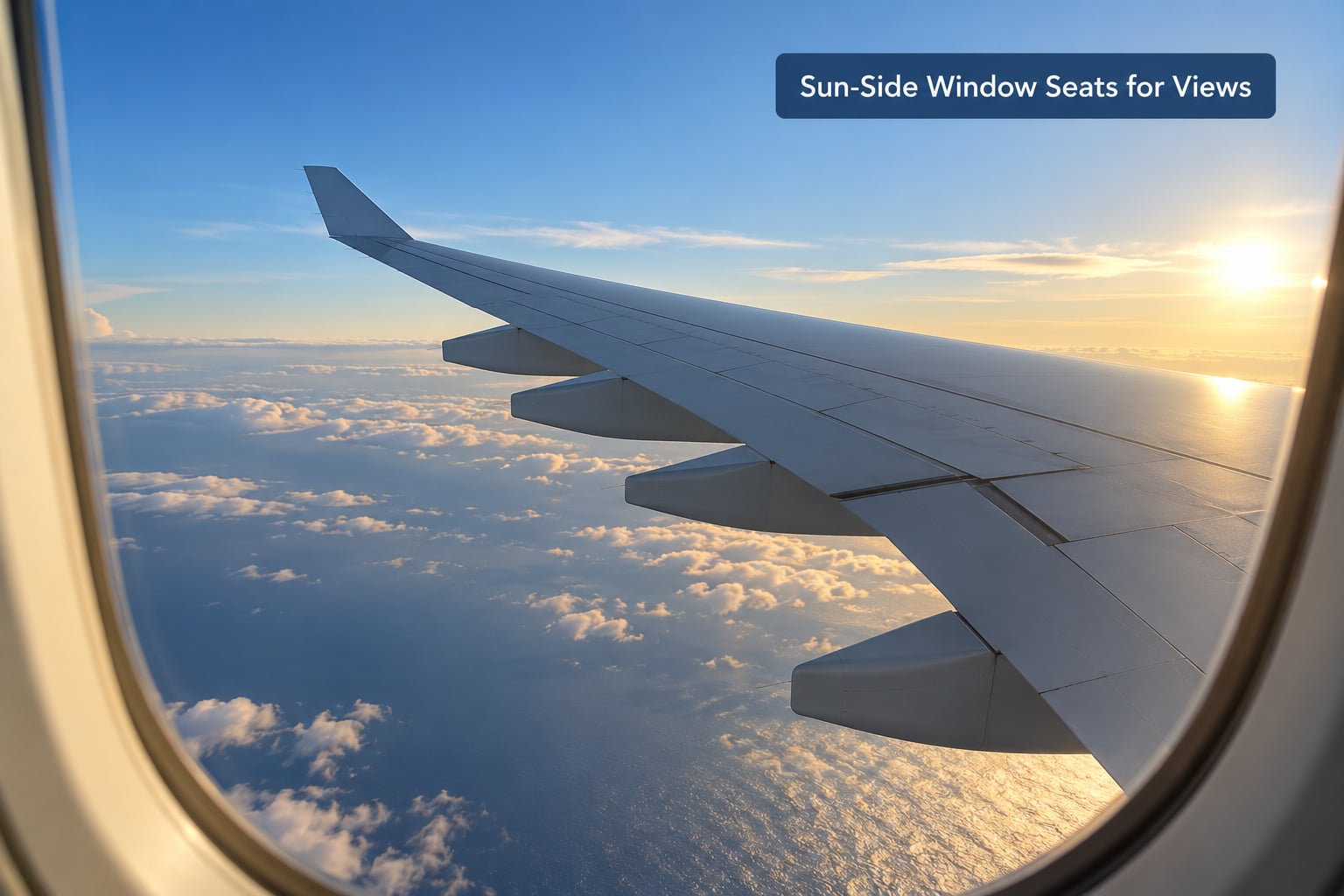
If you are flying a daytime route and want scenery, choose the side that matches the direction of travel and the time of day. Sun side gives you light and open landscape; shade side gives you a darker cabin and better screen visibility.
Working out which side that is
Pick your side by route direction first. Flights heading roughly north, with a midday departure, tend to put the sun on one side depending on season; flights heading south reverse it. Rather than guess, look up your flight number on a seat map tool that shows the great window seat per row, or simply choose the side opposite the sun at your departure airport for the first few hours, since the sun tracks across the sky during the flight anyway.
A concrete case: a daytime long-haul departing in the morning with an evening arrival is mostly flown north or west, and shade-side window seats keep the cabin dim for film watching while still giving a clear view of the ground below. On a southern route with an afternoon departure, the sun-side window seats get light for most of the flight and better landscape photography.
Glare, heat and screens
Sun-side means sun on your face and a warmer cabin, and if you work on a laptop the screen becomes unreadable at altitude with direct light on it. Shade side is the practical choice for anyone planning to use a device or watch the entertainment screen. If views are the goal and the flight is short, the sun side wins the day.
9. Middle Rows With Adjacent Seat Availability
On a 2-4-2 A330 economy cabin, a couple can book a window pair and have nobody between them. The window seats sit in a group of two with the two-seat side pair, so A and C are together and H and K are together, while the middle block of four seats is a separate pair of rows’ worth of strangers on your other side.
On r/delta, couples flying the A330-200 report doing exactly this, choosing forward business-class positions to get two windows and a mid-cabin location. The pattern repeats across carriers because it is a layout fact, not an airline quirk: two window seats, one aisle to reach them, no middle-seat neighbour.
For families with children
The same logic works with kids. A side pair gives you a wall to contain a restless child, a window for entertainment, and an aisle seat you can reach from the neighbouring pair. Families on r/HawaiianAirlines specifically call out rows where nobody reclines into the seat behind, which matters more with a child in the row than it does for an adult sleeper.
What the airline does not guarantee
An open adjacent seat is not something airlines promise on a standard economy booking. Middle seats fill last and most people board from the front, so an empty neighbour is more likely at the back of the cabin than the front. If you need a specific pairing, call the airline and ask about family or preferred seating products that place you together, and check whether your fare includes seat selection at all.
10. Accessible and Easy-Access Seats
Passengers who need easier entry, more legroom, or assistance should request seats through the airline rather than picking from the public seat map. Accessible and priority seating is handled by reservations staff and accessibility teams, not by the seat-selection dropdown.
Where these seats sit
Priority seats are generally at the aircraft doors, giving a short step into the cabin and a straight path to the aisle. Accessible seating is usually in a row with an adjacent empty seat, so a wheelchair can be moved and stowed without blocking a passenger. On an A330 these are often in the first rows of economy or at the nearest position to the accessible lavatory.
How to request it
Contact the airline as early as you can and give your flight number, date and the nature of the assistance required. Airlines often need several days to arrange equipment or to note the request on the reservation, and the seat may not appear on the passenger-facing seat map at all. Individual airline rules govern which rows qualify and what documentation is needed, so the airline’s own accessibility page beats any public seat map for this category.
If you are flying with a companion, say so when you request the seat. Some carriers place accessible rows in pairs for exactly that reason, and the request is easier to satisfy when made in advance.
Frequently Asked Questions
Are all Airbus A330 seats different?
Yes. The same A330 model is flown with different cabin layouts, seat designs and premium products depending on the airline and the individual aircraft. Seat spacing, recline, armrests, power outlets and preferred seat rules all change between carriers and even between two aircraft on the same airline. Always read the seat map attached to your specific booking rather than a generic product page.
What is the best seat on an Airbus A330 for sleeping?
A window seat in a two-seat side pair, away from the galley and lavatories, is usually the strongest choice for sleeping. You get a side wall to lean on, a window that aligns near head height, and only one neighbour instead of two. Leave two or three rows between your seat and any toilet or galley icon, and you remove most overnight foot traffic and light spill.
Which side of an Airbus A330 has the best view?
It depends on the route, the season and the time of day. Window seats beside the wing give a stable, defined view and work well for sleeping, while rows further forward or aft show more ground and horizon. Pick the sun side for light and photography, and the shade side for screen viewing and a cooler cabin. The best side changes with every itinerary.
Are the best seats on an Airbus A330 worth paying for?
Sometimes, when the product adds something real: more legroom, a larger seat, better recline, or a guaranteed accessible position. A standard mid-cabin window seat between service areas is genuinely comfortable and costs nothing extra, so paying is only worth it if you know exactly which row you are buying and what it fixes. Verify the seat map before paying.
Which exit-row seat is best?
On an A330, the exit row offers the most legroom in economy, usually well over 40 inches of pitch. The trade-offs are rigid armrests, a tray table mounted in the arm, and a door that can intrude into part of the seat on some variants. Check the door position on the seat map first. Travellers should also confirm they meet the airline’s exit-row eligibility requirements before booking.
How do I find the best seat on my A330 flight?
Enter your flight number into the airline’s seat map, then locate the galley, lavatory and exit symbols. Choose a window or aisle seat two or three rows clear of every service symbol, prefer a side pair if you are travelling as a couple, and confirm the seat pitch. Check the map again within 48 hours of departure, because aircraft swaps change row positions without warning.
Conclusion
Pick by travel priority. Sleepers choose a mid-cabin window seat in a side pair, two or three rows clear of the galley and lavatories. Couples book an A and C or H and K pair so nobody sits between them. Tall travellers take the exit row or a verified extra-legroom seat. Parents and solo travellers who want quiet choose the front rows of a cabin zone or a row well away from every service symbol. Then open the seat map for your actual flight, confirm the layout, and check it again 48 hours before departure.