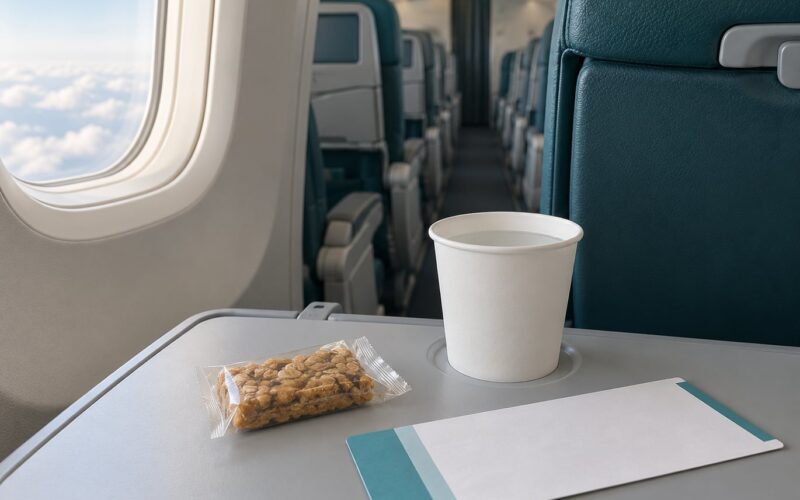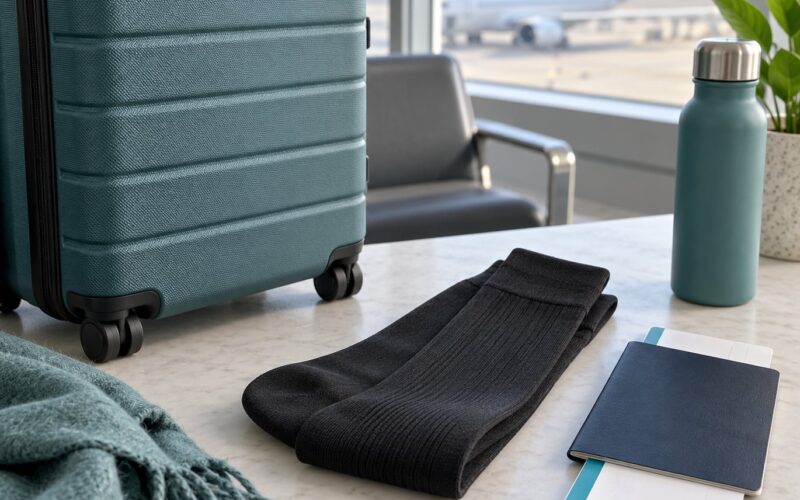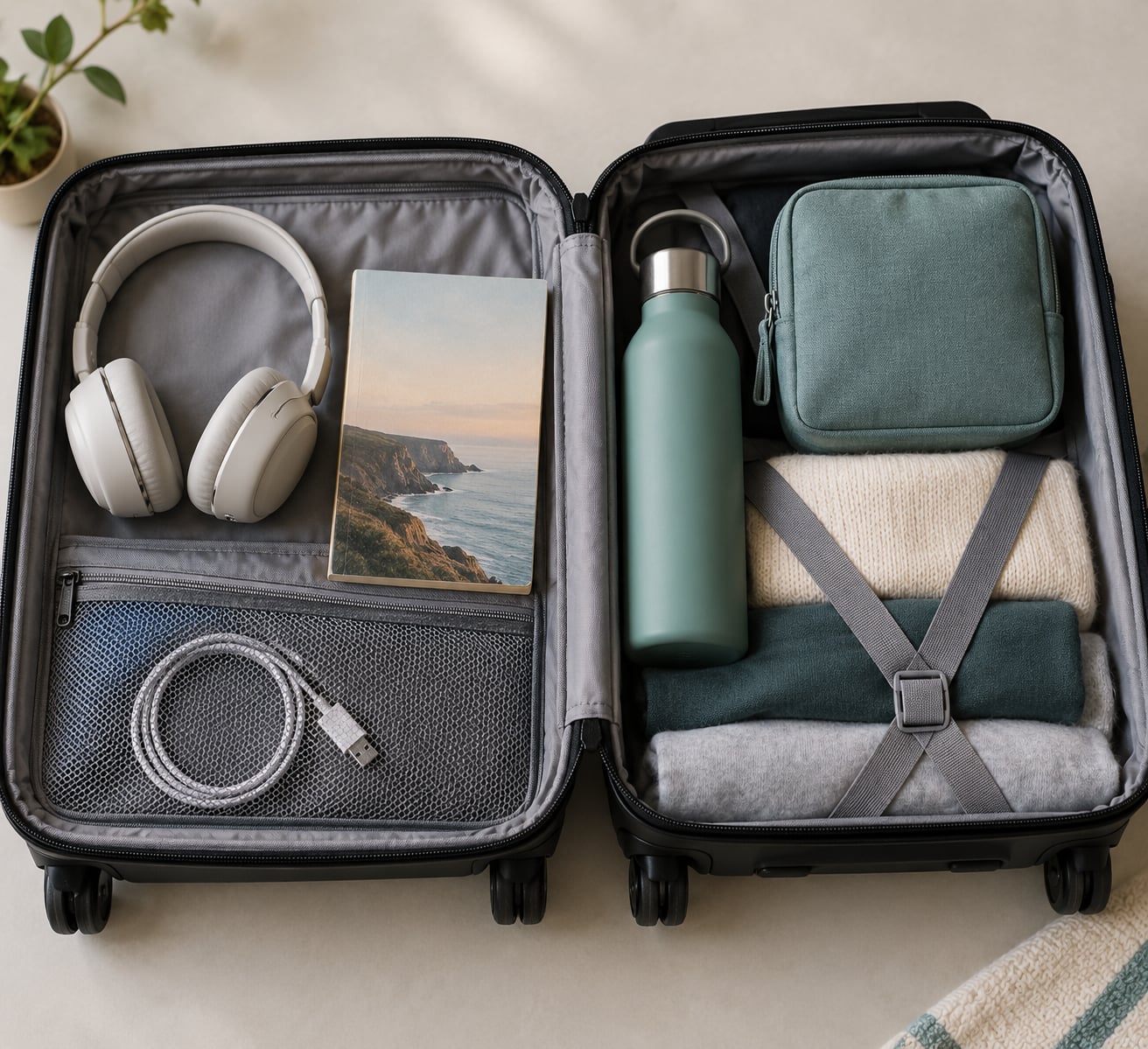
What to bring on a flight with no entertainment screen: pack a small kit that works with the tray table up and no internet. Download music, podcasts and ebooks first, then carry a paper book or puzzle book, a card deck, a pen and notebook, ear plugs, an eye mask, a refillable bottle and a few shelf-stable snacks. Everything past that list is a bonus, not a requirement.
I fly a lot of narrow-body routes where the seat in front of me has a blank plastic panel instead of a screen, and the difference between a good flight and a bad one is almost entirely what was in my bag. The cheapest fix is boring: decide your kit the night before, put it in one pouch, and stop thinking about it.
Table of Contents
- What to Bring on a Flight with No Entertainment Screen
- Build a Lightweight Personal-Item Kit
- What goes in the pouch
- What goes in the overhead bin
- What stays in the seat pocket
- What to skip
- Choose Entertainment That Works Offline
- Before you fly
- In the air
- What not to rely on
- What to Bring on a Flight with No Entertainment Screen for Reading
- For short flights under three hours
- For flights of three to eight hours
- For flights over eight hours
- Small, cheap, worth it
- Stay Connected and Powered
- Pack Food, Drinks, and Cabin-Friendly Snacks
- Improve Sleep and Comfort
- Plan for a Longer Flight Without Screens
- What to bring on a flight with no entertainment screen for longer trips
- Two-hour flight
- Four-hour flight
- Eight hours or more
- When a screen fails mid-flight
- What You Can Leave Behind
- Frequently Asked Questions
- Can I watch movies on a flight without a seatback screen?
- What should I download before flying with no entertainment?
- Is a power bank allowed in my carry-on bag?
- What is the best entertainment for a long flight without Wi-Fi?
- Do airlines provide headphones when there is no seatback screen?
- How should I pack for an eight-hour flight without entertainment?
- What to Pack First
What to Bring on a Flight with No Entertainment Screen
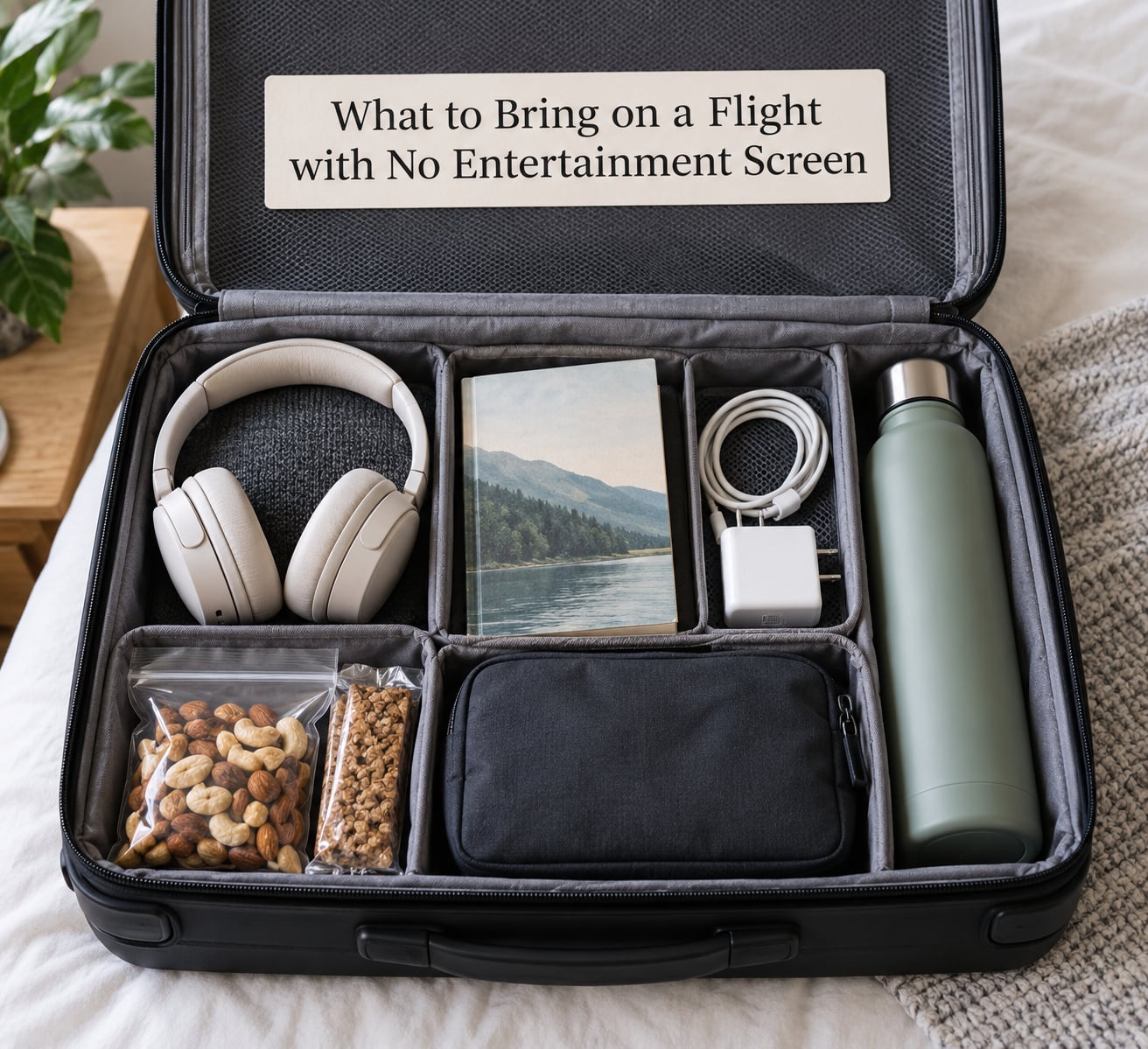
The table below is the short version. It groups items by the trip you are actually taking, because a two-hour regional hop and a nine-hour overnight need completely different amounts of stuff.
| Item | Trip it matters most on | Problem it solves |
|---|---|---|
| Downloaded music and podcasts | Any flight | Boredom and cabin noise |
| Paper book or puzzle book | Three hours and up | No battery, no signal, no screen |
| E-reader with charged library loans | Eight hours and up | Carrying four paper books |
| Card deck | Long flights, especially with a companion | Solo boredom |
| Pen and small notebook | Any flight | Puzzle pages, journaling, lists |
| Ear plugs or noise-reducing earbuds | Overnight and long-haul | Engine drone and chatty seatmates |
| Eye mask | Red-eyes and early departures | Cabin lights at any hour |
| Neck support or a rolled jacket | Sleeper seats, economy overnight | Neck pain on long legs |
| Refillable bottle, emptied at security | Flights over two hours | Dehydration and dry air |
| Shelf-stable snacks | Any flight over three hours | Meal gaps and long waits |
| Charged power bank and cable | Eight hours and up | Dead phone, no seat power |
| Lotion or lip balm | Long-haul, especially on red-eyes | Dry air and dry hands |
That is twelve items and most of them cost a few dollars. The one thing none of them share is a dependency on the aircraft, which is the whole point.
Build a Lightweight Personal-Item Kit
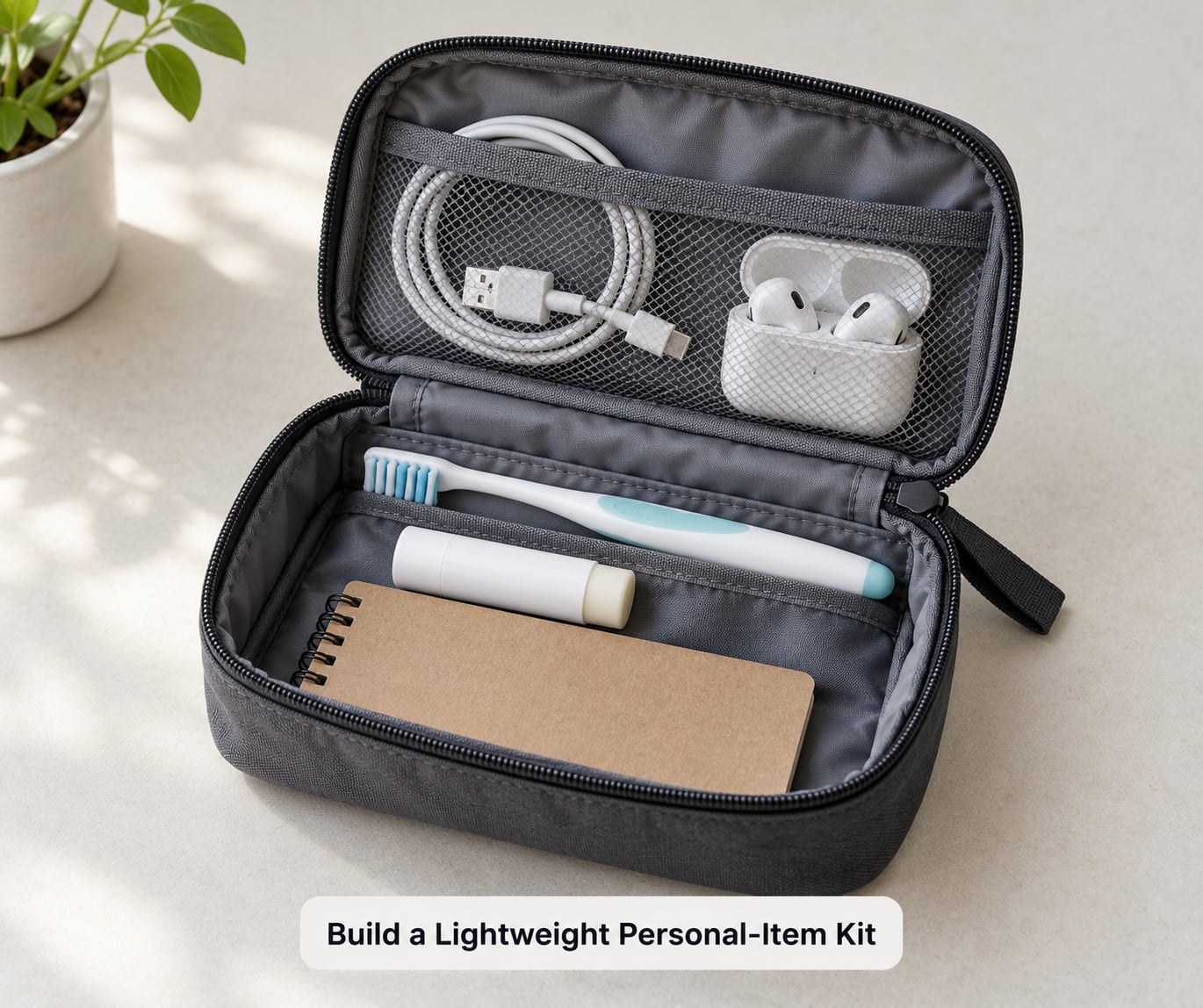
Put the kit in one zip pouch or a small backpack and keep it under the seat in front of you. Under-seat storage means you can reach everything without disturbing anyone, which matters more than people expect on a full flight.
What goes in the pouch
Audio first: headphones, earbuds, and a cable if your headphones are wired. Then the paper items, since they are the ones that cannot fail: book, puzzle book, pen, notebook. Comfort items go in next because they get used during the quietest, most uncomfortable stretch.
What goes in the overhead bin
Anything you will not touch during the flight. An empty water bottle can wait at the top of a bag, but the snack stash, the neck pillow and the second pair of shoes are fine up there. Keep the overhead compartment light enough that you can lift it one-handed.
What stays in the seat pocket
A single sheet of paper, your boarding pass, and one flat item. People jam things into the pocket, then spend the flight trying to work out why a paperback will not go back in. That is a real problem on a plane with nowhere to stand up.
What to skip
Skip the second phone, the bulky wall charger, and anything in glass. You are building a kit for a tube with one table and no shelf space, not a weekend bag.
Choose Entertainment That Works Offline
Offline is the operative word. Assume no in-flight internet, because many aircraft do not offer it, several offer it only above a certain altitude or on certain fare classes, and the ones that do can be slow enough that streaming stalls every few minutes.
Before you leave home, download more than you think you need. People often finish a podcast season in hour three and spend hours four through eight scrolling. Two long episodes of something plus a playlist is a starting point, not a plan.
Before you fly
Set your streaming service to download, then confirm the download by switching to airplane mode at home and playing it. This step catches more problems than anything else on this list. Also grab offline maps, since a phone with a dead battery is a phone you cannot use to find the hotel.
In the air
Put the device in airplane mode after downloading and before takeoff, then turn connectivity back on only if the cabin crew say Wi-Fi is live. Leaving mobile data on drains a battery for nothing.
What not to rely on
The seatback catalogue, the free entertainment page, and anything streamed through in-flight Wi-Fi. Treat all three as possible, never as planned.
What to Bring on a Flight with No Entertainment Screen for Reading
Reading is the most reliable screen-free option because it works in any light, needs no battery, and stops time without asking anything of you. The catch is volume: paper books are heavy, and one thin paperback disappears in four hours.
For short flights under three hours
One paperback is plenty. Pick something you have not read before, because rereading a familiar book on a plane feels slower than it should.
For flights of three to eight hours
Bring a book plus a puzzle book, or an e-reader with the library app loaded. Free library loans work like any other title once downloaded, and an e-reader weighs about the same as a single paperback.
For flights over eight hours
Two paper books and a puzzle book, or one e-reader with six titles on it. Bring a pen that writes on newsprint, since the glossier pages in some magazines fight the ballpoint.
Small, cheap, worth it
The in-flight magazine often carries a word search, sudoku and a quiz page. It costs nothing, it is already in your seat pocket, and it is genuinely fine for thirty minutes on a short hop.
Stay Connected and Powered
Power is the one resource a screenless flight quietly consumes. Nothing on this list runs on electricity except your phone, so plan for it before you fly.
Carry a power bank with enough capacity for at least two full phone charges, and check your airline’s current rules on spare lithium batteries, since most carriers require them in carry-on baggage and limits vary. A cable matters as much as the battery: a USB-C phone with a micro-USB cable is a brick in your pocket.
Do not expect seat power. Some rows on some aircraft have no outlets at all, and the ones that do are usually shared, slow, or behind a panel you discover at the worst moment. Treat onboard charging as luck, not planning.
A small universal adapter matters only if you are plugging into an airline outlet. If your plan is entirely offline, skip it and save the space.
Pack Food, Drinks, and Cabin-Friendly Snacks
Without a screen, eating becomes one of the few activities that fills time on its own, so plan it as entertainment rather than as fuel. That means eating at intervals you choose, not only when a tray appears.
Cabin air is dry and a long flight dehydrates you faster than you notice. Bring an empty refillable bottle through security and fill it at a fountain afterwards. Drinking in small amounts throughout the flight works better than one large glass, and it gives you a reason to stand up and move.
Choose shelf-stable snacks that survive three hours at room temperature and make almost no smell: nuts, crackers, dried fruit, granola bars, or plain sandwiches wrapped tightly. Strong-smelling food is a genuine problem for the person beside you, and word travels fast down a row.
On airline meals, expect a main tray, a drink, and a gap between them that can run four hours. Treat the meal as a marker in the day rather than the whole plan, and put a snack in the seat pocket for the gap.
Improve Sleep and Comfort
Sleep is the cheapest way to lose hours on a screenless flight, and it works on any aircraft with no entertainment system. The trick is doing the preparation before boarding, because you cannot buy an eye mask in the air.
An eye mask is the highest-value item here, especially on red-eyes where the cabin lights come up mid-afternoon. Add ear plugs or noise-reducing earbuds for the engine and the conversations behind you. A neck pillow helps on sleeper configurations and long overnight legs; if you do not want to carry one, a rolled jacket does nearly the same job.
Wear compression socks on flights over four hours, and get up and walk the aisle every couple of hours if the seatmate situation allows it. Long stretches of sitting raise the risk of blood clots in the legs, which is a real medical concern on long-haul flights and not something a good nap cancels out.
Choose loose clothing in layers you can add and remove, and skip jeans. Denim is stiff, holds warmth, and is unpleasant to sit in for eight hours.
Plan for a Longer Flight Without Screens
What to bring on a flight with no entertainment screen for longer trips
Scale the kit to the hours. Overpacking for a two-hour hop leaves you carrying things you never touch, and underpacking for a nine-hour flight is the version people regret on the walk to the gate.
Two-hour flight
Headphones, one paperback, a pen, a bottle, a snack. Nothing else earns its place.
Four-hour flight
Add a puzzle book, a card deck, an eye mask and a second snack. This is the tier where screen-free travel starts to feel normal rather than like a compromise.
Eight hours or more
Add an e-reader loaded with several titles or a second book, a power bank with the right cable, a neck pillow, compression socks and a full meal plan in your head. Bring a sleep mask and one long audiobook for the overnight stretch.
When a screen fails mid-flight
This is how most people meet the problem, because nobody expects it. Five things help. First, check whether the audio side still works, since a dead display does not always mean dead headphones. Second, tell a flight attendant early; there is often a spare unit or a different seat with a working screen. Third, switch to something you already downloaded rather than searching for new content. Fourth, write down what the flight is actually for, because the arrival card and a few notes take an hour when the screen is dead. Fifth, get up, walk, and refill the bottle before you settle in.
What You Can Leave Behind
Some screen-free travel advice is really just a packing list with filler. Skip the duplicate device, the oversized wall charger, loose snack bags that crack in the seat pocket, and printed boarding passes nobody needs anymore.
Also skip anything larger than your tray table can hold, and anything that makes noise during meal service. Small games that fall into the seat gap are not retrievable during flight, and that one lost puzzle book ends the entertainment.
If you pack nothing at all, the free layer still exists. The in-flight magazine has puzzles, the safety card has a diagram worth studying if you like airports, the cabin itself is worth watching from a window seat, and a walk down the aisle burns thirty minutes. It will not fill nine hours, but it beats an empty tray table and a bored face.
Frequently Asked Questions
Can I watch movies on a flight without a seatback screen?
Yes, on your own device. Download films or episodes before you leave home, because in-flight Wi-Fi is slow, expensive, or missing on many aircraft. A tablet or laptop with downloaded video works well; a phone works fine if you bring earbuds and a power bank. If the flight has no screen at all, there is nothing to rely on but what you packed.
What should I download before flying with no entertainment?
Download in two layers. First, a few hours of audio: two long podcast episodes, an audiobook chapter or two, and a music playlist longer than you think you need. Second, reading: library ebook loans or a few titles on your e-reader, plus offline maps for your destination. Test everything in airplane mode at home, because downloads that failed silently are common.
Is a power bank allowed in my carry-on bag?
Usually yes, and it must stay in your carry-on rather than checked baggage. Most airlines cap spare lithium battery capacity and ask that power banks stay in the cabin, where you can use them. Limits differ by carrier, so check your airline’s current rules before travelling. Spare lithium batteries are not permitted in checked luggage under most regulations.
What is the best entertainment for a long flight without Wi-Fi?
A combination beats any single option. Audio for the first stretch, a book or puzzle book for the middle, a short nap for the tired part, and a walk down the aisle in between. Match the activity to the time of day rather than watching a screen block on purpose. Bring at least three options, because boredom arrives faster than a single activity can.
Do airlines provide headphones when there is no seatback screen?
On aircraft with no seatback system, there is usually no headphone jack to provide a pair for. Airlines with entertainment systems may offer inexpensive or free headsets, but that arrangement disappears when the system does. Bring your own headphones every time. Wired earbuds take the least space; wireless earbuds add a charging case to your kit.
How should I pack for an eight-hour flight without entertainment?
Bring an e-reader with several downloaded titles or two paper books, a puzzle book, a pen, a card deck, ear plugs, an eye mask, a neck pillow or rolled jacket, compression socks, a charged power bank with a matching cable, a refillable bottle and enough shelf-stable snacks for the meal gap. Pack it all in one under-seat pouch so nothing is buried.
What to Pack First
Pack in this order and you will never be caught out. Documents and your phone, then one entertainment option you genuinely like, then a power source, then comfort aids such as an eye mask and ear plugs, and only then trip-specific extras like snacks or a second book.
If you remember one thing, remember the pen. It turns a magazine into an activity, a notebook into somewhere to write down what you will do next time, and a boring two-hour flight into something you can survive without borrowing a screen from a stranger.
One last check before you fly: confirm your airline’s current rules on spare batteries and cabin baggage, since both change and neither is worth a bin rep at the gate in 2026.