On a short flight, snack service usually means one small item and a drink handed to you from an aisle cart after takeoff, or nothing at all. There is no universal rule: how snack service works on short flights depends mainly on the distance of the route, and each US airline publishes its own threshold — 250 miles for American and Southwest, 300 for United, 349 for Delta. Above that number you can expect a cart; below it, plan on eating before you board.
Table of Contents
- How Snack Service Works on Short Flights
- What Determines Whether a Short Flight Gets a Snack?
- Distance, not duration, is the number airlines publish
- Why a short route still gets service
- How Long Does a Flight Need to Be for Snack Service?
- What Kinds of Snacks Are Usually Offered?
- How Is Snack Service Timed During the Flight?
- Does Cabin Class Change the Snack Service?
- How Can You Check Before You Fly?
- What Can You Do If No Snack Is Served?
- How Snack Service Differs on Short Flights and Longer Trips
- Frequently Asked Questions
- Do 2 hour flights have snacks?
- Which airlines give complimentary snacks?
- Can I fly with snacks from home?
- How do I know if my flight will serve food?
- Does Southwest give snacks on short flights?
- What to Do Before a Short Flight
How Snack Service Works on Short Flights
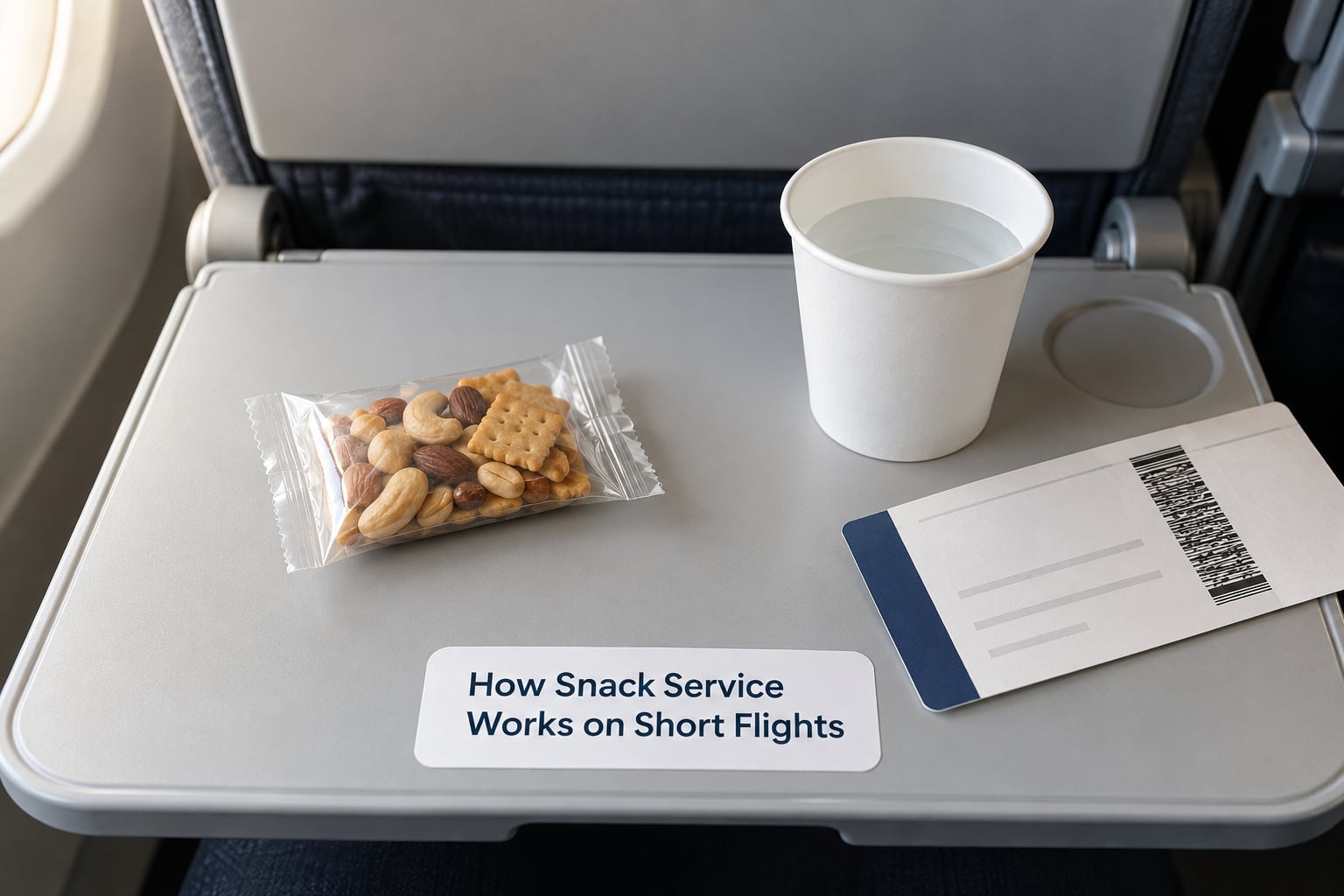
Airlines decide eligibility by mileage, not by hours in the air, and they run the service from a cart rather than a full galley crew.
Here is the short version. If the route is longer than the carrier’s published cutoff, a flight attendant walks the aisle with a tray of packaged snacks and a beverage service, usually once, usually early in the flight. If the route is shorter, the service is removed entirely, and the only water you may see is what is poured in business cabin or asked for by a crew member.
What disappears at the threshold is both food and drink together. That is the part travelers miss most: losing the pretzels on a 300-mile hop also loses the juice and the coffee on that hop.
What Determines Whether a Short Flight Gets a Snack?
Distance is the deciding factor in every published US policy, and it is the only factor airlines publish clearly enough for you to check yourself.
Distance, not duration, is the number airlines publish
A flight can take off at 9:40 a.m. and be in the air for two hours, and another can be airborne for 45 minutes. What separates them in the policy is great-circle miles between the two airports. Delta’s cutoff is written as 349 miles, United’s as 300, American’s and Southwest’s as 250. A timing-based rule would be far harder to apply consistently, so the carriers never adopted one.
Why a short route still gets service
Four things can push a flight past a threshold it would otherwise miss. A specific departure on a long route may fly a larger aircraft with a full galley rather than a regional jet with a limited one. A passenger-weighted fare class in the cabin — a first class seat, a Comfort or Premium Economy seat — may carry service regardless of the mileage. Catering contracts work by airport and by catering vendor, so two flights out of the same hub can be treated differently. And an operational test on a new route sometimes keeps the older standard in place longer than expected.
Passengers report the same flight behaving differently across a season, which is the practical proof that thresholds are a starting point rather than a promise. On reddit.com/r/delta and reddit.com/r/unitedairlines, recurring threads describe the identical route serving snacks one week and skipping them the next.
How Long Does a Flight Need to Be for Snack Service?
Longer than the airline’s cutoff, which for most major US carriers sits somewhere between 250 and 350 miles.
| Airline | Main cabin snack and drink cutoff | What happens below it |
|---|---|---|
| Delta | 349 miles | No food or beverage service in main cabin since May 19, 2026 |
| United | 300 miles | No complimentary snack or drink service |
| American | 250 miles | No snack or drink service; no seat-back screen on most of these aircraft either |
| Southwest | 250 miles | No snack or drink service; the airline’s published standard keeps drinks free only above the cutoff |
| Regional operators | Varies widely by operator and aircraft | Some do not offer a full beverage service below roughly 400 miles or a meal below roughly 800 |
Two-hour flights are the awkward middle. Most domestic two-hour itineraries cover 800 to 1,100 miles, which clears every threshold on the list, so they usually get cart service. A two-hour regional hop of 300 miles does not, and it will not regardless of the clock time you land.
The 349-mile Delta change matters beyond Delta. When the largest US carrier moves a threshold that high, it resets what passengers expect from everyone else, and competing carriers tend to hold their lines or follow within a season.
What Kinds of Snacks Are Usually Offered?
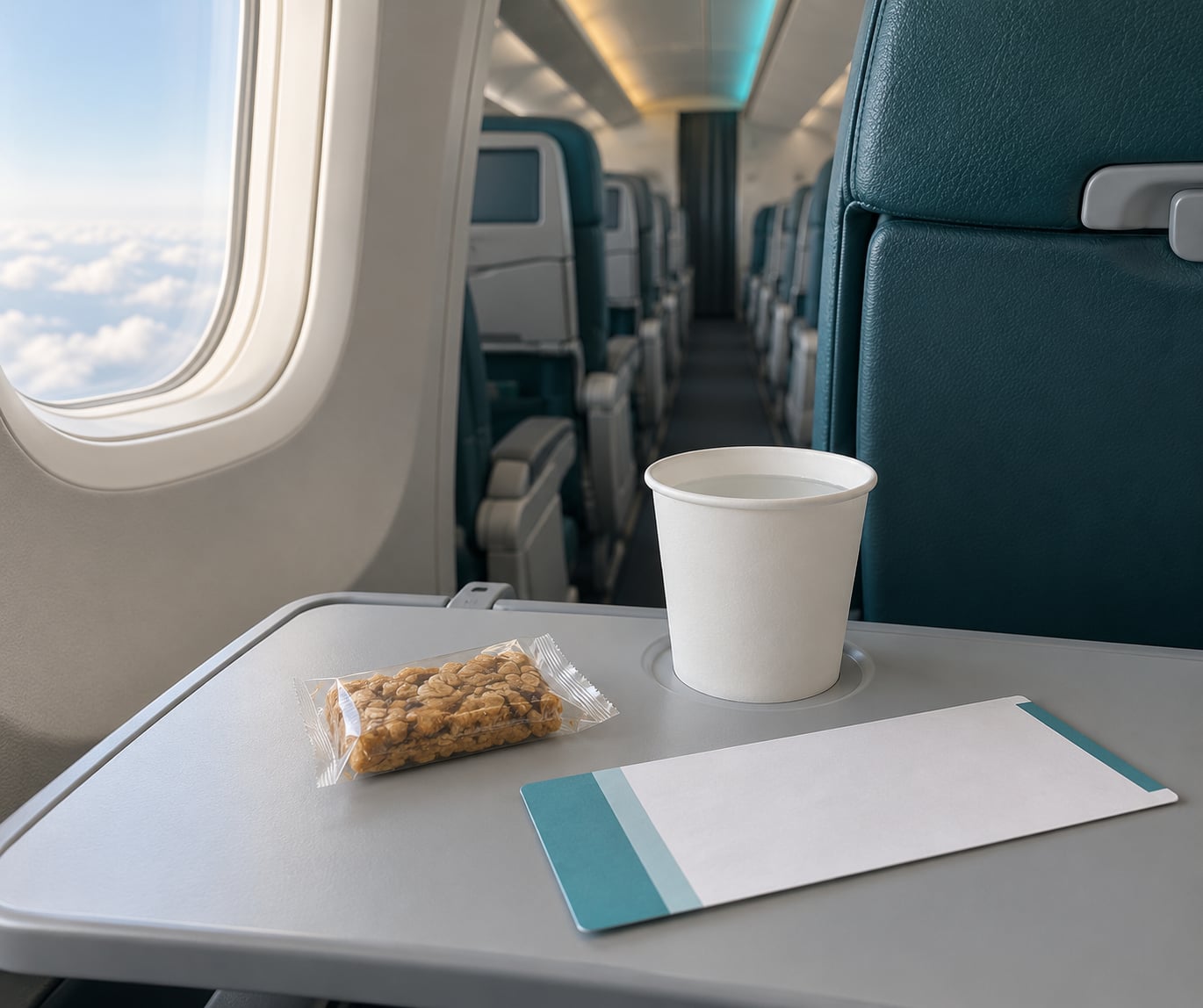
Expect shelf-stable, individually wrapped items that need no reheating and no cutlery, which is what makes them practical on a 40-minute service window.
Typical choices include crackers, pretzels, a cookie or biscotti, a small bag of snack mix, granola bars, and nuts. When American refreshed its complimentary main cabin lineup in 2026, the added items leaned heavily on sweet and savory pairings from brands such as Tate’s Bake Shop and Peterson’s, with Biscoff-style cookies appearing on the rotation. Beverage carts carry bottled water, juice, soda and coffee, sometimes tea.
What you rarely get is anything fresh. Fruit, sandwiches and anything cut open appear on premium-cabin trays rather than in the aisle cart, and those trays belong to longer flights.
Budget carriers are a different model entirely. When there is no complimentary service on a short flight, there is usually a buy-on-board offer instead, priced higher than the same item in the airport terminal. Packaged only, of course, and no hot food. That distinction is worth understanding before you assume an empty flight means an unfed one.
How Is Snack Service Timed During the Flight?
The usual sequence is: galley setup during climb, first beverage pass shortly after takeoff, then the snack pass once the flight levels off.
On a route just over the threshold, the window may be 15 to 20 minutes of usable cruise time. Crews start the service late enough to let the cabin settle and early enough to finish before the descent announcement, because a cart cannot be worked once the seatbelt sign comes on. That is the practical reason a 300-mile flight with service can feel thinner than a four-hour flight — the same cart makes one pass instead of three.
Regional jets are the other constraint. A smaller aircraft has one or two carts and a narrower aisle, so the same 20 passengers per cart ratio slows everything down. When a mainline flight is coded onto a regional operator, the smaller aircraft’s rules usually win, and passengers rarely get advance notice.
Does Cabin Class Change the Snack Service?
Yes — premium cabins are where short flights most often still show a tray, bottled water and something to eat.
- Main cabin follows the mileage threshold exactly. Above it, a cart pass; below it, nothing complimentary.
- Comfort, Premium Economy and similar cabins usually get the same cart service as main cabin, but on a dedicated higher-density trolley, and some carriers extend the service to shorter routes in these cabins than in main cabin.
- First and business cabin on a short flight more often means a plated or packaged snack with a hot drink, and less often means a full meal. Passengers on the first sector of a domestic itinerary may get a tray, then nothing at all on the return sector of the same day.
That last point trips people up. A red-eye pair booked into a premium cabin can get a full tray going out and a bare cabin coming home on the identical route.
How Can You Check Before You Fly?
You cannot see per-flight service in any booking tool, but you can narrow it down in about five minutes using published information.
- Find the great-circle mileage between your origin and destination airport. Search the route distance and compare it to the carrier’s cutoff.
- Confirm the operating airline on the booking. A regional operator’s rules can be stricter than the marketing carrier’s.
- Check the aircraft type shown on the itinerary. A regional jet under 400 miles often means no full beverage service at all.
- Look at the fare rules for your cabin. Complimentary snack and drink service is spelled out in the fare conditions for most US carriers, which is where the threshold actually lives.
- Ask the airline directly if the margin is close — a 290-mile leg on United deserves a question, a 190-mile leg does not.
No airline publishes a per-flight snack calendar, so step five is genuinely the only way to get a yes or no for a specific departure. Ask for the operating carrier and the flight number, not for “the food,” because that is the part they will promise.
What Can You Do If No Snack Is Served?
Eat a real meal before boarding and carry something with you. Nearly every passenger forum thread on the topic lands on the same answer, and it is the right one.
Solid food before you fly beats a vending-machine sandwich at the gate. If you want to bring something, US airport security allows solid snacks through the checkpoint — crackers, nuts, granola bars, dried fruit, unopened packaged items. Liquids, gels and anything spreadable such as peanut butter are subject to the carry-on liquid limits, and partially eaten or unpackaged food attracts far more questions at the belt than a sealed box ever does.
Medical and dietary needs deserve a different route entirely. Airlines can usually accommodate a documented dietary restriction or a low-blood-sugar request on flights with service, but they cannot manufacture a snack for a no-service flight. Tell the airline when you book, put the item in your carry-on rather than checked luggage, and check with your doctor before travel if you manage a condition that depends on eating at set times.
On board, asking politely works better than assuming. Crews on short flights have discretion about water and about handing over an extra portion when a supply is left over.
How Snack Service Differs on Short Flights and Longer Trips
The longer the flight, the more the service model changes from a quick cart pass to a structured meal service — and the portion sizes grow with it.
| Factor | Short flight (roughly under 350 miles) | Medium haul (roughly 350 to 1,500 miles) | Long haul (over 1,500 miles) |
|---|---|---|---|
| Whether food is offered | Only above the airline’s mileage threshold | Usually yes on main line carriers | Yes, on nearly all main line carriers |
| Service style | Single aisle cart pass | Cart passes plus a drink round | Multi-course meal served from a cart or tray table |
| Typical portion | One packaged snack | Snack plus a light sandwich or entrée | Full meal with several courses |
| Timing | One narrow window after takeoff | Snack then meal, hours apart | Scheduled meal times timed to the itinerary |
| Choice | Two to four snack items | Wider rotation, sometimes branded items | Full menu, often with preorder options |
| Water and coffee | Often gone with the snack service | Complimentary drinks included | Complimentary drinks and a wider bar |
The takeaway from that table is simple: a short flight is a cart or nothing, and a long one is a meal service. Everything in between depends on how far above the threshold the route sits.
Frequently Asked Questions
Do 2 hour flights have snacks?
Most two-hour domestic flights do, because two hours of flying usually covers 800 to 1,100 miles, which clears every US carrier’s main cabin threshold. The exception is a short-distance flight scheduled for two hours of block time, such as a 300-mile regional hop. Those fall under the cutoff and get nothing. Judge by mileage, not by clock time.
Which airlines give complimentary snacks?
Delta serves complimentary main cabin snacks and drinks on flights longer than 349 miles, United above 300 miles, and American and Southwest above 250 miles. Regional operators often set stricter limits of their own. Premium cabins frequently receive service below the main cabin cutoff, so the cabin you booked can matter more than the airline on a very short route.
Can I fly with snacks from home?
Yes, solid foods pass through US airport security without a liquid limit. That covers crackers, nuts, granola bars, dried fruit and unopened packaged snacks. Peanut butter, jams and other spreads count as liquids and fall under the carry-on liquid allowance. Keep everything sealed, and pack it in your carry-on rather than a checked bag.
How do I know if my flight will serve food?
Check the great-circle mileage for your route against the airline’s published cutoff, confirm whether a regional operator is flying the leg, and read the fare conditions for your cabin, where complimentary service is normally spelled out. No airline publishes a per-flight snack calendar, so for a borderline route, call the airline and ask about the operating carrier and flight number.
Does Southwest give snacks on short flights?
Southwest’s published cutoff is 250 miles. Above it, main cabin passengers get complimentary snacks and drinks from an aisle cart. Below it, neither is served, which surprises people who know the airline for its free drinks on longer flights. If your route is close to the line, check the mileage before you count on anything being handed to you.
What to Do Before a Short Flight
Check the mileage on your route against the airline’s cutoff, then eat properly before you board if the number is close or under it.
Everything else is a backup. Pack a sealed snack in your carry-on, drink water in the terminal, and if you depend on eating at set times, tell the airline at booking and bring your own backup rather than counting on a cart that may never come down the aisle.