A seat kicker is a passenger behind you who repeatedly kicks or bounces the back of your seat, usually a child or teenager, sometimes an adult. To handle a seat kicker on a flight without escalating: fix what you control first, say one calm sentence if it continues, then catch a flight attendant privately in the aisle rather than in front of the person.
Repeated impacts on a seat frame travel straight up into your shoulders and skull, so even a light tap lands as a rhythmic thump you feel rather than hear. The jolt keeps you from settling, which is why the behavior lands near the top of airline etiquette surveys as the thing passengers find most annoying.
Most of the fear here is social, not physical. People worry far more about the awkwardness of speaking up than about the kick itself, so having a plan written in your head is the single biggest advantage you can bring to the situation.
Table of Contents
- How to Handle a Seat Kicker on a Flight: What You Need
- Step-by-Step
- 1. Decide Whether the Kicking Seems Accidental or Intentional
- 2. Protect Yourself Without Starting a Confrontation
- 3. Check Whether You Can Adjust Your Own Position
- 4. Use a Short, Calm Boundary Statement to Handle a Seat Kicker Without Escalating
- 5. Wait and Watch for a Change in Behavior
- 6. Involve the Flight Attendant if the Problem Continues
- 7. Document Repeated Incidents and Follow Up
- How to Handle a Seat Kicker on a Flight: Common Mistakes
- Frequently Asked Questions
- What if the passenger says they cannot stop kicking their feet?
- Can a flight attendant move me to another seat because of a seat kicker?
- How do I report a seat kicker without knowing the passenger’s name?
- Should I document the incident with photos or videos during the flight?
- When should I move or seek immediate help instead of confronting the passenger?
- Conclusion
How to Handle a Seat Kicker on a Flight: What You Need
You need almost nothing. Knowing which flight attendant is working your section and having one clear sentence ready does more work than any gadget.
- A personal line you will not cross. Decide in advance what actually bothers you. A tap every few minutes and a full-force heel every thirty seconds are different problems, and you need to know which one you are dealing with before you open your mouth.
- A sense of where the crew are. Note the attendant working your zone when you board, usually the one closest to your row, and whether they are mid-service. Catching them at the right moment matters more than catching the right one.
- Something to write on. A boarding pass, a napkin, or a note on your phone. Time stamps and seat numbers make a later report to the airline factual rather than vague.
- The airline’s contact details. Save the customer-service number before you fly if you think you may need it. Doing it mid-flight rarely works well.
Keep safety separate from comfort while you plan. A hard kick that damages your seat or a clash with someone unstable is a different category from an irritating habit, and crew respond faster when you describe the first kind plainly.
Step-by-Step
1. Decide Whether the Kicking Seems Accidental or Intentional
Watch for a few minutes before you act. Kicking that begins when the person settles down, stops entirely during the meal service, and starts again afterwards reads as restless or unconscious rather than aimed at you.
Kicking that continues at the same force after you have asked, or that comes with turning around to argue, is deliberate. You do not need to prove which one it is. The goal is to handle a seat kicker without assuming the worst, and involuntary movement still deserves a boundary.
2. Protect Yourself Without Starting a Confrontation
Clear the seat-back pocket, tuck loose items under your legs, and move anything fragile away from the impact zone. If you brought a laptop or a tablet, keep it out of the strike area.
Use your footspace normally. You are entitled to the space your seat gives you, and you are not obligated to make yourself smaller to reduce the force of a kick you did not cause. Never swing your own feet back, tap the seat in retaliation, or block the aisle to make a point; a safety hazard gives the crew a bigger problem than the one you raised.
3. Check Whether You Can Adjust Your Own Position
Small changes often end the issue on their own. Shift how you sit, adjust your recline, move your knees out of the way, or place a bag under your feet as a crude footrest if the carrier permits it.
Reseat yourself facing a little differently and the contact point moves. Plenty of people never say a word because a three-minute posture change solved it. How you will know it worked: the thump stops or moves somewhere harmless without any conversation.
4. Use a Short, Calm Boundary Statement to Handle a Seat Kicker Without Escalating
Turn around, keep your voice at conversation level, and use one sentence.
With a child, talk to the adult beside them. Something like: “Sorry to bother you. Your child is kicking my seat quite hard, and it is uncomfortable. Could you ask them to stop?” Forum threads repeatedly show parents apologising the moment they are told, which is why this route works better than addressing the child directly.
With an adult, keep it factual and free of labels. Try: “Excuse me, could you stop kicking my seat? It’s uncomfortable back here.” Avoid the words aggressive, harassing, or rude, and never mention consequences. You will know it landed if the behaviour stops, slows, or the passenger apologises.
5. Wait and Watch for a Change in Behavior
Give them a fair chance. Most people need a moment to register the request, and a passenger who was not aware of the problem often needs a second. There is no universal time limit that fits every case; a short flight with a toddler is different from a nine-hour overnight.
Keep protecting your space while you wait. If the kicking drops from every thirty seconds to once in a while, treat that as progress. If it resumes at the same force, move to the next step rather than giving a second warning, because repeated reminders turn into an argument.
6. Involve the Flight Attendant if the Problem Continues
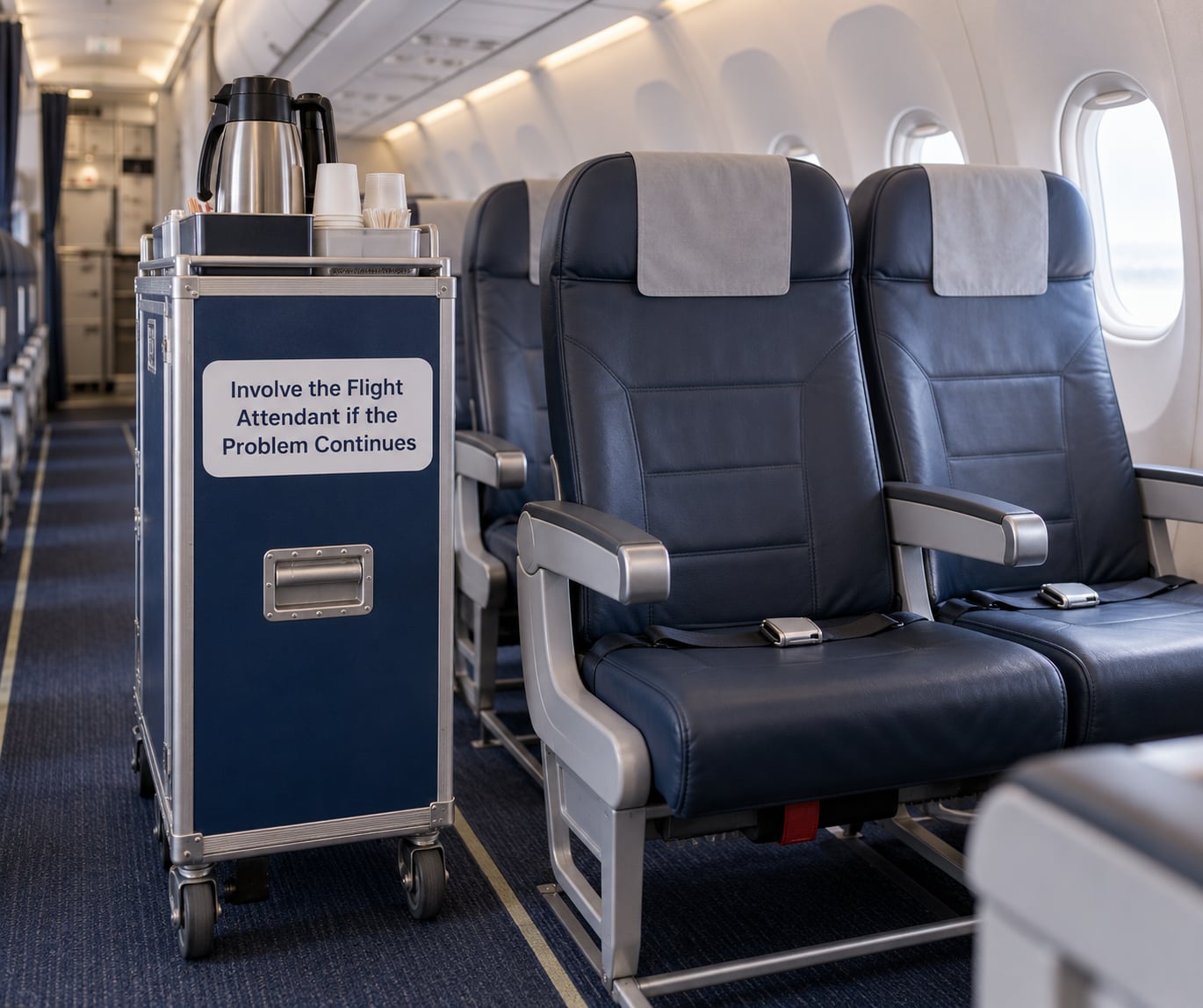
Signal the nearest crew member rather than pressing the call button in a hurry. The call button is fine, but pressing it mid-service tends to produce a rushed conversation. Waiting for a calm moment, or catching the attendant in the aisle as they pass, is what passengers on flight forums describe as the move that actually works.
Then take the conversation away from your row if you can. Get up, walk toward the galley or the lavatory, and speak there so the person behind you cannot hear you describing them. That single change of location is the most repeated tip across seat-kicker threads, because it removes the audience that turns a request into a show.
Keep the report short and factual: “The passenger behind me has been kicking my seat for the last twenty minutes. I asked them politely to stop and it has continued.” Then say what you would like, usually help getting the behaviour to stop.
Crew members may check on the passenger, explain cabin expectations, note the report, or look at whether a spare seat is available. They will not always act, and they will not always tell you why. If nothing changes, ask once more plainly what options you have, then protect yourself for the rest of the flight.
7. Document Repeated Incidents and Follow Up
If it happens on one flight only, a note to yourself is enough. If the behavior recurs, write down the flight number, date, seat, when the kicking started, what you said, what the crew did, and when it stopped.
Save any message you send the airline and keep photographs you already took, such as a photo of a damaged tray table armrest or seat-back pocket. Take new photos of other passengers only if you are comfortable doing so; you do not need a recording of their face for the airline to act on a pattern.
Contact customer service after you land and describe the pattern, not the insult. Documentation supports a future complaint or a request for a seat assignment on a future booking. It is not a substitute for asking a crew member for help in the moment, and it does not replace moving away if the situation feels unsafe.
How to Handle a Seat Kicker on a Flight: Common Mistakes
Most bad outcomes come from doing one of six things, each with a simple fix.
- Reacting with force. Kicking back, spinning around, or raising your voice turns a comfort problem into a cabin incident, and the crew now have to manage two people. Fix: deal with it in a normal tone, face forward, and take it to the aisle if you need more.
- Arguing over every accidental touch. A single brush of a bag or a footrest catching your seat is not the same as repeated deliberate kicking. Fix: mention the pattern, not isolated bumps, and save the complaint for the behavior that repeats.
- Threatening consequences. Saying you will report them or get them removed invites a standoff you cannot win. Fix: state your boundary, then let crew decide what policy applies.
- Public shaming. Loud complaints aimed back at the seat make the whole cabin watch you. Fix: keep it to one calm line in person, and the detail conversation with crew out of earshot.
- Leaving belongings exposed. A kicked laptop or a broken seat-back pocket is an avoidable loss. Fix: stow or secure anything you would hate to lose before the first thump.
- Waiting too long for crew. Hoping the problem resolves itself on a ten-hour flight is optimistic. Fix: one request, a short wait, then the attendant, then consider moving.
For future flights, seat choice is the only real prevention. A bulkhead or exit row removes the seat in front of you entirely, which is the strongest fix available. Otherwise, avoid rows behind a family with a toddler, stay away from the galley and lavatory where movement is constant, and pick an aisle seat over a middle one so you can stand up and change position freely. On a red-eye, bring over-ear noise-cancelling headphones, which regular flyers rate as the practical option, and pack foam earplugs as a backup. Expect partial relief: the thud travels through the seat frame, and cancelling it helps with impact more than with low-frequency vibration.
Frequently Asked Questions
What if the passenger says they cannot stop kicking their feet?
Believe them, and stop arguing about intent. If the movement is involuntary, the goal shifts from requesting a behaviour change to reducing contact: adjust your posture, move your legs clear, use a footrest or a bag where the carrier allows it, and ask the flight attendant to help. Crew can also discuss it with the passenger as a comfort issue rather than a complaint, which usually lands better than a request to stop.
Can a flight attendant move me to another seat because of a seat kicker?
Sometimes, yes, but never assume it. Whether you can move depends entirely on the load, the cabin layout, and whether a spare seat is open. Crew cannot always reseat you in the same class, and they may ask you to wait. Ask directly rather than assuming the answer: ask whether any other seat is available on this aircraft. If none is, plan to protect your own space for the rest of the flight.
How do I report a seat kicker without knowing the passenger’s name?
You rarely need it. Tell the flight attendant your seat row and the row behind you, plus roughly how long the behavior has been going on. Cabin crew work from position and description, not names. If you want to follow up with the airline afterward, give the flight number, date, your seat, and the row behind you, and describe the behavior factually. That is usually all the details the customer-service team can use.
Should I document the incident with photos or videos during the flight?
Record only if you are comfortable doing so, and keep it to things you already have a reason to photograph, like a damaged seat-back pocket or tray table armrest. A video of another passenger is rarely needed for an airline to act and can turn a comfort issue into a confrontation. Notes with times and seat rows are more useful than footage, and they are easier to act on later.
When should I move or seek immediate help instead of confronting the passenger?
Move or get help straight away if the passenger seems agitated, intoxicated, or is being deliberately aggressive, if you are travelling with a small child, or if the kicking is hard enough to damage equipment or hurt you. In those cases skip the direct conversation and catch a flight attendant as soon as one passes. You are never obligated to have a face-to-face conversation with someone whose behaviour unsettles you.
Conclusion
Start with a safety check. If nothing is damaged and nobody seems aggressive, try one practical adjustment to your own position and belongings first. If the thump continues, say one calm sentence, to the parent if a child is involved, and give them a moment to respond.
When it carries on, catch a flight attendant away from your row and describe the behavior and how long it has lasted. That is how to handle a seat kicker on a flight without turning yourself into the person the cabin is watching. Write down the details as it happens so a follow-up call is easy if the behavior returns.