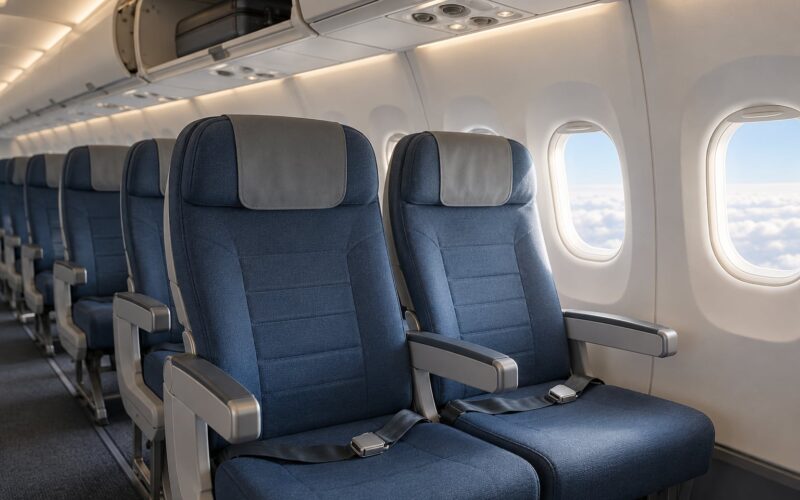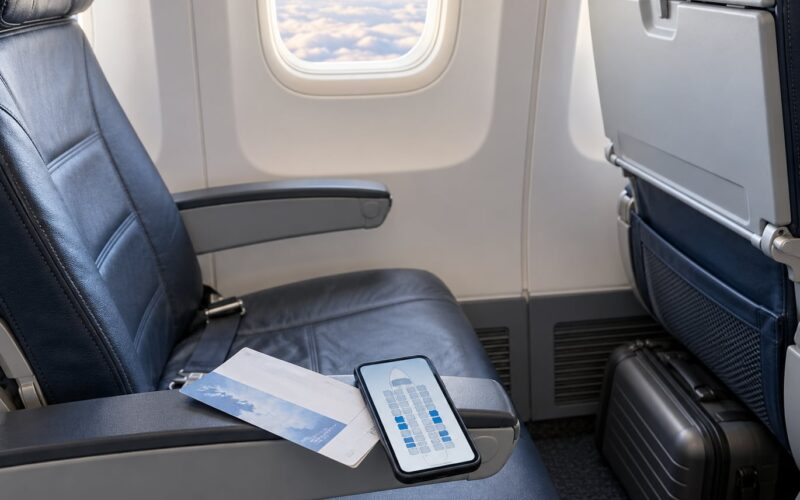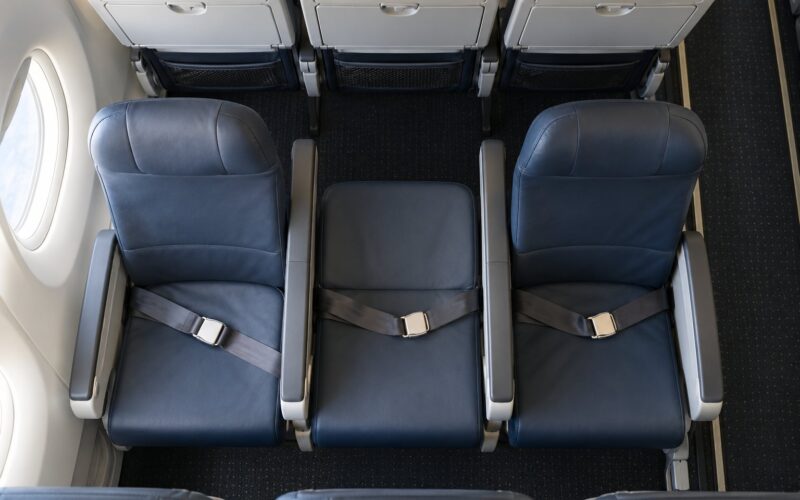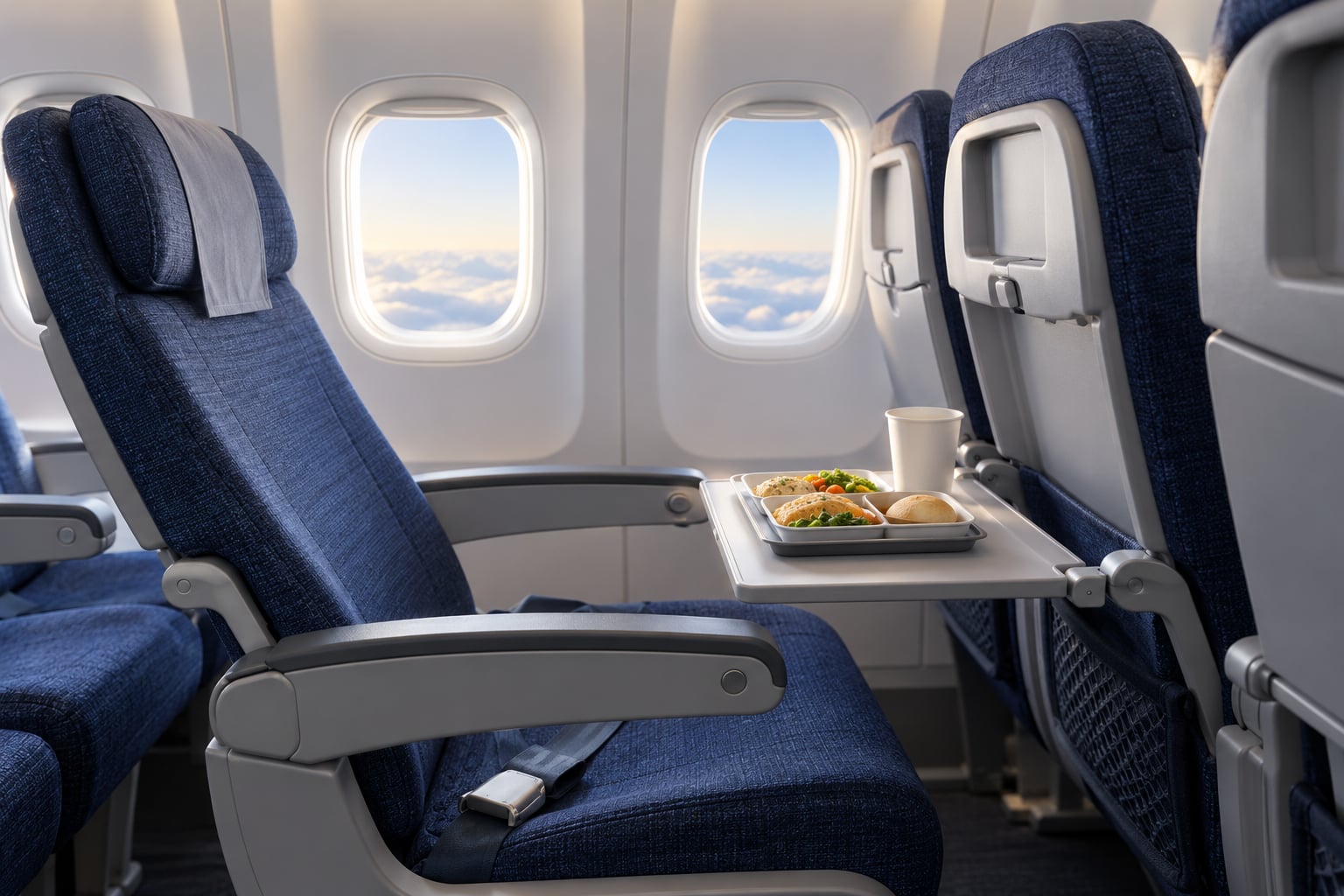
Is it rude to recline your airplane seat? No, not on its own. A paid economy seat is built to recline, and using that range is your right. It turns rude when you slam it back without warning, ignore a tray table in use, or lean back during meal service. One glance behind you fixes most of it.
I fly short-haul routes often enough that the pattern is familiar. The conflict almost never comes from the recline itself. It comes from the surprise, and from a person in row 22 who eats most of the meal service with their knees up against a tray table.
Table of Contents
- Is It Rude to Recline Your Airplane Seat?
- What Is the Etiquette for Reclining an Airplane Seat?
- When you can recline your airplane seat without asking
- What the seat actually does when it reclines
- Should You Ask a Seatmate Before Reclining?
- When Is Reclining Your Seat Especially Unwelcome?
- How to Recline Without Creating Conflict
- What If the Person Behind You Objects?
- Can the Flight Crew Set the Rules?
- Frequently Asked Questions
- Is it rude to recline your airplane seat?
- Should I ask permission before reclining my airplane seat?
- Is it okay to recline during meal or beverage service?
- What should I do if the passenger behind me is using my tray table?
- What if the passenger behind me keeps reclining into my space?
- Conclusion
Is It Rude to Recline Your Airplane Seat?
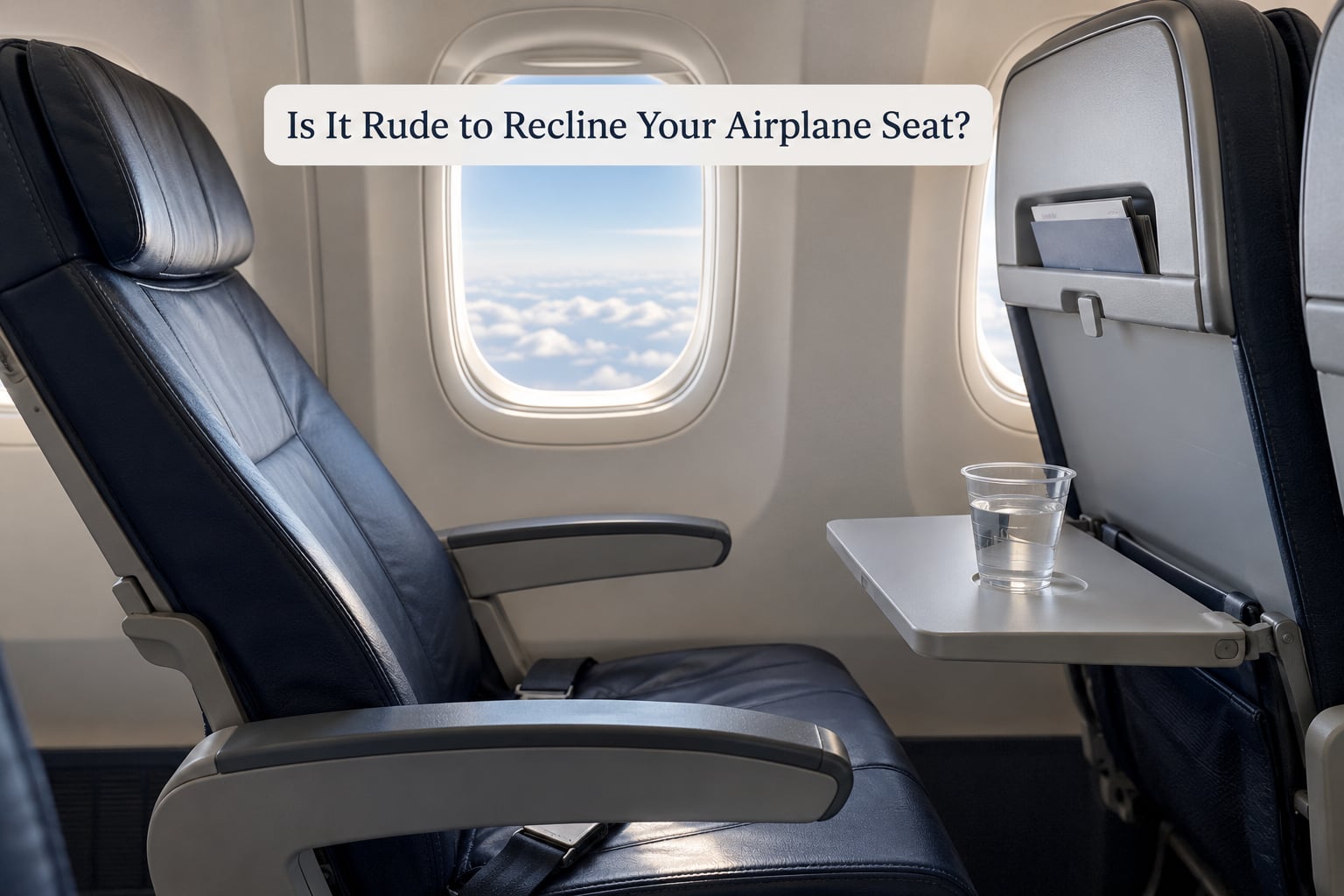
Short answer: reclining is acceptable and expected. Seats recline because the airline built them to, and the passenger behind you signed up for a seat in front of a reclinable one. What people actually object to is the delivery, not the movement.
Three behaviours turn an ordinary recline into a confrontation:
- Slamming the seat back with no warning, which lands a tray table, a laptop or a drink in someone’s lap.
- Reclining while the passenger behind you has the seatback tray table down and is eating or working.
- Leaning back during taxi, takeoff and landing, or straight through meal service.
Recline halfway instead of all the way, and you have cut most of the impact. On a modern economy seat the range is small enough that the difference between upright and fully back is a few inches, not a foot.
What Is the Etiquette for Reclining an Airplane Seat?
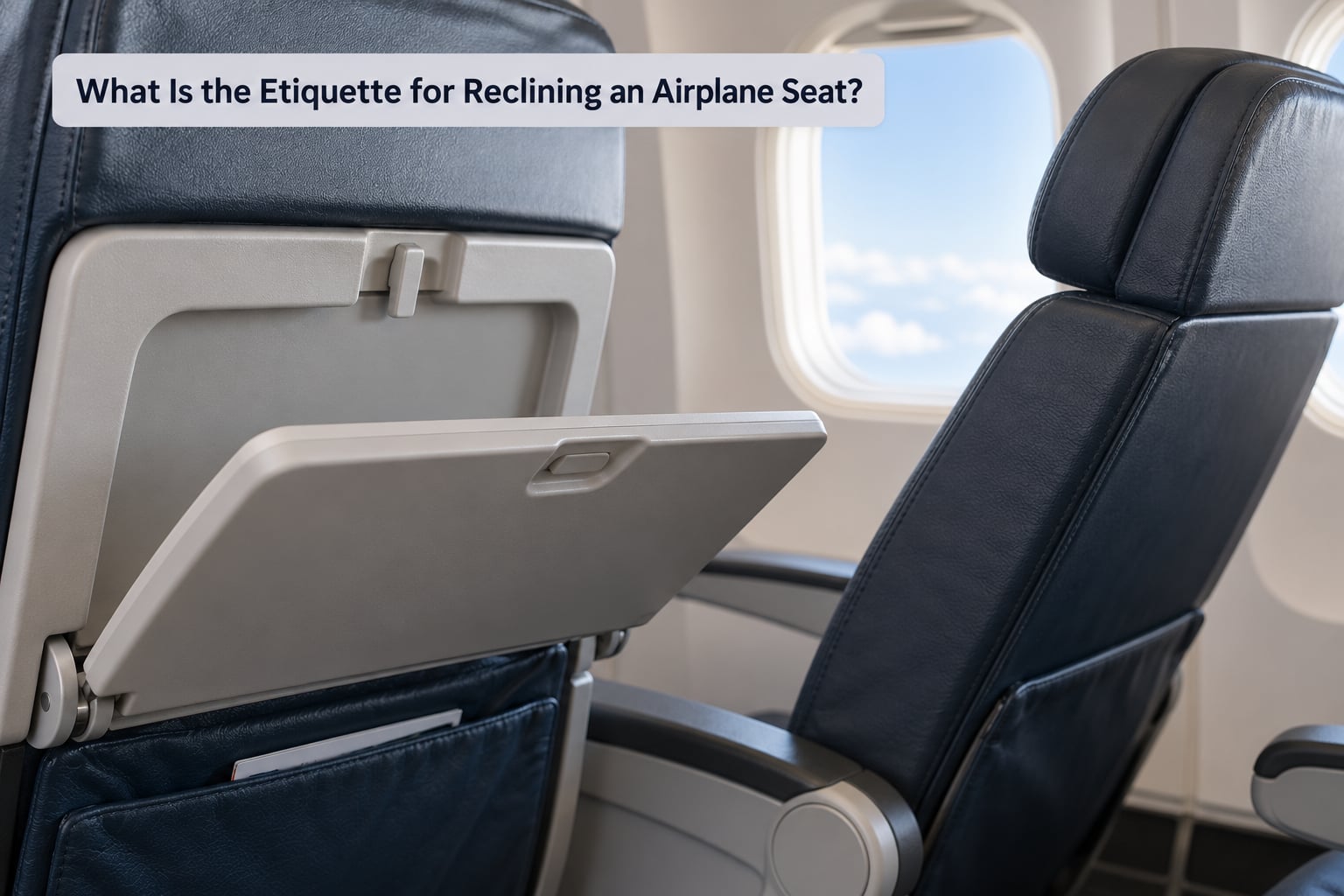
The baseline norm is simple: airplane seats may recline, so using the button is not an imposition. Etiquette adds one step on top of that, which is to check the row behind before you use it. Outside ran a piece asking several working flight attendants about the topic, and the verdict was consistent. A deliberate, slow, checked recline is fine. A sudden one is not.
When you can recline your airplane seat without asking
You almost never need to ask if the tray table behind you is up, the seat is already reclined, or the row is asleep on a red-eye. If you want to be safe and it costs you nothing, ask anyway. The awkwardness is far smaller than people imagine.
What the seat actually does when it reclines
Most economy seats pivot at the base and slide forward as they go back. That forward slide takes legroom away from the row behind at the same time as the seatback takes knee room away, which is why tall passengers feel a full recline twice as hard as the seat pitch suggests. Seat width has narrowed from roughly 18.5 inches toward 17, and economy pitch has dropped from around 35 inches toward 30, with some rows near 28. The margin for error is gone.
Should You Ask a Seatmate Before Reclining?
A quick check is the cheapest courtesy in flying, and it takes about three seconds. Turn around, look at the tray table, then say something short: “Mind if I lean back a bit?” or “Do you need the tray table up?” Either phrasing works. The tone matters far more than the wording.
Asking every single time does start to feel excessive on a nine-hour flight where the answer is obviously no. Frequent flyers describe a glance-back norm instead. You look, you judge, and you either go halfway or skip it. On short flights, the return on two inches of recline is so small that plenty of regulars never bother at all.
Thread after thread on r/travel and r/changemyview lands on the same point. The annoying version is not the recline. It is the passenger who reclines and then pretends not to notice a pair of knees pressed into their back.
When Is Reclining Your Seat Especially Unwelcome?
Timing decides most of it. Reclining is most unwelcome when the person behind has a tray table down with a meal or laptop on it, during meal service itself, during takeoff and landing, and on short flights where you will be back on your feet in 90 minutes.
It is also unwelcome when it is going on for hours without a word. A passenger working on a laptop who loses screen clearance for three hours has a real grievance, and so does a parent trying to settle a child or feed a baby. The same recline on a red-eye, with the cabin lights dimmed and the row already asleep, is usually welcome.
A poll shared on the Rick Steves travel forum found 41 percent of respondents calling a mid-flight recline very or somewhat rude, while most of the same respondents said they would accept it from the passenger in front of them. The disagreement is real, but it is not as lopsided as cabin arguments suggest.
How to Recline Without Creating Conflict
There is a sequence that works almost every time:
- Turn around and check the tray table behind you.
- Ask a short question if the tray is down or the passenger is awake and working.
- Recline slowly, in stages, using the handle or foot lever rather than shoving the seat back.
- Stop halfway if the person behind shifts, rather than treating any movement as an insult.
- Return the seat upright when asked, and when the tray table sign lights up for service.
- Do not fidget. Repeatedly leaning back and sitting up is more irritating than any single recline.
| Flight phase | Recline? | Why |
|---|---|---|
| Boarding and deplaning | No | Passengers are standing in the aisle and need the space |
| Taxi | No | Seats must be upright while the aircraft moves on the ground |
| Takeoff and landing | No | Seat must be upright and the seatbelt fastened |
| Initial climb | Usually fine | Check the tray table first, then ease back partway |
| Meal service | No | The person behind needs room for a tray and a drink |
| Cruising | Yes, with care | Ask or glance first, go slowly, stay at one angle |
| Red-eye with lights dimmed | Yes | Most rows are asleep and a recline helps both of you |
| Turbulence | Return upright | Everyone expects seats up and belts on when the seatbelt sign is on |
What If the Person Behind You Objects?
If you are the one reclining, the response is unglamorous. Bring the seat upright, say “Sorry, of course,” and leave it there for a while. Arguing the physics of seat pitch with a stranger at 35,000 feet helps nobody. Seat attendants on airline forums describe recline disputes as a recurring but manageable kind of in-flight friction, not a serious safety problem.
If you are the person behind, do not grab, kick or poke the seatback. It reads as aggressive even when your knees genuinely hurt. Turn around, explain what you are trying to do, and ask for a partial recline rather than none. If nothing changes, use the call button and let the crew sort it out. You are not obligated to resolve it yourself, and the crew does have authority to direct a passenger to return their seat.
Knee defenders, the hard plastic panels that clamp onto a tray table to block a reclining seat, are banned by several major carriers, and they turn a small annoyance into an onboard incident.
Can the Flight Crew Set the Rules?
Crew can decide specific things, and their instructions are binding. A flight attendant can ask you to return your seat because the row behind is a tall passenger with a medical issue, or because the service is about to start. They can also handle a persistent dispute, and repeated refusal of a crew instruction is treated as a conduct problem rather than a seating preference.
Beyond that, there is no universal recline rule. Federal aviation regulators set no standard for how far a passenger seat may lean, and airlines vary widely by aircraft. Some rows do not recline at all, and some seats are sold as non-reclinable on the ticket itself. Business and first class seats usually recline flat, which removes most of the tension. Economy, where the space is tightest, is where every one of these fights happens.
If you want to sidestep the whole problem, seat selection does more than politeness. A bulkhead row, an extra-legroom row or a known non-reclining row changes the geometry of the flight. Frequent flyers on the forums tend to recommend exactly that rather than fighting over the button.
Frequently Asked Questions
Is it rude to recline your airplane seat?
No. The seat reclines by design, so using that range on a seat you paid for is not rude. It becomes rude when you slam it back without warning, recline while the passenger behind has a tray table down, or lean back during meal service, taxi, takeoff and landing. A glance behind you and a slow, partial recline resolves nearly every case.
Should I ask permission before reclining my airplane seat?
Ask when the passenger behind seems awake and busy, or when the tray table is down. A three-second question, such as mind if I lean back a bit, is fine on any flight. On long-haul runs where nobody is working, most frequent flyers say a quick glance back is enough and repeated asking starts to feel excessive.
Is it okay to recline during meal or beverage service?
No. Meal and beverage service is the most commonly cited complaint after a sudden recline, because the tray table has nowhere to go. Crew will usually ask for seats upright around service anyway. If you were asleep when service started, move the tray table up first and only lean back once the cart has passed.
What should I do if the passenger behind me is using my tray table?
Turn around and look before you touch the recline button. If the tray table is down with a meal, a drink or a laptop on it, ask first and offer a partial recline. If they are asleep or away, a partial recline is usually enough. Grabbing or kicking the seatback in response escalates quickly and hands the problem to the crew.
What if the passenger behind me keeps reclining into my space?
Explain what you need, ask for a partial recline rather than none, and avoid poking or kicking the seatback, which reads as hostile. If nothing changes, use the call button and let a flight attendant intervene. Crew instructions on a seat are binding, and if reclining your airplane seat is causing a medical or knee problem, say so plainly and ask for help.
Conclusion
Is it rude to recline your airplane seat? Only when you skip the basic steps. Look behind you, ask if the tray table is down, ease the seat back instead of shoving it, and give it up when service starts or someone asks. Do that and you will rarely get a look from the row behind at all.