Airline boarding groups are numbered tiers printed on your boarding pass that set the order passengers get on the aircraft. Preboarding goes first, then premium cabin, elite members and cardholders, and unrestricted basic economy flyers board at the end. That is how airline boarding groups work, and the order can change on the day.
Most people only think about this when they are staring at a boarding pass, wondering why a stranger in first class walked past them. Understanding the system takes about two minutes, and once you know what the number means you can decide whether it is worth doing anything about it.
Table of Contents
- What Are Airline Boarding Groups?
- How Airline Boarding Groups Work: What Decides Your Number
- How Airline Boarding Groups Work by Cabin
- Does Boarding Group Equal Seat Assignment?
- Why Do Airlines Change the Boarding Order?
- What Happens With Families, Assistance, and Connections?
- What Should Passengers Do at the Gate?
- Frequently Asked Questions
- What is the meaning of airline boarding groups?
- Why am I in a later boarding group?
- Does boarding group 1 always get to board first?
- Can I board with my family if we have different group numbers?
- What if the airline boards in a different order than expected?
- Does an assigned seat guarantee that I will board with my group?
- Key Takeaways
What Are Airline Boarding Groups?
A boarding group is a label, usually a number or a letter, that tells the gate agent when you are called to line up and board. Preboarding comes before the numbered groups. Inside those groups, a lower number means an earlier call.
The group label is separate from two other things people confuse it with. It is not your seat number, and it is not your fare type. A passenger in seat 32C on a basic economy ticket still carries a late group number, and a passenger in the last row on a premium fare can carry an early one.
How Airline Boarding Groups Work: What Decides Your Number
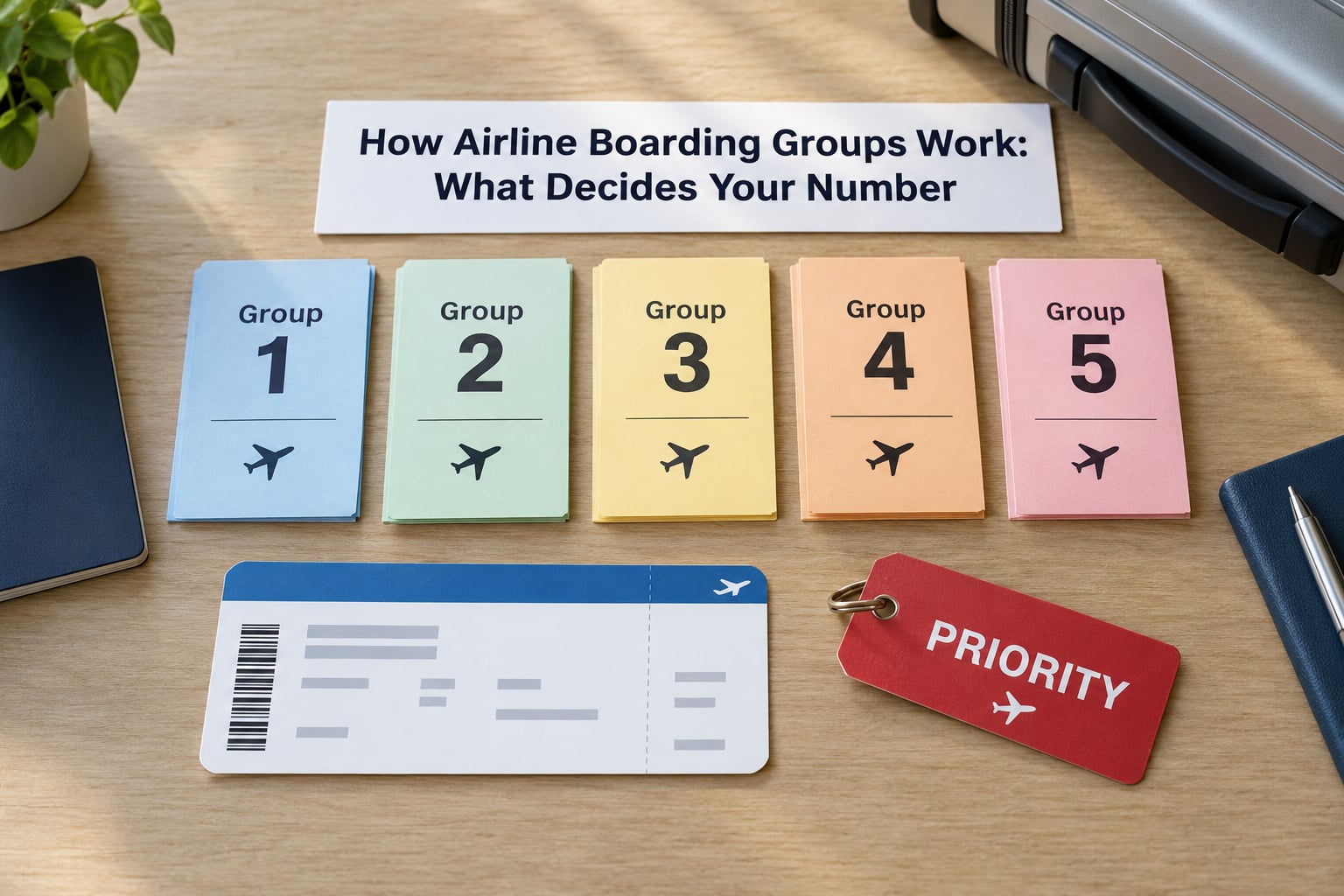
Airlines score each reservation on a handful of factors and print the result on your pass. Nobody draws lots for your group. In most cases you can trace the number back to something specific about your booking or your history with the carrier.
The factors that decide your group, roughly in the order airlines weight them:
- Assistance needs. Passengers who need help or are traveling with an assistive device board during preboarding.
- Cabin class. First and business class board before the main cabin, on every carrier I have looked at.
- Loyalty tier. Top status levels board early, and many carriers extend that to partner airlines in their alliance.
- Fare family. Within the main cabin, flexible and premium fares sort ahead of the most restricted ticket type.
- Co-brand credit card. Holding a card in the airline’s own bank program usually nudges you up a group.
- Purchased priority. You can pay for an earlier group at check-in or when you buy the ticket.
Two carriers can hand you the same tier and still put you in different groups. Delta calls its tiers zones, American uses letters after the first few groups, and Southwest moved to eight numbered groups in October 2026. Check your own pass rather than assuming your usual airline’s system carried over.
How Airline Boarding Groups Work by Cabin
Cabin class and boarding order move together almost everywhere. First class, then business, then premium economy, then main cabin is the standard shape, and each carrier expresses it with its own naming. Delta runs numbered zones. American uses numbers early and letters later. Alaska and JetBlue split their main cabin into smaller tiers than the big three do.
The neat assumption that you board early because you sit forward falls apart in the main cabin. Nobody’s seat row is the main driver there. Your fare, your card and your status are.
Does Boarding Group Equal Seat Assignment?
No. A boarding group decides when you walk down the jet bridge, and a seat assignment decides where you stop walking. They are produced by different parts of the airline’s systems, and either one can change independently of the other.
Seating also comes in flavors. Some flights have assigned seats for everyone. Some have open seating where you pick any open place once aboard. Some use random unassigned seating, common on European carriers. A random seating assignment is not a priority signal, so do not read one into the other.
Southwest removed open seating and moved to eight numbered boarding groups in October 2026. That change put every passenger in a fixed seat, which left group timing as the main thing left to manage.
Why Do Airlines Change the Boarding Order?
The printed order is a plan, and plans change. Gate agents run the call-up based on what is actually happening at the gate, and the announced order always wins over what your pass says.
Common reasons the order shifts:
- Gate or aircraft swap. A change to the departure gate or a different aircraft changes how much time you have and how many bags fit in the cabin.
- Smaller plane. Regional jets have fewer overhead bins, so agents frequently call several groups together instead of waiting between each one.
- Connecting passengers. Airlines try to get people with tight onward connections aboard early so the connection holds.
- Crew and cabin needs. Priority cabins may board first when they need time to settle a cabin that will be served differently.
- Running behind. When the flight is late, agents compress the process and cut the pauses between groups.
That last one catches people out. If you are sitting in a cafe down the concourse when your group is called, you are not simply late, you may be re-sequenced behind a group that boarded after you would have. Stay near the gate.
What Happens With Families, Assistance, and Connections?
Passengers who need assistance, including travelers with a disability, active-duty military and service members, and adults traveling with small children board during preboarding. Under the Air Carrier Access Act, passengers with disabilities must be allowed to board and disembark before most other passengers, ahead of a premium cabin ticket in practice.
Families get help with a practical problem rather than a rule: a parent in Group 2 and a child in Group 7 cannot board together. Airlines handle this by assigning children who cannot travel alone to an earlier group or boarding with an accompanying adult where one is permitted. Unaccompanied minors follow their own check-in, escort and gate-release procedure, with staff handing them over at the gate and collecting them at arrival.
Connecting passengers get priority for a practical reason. An airline that misses a tight connection causes a much bigger problem than one that adds five minutes to boarding. Many carriers will move a passenger with a short onward connection into an earlier group on request at the check-in counter or gate, though it depends on load and cabin space.
If you are flying to a gate that closes for an international connection, tell the agent when you check in. Some carriers will note the itinerary and build the connection into the boarding sequence.
What Should Passengers Do at the Gate?
A short routine covers almost every situation. Check the group and sequence printed on your boarding pass before you leave the gate area, then pay attention to the screen and the announcements rather than to your phone.
Line up when your group is called, not before, unless the line is already forming for the previous group. Frequent flyers report that positioning at the front of the line matters more than the group number itself, so a Group 2 passenger who arrives early often beats a Group 1 passenger who arrives late.
Have your boarding pass in hand before the line moves and keep your carry-on with you. Stow bags directly above your seat where you can, since bags placed far forward are the single most common complaint from passengers who board late and find full bins.
When the order does not match your pass, follow the gate agent. There is no advantage to arguing your way into an earlier group, and the agent usually has a reason that has nothing to do with you.
Frequently Asked Questions
What is the meaning of airline boarding groups?
Airline boarding groups are numbered or lettered tiers on your boarding pass that set the order you board the aircraft. Preboarding comes first for passengers needing assistance, then groups follow in sequence, usually from premium cabin down to the most restricted fares. A lower number or earlier letter means you are called earlier.
Why am I in a later boarding group?
Later groups usually reflect your cabin, fare family, loyalty tier and credit card status rather than anything random. The most restricted main cabin fare type boards near the end, and a tight connection can push you later as well. Check your boarding pass after check-in, since the group is assigned to the reservation rather than to you personally.
Does boarding group 1 always get to board first?
No. Preboarding passengers board before any numbered group, including first class. Gate agents can also merge groups or re-sequence when the flight runs late or the aircraft is small. Group 1 is an early call, not a guarantee, and the order announced at your gate is the order that applies.
Can I board with my family if we have different group numbers?
Sometimes. Airlines commonly assign children who cannot travel alone to an earlier group, and an adult may board with them under that setup. Adults should ask the check-in agent to link the reservation so the group numbers match. For an infant or toddler, boarding with an accompanying adult is generally arranged at booking or check-in.
What if the airline boards in a different order than expected?
Follow the gate agent and the announcements. Agents merge groups on smaller aircraft and compress the schedule when a flight is delayed, and the gate order overrides what your boarding pass printed. Boarding with a later group you already lined up for is usually fine, but boarding after your own group has been called can cost you bin space.
Does an assigned seat guarantee that I will board with my group?
No. An assigned seat tells the airline where you sit, not when you board. Group and seat are separate, and a seat change at the gate does not move you to an earlier group. Assigned seating removes the walk to an open seat, which makes early boarding less urgent, but it does not change the call-up order.
Key Takeaways
Check your boarding pass after check-in, learn which factor moved you into your group, and stay within earshot of the gate. That is the whole system.
Boarding order is set by the airline on the day, so listen to the gate agent rather than the order printed on your pass. If an earlier group matters to you, a higher fare family or an airline’s own credit card are the two levers most people can actually pull. Rules and group structures change, so check with the airline before you fly.
Updated for 2026.