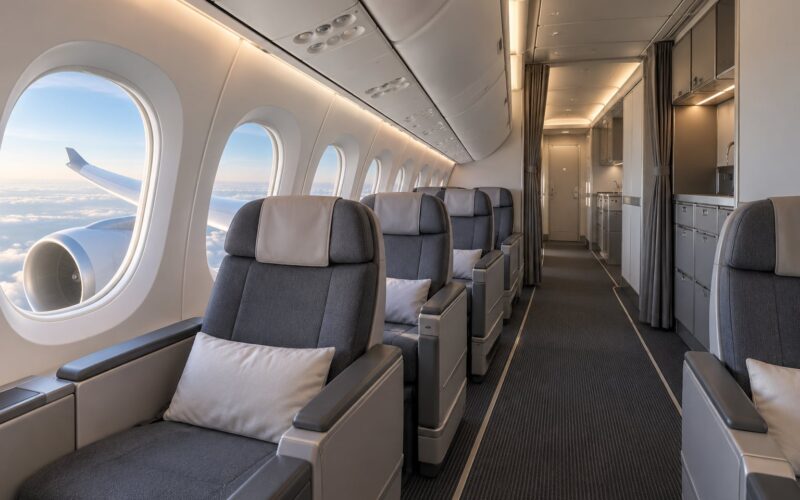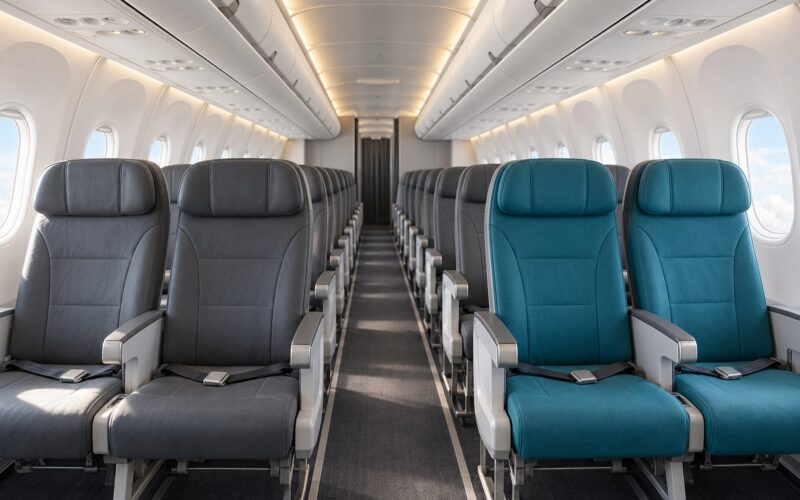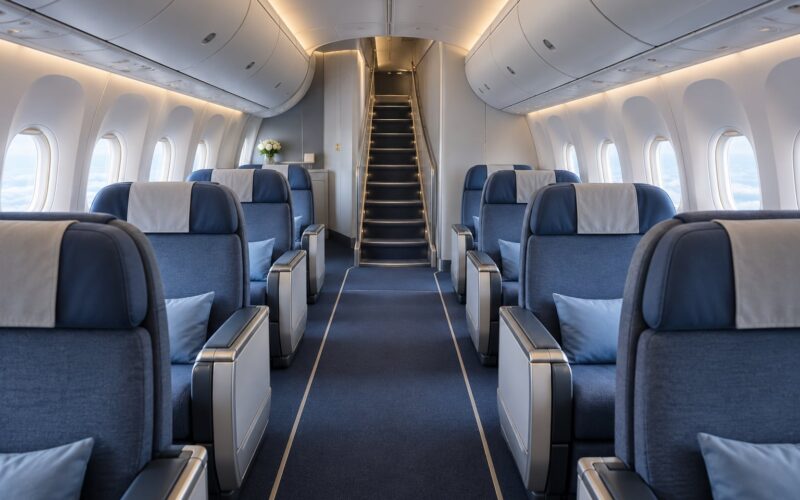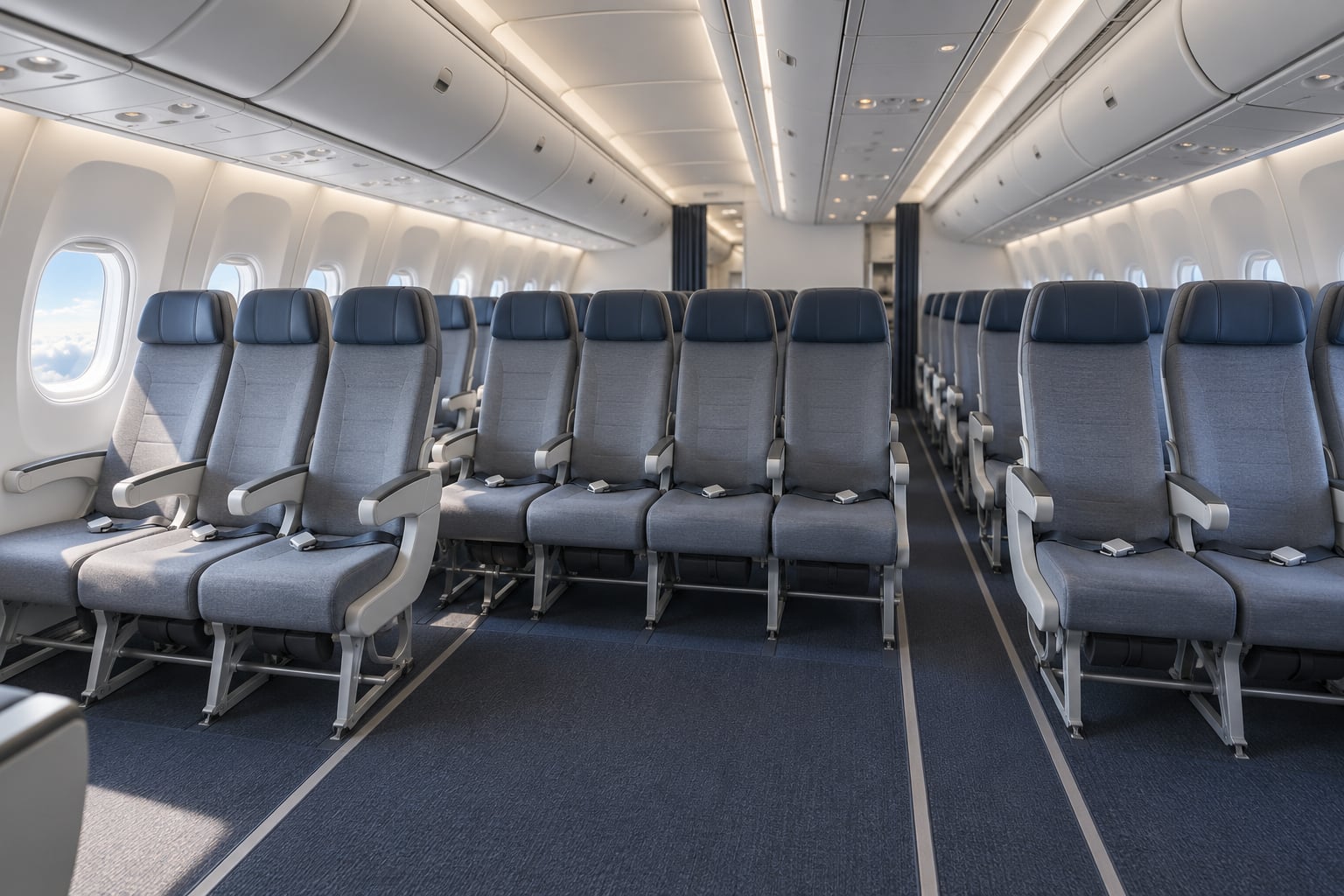
A 3-4-3 layout is an economy cabin arrangement with three seats on the window side, four seats in the middle section and three seats on the other window side, so ten passengers sit in one row with two aisles between them. The 3-4-3 airplane layout matters because it is a width decision rather than a legroom one: pitch usually stays roughly the same while each cushion gets narrower, and four of the ten seats in the row are middle seats.
Most people read “3-4-3” under a flight number and assume it describes legroom, because that is the word most of us use for comfort. It does not. Separate width from pitch and the layout makes complete sense, and picking a good seat inside it takes about thirty seconds.
Table of Contents
- What Is a 3-4-3 Airplane Layout?
- Why Does a 3-4-3 Airplane Layout Matter?
- Width is not pitch
- The numbers people actually feel
- Middle seats become a coin flip with bad odds
- Who feels it most
- What softens it
- What Is the 3-4-3 Layout Like in Different Cabins?
- Where Do Airlines Use a 3-4-3 Layout?
- How Does 3-4-3 Compare With 3-3 Layouts?
- How Can You Choose the Best Seat in a 3-4-3 Cabin?
- Frequently Asked Questions
- Is a 3-4-3 airplane layout comfortable?
- Why is the middle seat in a 3-4-3 layout considered less desirable?
- Does a 3-4-3 layout always have 10 seats in every row?
- What is the difference between a 3-4-3 and a 3-3 airplane layout?
- Can you choose any seat in a 3-4-3 configuration?
- Does a 3-4-3 layout exist in business class?
- Conclusion
What Is a 3-4-3 Airplane Layout?
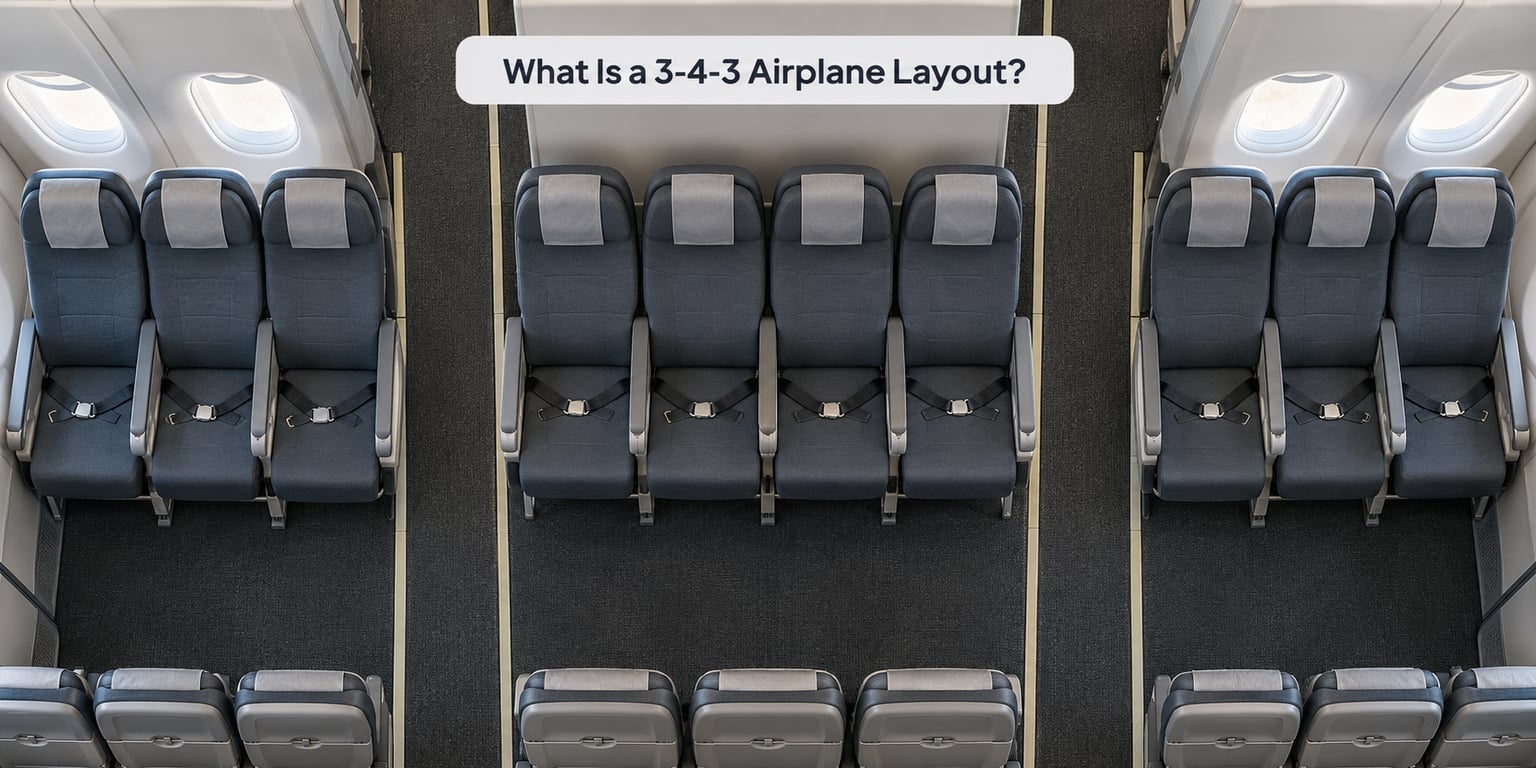
A 3-4-3 layout is a cabin seating arrangement where each row has three seats on one side, four seats between the two aisles, and three seats on the other side. That is ten passengers per row in a twin-aisle widebody economy cabin, with two aisles serving the whole row.
The numbers are simply a count of seats in each group, read from one side of the aircraft to the other. Nobody is rating the groups, and the middle group is not a premium area. It is arithmetic.
| Group | Seats | Seat letters | What it means |
|---|---|---|---|
| Window-side group | 3 | A B C</ | A is the window, C is the aisle |
| Middle group | 4 | D E F G | Every one of these has a neighbour on both sides |
| Window-side group | 3 | J K L | J is the aisle, L is the window |
Notice there is no letter I. Seat maps skip it so that a capital I is never confused with the digit 1 in a row number such as 31. Some airlines run past the usual alphabet instead, ending rows with J K L or K L M, so read the map rather than assuming the letters match.
Most rows hold ten seats. Some do not. Tapered rows at the back of the cabin, exit rows, accessible positions, bassinet rows and rows next to a lavatory can all drop a seat, which is why a seat map sometimes shows nine across on a ten-across cabin.
The industry term for the same thing is 10-abreast seating. Eight across on the same fuselage is usually 2-4-2, and nine across is typically 3-3-3. The gap between those densities is the whole subject of this guide.
Why Does a 3-4-3 Airplane Layout Matter?
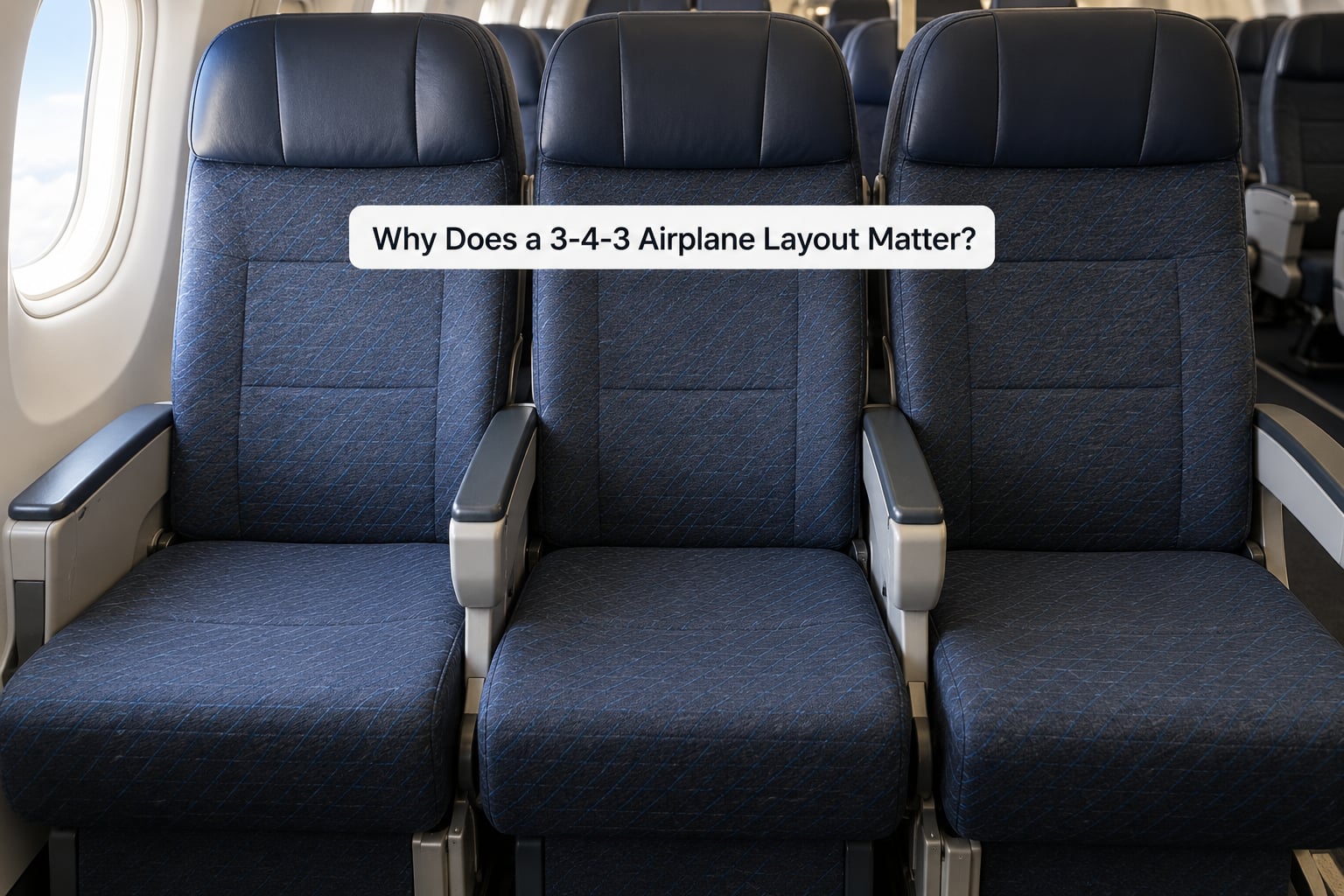
Because it decides who has to sit between two strangers, and because shoulder room is the first thing to disappear on a ten-hour flight.
Width is not pitch
Seat pitch is the distance from the back of one seat to the back of the next, measured in inches, and it is what most people mean by legroom. Seat width is the usable cushion width of a single seat, also in inches, and it decides how much shoulder room you have and whether you can turn to face the aisle.
Going from nine to ten across does not shrink the fuselage. The cabin is exactly as wide as it has always been, so the extra passenger has to come out of the middle block, where the seats are narrowest. Pitch is largely untouched. That is the whole trick, and it is why regulars on aviation forums keep saying that comfort in a 3-4-3 cabin has more to do with who built the seats than with the layout itself.
The numbers people actually feel
Economy seats across a widebody generally fall between about 16 and 19 inches wide, with pitch usually landing somewhere between 30 and 34 inches. When Cathay Pacific moved toward 10-abreast seating on its Boeing widebodies, the headline figure was width falling from about 18.5 inches to roughly 17, a loss of around 1.5 inches, while pitch stayed in the low thirties.
One inch does not sound like much until you try to sit in it for eleven hours. Seat reviews of American’s 777-200 main cabin, for example, put that cabin at 3-4-3 with slimline seats and 31 inches of pitch, which is a fair illustration of a typical installation.
Middle seats become a coin flip with bad odds
In a 3-4-3 row, four of the ten seats are middle seats. That is a 40 percent chance of being stuck between two people you did not choose. A nine-across 3-3-3 cabin puts three middle seats in nine, about 33 percent.
It gets worse than the raw numbers suggest. Seats D and H are the outer positions of the middle block, so they carry a neighbour on one side, an armrest they have to ask to share, and a stranger’s full recline on the other. Passenger forums describe 3-4-3 economy as the tightest layout they regularly fly, and contrast it with the 3-3-3 they remember from earlier widebody and 747 configurations.
Ask a traveller to buy an extra seat, pay for seat selection, or accept a middle seat in a tight cabin and you will hear the same trade-off named on every aviation forum: comfort is a trade between width and pitch, not a good-versus-bad axis.
Who feels it most
Anyone over six foot, anyone with a broader build, and anyone sleeping on an overnight sector. Shoulder width matters more than leg length in a narrow middle seat, because you cannot angle your hips or turn away from a neighbour. On whether a 350 pound passenger can fit, the honest answer is that a middle seat at 17 inches is very hard, while a window or aisle seat at 18.5 inches is often manageable, and the aisle seat usually matters more than the extra width does.
Long-haul night flights are where the complaints get loudest. Aisle access is the other half of the problem: in a ten-across cabin two aisles serve twenty seats, so a middle-seat passenger has two neighbours and one of them will get up at some point in the night.
What softens it
Amenities carry some of the load. Passengers describe 3-4-3 as tight but doable when it comes with large seat-back screens and a decent entertainment system, which is more common on modern 787 and A350 installations. Adjustable headrests, a pillow you can borrow, and a window shade that actually blocks light all help more than people expect.
What Is the 3-4-3 Layout Like in Different Cabins?
The same airframe usually runs several different arrangements, and the pattern people recognise changes as you move up the cabin.
Economy on a Boeing 777 or Airbus A350 is where 3-4-3 shows up most often: ten across, two aisles, four middle seats. Premium economy on the same jet often uses 2-4-2, which removes one seat from each side group and gives those two passengers noticeably more width. Business class typically runs 1-2-1 on a single-aisle side or 2-3-2 across, with wider seats and, on newer cabins, doors that give every seat direct aisle access.
So the three-group logic still exists upstairs, just at a lower density. What changes is the ratio: more space per passenger, fewer neighbours, and often a seat that converts to a bed.
Where Do Airlines Use a 3-4-3 Layout?
Mostly on twin-aisle widebodies flying long-haul and dense high-demand routes, where the extra density helps hold fares down across the rest of the cabin. Representative aircraft include:
- Boeing 777-200 and 777-300ER — the most common home of 3-4-3 in economy, in nine-abreast and ten-abreast versions depending on the delivery date and the operator.
- Boeing 787 — often nine-across, though ten-across factory options and retrofits exist on some variants.
- Airbus A350 — a standard ten-across option in economy, usually paired with a two-across premium cabin rather than a 2-4-2.
- Airbus A380 — a common economy arrangement running in long blocks of rows, for example from the 40s into the 70s on one widely discussed Singapore Airlines configuration.
- Boeing 747-400 upper deck — the older home of four seats in the middle block, and the version aircraft regulars remember fondly.
Configurations vary by aircraft model, by operator and by cabin, sometimes within the same airline on the same route. A carrier can also reconfigure an aircraft after delivery, at real cost, which is why seat maps for the same flight number are not always identical month to month.
Economics drives it. Cathay Pacific’s 2016 announcement put the maths plainly: one added row is worth roughly 17 more long-haul economy seats, closer to 35 on shorter regional sectors, and rolled across a widebody fleet it adds about 4 percent to annual seat growth. That extra capacity is part of what keeps fares where they are.
How Does 3-4-3 Compare With 3-3 Layouts?
Both put an aisle on either side of a middle block. The difference is how the nine or ten seats divide, and what that costs you in width and in middle seats.
| Layout | Seats per row | Middle seats | Typical width | Typical pitch | Best for |
|---|---|---|---|---|---|
| 3-4-3 | 10 | 4 of 10 | Narrowest of the group, about 16-18 inches | About 30-32 inches | Carriers maximising capacity on dense long-haul |
| 3-3-3 | 9 | 3 of 9 | Wider, about 18-19 inches | Similar, often 31-33 inches | Passengers who want width more than headcount |
| 2-4-2 | 8 | 4 of 8 | Wider sides, narrow middle | Usually the most generous, 38-42 inches | Premium economy and some older widebodies |
| 2-3-2 | 7 | 3 of 7 | Comfortably wide | Very generous | Business class and other premium cabins |
Neither configuration wins outright. A 3-3-3 cabin gives every seat a little more width, but the middle block still has three seats, so you can still end up between strangers. A 2-4-2 cabin has fewer passengers and far more pitch, but four of its eight seats are still middle seats, which is a 50 percent middle-seat share.
The honest comparison: 3-4-3 buys capacity with width, 2-4-2 buys comfort with capacity, and 3-3-3 sits in between on the older aircraft that still have the width for it.
How Can You Choose the Best Seat in a 3-4-3 Cabin?
Ten positions, ranked by who they suit. Seat letters assume the usual A B C, D E F G, J K L arrangement.
- Window seat, A or L — best for sleeping, for anyone who values not being touched, and for long-haul overnight. You absorb aisle traffic when someone needs past.
- Aisle seat, C or J — best for tall passengers, for anyone who wants to stand up and stretch on a long sector, and for parents with a lap child. Also the easiest seat to leave quickly.
- Middle block outer seats, D or H — workable in a pinch. One shared armrest, and an aisle-side neighbour rather than a fuselage wall on the other.
- Middle block core, E, F and G — the crowded centre of the four-seat block, with F the single most boxed-in seat in the row. Avoid these on an overnight flight if you can.
- K, the second window — on many 777 and A350 maps K is the equivalent of A on the other side, and it is often the last row of a two-seat tapered block at the back of the cabin, which makes it the one genuinely clever seat to look for.
A few more things worth checking before you pay for a seat.
Rows to think twice about: the last three or four rows near the rear galley, where the queue forms and machine noise carries; rows beside a lavatory; and bulkhead rows, where the seat in front has no tray table and no screen, and you lose the footwell space the missing seat would have given you.
Exit rows give you noticeably more legroom and a better view, and they usually charge a fee. The trade is a narrower seat cushion, a tray table that stows away, and armrests that do not fold, so if you are a larger passenger the fee is often not worth it.
The practical routine is short. Check the seat map on the airline’s own site, read the aircraft type for your specific flight rather than the route, and look up the installed seat width in inches for that flight number. Then check again closer to departure, because equipment swaps at the gate are routine and a 3-3-3 booking can turn into a 3-4-3 flight without warning.
On an overnight sector, pay for a seat rather than gambling on a random middle assignment. On a daytime flight where you mostly need to sit still, the middle block is survivable. If you have a child, an infant, or a long walk between rows, take an aisle seat. If you can afford it, block the middle seat next to an aisle seat, which turns a 40 percent gamble into a 20 percent one.
Frequently Asked Questions
Is a 3-4-3 airplane layout comfortable?
It depends almost entirely on seat width, not on the layout label. Ten-across economy seats are usually between 16 and 19 inches wide at 30 to 34 inches of pitch, so a 3-4-3 cabin with wider cushions can be fine, while a narrow one is genuinely tight. Check the installed width for your aircraft before you decide.
Why is the middle seat in a 3-4-3 layout considered less desirable?
Because four of the ten seats in the row are middle seats, a 40 percent chance of having strangers on both sides rather than the 33 percent you get in a 3-3-3 cabin. The outer middle seats, D and H, also mean sharing an armrest with someone you never asked to sit next to.
Does a 3-4-3 layout always have 10 seats in every row?
No. Tapered rows at the back of the cabin, exit rows, accessible positions and bassinet rows can drop a seat, so some rows read nine across. Airlines can also reconfigure an aircraft after delivery, and equipment swaps at the gate change the map entirely, so confirm the seat map for your specific flight.
What is the difference between a 3-4-3 and a 3-3 airplane layout?
A 3-3 cabin is nine-across, with three seats either side of one middle block, usually giving wider seats around 18 to 19 inches. A 3-4-3 cabin is ten-across, adding one more middle seat and taking the cushions down to roughly 16 to 18 inches. The fuselage is the same width in both cases, which is why pitch barely changes.
Can you choose any seat in a 3-4-3 configuration?
Usually, yes, if you book early enough or pay for seat selection. Window seats and the C and J aisle seats go first, then the outer middle seats D and H, and the crowded middle seats E, F and G are usually the last to go. On ultra-low-cost carriers, seat choice may cost extra or be assigned at the gate, which removes most of the control.
Does a 3-4-3 layout exist in business class?
Business class rarely runs three-four-three. The same widebody usually seats premium cabins in 1-2-1, 2-3-2 or reverse herringbone arrangements, with wider seats, more pitch and often a door giving every seat direct aisle access. The three-group logic survives, but at much lower density and higher comfort.
Conclusion
A 3-4-3 layout trades seat width for cabin capacity: ten seats across instead of nine, four of them middle seats, with pitch mostly unchanged. Before you choose or pay for a seat, check the exact aircraft on your flight, look up the installed seat width in inches, then pick a window or aisle seat and avoid the middle-middle block.