How to sleep without a travel pillow comes down to one idea: give your head somewhere to rest sideways rather than clamping your neck. Press your cheek and temple against the cabin wall, the headrest edge, or a folded jacket, and keep your chin gently tucked so the weight of your head goes into the wall and your shoulder instead of your neck muscles.
That is the whole trick, and it costs nothing. The wall is already beside you, you are already wearing a jacket, and you almost certainly have a scarf or a sweater in the bag.
Here is the honest version before anything else. Sleep sitting upright on a plane is light sleep. Most people get two or three uncomfortable hours, wake repeatedly, and land tired rather than restored. That is still worth optimising for, because the alternative is usually no sleep at all and a stiff neck to show for it.
If you want the short answer before the detail, these are the moves that matter: pick a window seat if you can, build a side support from a jacket or scarf, anchor your lower back so your torso stops sliding, keep your feet flat, block light and noise, set your sleep window before you board, stay still through service, and run a sixty-second reset whenever you wake.
Two different problems get lumped together in most advice, and they need different fixes. A forward head drop is your chin sinking toward your chest while you doze. A sideways head fall is your head tipping toward the aisle or into your seatmate. One is fixed with something in front of you, the other with something beside you.
Table of Contents
- What You Need
- Step-by-Step: How to Sleep Without a Travel Pillow
- Choose a Seat That Supports Sleep
- How to Sleep Without a Travel Pillow Using Only What You Have
- Use Clothing and Seat Space for Support
- Block Light and Noise
- Set a Sleep-Friendly Routine Before Boarding
- Protect Sleep When the Cabin Changes
- Extra Tips for Longer Flights
- Common Mistakes
- Frequently Asked Questions
- What to use instead of a neck pillow on a plane?
- How to keep head from bobbing on a plane?
- How to sleep on a plane without hurting your neck?
- How do you sleep with neck pain and no pillow?
- Is it okay if I sleep without a pillow?
- Is it good to sleep with a travel neck pillow in bed?
- Conclusion
What You Need
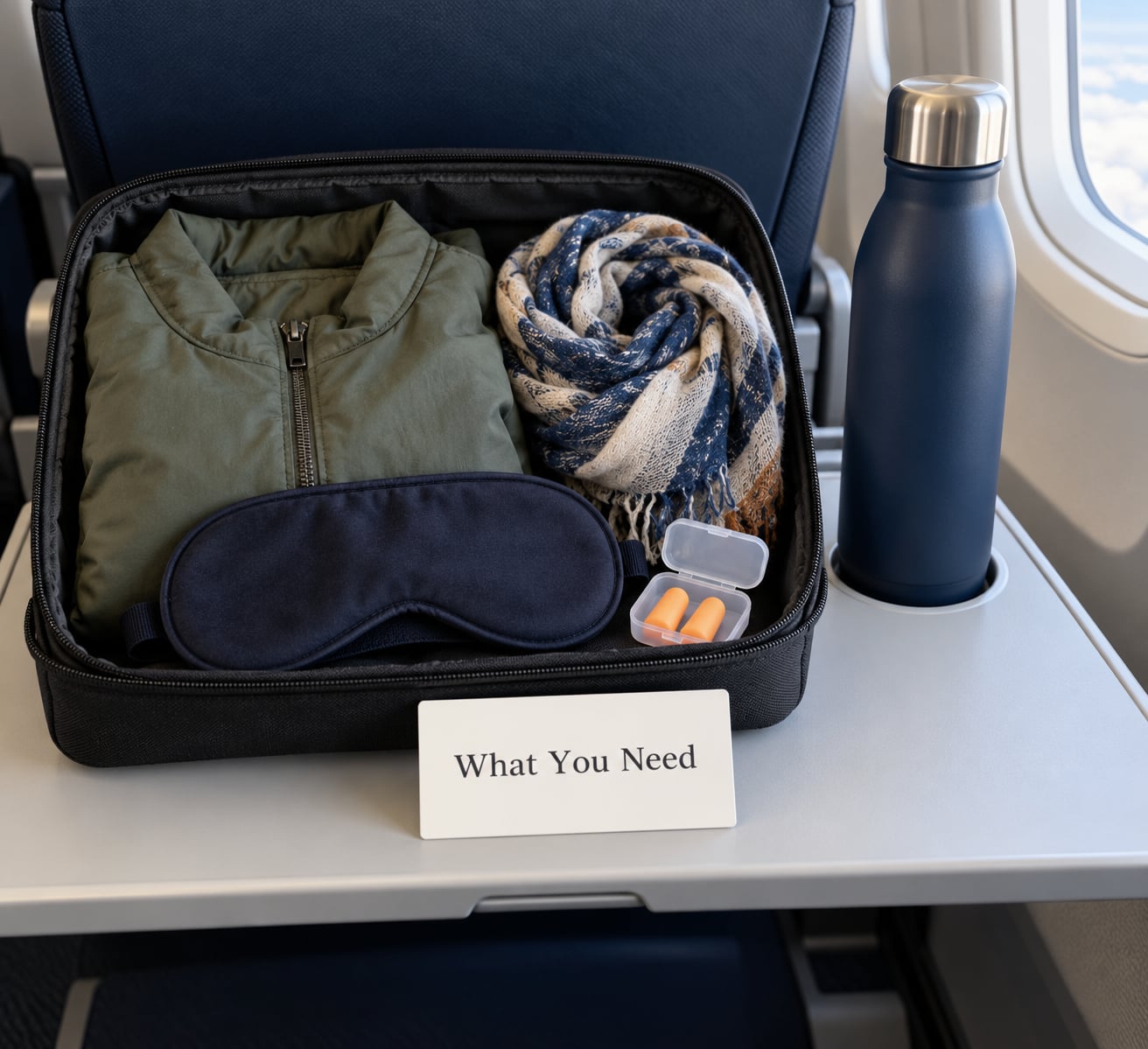
Nothing on this list is essential. If you board with a phone and a jacket, you have enough to work with.
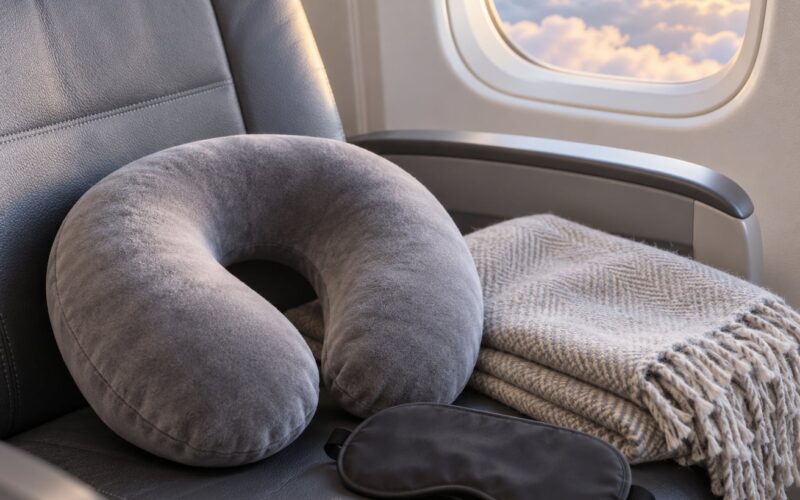
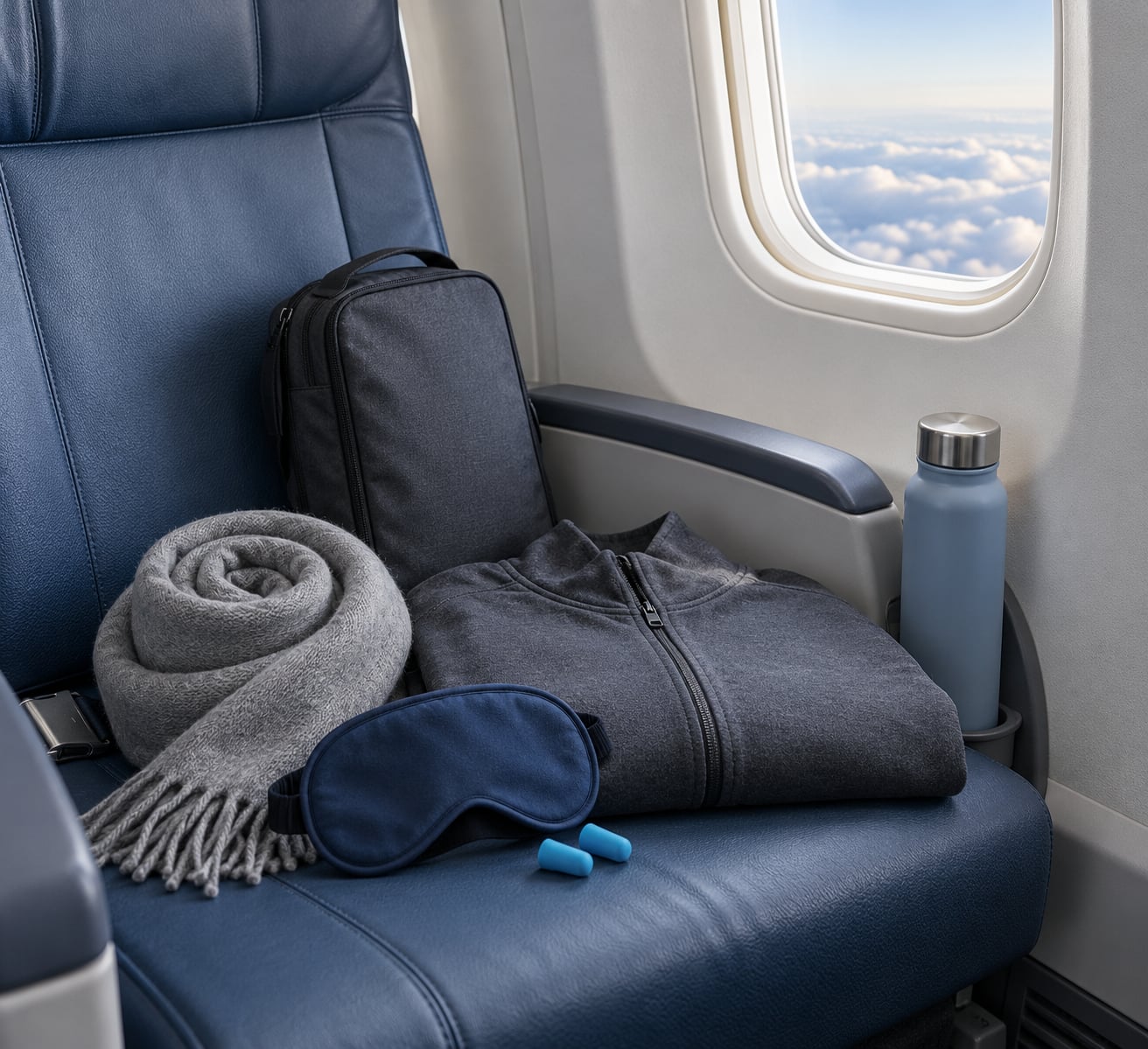
A thin eye mask and a pair of foam earplugs are the two items that earn their place in any bag. Everything else can be improvised from what you are already wearing or carrying.
| Substitute | Best at | Bulk | Notes |
|---|---|---|---|
| Folded jacket | Sideways head fall | None, already packed | Softest option. Fold it into a square about the size of your head and rest your temple on it. |
| Scarf | Lumbar support and noise | Very small | Roll it and tuck it behind your lower back. Doubles as an ear cover. |
| Sweater or hoodie | Torso anchoring | None | Bun it behind your waist. Stops the sliding that wrecks your neck. |
| Hoodie hood | Forward head drop | None | Pull the hood up and let the back of it take the weight when your chin dips. |
| Paper airline bag | Crude bolster | Crushes flat | Stuff it, fold it, put it behind your back. Better than nothing for an hour. |
| Blanket from the cabin | Warmth, then padding | None | Fold it into a wedge. Thick enough to build a real surface. |
The ranking matters more than it looks. A jacket behind your lower back does more for your neck than a towel under your head, because a torso that keeps sliding forces your neck to re-stabilise every few minutes. Frequent small corrections are what leave you sore, not one bad position held for an hour. That is the part of learning how to sleep without a travel pillow that most people skip.
Step-by-Step: How to Sleep Without a Travel Pillow
Choose a Seat That Supports Sleep
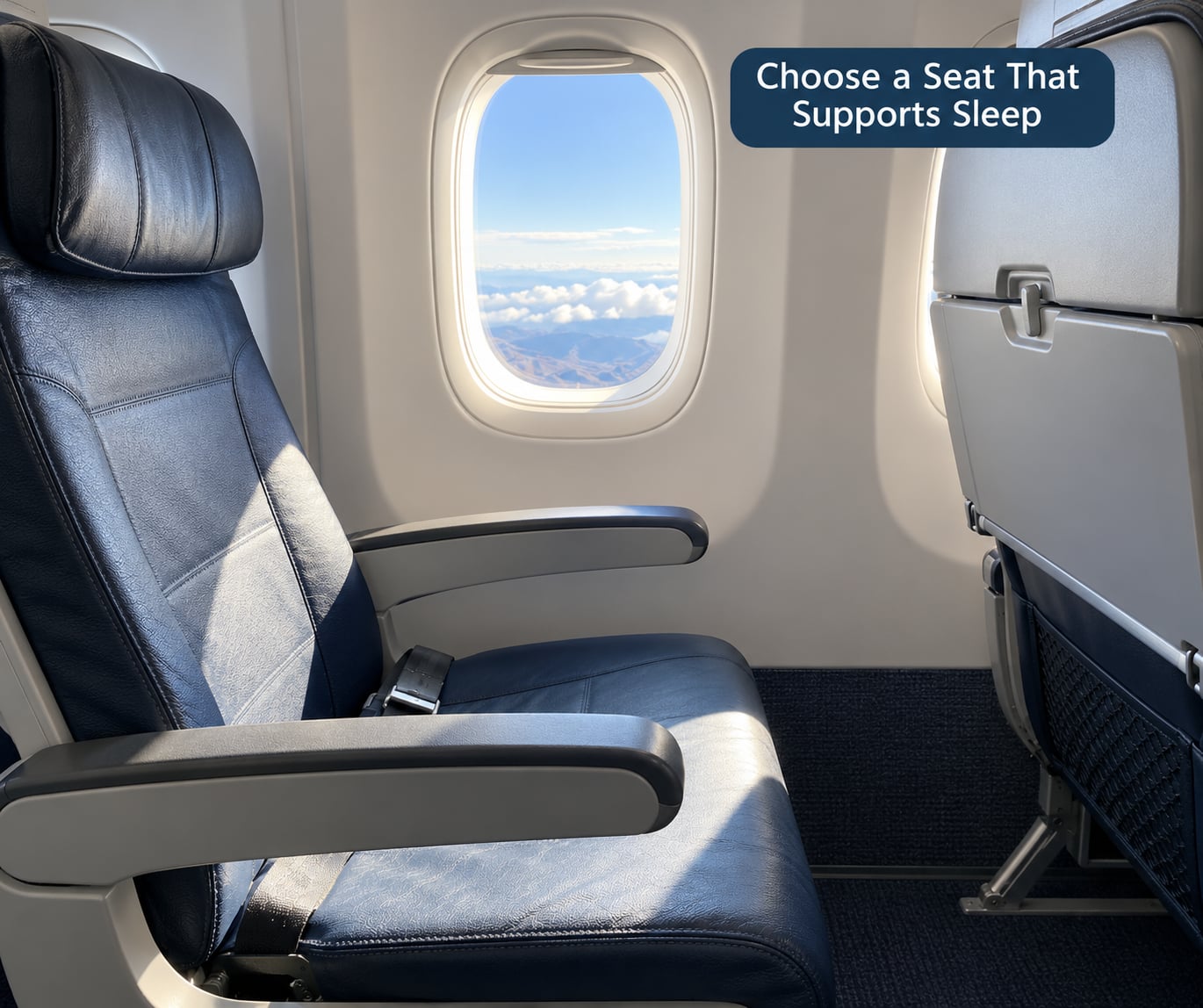
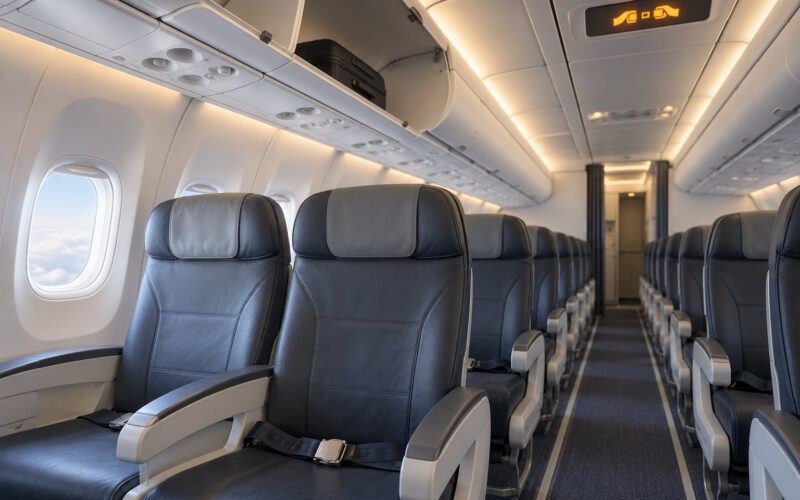
A window seat is the best seat for sleeping without a pillow, because the cabin wall is the only free head support you will get all night.
You lean sideways into that wall, the wall takes the weight of your head, and your neck stops working. That one physical fact beats every gadget.
| Seat | Head support | Trade-off |
|---|---|---|
| Window | Wall on one side | Getting up for the lavatory means waking a neighbour. Prefer it when you are exhausted. |
| Bulkhead | Wall in front | More legroom, but no side wall and a rigid tray table in front of your shins. |
| Aisle | None built in | Easy lavatory access and a place to stand and stretch. Wakes you twice at most. |
| Middle | None | No wall, two strangers, one armrest fight. Work hardest here. |
| Exit row | Nothing to lean on | Legroom is fine. For sleep it is the worst of the lot. |
If you cannot get a window seat, take the aisle and travel with a hoodie or a jacket you can bundle into a bolster. People who move around every hour tend to sleep better than people who are parked for nine hours next to a wall.
How to Sleep Without a Travel Pillow Using Only What You Have
Start with a jacket. Fold it in half, then in half again, and you have a flat square roughly head-sized. Turn slightly into the aisle, rest the side of your face against it, and let your cheek and temple take the load rather than your jaw.
A scarf works as a second line of defence. Tie it loosely around the base of your skull and cross the ends under your chin so the pull stops your head tipping forward. Keep it loose. Anything tighter turns into a strangle problem the moment you swallow.
A hoodie does something a jacket cannot. Pull the hood up and the back of your head has a soft, curved surface to fall into. It is an accidental forward-head-drop fix, and it works on long flights.
For the sideways fall with nothing in your hand, angle your body. Rotate your shoulders about twenty degrees toward the seat rather than facing dead ahead, so your cheek and the headrest edge line up as a wall. It is an awkward position to hold consciously and a natural one to sleep in.
The paper airline bag is worth mentioning only because it comes in the seat pocket and costs nothing. Stuff it, fold the handles flat, and wedge it behind your lower back. It crushes within the hour, and you will have to re-bundle it, but it covers the first stretch of a nap.
Use Clothing and Seat Space for Support
This is the least glamorous part and the one that decides whether the flight works.
Roll a sweater or bunch a jacket and put it behind your lower back, in the curve between your spine and the seat. Once your lumbar is supported, your torso stops creeping forward every time you relax, and your neck stops having to correct for it.
Put your feet flat on the floor. Dangling feet make small swinging motions that pull your shoulders forward, and your head follows. If there is no floor, cross your ankles and press them into the seat in front, which does the same job.
For the arms, keep your lower arms on the armrests if you have them, or fold them together in your lap. Hanging arms make you hunch, and hunching shortens your neck.
The tray table is for a forward lean, not for a pillow. Keep it stowed and upright in front of you and rest your forehead lightly on the back of it if your head keeps dropping forward. Only ever use it with the seat reclined and the table stowed, the way the crew demonstrate before takeoff, and never lean into it while it is open.
Block Light and Noise
Even a cheap eye mask changes the flight, because cabin lights stay on at dim levels all night and your body reads them as daytime.
No mask? A scarf pulled loosely over the eyes does the same job. It is not elegant, but it blocks the worst of it and it is already in your bag.
For noise, foam earplugs beat anything else you can improvise. Airplane noise is low and constant, which is easier to mask than intermittent conversation, and it is the conversation from the row behind that wakes people rather than the engines.
There is a second benefit to the mask that nobody mentions. Wearing it signals that you are unavailable, and it makes attendants and seatmates far less likely to lean over you during service.
Do not use alcohol as a noise and sleep aid. It knocks you out shallowly, dehydrates you in already dry air, and guarantees a heavy head in the morning.
Set a Sleep-Friendly Routine Before Boarding
Decide when your sleep window is before you sit down, because boarding is the only part of the flight you control.
Drinking water matters because cabin air is dry, and dehydrated muscles tighten, which makes an uncomfortable neck feel worse. Sip steadily through the flight rather than downing a bottle in one go.
Skip the second coffee. Most flights are long enough that caffeine taken near boarding is still in your system at the time you want to sleep, which is the opposite of helpful.
Eat before you board or eat early in the flight rather than during your sleep window. Waking to a meal service in front of you costs you twenty minutes you will not get back.
Set an alarm for your arrival time before you take the phone off. People who sleep through their landing wake up groggy and disoriented, and the stress of that can undo an hour of rest.
If you are crossing time zones, set your watch to destination time the moment you board and start eating and drinking on that schedule. Jet lag is mostly a timing problem, and the adjustment starts at the gate rather than at the gate you land at.
Protect Sleep When the Cabin Changes
Something always happens. Service comes round, an announcement fires, the cabin drops in temperature, or turbulence starts. Each one costs you ten minutes of the low-sleep phase, and the ten minutes right after you were pulled out is the hardest to get back.
Have an answer ready for service so it does not startle you. Sit up slowly, keep the jacket over your chest, eat without hurrying, and lie back down the same way you were lying before.
For the lavatory, aisle seats make this easy and window seats make it a negotiation. Either way, walk rather than shuffle. Shuffling keeps you half-asleep and you come back warmer and stiffer.
Keep the cabin blanket weight over you even if you feel warm, because cold arrives suddenly and shivering wakes you properly. Layer a sweater under it rather than piling everything on at once.
Here is the sixty-second reset. Roll your shoulders backwards five times. Let your jaw hang slightly open. Turn your head left, hold, then right. Open and close your hands twice. That is enough to undo the small knots that build up over four hours of immobility.
Extra Tips for Longer Flights
On red-eyes, set your alarm before takeoff, because boarding announcements and a bright cabin will usually destroy any chance of sleeping in the first hour. Sleep late instead of sleeping early.
On narrow-body aircraft, the wall is closer to your head and the legroom is tighter, which makes the window seat noticeably better than usual and the middle seat noticeably worse. If you are in the middle, turn fully sideways and borrow the seatback in front of you as a surface.
For overnight itineraries, aim for rest rather than deep sleep. Two unbroken hours beats five broken ones, and most flyers in economy cannot get the second kind.
Stand up once an hour if the seat allows it, or do seated ankle circles and shoulder rolls if it does not. An hour of stillness is what makes your lower back seize on descent.
Stay warm without restricting circulation. A blanket over the legs is fine. Wrapping a scarf tight around a neck or a wrist is not, and anyone selling you compression advice you did not ask for on a plane is a warning sign.
Traveling with a small child reverses the problem. You will not get a nap, so lower your expectations, take turns with a travel companion, and use the window-seat logic for your own recovery between naps.
Common Mistakes
The most common error is treating forward head drop and sideways head fall as one problem. They need opposite fixes. A forward drop needs something in front of your head, like a raised hood or the back of a stowed tray table. A sideways fall needs something beside your head, like a folded jacket or the wall.
Second mistake: leaning directly against the window. The window shade gives you almost nothing, the pane is cold, and pressing your head into it folds your neck sideways. Turn to the wall beside the window instead.
Third: using a soft, unstable object. A lumpy hoodie under your head moves when your head moves, which makes your neck chase it all night. If you use clothing as a head support, fold it flat and wedge it so it cannot shift.
Fourth: packing a travel pillow you will not use. Bulky, and the fluff collects germs from every baggage belt. If you sleep on long flights regularly, carrying one is fine. If it sat in your bag unused for a year, leaving it behind gives you space for something you will actually reach for.
Fifth: twisting your neck to reach a window behind you. Turning the head past about sixty degrees and holding it there is the fastest route to the pinched, sore neck people complain about after long flights. Lean with your body instead, or give up on that seat.
Sixth: expecting deep sleep. The most common disappointment on any flight is not discomfort, it is simply not having slept as much as expected. Set the goal at an hour or two of light rest and you will be pleased. Expect eight hours and you will be disappointed every time.
Seventh, and worth saying plainly: do not start any sleep medication, prescription or supplement, on flight day. People on sedatives report grogginess, a foggy descent, and some genuinely bad reactions at altitude. Anyone considering melatonin or anything stronger should talk to a pharmacist or doctor first, especially if they take other medication.
Frequently Asked Questions
What to use instead of a neck pillow on a plane?
Use a folded jacket for sideways head support, a rolled scarf behind your lower back to stop your torso sliding, a raised hoodie hood to catch a forward head drop, and the cabin wall itself if you have a window seat. Add a thin eye mask and foam earplugs for light and noise. None of it needs buying, and the wall is already beside you.
How to keep head from bobbing on a plane?
Bobbing happens because the neck muscles have to catch your head every time it tips. Stop the tipping first: turn slightly sideways so your cheek meets the headrest or the wall, and wedge a folded jacket or hoodie between your head and the surface. Then anchor your lower back with a rolled scarf so your torso stops creeping forward and pulling your head with it.
How to sleep on a plane without hurting your neck?
Keep the chin gently tucked rather than lifted, drop your shoulders away from your ears, and let your jaw hang slightly open. Give your head a wide, soft surface to lean sideways into so the weight goes into the wall and your shoulder instead of the neck muscles. Micro-adjusting your position every few minutes causes far more soreness than one slightly imperfect position held for an hour.
How do you sleep with neck pain and no pillow?
Stop using a head support that pushes your neck forward. Rest the side of your face on the headrest edge or the wall, support the gap between your shoulder blades so your torso is not dragging your neck, and keep your feet flat. A soft cervical collar from a pharmacy can hold the chin in neutral for short naps, but if you have ongoing neck pain, see a doctor before flying rather than experimenting with gear.
Is it okay if I sleep without a pillow?
Yes. Plenty of people sleep fine without one, and adults generally do not need a pillow if they are comfortable. On a plane the issue is not comfort, it is that a vertical seat gives your head no natural resting place, so it falls forward or sideways until your neck muscles tire. A folded jacket or the cabin wall simply supplies that missing resting place.
Is it good to sleep with a travel neck pillow in bed?
A travel pillow is built to be pressed against the sides of your neck while seated upright, so using it flat in bed is not what it is shaped for. In bed you want your neck supported and the head at roughly the same height as your shoulders. If a travel pillow feels good to you and you are not in pain, it is harmless, but a normal bed pillow is a better fit for that position.
Conclusion
Do these four things and the rest is detail. Take a window seat so you have a wall. Fold a jacket or roll a scarf before you board and put it somewhere useful. Anchor your lower back and keep your feet flat so your torso stops dragging your neck around. Block the light.
Everything else on this page is refinement. Learning how to sleep without a travel pillow is mostly seat choice and two soft things you already own. And if you manage three hours of light sleep on a nine-hour flight, that counts as a good night.