If your heart rate climbs the moment the door closes, seat choice matters more than most guides admit. Most nervous flyers do best in a window seat roughly over the wings, where the aircraft sits closest to its centre of gravity and the ride feels calmest, or in an aisle seat near the front so you can stand up and move. This guide breaks the options down by the anxiety each one actually helps, including the row placements worth skipping.
Two things are worth saying up front. First, no seat makes turbulence disappear, and seat choice helps most with mild chop and motion, less with genuinely violent weather. Second, cabin crew see anxious passengers constantly, and telling one early is the single most useful thing you can do on board.
Table of Contents
- Best Seats for a Nervous Flyer at a Glance
- 1. Choose an Exit-Row Seat for a Clear View and More Space
- 2. Sit Near the Front of the Aircraft for a Shorter, More Stable Ride
- 3. Pick a Window Seat Away From the Middle for a Calm Sense of Security
- 4. Select an Aisle Seat for Easy Movement and Visible Crew
- 5. Choose a Seat Beside a Trusted Travel Companion
- 6. Reserve a Bulkhead or Other Extra-Space Seat for Room to Stretch
- 7. Avoid the Seat Directly in Front of the Lavatory
- 8. Avoid Seats Beside or Directly Behind the Galley
- 9. Choose an Empty Adjacent Seat When Booking Allows It
- 10. Select a Quiet Window or Middle Seat for Fewer Sensory Distractions
- Frequently Asked Questions
- What are the best seats on a plane for nervous flyers?
- Is the window seat or aisle seat better for anxiety?
- Where is the bumpiest place to sit on a plane?
- What seat should I avoid on a plane if I am anxious?
- Should nervous flyers choose an exit row?
- Does sitting near the wings actually reduce turbulence?
- How to Choose the Right Seat for Your Flight
Best Seats for a Nervous Flyer at a Glance
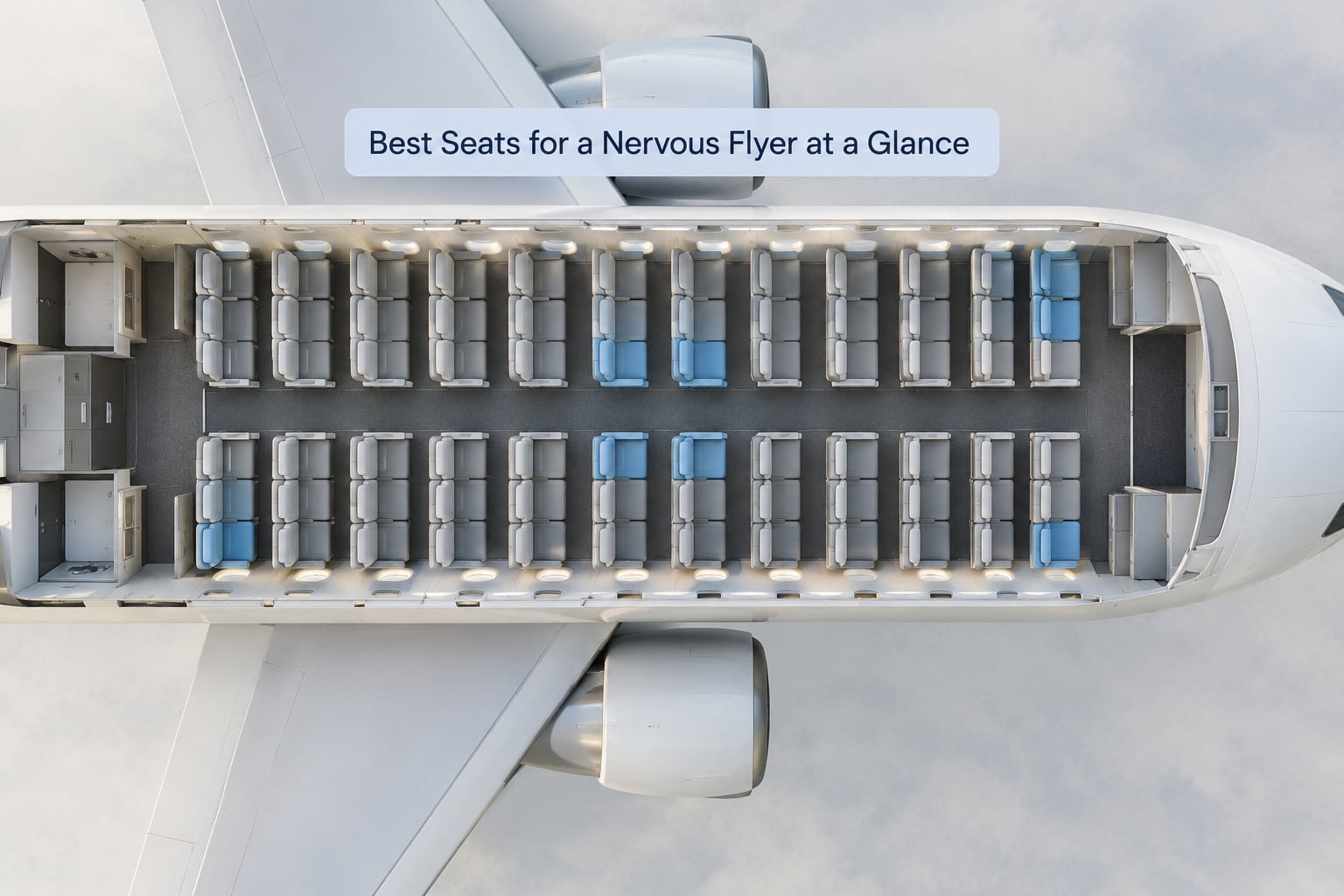
| Seat choice | Helps most with | Main drawback | Suits |
|---|---|---|---|
| Over-the-wings window | Turbulence, feeling of motion | Trapped if a neighbour is uneasy | Visual-anchor types |
| Over-the-wings aisle | Turbulence, escape urge | Aisle traffic, service carts | Most people |
| Front rows | Time in the air, noise | Galley noise on some aircraft | Short-haul and takeoff fear |
| Exit row | Space, visible aisle | Extra briefing, no underseat storage | Travellers who like room |
| Bulkhead row | Legroom, no seat in front | Near galley and lavatories | Long legs, stretcher types |
| Empty seat beside you | Touch, personal space | The neighbour may still fill | Space-sensitive flyers |
| Middle seat | Sensory load, being touched | No view, hardest to leave | Sensitive to people |
| Seat beside a companion | Panic, needing reassurance | Only helps if you travel together | Travelling with someone trusted |
| Rear galley row | Nothing, honestly | Carts, announcements, doors | Avoid |
| Row before a lavatory | Nothing, honestly | Noise, odour, foot traffic | Avoid |
1. Choose an Exit-Row Seat for a Clear View and More Space
An exit row gives you the widest floor space of any standard economy seat, a large window on most aircraft, and an unobstructed view of the aisle. For flyers who feel penned in, that sightline alone calms things down.
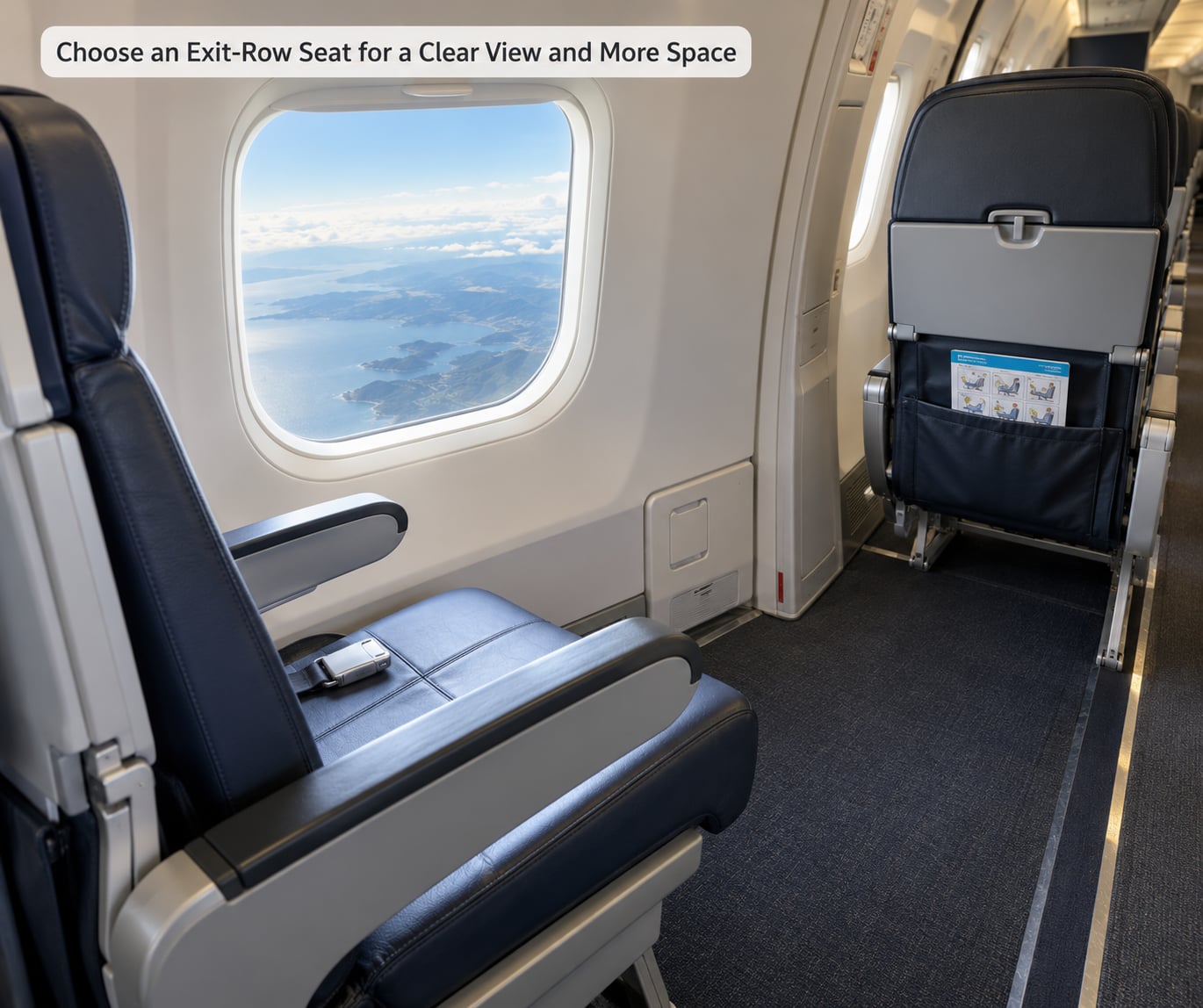
The trade-offs are real, though. There is often no window between exit-row seats, so a middle exit seat can feel boxy. You may have no underseat storage, no ability to recline, and reduced legroom when the seat in front reclines. Some flyers also find the extended pre-departure safety briefing raises their pulse instead of lowering it.
Airlines set eligibility rules, usually requiring you to be at least 15, to be able to lift the seat armrest, and to follow safety instructions in English or the language printed on the safety card. Check before you pick it, or you may be moved at the gate.
2. Sit Near the Front of the Aircraft for a Shorter, More Stable Ride
Forward rows mean less time in the air, which matters a lot when the worry is the flight itself rather than any one moment in it. A three-hour hop from the front row feels shorter than the same hop from row 34, mostly because takeoff and landing pass sooner.
The nose also sits further from the tail, which is the part that swings hardest during chop. The trade-off is that the front of a narrow-body is often close to a galley. Ask at check-in whether row 4 or 5 is next to the carts.
3. Pick a Window Seat Away From the Middle for a Calm Sense of Security
A window seat gives you a fixed visual reference. Passengers describe far-fixing on a distant point on the horizon as the thing that takes the edge off the sensation of movement, and a window removes the urge to check whether the person beside you is also uneasy.
The window also defines your space. A wall on one side means nobody has to squeeze past you, which removes a small but constant source of dread. The downsides are real: you may have to climb over two people to reach the aisle, and the wing can block the view entirely if the row is slightly too far back or forward.
Aim for the window just aft of the wing rather than directly over it if you want an unobstructed outlook and a little more privacy from the cabin.
4. Select an Aisle Seat for Easy Movement and Visible Crew
The strongest argument for an aisle seat is behavioural. You can stand, stretch your legs, walk to the lavatory and change seats without negotiating with a stranger, and an aisle lets you see cabin crew move through the cabin. Long-running traveller threads on Tripadvisor and Fodors keep landing on the same advice: take an aisle so you can get up whenever you need to.
For takeoff and landing, most aisle seats have another benefit. Legroom in front of you is unobstructed, so you can extend your legs and breathe lower into your belly instead of up into your chest.
What you give up is quiet. Aisle seats take the foot traffic, the overheard phone calls, and the service-cart rattle during the cruise. Near the front of a narrow-body that noise can be significant.
5. Choose a Seat Beside a Trusted Travel Companion
Of all ten options, sitting next to someone you know is the one with the most consistent track record. A hand to hold, someone to point out clouds, and permission to say out loud that you are frightened all reduce the panic response more reliably than any row number.
Book the seats together in one transaction so you are not separated by a later change. If boarding groups split your row, choose a window and an aisle beside each other rather than two middle seats, so the gap does not swallow you.
Agree on one small plan in advance: four slow breaths if turbulence starts, who gets up for water, and that you are both getting off at the destination regardless of how you feel. Having a shared instruction lowers the adrenaline response before it peaks.
6. Reserve a Bulkhead or Other Extra-Space Seat for Room to Stretch
A bulkhead row has no seat in front of it, so your knees stay clear and you can stand and stretch without asking a stranger to move. That range of movement is worth a lot to people whose anxiety shows up in their body first.
On many narrow-body aircraft, bulkhead rows sit right by a galley or a bassinet fitting, which means cart noise and an extra safety briefing for the strap. Some airlines also restrict front bulkhead rows in economy to passengers travelling with an infant. Extra-legroom rows at the door are a cleaner alternative if you want the space without the equipment beside you.
7. Avoid the Seat Directly in Front of the Lavatory
This is a tactic, not an attractive seat. The row in front of a lavatory gets the door opening and closing all flight, the queue of people stepping past your knees, and the attendant’s call for the whole cabin. On some aircraft you can also pick up the scent of the sink.
The privacy problem is the part that unsettles anxious flyers most. There is no curtain and no wall, only a wall panel and a footwell, so you are using the lavatory with people standing a metre away. To find these rows, look for the lavatory icons on the seat map; they usually cluster in a block mid-cabin and aft.
Pick a row at least three rows away in either direction. That also removes the last-minute odour question from your flight entirely.
8. Avoid Seats Beside or Directly Behind the Galley
Galleys are the single loudest place in an economy cabin. Cart brakes squeak, attendants work around you, and crew use your row as a staging point during service. For someone already listening for danger signals, that noise reads as something wrong.
Rows immediately behind a galley also add a second problem: crew walking through during service have to squeeze past, often with an arm around your headrest.
Aircraft layouts vary widely, so do not rely on a generic guide. Check the specific aircraft model for your flight, since a galley position on one aircraft type sits somewhere else entirely on another.
9. Choose an Empty Adjacent Seat When Booking Allows It
An empty seat beside you doubles your personal space and removes the risk of unexpected contact from a stranger’s elbow, bag, or nervous twitching. Several anxious flyers describe buying a second seat beside them as the fix that finally worked, and on busy routes block-a-seat tickets are sometimes available.
Set expectations carefully, though. Seat forecasts are estimates, not guarantees, and assuming an empty neighbour can sour a flight before it starts. If the adjacent seat fills, you have still gained a guaranteed aisle or window, so the seat choice itself remains a good one.
Booking early improves the odds of a gap without needing to pay for it, and pre-boarding takes your pick of the roomier seats before the cabin fills.
10. Select a Quiet Window or Middle Seat for Fewer Sensory Distractions
Some anxious flyers are not calmed by a view or an escape route. They are worn down by people: a stranger breathing loudly, a child kicking the seat back, an arm across the aisle. For those passengers a middle seat, booked early on a wide-body with a two-four-two layout, puts fewer strangers in eye contact and gives you two armrests.
A middle seat is the wrong choice if your fear is a panic response, because it is the hardest seat to leave during a bad moment. Know which kind you are before you rule it in or out.
Notice that the quietest stretch of most aircraft is the middle of the cabin, away from the doors, so a mid-cabin middle seat on a large plane is often the calmest square foot available.
Frequently Asked Questions
What are the best seats on a plane for nervous flyers?
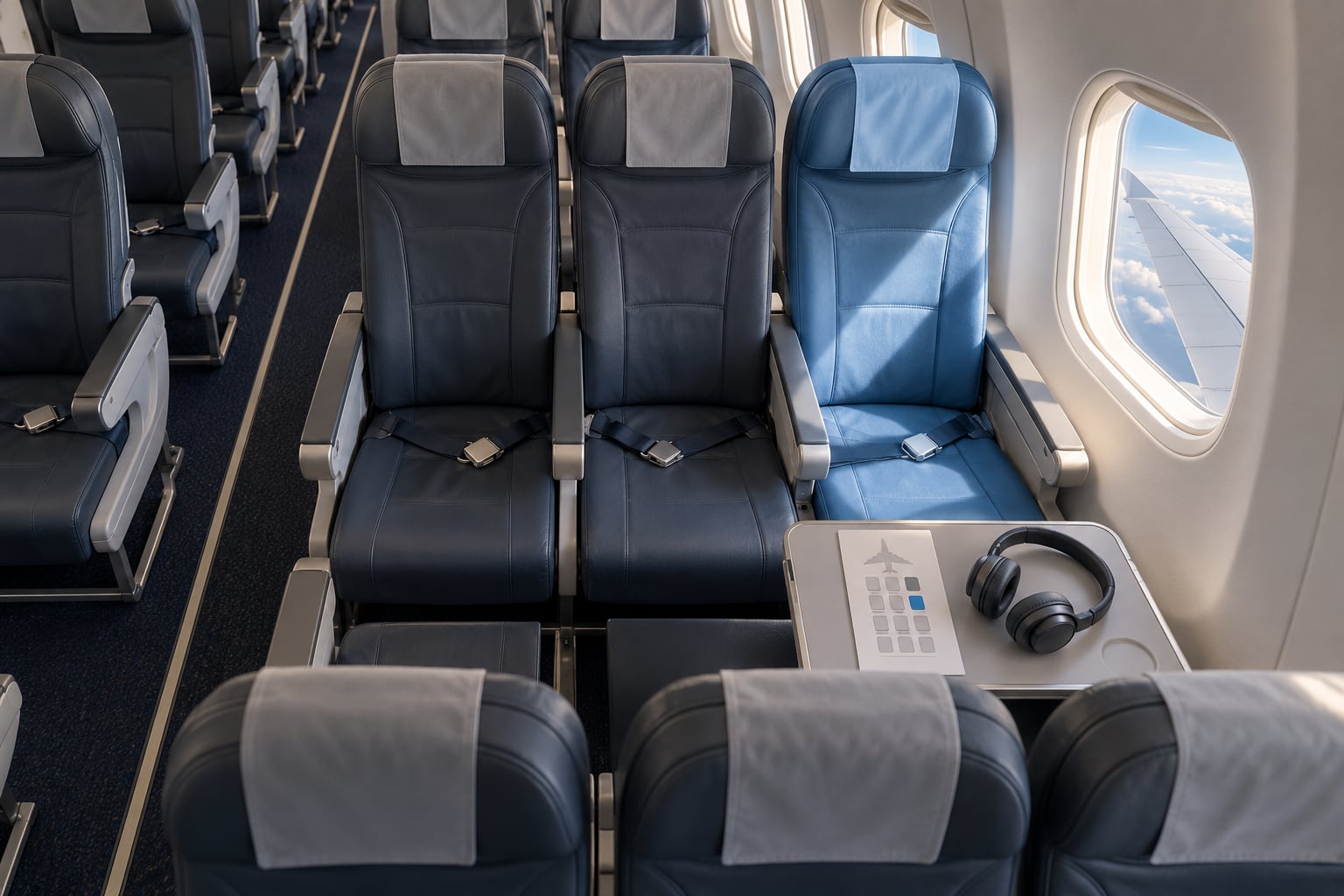
An aisle or window seat just over the wings, in the middle of the cabin, suits most nervous flyers. That is the point closest to the aircraft’s centre of gravity, where the same turbulence feels smallest. Pick the window for a fixed visual reference or the aisle for easy movement, and add a few rows forward if takeoff itself is what worries you most.
Is the window seat or aisle seat better for anxiety?
It depends on which anxiety you have. Window seats help with motion and turbulence because you have a stable horizon to look at and a wall beside you. Aisle seats help with claustrophobia and panic because you can stand and walk without climbing over anyone. If trapped feelings are your main symptom, take the aisle.
Where is the bumpiest place to sit on a plane?
The rear rows feel the bumpiest. Turbulence makes the tail swing up and down, and because the tail sits furthest from the centre of gravity, that movement is amplified for passengers in the last few rows. The front of the cabin is steadier for the same reason. This changes the feel of the ride, not the severity of the turbulence itself.
What seat should I avoid on a plane if I am anxious?
Skip the row directly in front of a lavatory and any row attached to a galley. Cart noise, the queue of passengers, foot traffic and a lack of privacy all add stress. Also avoid the very last row if motion bothers you, since the tail swings most there. On some aircraft these rows also sit behind a bulkhead with no window.
Should nervous flyers choose an exit row?
Only if you check the airline’s rules first. Exit rows usually require you to be at least 15, able to lift the armrest, and able to follow safety instructions in the printed language. Some flyers find the extended briefing more unsettling than a standard seat. You also lose underseat storage and often cannot recline, so weigh that before choosing one.
Does sitting near the wings actually reduce turbulence?
It reduces how much turbulence you feel, not how much the aircraft experiences. Seats over the wings sit close to the centre of gravity and at the pivot point of the tail’s movement, so the same chop registers as a much smaller jolt. Severe turbulence is felt everywhere in the cabin, and no row makes that go away.
How to Choose the Right Seat for Your Flight
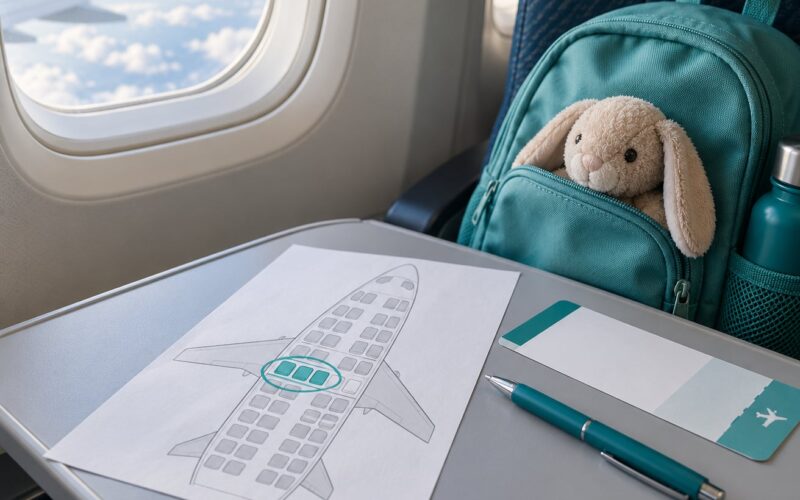
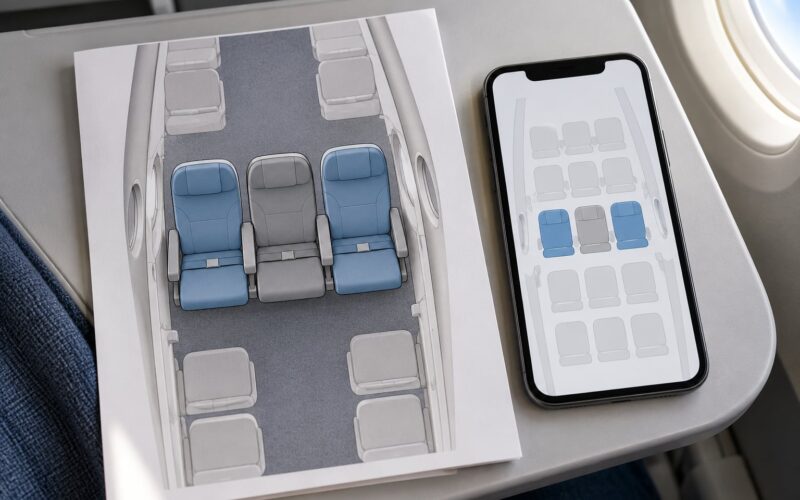
Start by checking the aircraft type and seat map for your specific flight, not a generic guide. Find the over-wing row first, then the lavatory and galley icons, and rule out anything within a row or two of them.
Next, name your main anxiety in one word, because the answer follows from it. Turbulence points to the wings and the front. Feeling trapped points to an aisle. Motion points to a window with a clear horizon view.
Then pick one or two benefits rather than chasing a perfect seat. Requesting over-the-wings aisle in economy often costs nothing, and choosing early gives you the pick of what is left. Mention you are a nervous flyer when you check in, ask for pre-boarding, and say it again to a cabin crew member after boarding.
One last thing: if your fear is not settling on its own, tell a cabin crew member early in the flight rather than waiting for the moment it peaks. They have heard this request many times before, and they can see the seat map and the cabin better than you can from row 24.