Knowing how to use the call button politely takes about ten seconds to learn and saves you from the thing that annoys crew most: pressing it repeatedly for something you could have asked for in a single sentence. Press once, give your seat number, say what you need in one short sentence, then thank them. That is the whole formula, and it works in economy as well as business class.
The reason the etiquette matters is not that flight attendants mind being asked. They do not. It is that every chime reaches the galley, and on a full flight a 737 or an A320 with 180 people, the person next to you with a medical emergency has to compete with your request for a napkin. Use the button when you need a person, and wait for one when you only need a moment.
Table of Contents
- What You Need
- Step-by-Step: How to Use the Call Button Politely
- 1. Check Whether You Need the Call Button
- 2. Wait for a Safe Moment
- 3. Press the Button Once
- 4. Explain Your Request Clearly: How to Use the Call Button Politely, Word for Word
- 5. Thank the Flight Attendant
- Common Mistakes
- Frequently Asked Questions
- What should I say when I press the call button on a plane?
- How long does it usually take for a flight attendant to answer the call button?
- Should I press the call button during turbulence or takeoff?
- Can I use the call button in an airplane bathroom?
- What if I accidentally press the call button?
- What should I do if I need help urgently after pressing the button?
What You Need
Three things, none of which you have to buy. Your seat number, a single clear request, and a quick read on whether your need is urgent or can wait a few minutes.
The seat number matters more than people expect. Crew read a light above row 14, not a face six rows back. If you are in 22C, say 22C first, every time, even if the attendant is standing right there.
Deciding urgency takes a second of honest thinking. Could you handle this yourself safely? If yes, it waits. If no, press. That single test covers most of what people agonise over on forums like r/Flights.
Step-by-Step: How to Use the Call Button Politely
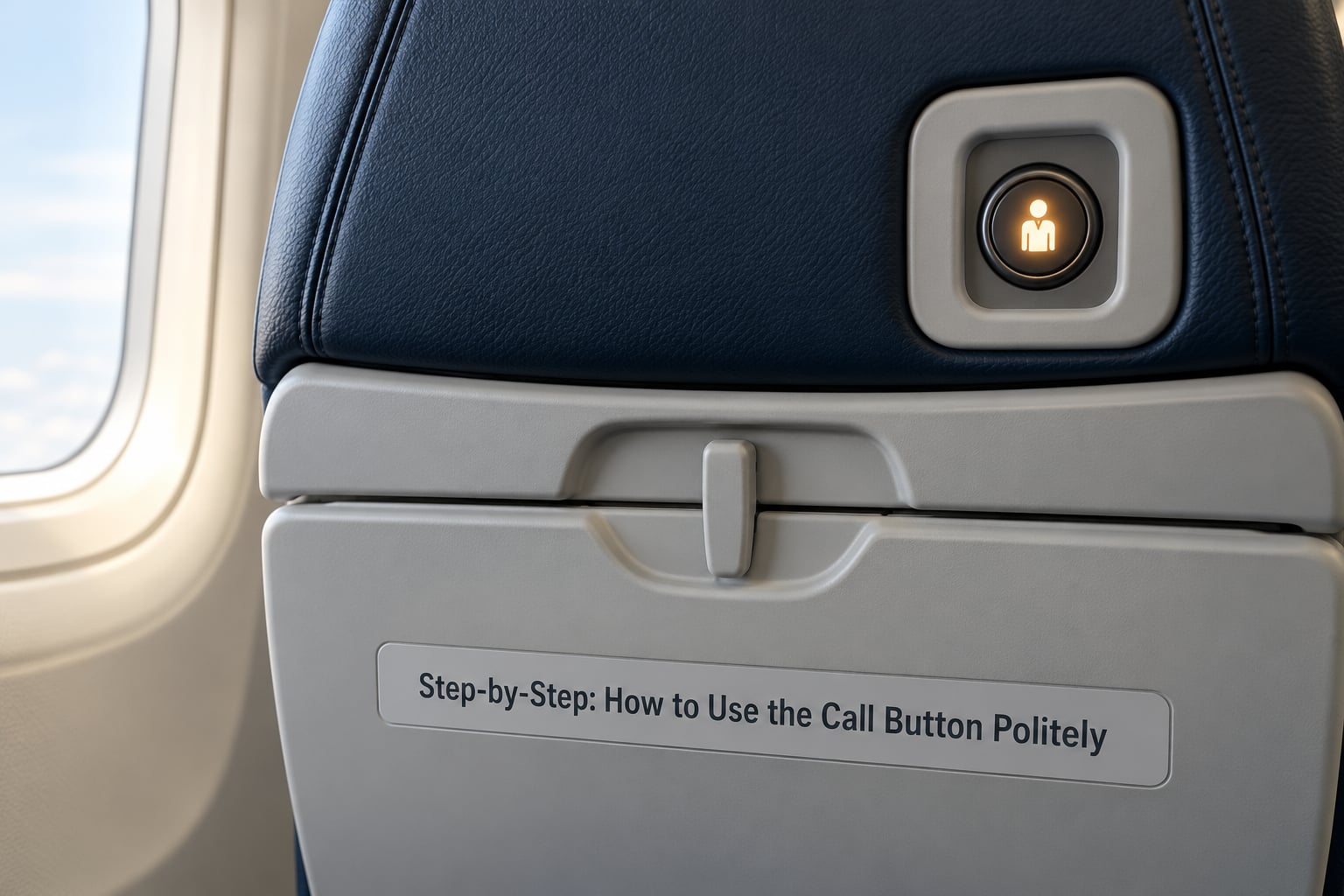
1. Check Whether You Need the Call Button
Press for anything where being wrong would be uncomfortable or unsafe: you feel faint, someone is having an allergic reaction, a drink has spilled across a laptop or an electric device, the lavatory is overflowing, your child needs the lavatory urgently, or a seat, tray table or screen has stopped working. These are requests a person should handle.
Wait for the next walkthrough for the rest. On most US carriers the crew does a cabin round roughly every fifteen minutes once you are at cruising altitude, so a snack request might be twenty minutes away rather than never. Drinks, blankets, seatbelt extenders, an extra pillow, help with an overhead bin, or a question about the connection are all waitable.
Two exceptions worth remembering. If you need water for medication, or you need a bottle warmed for a baby, say so plainly when the crew next comes by and flag that it is medical or infant-related. Those jump the queue legitimately.
2. Wait for a Safe Moment
Do not press during boarding, takeoff, landing, or while the seatbelt sign is on. Crew are strapped in or securing the cabin, and they physically cannot answer. Pressing then does nothing except light up the seat in front of you and mark you out.
Same logic during turbulence. Seatbelt on, phone away, hold the armrest. If someone is genuinely unwell during a rough patch, press the button anyway and add a word when the attendant arrives, because they may need to decide whether to bring a drink immediately or wait it out.
And if an attendant is standing two rows away serving someone else, wait thirty seconds. Catching their eye and asking quietly uses less of their attention than a chime from row 30.
3. Press the Button Once
On most aircraft it is a single button on the seatback, often shaped like a bell and labelled with a phone or attendant icon. Press it once and let it go.
What happens next depends on the aircraft. On many jets a small light illuminates above your seat and a chime sounds in the galley, so the crew knows the row. On older or budget interiors the system is wired differently and you may only get the chime. Either way, one press is the signal. Tapping it repeatedly does not speed anything up, it just makes you memorable in the worst way.
Give it a few minutes before assuming nobody heard. Crew may be mid-service with a full cart, and on a busy flight an attendant may be working a section rather than yours.
4. Explain Your Request Clearly: How to Use the Call Button Politely, Word for Word
When someone arrives, keep it to seat number, then the ask. That is the pattern, and it is short enough to use every time.
- “22C, could I get a glass of water please?” Water, and it takes three seconds.
- “14A, could you bring me a blanket when you have a moment?” The “when you have a moment” is not filler. It tells them it is not urgent.
- “7D, my screen is frozen, could someone take a look?” Reports the problem instead of describing it vaguely.
- “31A, my bag spilled in the overhead bin and it’s on my laptop.” Specific enough to act on immediately.
- “18C, I feel dizzy, I think I need water and to sit down for a bit.” Say this plainly. Crew take symptoms seriously when they are named.
That last one matters more than etiquette. Passengers often downplay how they feel because they are embarrassed, and a named symptom is what lets a crew member move fast or pick up a medical kit.
5. Thank the Flight Attendant
Close the interaction. A thank you, or simply stepping back out of the aisle so they can keep moving, is the polite ending and it is genuinely enough.
If the request cannot be done right then, ask what to expect instead of pressing again: “Will there be another service round?” or “Would it be better to ask the crew at the front?” That gives you information instead of adding a second interruption to the crew’s list.
Common Mistakes
Six habits come up again and again on r/flightattendants and in crew communities, and each has an easy fix.
- Pressing repeatedly because nobody came. One press is the request. If a few minutes pass with no answer, try the seat directly in front of you or catch an attendant’s eye rather than adding chimes.
- Using it for every small request. Batch them. Blanket, water, and an extra pillow are one interruption, not three, and crew genuinely prefer the combined version.
- Shouting across the aisle. Calling out to the crew from a distance works on a small aircraft and fails badly on a widebody. The button and a seat number exist precisely so you do not have to.
- Grabbing an arm or shoulder to get their attention. On some carriers this has been formally discouraged for safety reasons after incidents in the aisle. The button is the sanctioned method.
- Forgetting the seat number. Say it first. Even when the attendant is standing beside you.
- Pressing during a critical phase. Takeoff, landing, and turbulence are the three moments crew cannot respond. Nothing happens except your call being logged and ignored.
One more worth knowing: on long-haul and many international carriers, the call button is the preferred method. The galley is usually a stocked bar fridge, not a service point, and crew work the cabin by seat rather than inviting walk-ups. On short domestic hops the rhythm is different, but the button still works the same way.
Frequently Asked Questions
What should I say when I press the call button on a plane?
Give your seat number first, then one short sentence with your request. u002222C, could I get a glass of water please?u0022 works well. For anything medical, name the symptom plainly: u002218C, I feel dizzy and need water.u0022 Crew can act far faster on a specific sentence than on a vague one, and it keeps the interaction short for everyone standing in the aisle.
How long does it usually take for a flight attendant to answer the call button?
Usually a few minutes, sometimes longer on a full flight when the crew is working a section with a service cart. Cabin walkthroughs on most US carriers happen roughly every fifteen minutes once at cruising altitude, so a chime pressed just after a round passed can easily wait ten. If several minutes pass, catch an attendant’s eye directly rather than pressing again.
Should I press the call button during turbulence or takeoff?
Avoid it during takeoff, landing, and turbulence, because crew are seated and securing the cabin and cannot answer. If someone is genuinely unwell during rough air, press it anyway, then explain the moment an attendant reaches you. Saying you would rather wait ten minutes for calmer skies gives them the information they need to decide.
Can I use the call button in an airplane bathroom?
If the lavatory button does not work and the door will not open, use the call button immediately and tell the attendant which row the lavatory is in. That is a genuine fault and exactly the kind of thing crew would rather hear about early. If you only want to report a mess or a missing supply, wait until you are back in your seat.
What if I accidentally press the call button?
Say sorry and explain when the attendant arrives. It happens constantly and nobody minds. A quick u0022Sorry, I pressed that by mistakeu0022 clears it entirely. There is no need to hide from the seat or pretend you meant it, and no penalty for an accidental press, so do not lose sleep over it.
What should I do if I need help urgently after pressing the button?
If nothing happens after a few minutes, try a louder voice, move into the aisle and flag the nearest attendant, or use the call button again once. Tell the crew member exactly what the problem is and how serious it is, using words like urgent, medical, or cannot breathe. On most aircraft the crew can reach the cockpit or request a medical diversion, so clarity matters more than politeness.
If you take one thing from this, make it the order of operations. Check whether it is really urgent, wait for a calm moment, press once, lead with your seat number, and say what you need in a single sentence. Nothing about that makes you difficult to fly with, and it means the chime that finally sounds is one worth answering.
Updated for 2026.