Knowing how to sit together as a family on a plane comes down to three things: booking every traveler on one reservation, choosing a fare that includes seat selection, and picking a row with enough continuous seats for your group. Do all three and the airline’s system will seat you together automatically. Skip them and it assigns seats at random, which is how parents end up walking back down the aisle while a toddler screams. The whole process takes about ten minutes at booking.
Families keep asking me for a version of this that isn’t just “book together and hope.” So here is the actual decision procedure, what the seat map is really telling you, and what to do when the airline shuffles you anyway.
Last updated: October 2026. Airline seating policies change often, and equipment swaps can change the map hours before departure. Confirm your seats in your booking account and with your airline before you travel.
Table of Contents
- What You Need
- How to Sit Together as a Family on a Plane: Step-by-Step
- How to Sit Together as a Family on a Plane When Booking
- Pick a Seat Block That Fits Your Family
- Confirm the Seats Before You Travel
- What to Do If the Airline Moves Your Seats
- Common Mistakes
- Frequently Asked Questions
- Can a family sit together on a plane without paying extra?
- How do you get seats next to each other when the flight is full?
- Should parents split up with children on a plane?
- What is the best airplane seat arrangement for a family with young children?
- Can a family with an infant or mobility needs sit together?
- Is it better to choose an aisle or window seat for a family?
- Conclusion
What You Need
Before you open a seat map, gather five things. Rushing straight to seat selection is why so many groups end up scattered.
- Everyone’s age and who needs to be next to whom. Under-twos, children with sensory or anxiety needs, and anyone who cannot safely be more than one seat away from a responsible adult need adjacency treated as a requirement, not a preference.
- Your confirmation number. All travelers booked together sit on one reservation, which is the single biggest factor the airline’s seating system looks at. Separate bookings are separate problems, even on the same flight.
- The aircraft for your exact flight. A Boeing 737 is three seats across on one side. A regional jet is two by two. A widebody may be three-four-three. The same seat number means something different on each.
- Your fare rules. The cheapest fare on most US carriers is a basic economy product with no free advance seat selection. Check before you pay, because that single fact decides whether you pick seats or the computer picks them for you.
- Equipment or accessibility constraints. Car seats, a bassinet request, a service animal, or a need for extra legroom all have their own booking rules and their own deadlines.
- Who is supervising the children. Write down the adult-to-child plan. It decides whether you need one row, two rows, or an aisle plus a window arrangement.
How to Sit Together as a Family on a Plane: Step-by-Step
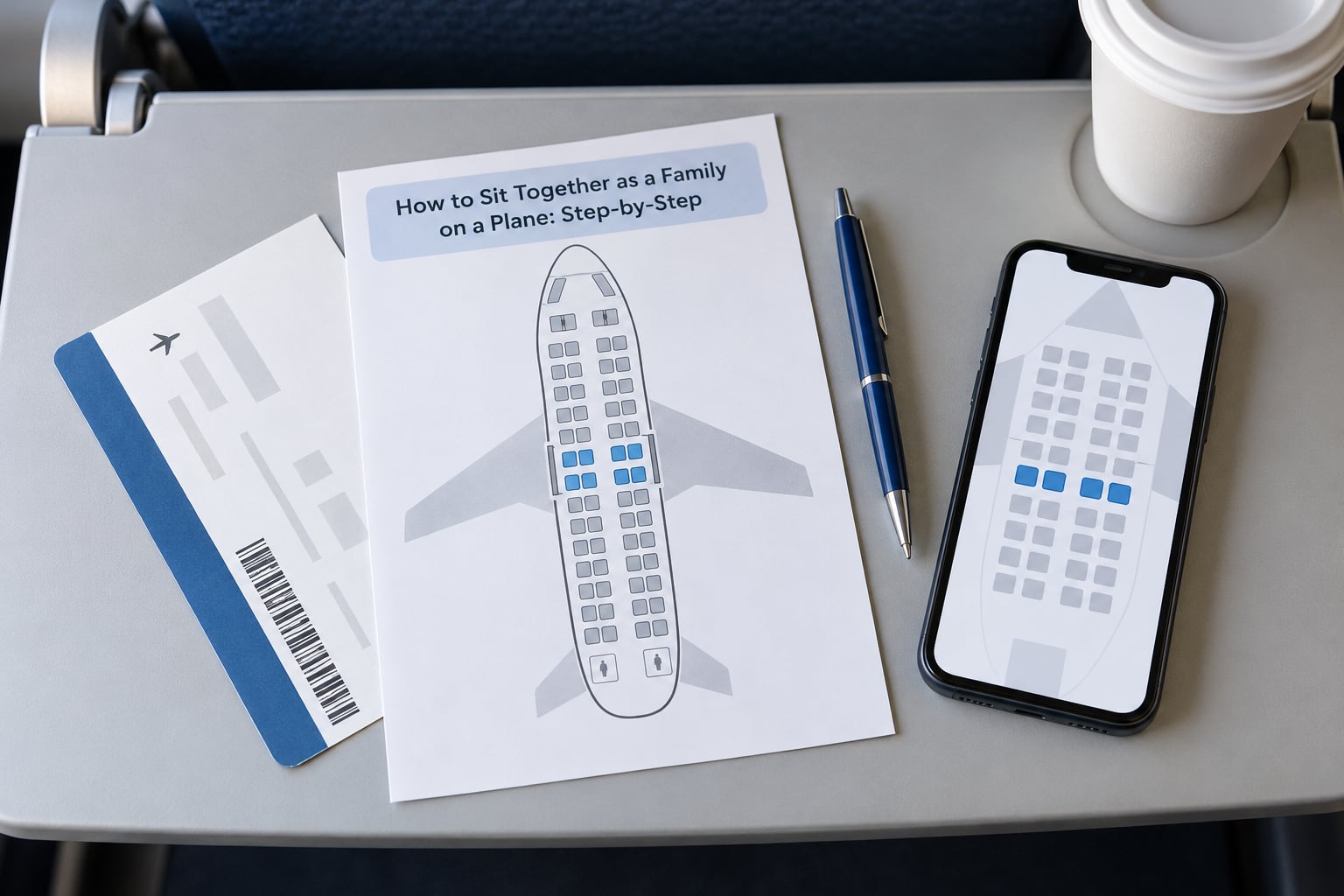
The process repeats for every trip: book on one reservation, pick a fare that lets you choose seats, read the actual layout for your aircraft, select a continuous block in one transaction, then recheck it at check-in and again at the gate. Each step below explains what to do and how you can tell it worked.
How to Sit Together as a Family on a Plane When Booking
Start on the airline’s own site rather than a third-party search page. OTAs often split travelers into separate bookings or hide fare rules that decide seat selection, and you end up troubleshooting a system you cannot see.
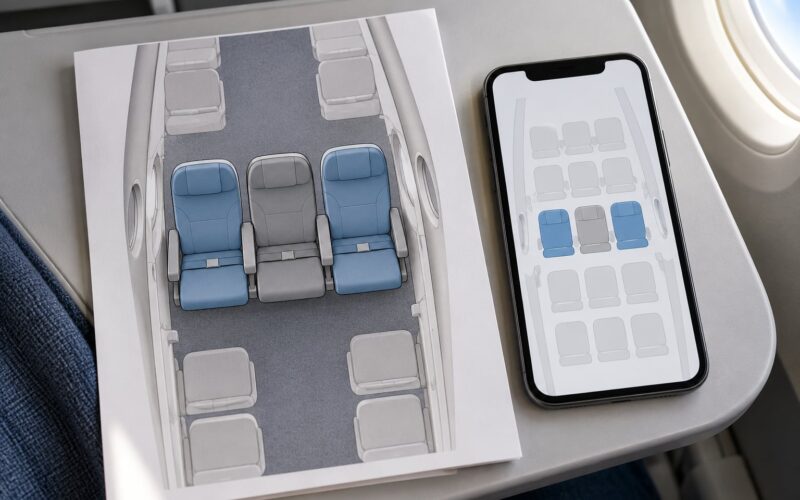
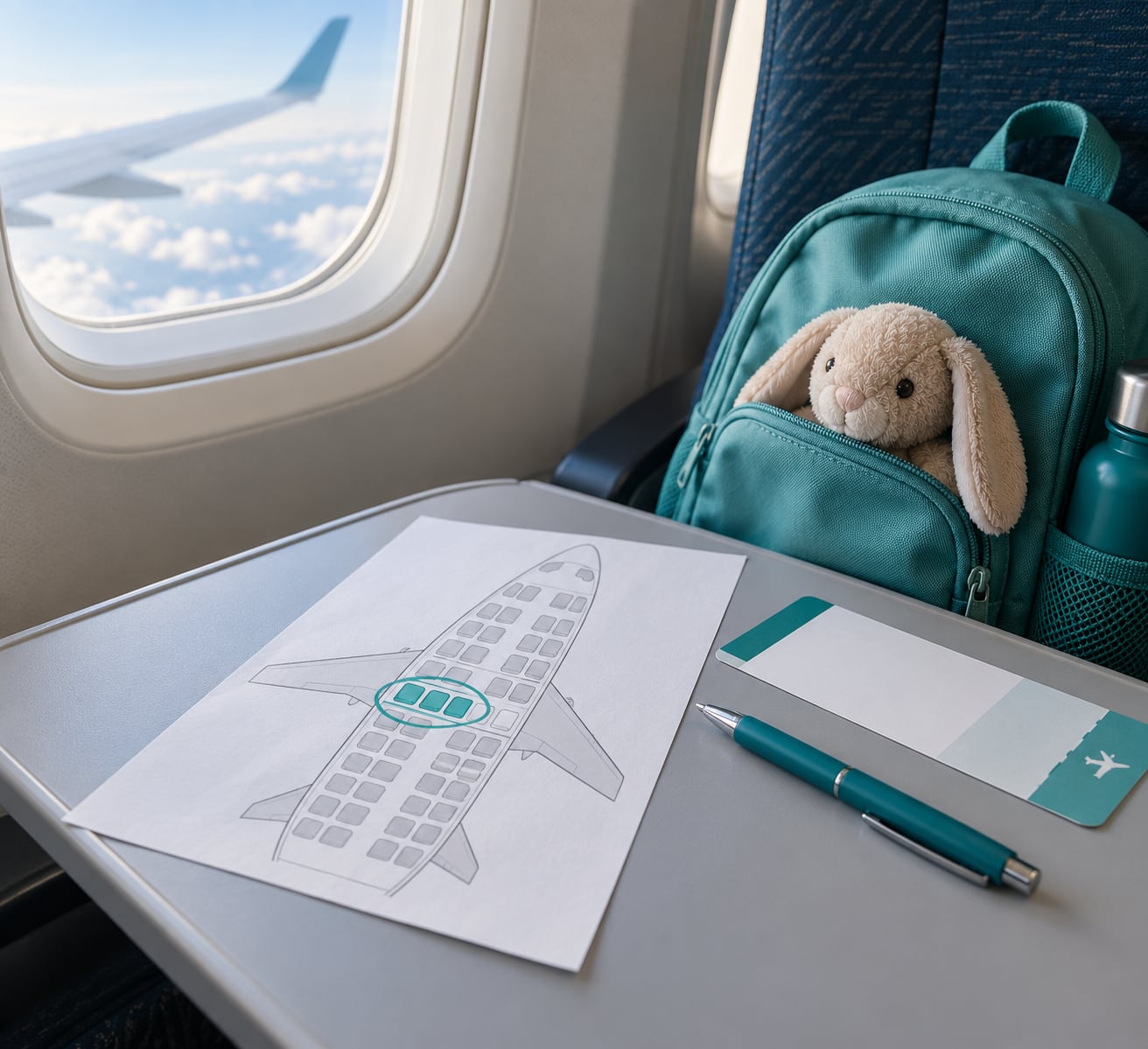
Add every family member in one go before you pick seats. Once everyone is on the reservation, open the seat map. You are looking for rows where the seat letters you need are all the same color, meaning free and selectable together. On a three-across narrowbody the letters run A, B, C one side and D, E, F the other, so three continuous seats are ABC or DEF, never a scattered mix.
Then select every family member’s seat in a single pass. Most systems time out or reset if you leave the map mid-selection, and that reset is where groups get broken up.
On fare choice, three options cover almost everyone. Basic economy gives you no seat choice and random assignment, which is why it is the wrong product for most families. A standard economy fare usually includes free advance seat selection, which is the sweet spot for most groups. Upgrading to extra-legroom economy mainly helps if it comes with free seat selection, since legroom alone does nothing for adjacency.
For carriers with open seating, the calculation changes. On an open-seating airline you choose a boarding group rather than a seat, so the strategy moves to checking in early and boarding first.
Pick a Seat Block That Fits Your Family
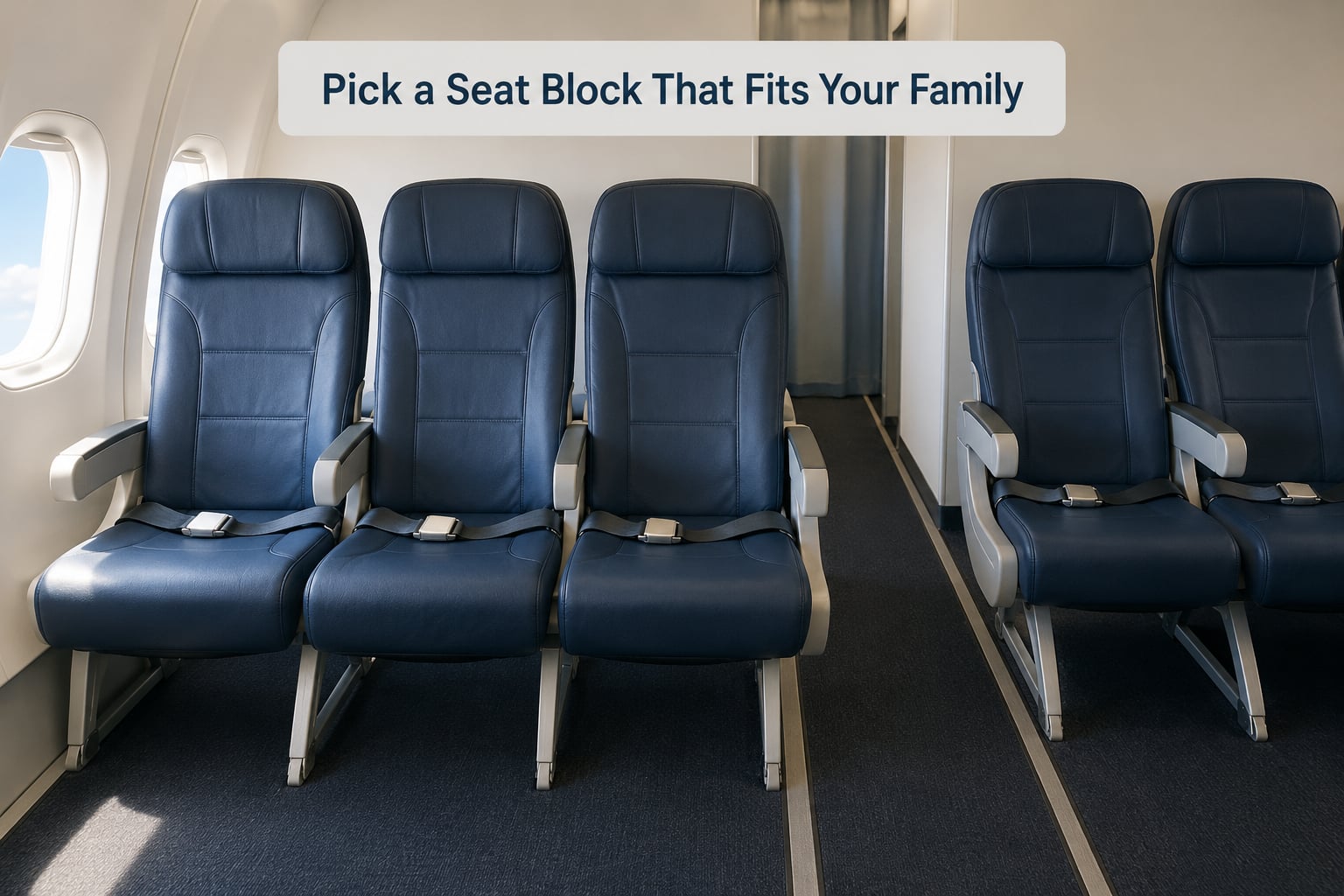
On a three-across narrowbody, one row gives you exactly three seats. A parent plus two children fits in ABC or DEF, and leaving the middle seat for a child under ten is usually easier than trying to keep a toddler quiet between two adults.
Two by two aircraft are harder. A group of three cannot fit in one row without taking an aisle seat from a stranger, so plan on two adjacent rows, such as the window pair in one row and the aisle pair in the next. Read it as two adjacent blocks rather than one, and tell the older children where everyone will be before you board.
For groups of five or six, aim for a pair of three-across rows on the same side. That is the hardest case to solve, so book it earlier than everything else.
A few row types deserve care. A bulkhead row has no seat in front, which is useful for a child who needs to stretch their legs but usually cannot hold a car seat in an upright position. Exit rows come with age and health restrictions and may be blocked to you, so do not plan around one. Rows next to a galley or a lavatory mean constant traffic, occasional spillover noise, and the scent of lavatory air.
Avoid the very back row if a nervous child is along, since the area behind the seats is where passengers stand during taxi and landing. Rows behind the wings, ahead of the exit rows, tend to be calmer and quieter, which matters more than the view.
Aisle versus window comes down to your children. With a baby or a toddler who will need to get out, an aisle seat for the parent beats a window every time. With an older child or a sensory-sensitive traveler, the window side reduces visual stimulation and gives them a wall to lean on.
Confirm the Seats Before You Travel
Seat selection at booking is a request, not a lock. Aircraft get swapped, cabins get reconfigured, and a family that planned carefully around seat 12 can wake up on a different layout.
Recheck the itinerary in your booking account a few days before departure, then again when you check in online. If the map looks unfamiliar, the aircraft changed and you need to redo the selection. Swapping equipment mid-trip is the single most common reason a family ends up scattered, and it is also the easiest to fix while seats are still open.
Check for equipment notes too. A car seat in the cabin needs a bulkhead row with the seat upright, which is a booking-time request rather than something a gate agent can add on the day. Bassinet requests also need to be made in advance, and availability is limited even on empty flights.
Most carriers open check-in 24 hours before departure for domestic flights and a little later for international ones. Check in the moment it opens, confirm your seats then, and note any change immediately.
What to Do If the Airline Moves Your Seats
Start by assuming the aircraft changed, not that the system made a mistake. Open the new seat map and count what is actually free before you complain about anything.
Call the airline, not just the app. Front-line agents can see whether your family was auto-assigned or blocked, and can often move a whole group together, while the website tool frequently cannot.
State the problem plainly and specifically: “Two adults traveling with a three-year-old on reservation ABC123, currently separated by four rows. Can we move them into one row together?” Specifics get solved faster than “we want to sit together.”
Then handle the escalation path in order. Gate agents have the final say on boarding-day seat changes, so approach them early at the gate rather than after boarding with a crying child. Keep a screenshot of your original seat assignments and the new ones, since it is useful if you need to file a complaint or request compensation later.
If the flight is full and nothing adjacent is open, ask about a later flight with a better map, or about rebooking that keeps the group in one row. If you are already on board and genuinely need to move, a polite ask to the people in the empty aisle seat works far more often than people expect. Keep the children settled and nearby while you sort it out, and accept a no gracefully. A flight attendant can help with an open seat, but they cannot move a paying passenger who is comfortable where they are.
Common Mistakes
Assuming the seat map matches the aircraft. The map at booking shows today’s equipment. Seats get reassigned before departure. Fix: recheck at check-in, and treat any unfamiliar row number as a signal to redo the selection.
Booking family members one at a time. Separate purchases create separate reservations, and the seating system treats each traveler independently. Fix: book everyone in one transaction. If tickets already exist separately, call the airline and ask them to link the reservations.
Overlooking exit row restrictions. Exit rows are limited to eligible ages and can be blocked at boarding, which can split a group at the last minute. Fix: treat exit rows as unavailable when you have children.
Choosing seats next to avoidable noise. Galley and lavatory rows work fine for adults and poorly for light sleepers. Fix: pick rows mid-cabin, ideally behind the wing.
Relying on an aisle seat for a large group. Aisle access helps one person; it does nothing for adjacency. Fix: plan around continuous seats first, convenience second.
Checking in late. On assigned-seat airlines the best blocks disappear as check-in proceeds. Fix: set an alarm for exactly when check-in opens.
Ignoring the fare rules. Basic economy and Blue Basic fares are the main reason families get auto-assigned. Fix: read what the fare includes before paying, and pay for adjacency deliberately if the fare does not include it.
Frequently Asked Questions
Can a family sit together on a plane without paying extra?
Usually yes, as long as everyone is on one reservation and the fare includes advance seat selection. United auto-assigns families with young children together on basic economy and Standard Economy fares. On carriers where the cheapest fare excludes seat selection, the airline assigns seats at random at check-in or at the gate, which is when groups get separated. Check your fare rules before you pay, and select seats yourself whenever the booking flow allows it.
How do you get seats next to each other when the flight is full?
Book earlier, because adjacent inventory is the first thing to disappear. When you book, look for rows with three or more continuous free seats rather than scattered availability, and select every family member in a single transaction so the system does not reset. If the flight is already full, call the airline and ask for help, then approach the gate agent before boarding. On open-seating carriers, boarding group order decides the outcome.
Should parents split up with children on a plane?
Not if you can avoid it, especially with a child under 12 or one who has anxiety or sensory needs. A parent assigned several rows away turns boarding into a distress scene for everyone around you. If the only option on offer is a split, keep the parent on the aisle closest to the child and explain before boarding where the child will sit. Ask the gate agent for the arrangement that puts the child in the middle of the adult group.
What is the best airplane seat arrangement for a family with young children?
One row of three continuous seats on a three-across narrowbody, with the middle seat given to the youngest child. Extra legroom is not the priority; adjacency and being near an aisle are. Put the parent on the aisle so getting out is easy, and avoid galley and lavatory rows and the very back row. Behind-the-wing rows tend to be the calmest stretch of the cabin.
Can a family with an infant or mobility needs sit together?
Yes, and you should arrange it in advance rather than at the gate. Infant equipment needs a bulkhead row and a car seat must be able to stay upright, which is a booking-time request. Mobility needs and service animals should be declared during booking so the airline can block the right seat and clear the space. Accessibility requests are handled by a dedicated team, so call early and confirm what was recorded.
Is it better to choose an aisle or window seat for a family?
Choose an aisle seat for the adult who will be getting up with a baby, toddler or a child who needs the toilet mid-flight. Choose a window seat for an older child or anyone sensitive to noise and visual stimulation, since the wall gives them somewhere to settle. In a three-across row the middle seat is the least convenient position, so give it to the child who will stay seated longest.
Conclusion
Start by entering every family member’s details in one booking, then open the seat map for your exact aircraft and choose the most continuous block of seats it offers. That single decision does more for a smooth trip than any amount of gear you pack. Then recheck your seats at check-in and confirm them with the gate agent before boarding, because that is when a last-minute change is still cheap to fix.