There is no single best seat on a plane, and anyone who tells you otherwise has a row number they like. The best seat is the one whose position and type match what you actually need on that flight: bulkhead or exit-row seats for legroom, an aisle seat for easy movement, a window seat for sleeping, rows near the front for fast deplaning, and rows over the wings for a calmer feel. Work through these seven steps and you can choose the best seat on a plane on almost any airline.
The short version, if you want it in one glance:
- For maximum legroom: a bulkhead row or an emergency exit row, with the caveat that you may not be allowed in the exit row.
- For easy movement or frequent lavatory use: an aisle seat, roughly 15 to 24 rows back.
- For sleeping and views: a window seat, ideally on the shaded side of the aircraft.
- For a quick connection: an aisle seat in the front cabin, around rows 5 to 15.
- For the smoothest feel: over the wings or just forward of them, knowing turbulence can show up anywhere.
- For personal space: the rear cabin, where the seat beside you is more likely to stay empty.
Table of Contents
- What You Need
- Step-by-Step: How to Choose the Best Seat on a Plane
- Check the aircraft and seat map first
- Decide which benefits matter most
- Compare the strongest seat positions
- Check fare and eligibility rules
- Read recent aircraft-specific reviews
- Confirm the seat after booking and before departure
- One last check before boarding
- Common Mistakes
- Frequently Asked Questions
- Why avoid seat 11A on a plane?
- What is the best way to choose seats on a plane?
- What is the 3 seat economy trick?
- What seat to avoid on an airplane?
- Is window or aisle better on a plane?
- Are exit row seats worth it?
- Conclusion: Pick Your First Two Seat Choices
What You Need
You cannot judge a seat from the seat number alone. Two airlines sell row 22A on aircraft that share a type and name, and the seats can be ten inches apart in pitch. Before you pick anything, have four things open at once.
- Your booking page. Every airline shows a live seat map during purchase and inside the manage-booking tool, usually under a link labelled My Trips, Manage Trips or Find My Booking.
- The aircraft type for your specific flight. Read it on the itinerary as a three-digit code such as 738 or 32A, then check whether the airline has swapped that aircraft for another one on your route.
- The fare rules. Your fare family decides whether seat selection is free, costs a few dollars, or is bundled into a seat product that comes with extra legroom and a power outlet.
- Online check-in timing. Most domestic flights open check-in 24 hours before departure, and many international itineraries open seat selection around 90 to 100 days out. Both windows decide whether you choose now or later.
Add one personal list to that: what hurts most on a flight for you. Tall travellers need pitch. People who get cold need a wall to lean on and a working shade. Anyone with a 90-minute connection cares only about deplaning speed. Write your top two priorities down before you look at the map, because the map is much easier to read once you know what you are reading it for.
Step-by-Step: How to Choose the Best Seat on a Plane
Check the aircraft and seat map first
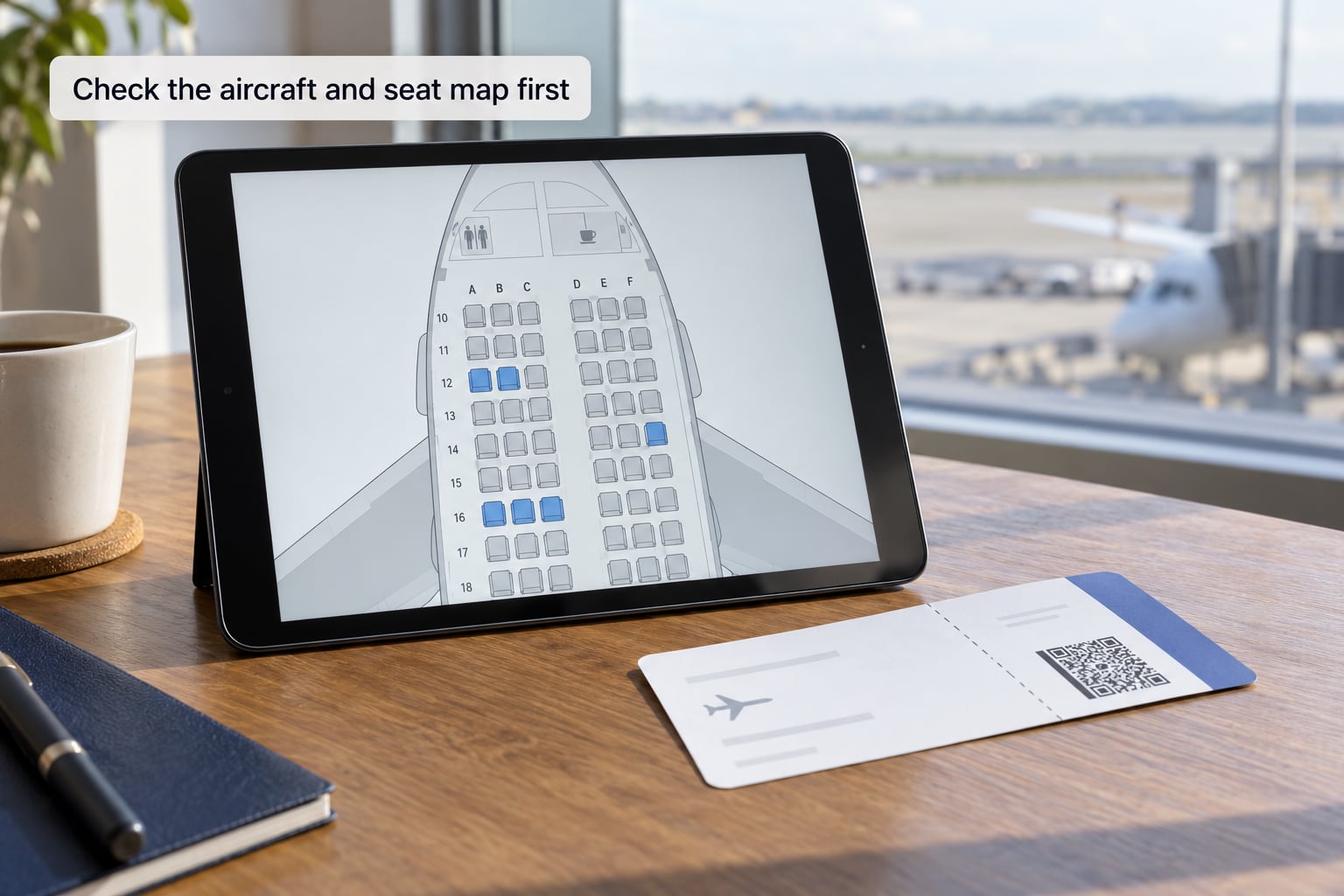
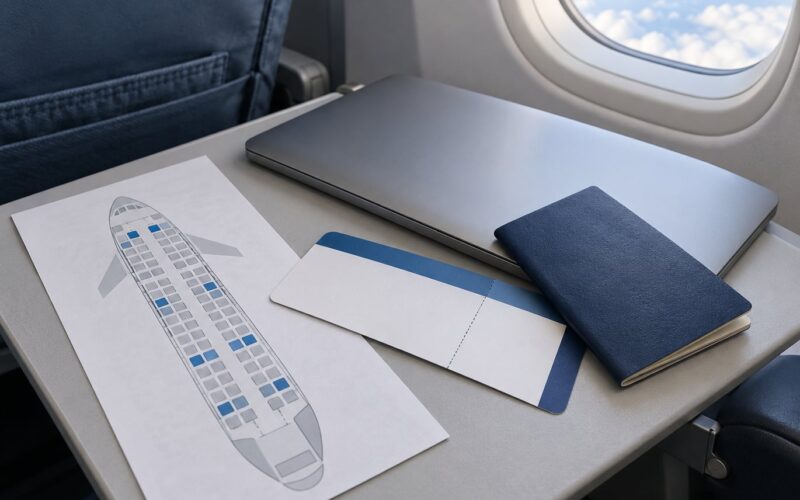
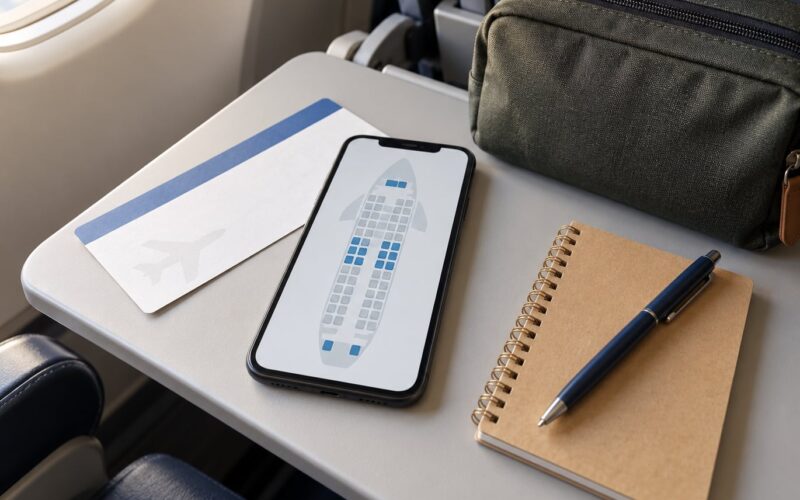
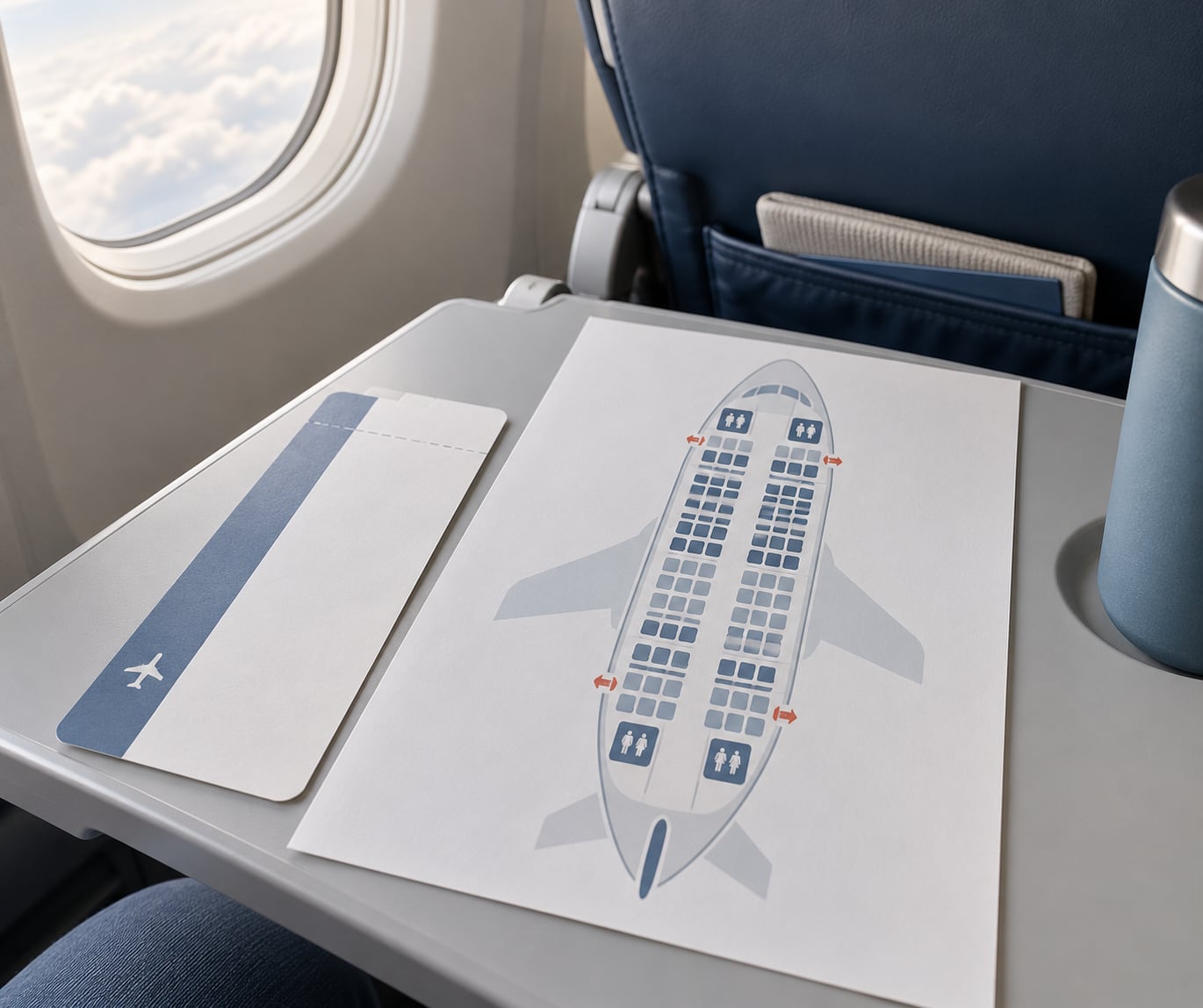
Start with the layout, not the row. Seat maps carry symbols that tell you most of what you need: exit icons mark rows with a door, lavatory and galley icons show where the noise and the queues start, and a seat with no window symbol is a window seat with no window, which happens on some widebody configurations behind curved fuselage sections.
Three numbers describe the physical space. Seat pitch is the distance from the back of your seat to the back of the one in front, measured in inches, and it is the single best proxy for legroom. Seat width is the cushion across, typically 17 to 18 inches in a standard narrowbody. Cushion depth decides how long you last, and it is the one number almost nobody publishes. When a map shows no numbers at all, assume standard economy pitch and treat any extra-legroom label as worth checking.
Row numbers reset on every aircraft, and some cabins start counting again after a bulkhead or a galley break. Two A seats on opposite sides of the aircraft are the same letter in most cabins, but not all: a 3-3 narrowbody uses A, B, C and D, E, F, while many 2-2 and 3-4 widebody cabins use A, C, D, K or A, C, D, F. Read the letters on the map rather than assuming.
Compare across airlines too. If you want an outside read on the exact type and configuration, the aircraft-specific seat databases that flyers use are more useful than a general search, because they chart real configurations rather than averages. Bookings.com and airline sites will show you the live map for your flight; the specialist seat charts are the fallback when your airline publishes nothing.
Decide which benefits matter most
Rank your two strongest priorities and ignore the rest. Most arguments about seats never resolve because two people are answering different questions. One wants the widest possible space, another wants to be asleep by hour one.
- Legroom points to bulkheads, exit rows and airline-branded extra-legroom rows.
- Quiet points away from galleys, lavatories and the last few rows near the wing exit, and toward the middle of the cabin or the rear on a large aircraft.
- Speed off the plane points to the front cabin, where boarding usually starts.
- Sleep points to a window seat with a controllable shade, away from the sidewall vents that can send cold air down your neck.
- Underseat space points away from bulkheads, which have a wall in front instead of a storage bin.
- Bassinet eligibility points to specific bulkhead rows, which you must request rather than select.
- Being near your party points to a row you can book as a block, which is usually a rear or middle row in a 3-3 layout.
Compare the strongest seat positions
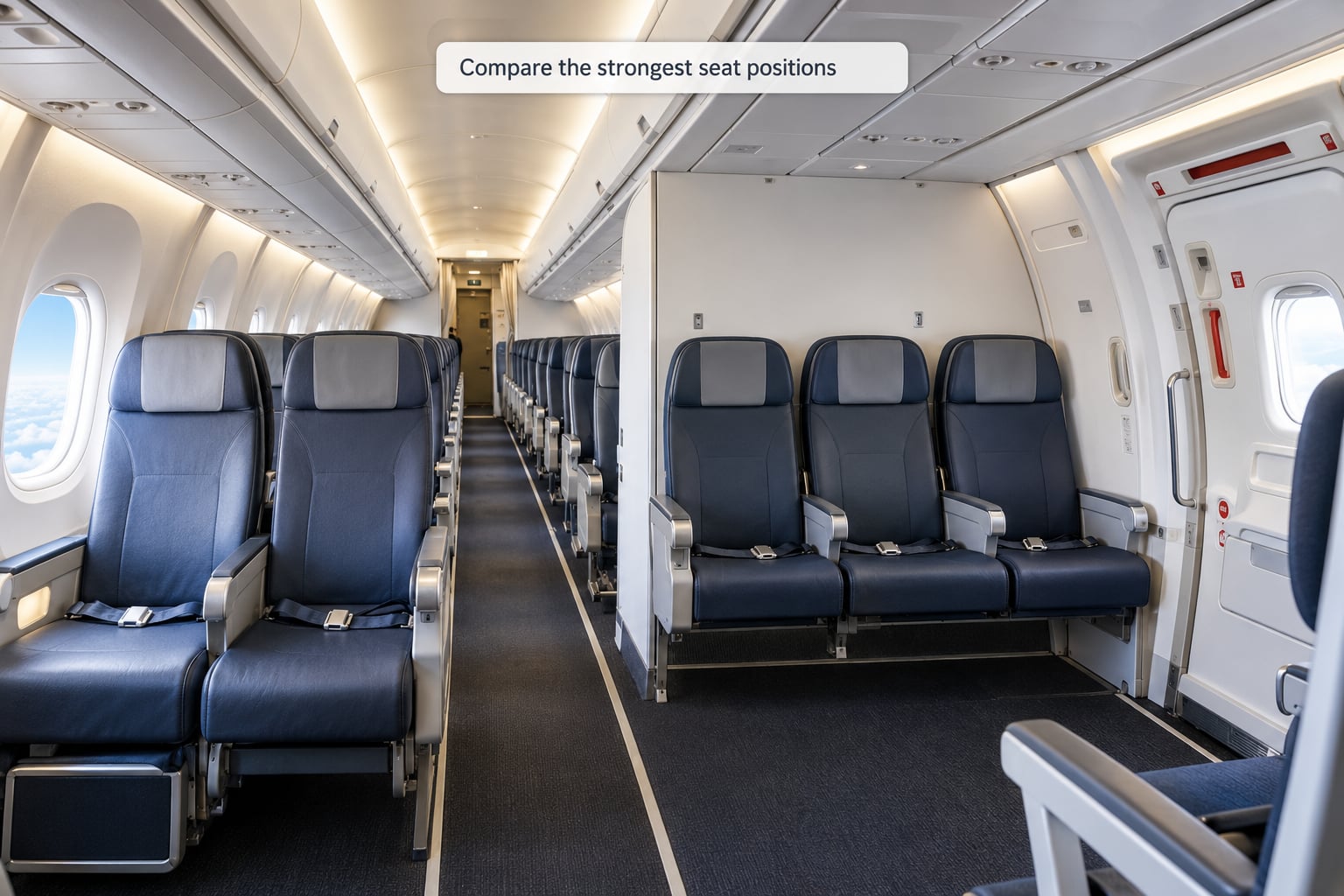
Every position trades one thing for another. This is the honest version of the comparison, with the caveat attached to each row.
| Seat position | Legroom | Sleep | Noise | Getting up | Deplaning | Best for |
|---|---|---|---|---|---|---|
| Bulkhead row | Above average | Good, no seat in front | Can be loud at boarding | Easy | Fast | Tall travellers, and anyone who will manage overhead stowage during takeoff and landing |
| Exit row | Highest | Good | Draft from the door | Easy | Fast | Adults who can lift the door and accept the emergency duty |
| Standard aisle | Standard | Fair, disturbed often | Loud, people passing | Easiest | Fast | Frequent lavatory use, tight connections, long legs |
| Standard window | Standard | Best | Quietest of the three | Awkward | Medium | Red-eyes, cold sleepers, anyone with a wall to lean on |
| Middle seat | Standard | Poor | Medium | Awkward | Medium | Nobody, unless it is empty on a 3-3 aircraft |
| Over-the-wing | Standard | Fair | Moderate | Medium | Medium | Nervous flyers who want the calmest feel |
| Rear cabin window | Standard | Fair | Quiet on a big aircraft | Awkward | Slowest | Budget travellers and anyone hoping for an empty neighbour |
Two claims need correcting because they circulate constantly. Not every exit row is wider: the extra space comes from pitch, not seat width, and some rows lose it to a wall-mounted armrest. And not every bulkhead gains pitch, because the same exit row above may sit right in front of it. Some bulkheads also lose the standard cushion width to a tray table built into the armrest, and some carry bassinet fittings that block part of the footwell.
The front-versus-back argument is real and both camps have a point. Front rows win on deplaning speed and on the empty overhead bin, since boarding usually starts there. Rear rows win on quiet and on the odds that nobody books the seat beside you, since most people pick forward of the middle. Regular flyers on travel forums tend to converge on an aisle seat somewhere between rows 15 and 24 as the balanced pick, which is exactly the range that avoids the front galley noise and the rear lavatory queue.
Check fare and eligibility rules
Seat rules are set by the airline, and the airline publishes them clearly enough that it is worth reading before you click. On most major US carriers, seat selection used to be free for every passenger and now often costs a few dollars for standard seats, with preferred rows and extra-legroom rows priced higher. Many bundles include a free standard seat as a condition of purchase, which is worth comparing against paying for one separately.
Eligibility matters as much as price. Exit-row passengers must generally be at least 15, must be able to reach and operate the door without assistance, and must accept a safety briefing. Gate agents apply those rules personally, and they can move you out of the row at boarding. Travellers who cannot meet the assistance requirement, including some passengers travelling with an infant, or passengers the agent judges unable to act in an emergency, are typically reseated, sometimes on a quieter aircraft, which means a different seat entirely.
Bassinet positions are not chosen like other seats. They are installed in specific bulkhead rows, limited in number, and usually requested through the airline before travel or at the gate. Crew rest areas, galleys, accessible seating positions and rows needed for weight and balance also appear as unavailable on the map. If a seat is blocked, that is the reason, and no amount of refreshing changes it.
Read recent aircraft-specific reviews
Generic roundups tell you bulkhead rows have more legroom. Aircraft-specific flight reports tell you whether the tray table in your row clears when the seat in front reclines, whether the recline actually works, where the outlets are, and how loud the row is at night. That level of detail comes from people who flew the exact type on a recent date.
Search by aircraft type plus seat letter rather than by airline alone. Look for reports from the last year or two, since cabins get refitted, and cross-check at least two or three reports before treating a comment as typical. One detail worth confirming every time: whether the seat in front of you is in a non-reclining row, because it is common on aircraft where a row sits directly ahead of an exit row and the exit mechanism needs clearance.
Flyer forums are also useful for the things maps cannot show. Reddit’s flight communities and the bigger travel forums carry long threads on which rows feel calmest, how often seat assignments shift, and what happened after an aircraft swap.
Confirm the seat after booking and before departure
Your seat assignment is not settled when you pay. Airlines reassign cabins, upgrade sold-out bookings, and swap aircraft on the same route weeks ahead of departure. Check your reservation a few weeks out and again a few days out, and look at three things: the seat letter, the aircraft type, and whether you have been moved to a different cabin.
Then use your selection window. When online check-in opens, usually 24 hours before a domestic departure, the full seat map becomes available to everyone, which is the last chance to take a better seat without asking. Book early where possible, because the good positions genuinely do go first.
If your chosen seat is gone at check-in, ask at the gate. Politely, with a reason. Gate agents can sometimes open a seat that the map shows as taken, occasionally reseat you when the cabin is quiet, and sometimes move you forward if the aircraft ends up with empty rows in premium cabins. They cannot override an aircraft or safety rule, so manage your expectations.
One last check before boarding
On the boarding pass, verify that the seat is printed and that the letter matches what you selected. If you paid to select a seat and it is different or missing, say so at the gate before the doors close rather than in the aisle after take-off. Airline policies on refunds for seat selection vary, so check the fare rules at the time you book rather than assuming.
Common Mistakes
Picking by row number alone. Row 22 means nothing until you know the layout around it. Fix: read the map for the door, lavatory and galley icons before the row number does anything.
Assuming every exit row is wider. The extra room is pitch, and some exit rows keep a standard-width cushion with a wall-mounted armrest eating into it. Fix: check the pitch figure, not the seat category.
Ignoring lavatory noise. Two rows from a lavatory door means queue noise, door slams and foot traffic for the whole flight. On a long-haul, that is the difference between sleeping and not. Fix: leave at least three rows of clear air on either side, more if you are sensitive to it.
Forgetting that aircraft change. The seat you picked and researched belongs to an aircraft type that may no longer be flying your route. Fix: re-read the aircraft code on your itinerary every few weeks.
Skipping the fee and eligibility rules. A seat that costs extra should be worth more than the fee, and an exit row you cannot occupy is a wasted seat number. Fix: read the fare terms and the exit-row conditions before paying.
Trusting a middle seat to stay empty. It often does not. On a 3-3 aircraft the community trick is to book the window and the aisle together toward the rear, leaving the middle as the most likely seat to stay unclaimed, and to swap politely if it does not.
Frequently Asked Questions
Why avoid seat 11A on a plane?
Seats like 11A are usually an exit row or a window position beside one, and both come with restrictions and drawbacks. Exit rows require passengers to be at least 15, able to reach and operate the door, and willing to take on emergency duties, so the airline or gate agent can move you out. Some aircraft configurations also place 11A where the window is missing or narrowed by the fuselage curve. Check your exact aircraft seat map rather than assuming the letter is the same everywhere.
What is the best way to choose seats on a plane?
Decide what matters most on that specific flight, then read the seat map for your exact aircraft to find where the doors, lavatories, galleys and bulkheads sit. Match the seat type to your priority, book early if the seat is free, and reselect during online check-in about 24 hours before a domestic departure. Rows near the front deplane fastest, rear rows tend to be quieter, and rows over the wings feel calmest.
What is the 3 seat economy trick?
On a three-by-three aircraft, booking the window and the aisle seats together in the same row, usually toward the rear, leaves the middle seat as the one most likely to stay empty. Some flyers also book three seats across for a family and accept the middle. It works best on routes with a few empty rows, and it fails quietly on a full flight, so treat it as a free upgrade rather than a plan.
What seat to avoid on an airplane?
Start with the middle seat, then rows within a couple of seats of a lavatory or galley, where noise and queues last all flight. Also avoid the row directly ahead of an exit row, which often cannot recline, and the last-row window seat where a wall sits behind you. Bulkhead bassinet rows can be noisy with small passengers, and on some aircraft a window seat has no window at all.
Is window or aisle better on a plane?
The aisle seat wins if you get up often, stretch your legs, or have a tight connection. The window seat wins for sleeping, for not being bumped in the aisle, and for leaning against a wall. One caveat most guides skip: window seats sit beside the sidewall air vents, so cold drafts travel down your neck, and the glass can be cold in winter. Bring a layer whichever seat you take.
Are exit row seats worth it?
Usually yes, if you meet the eligibility rules. You get the most legroom in economy and a window all to yourself, which makes it strong for long flights. The trade-offs are a draft from the openable door, no under-seat storage, a tray table that may restrict how far the seat reclines, and a duty to help with an evacuation. Travellers who cannot lift the door are usually moved at the gate.
Conclusion: Pick Your First Two Seat Choices
Decide on a first choice and a backup, then look at the seat map for your exact aircraft and pick the one that matches your priority. An aisle seat around rows 15 to 24 is the safe all-rounder; an exit row or bulkhead is worth it on a long flight if you qualify; a window seat wins for sleeping; the front cabin wins for connections.
Book it early if the seat is free, reselect during online check-in if it is not, and recheck the aircraft code a couple of weeks before you travel. That is how to choose the best seat on a plane without spending an evening on it. Updated for 2026.