Airlines gate check carry-on bags because the overhead bins on a given flight will not hold every bag that walks down the jet bridge, and the crew works from an estimate rather than a live count. Gate checking means a gate agent takes your bag at the aircraft door, tags it, and stows it in the cargo hold instead of letting you stow it yourself. It is usually free, but you lose access to the bag for the rest of the flight. Understanding why gate checking a bag happens makes it far less surprising when it happens to you.
This guide covers the operational reasons behind it, the aircraft and boarding rules that decide it, and what to do in the ten minutes after a tag goes on your handle.
Last updated: October 2026
Table of Contents
- What Does Gate Checking a Bag Mean?
- How a gate check differs from a counter check
- Why Gate Checking a Bag Happens at the Gate
- Why the bins can look empty once you are on board
- Bag shape decides how much of the bin you actually get
- Does Gate Checking Happen Because of Security or Randomly?
- How Airline Boarding Rules Trigger Gate Checks
- What a gate check costs you
- Why Gate Checks Are More Common on Small Aircraft and Short Routes
- Why gate checking a bag happens less on weight-restricted flights
- What to Do If Your Bag Is Gate Checked
- Can you refuse a gate check?
- How to Avoid Having a Bag Gate Checked
- Frequently Asked Questions
- Why is my carry-on being gate checked when the overhead bins look empty?
- Is gate checking a bag free, or do I pay a checked-bag fee?
- When are gate-checked bags returned at the destination?
- Can I take a gate-checked bag through a connecting airport?
- What if my gate-checked bag contains medicine, documents, or valuables?
- Conclusion
What Does Gate Checking a Bag Mean?
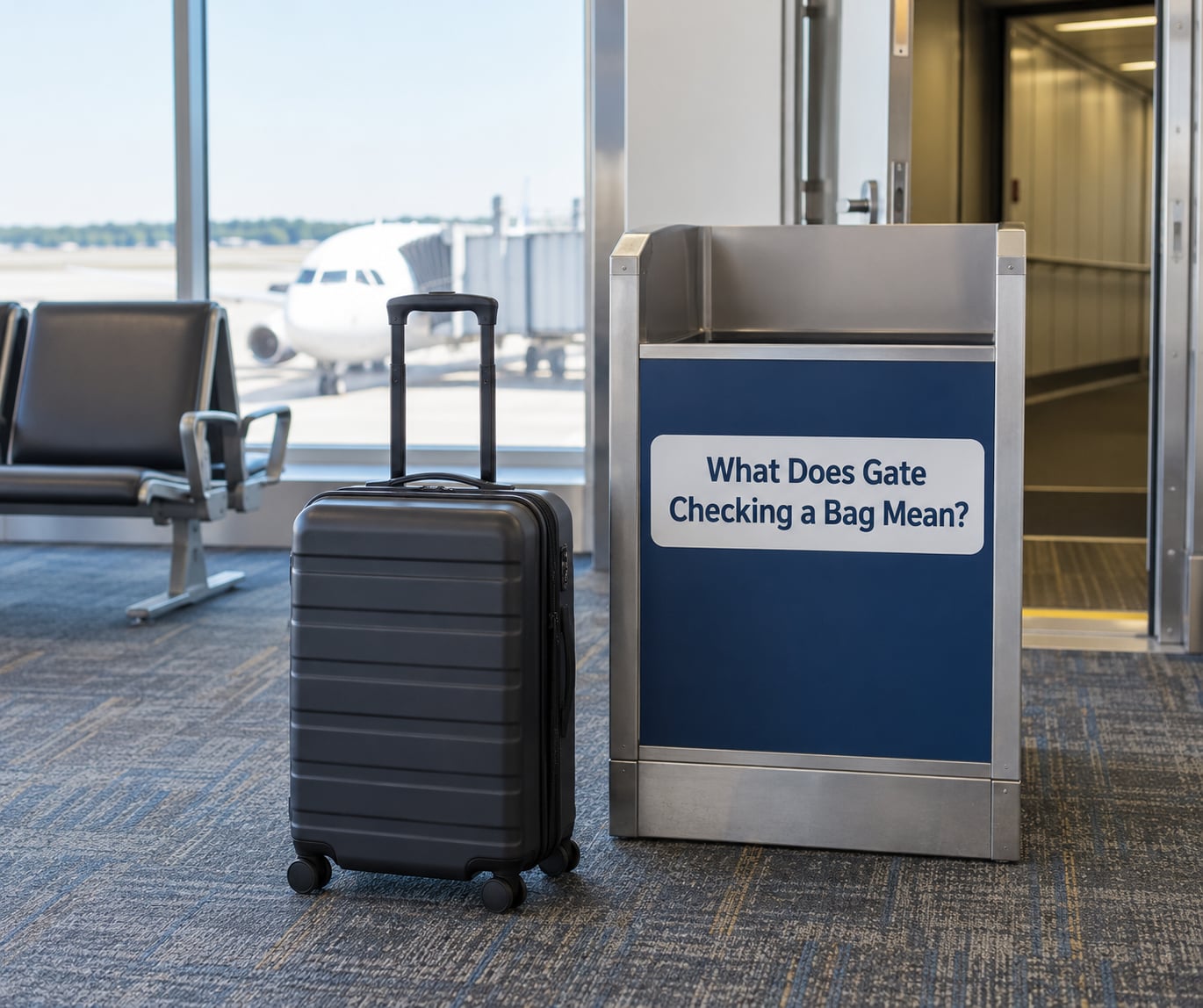
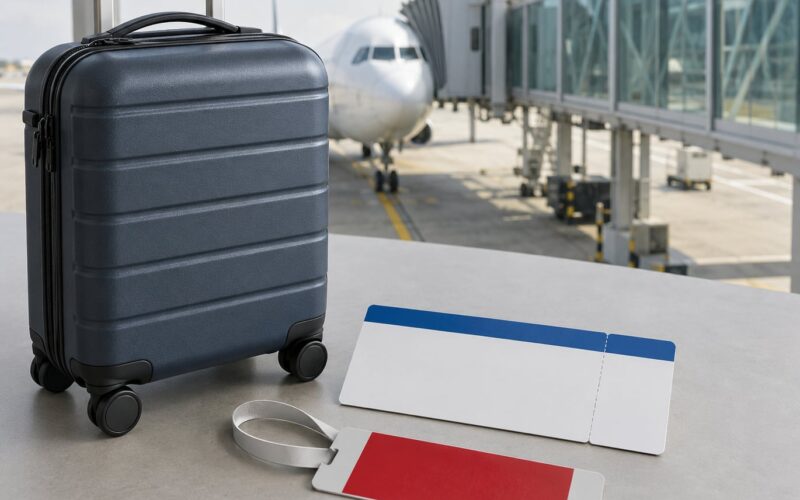
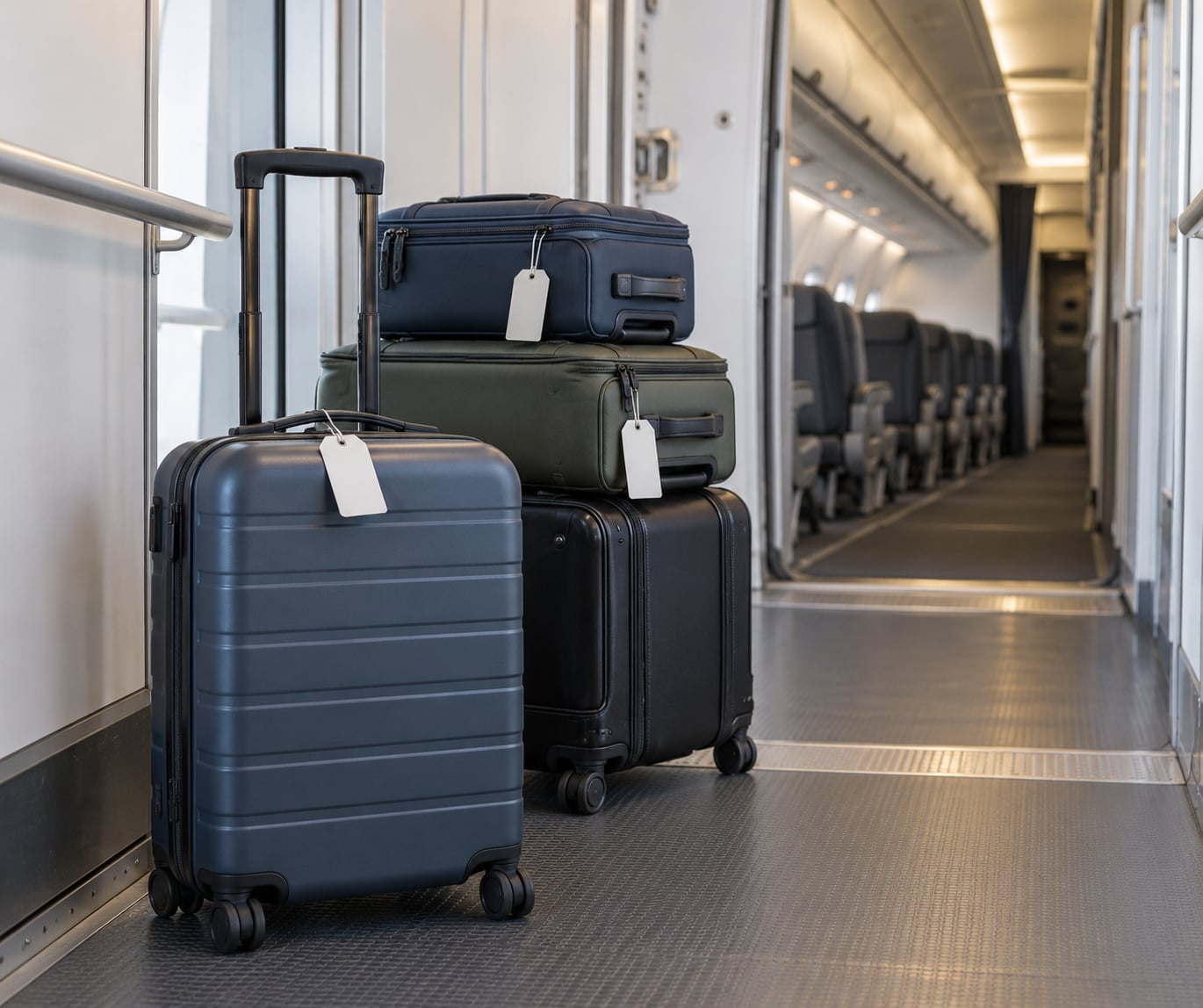
Gate checking is when a gate agent takes your carry-on bag at the aircraft door, attaches a routing tag to the handle, and loads it into the cargo hold as though you had handed it over at the ticket counter.
You keep your boarding pass and your personal item. Everything else in that roller goes below, and you collect it either at the jet bridge or on the baggage carousel at your destination.
How a gate check differs from a counter check
A counter check happens hours before departure, gets a normal claim tag, and goes into the hold during the loading process. A gate check happens in the last fifteen minutes, gets a brightly coloured gate-check sticker, and is loaded last.
Because a gate-checked bag is loaded right before the doors close, it often comes out of the hold first. That is the one practical advantage to it.
Why Gate Checking a Bag Happens at the Gate
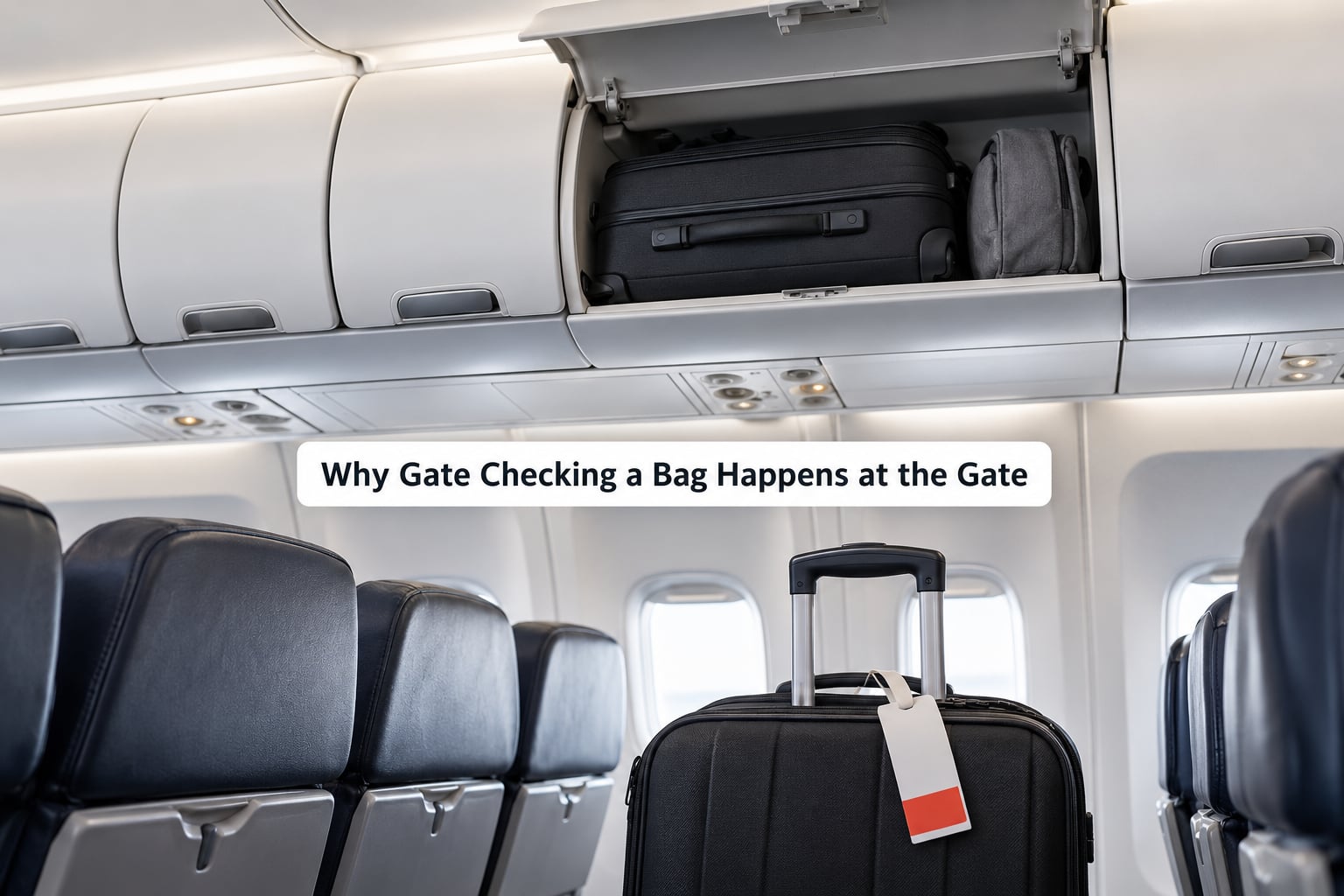
Gate agents are not reacting to your bag. They are working through a number they estimated before you walked to the plane.
Before boarding, the airline calculates how many carry-on bags the flight expects based on the number of passengers, the size of the bins on that specific aircraft, and the boarding groups involved. Once that expected number is reached, every bag after it gets tagged, no matter how the bins actually look. These are the triggers that decide it:
- The bin count ran out. The aircraft is not full, but enough earlier passengers brought larger bags that the physical capacity is used up.
- Small bin space. Regional jets and turboprops have a fraction of the stowage of a wide-body, so the number runs out sooner.
- Your boarding group. Passengers in the last groups are routinely tagged, since the estimate assumed they would board after space was already claimed.
- Fare rules. Basic economy and ultra-low-cost fares often board last by design, which stacks the odds against them.
- A bag that fails the sizer. If it does not fit the test frame at the jet bridge, the options are checking it or boarding without it.
- Schedule pressure. Gate agents are measured on on-time pushback and on ground delay time, not on how many bags went into the bins.
Item six is the one passengers rarely consider. Boarding a full jet bridge of carry-ons is slow, and a slow boarding process eats directly into the metrics the airline reports publicly.
Why the bins can look empty once you are on board
This is the complaint that comes up constantly in passenger forums: you are told the bins are full, you comply, and then you walk on board and see open space. There are ordinary explanations for it.
Seats fill in sequence, and the passengers ahead of you may have taken overhead space for a group or stowed bags for children sitting in the same row. Some bins also hold less usable volume than their outer shell suggests, because the shell curves inward above the door and the floor slopes. What looks like empty space mid-cabin can be unusable for a large bag that will not sit upright.
Agents also tag early on purpose. Once they start, they keep going, because stopping and re-evaluating costs more time than tagging four extra bags.
Bag shape decides how much of the bin you actually get
A 22-inch bag is not a 22-inch bag. Hard-shell rollers stand upright or they do not, and a roller that will not sit flat occupies a full bin length while using a fraction of the height. Soft-sided duffels and backpacks compress into the gaps above and between bags, so two people can share space that only fits one hard case.
Fuselage curvature is the other factor. Bins taper toward the ceiling on most aircraft, so the usable volume is narrower at the top than the door outline suggests. Bags get pushed to the middle because the ends physically will not take them.
Does Gate Checking Happen Because of Security or Randomly?
No. Routine gate checking is a capacity decision, not a security decision, and it is not random either.
Screening happens at the checkpoint long before you reach the gate. Gate agents do not open bags or ask about contents during boarding. The only exception in practice is an item that is not allowed in the cabin at all, such as a spare lithium battery or a large power bank, which has to go into the hold with the bag rather than into an overhead bin.
The randomness people feel comes from inconsistency between agents rather than from the decision itself. Two agents on the same flight will run the same policy very differently, which is why one boarding group sails through and the next gets the full speech.
Forum threads also distinguish between a bag you are told to hand over and a bag you volunteer. On some routes, regulars describe agents repeating the request until people give in, without formally requiring anything. The tag is the same either way.
How Airline Boarding Rules Trigger Gate Checks
Boarding order is the biggest lever a passenger has, which is why the gate-check rate varies so much between airlines and between flights on the same route.
Sequential loading means bags claim space in the order people walk down the aisle. A premium cabin passenger storing three bags at row 5 uses capacity a row 28 passenger cannot recover later in the boarding sequence.
Basic economy almost always boards in the final group by design, because it is the cheapest fare. That means basic economy passengers are tagged at a higher rate than the same passenger paying for a standard fare on the same aircraft.
The clearest counterexample is Southwest, where checked bags are not charged. Passengers on the airline’s own boards report far fewer forced gate checks, and the economic logic is straightforward. When a checked bag costs nothing, more people check it, so fewer bags compete for the same bins.
What a gate check costs you
On most full-service carriers, a voluntary gate check of a bag that was within your allowance is free, and it does not consume your free checked-bag allowance. Some carriers and some ultra-low-cost fares charge the standard checked-bag fee instead, and a few count it against your allowance. Policies differ by airline and change, so check your own carrier’s terms rather than assuming.
Also check your fare class for a carry-on restriction. Some basic economy products on US and European carriers permit a personal item only, in which case the bag is a checked bag from the moment you reach the counter.
Why Gate Checks Are More Common on Small Aircraft and Short Routes
Bin space is fixed per aircraft, so the same number of passengers creates very different pressure depending on what they are flying.
| Aircraft type | Typical cabin stowage | Gate-check pressure |
|---|---|---|
| Regional jet (CRJ, Embraer) | Very small bins, often shared with larger seats | High, especially on the last groups |
| Turboprop (Q400 and similar) | Small bins plus a forward or aft closet | High, closets fill first |
| Narrow-body (737, A320 family) | Standard bins, high load factors | Moderate to high |
| Wide-body (787, 777 and similar) | Large bins, more closet space | Low on most flights |
Short routes concentrate the pressure in another way. Regional aircraft on thin routes are frequently flown at high load factors with a low ratio of flights per day, so there is no spare aircraft to reassign and no second departure to move passengers onto.
On a bad morning the tags start stacking up along the jet bridge before boarding finishes, which shows how far a routine estimate can drift once the numbers are wrong.
Why gate checking a bag happens less on weight-restricted flights
Here is the counterintuitive exception. A payload-optimized flight is one where weight and balance, rather than bin capacity, limits how many passengers and bags fly.
When a hot-weather departure needs to shed weight, passengers are told to check carry-ons before boarding. The bags move to the hold ahead of time, and the bins stay mostly empty on purpose. On those flights you are rarely tagged at the door, because the space was never contested.
International flights behave the same way at the front end, with one added wrinkle at the back. Cabin weight limits are enforced more strictly on long-haul services, so a bag that passed the sizer at the origin gate can still be required into the hold if the aircraft is running heavy.
What to Do If Your Bag Is Gate Checked
You have a short window, and the order matters. Take these items out before you hand it over:
- Passport, boarding pass copies, travel documents, keys
- Medications, including anything you need mid-flight
- Spare lithium batteries and power banks, which are not allowed in the cabin anyway
- Laptops, cameras, and other valuables
- Children’s essentials: diapers, wipes, a change of clothes, snacks
- A phone charger and headphones, since you will not have access to anything in the hold
Put all of it into your personal item or a backpack under your seat. If you have nothing to carry, tuck valuables inside your jacket.
Then take a photo of the bag before it leaves, with the tag visible. Photograph the tag number itself, since that is what baggage services use to trace a bag that never arrives.
Keep the gate-check sticker. It tells you where your bag was unloaded, and on some routes it means your bag is waiting at the jet bridge rather than on a carousel.
Can you refuse a gate check?
You can ask, and a polite question gets a real answer. If your bag fits the sizer and the aircraft still has space, an agent can often allow it.
If the answer is a firm no, refusing is not a practical option. Passengers who decline and then board without the bag either do it because someone moved down a bin for them or because they accepted a checked tag. You cannot board while keeping a bag the crew has decided not to stow.
How to Avoid Having a Bag Gate Checked
Most of this sits outside your control, but a few things genuinely change the odds.
Board early. Choosing a seat in the first boarding group is the single most effective lever, and it works because space is claimed in order.
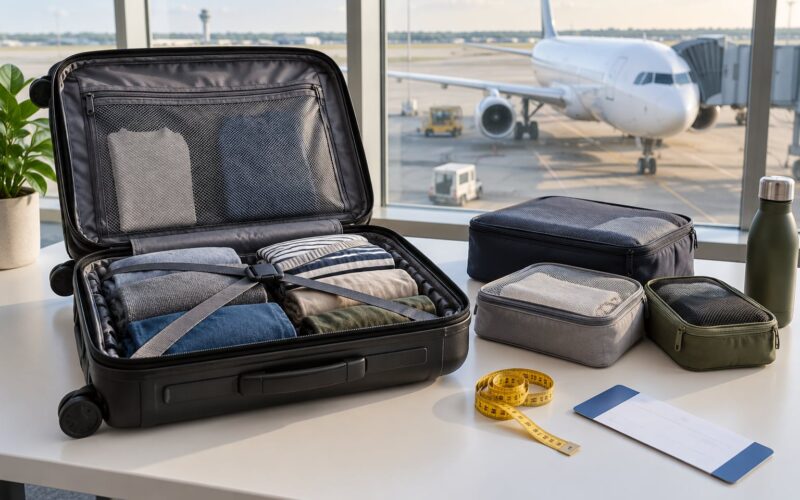
Measure your bag against your airline’s sizer at home, handles and wheels included. Most carriers allow roughly 22 by 14 by 9 inches, and a bag a few inches over is the most common reason for a tag at the jet bridge.
Choose a softer, smaller bag if you fly often. Soft-sided duffels compress into gaps that hard-shell rollers cannot occupy, and a bag that tucks vertically leaves more room for the person behind you.
Consolidate. One properly sized carry-on plus a personal item beats an oversized roller plus a tote that gets tagged in the doorway.
Check your boarding group before you fly, and check whether your fare allows a carry-on at all. If you fly weight-restricted routes in summer, checking early can be the easier plan rather than a fight at the door.
Frequently Asked Questions
Why is my carry-on being gate checked when the overhead bins look empty?
The gate agent is working from an estimate of how many bags the flight expects, not a live count. Once that estimate is reached, tagging continues so boarding stays fast. On board, bins can look open because earlier passengers stored bags for a whole group, and because curved bin shells near the doors hold far less usable volume than they appear to.
Is gate checking a bag free, or do I pay a checked-bag fee?
On most full-service airlines it is free and it does not use up your free checked-bag allowance. Some carriers and some ultra-low-cost fares charge the standard checked-bag fee, and a few count it against your allowance instead. The rule varies by airline and fare class, so check your carrier’s policy rather than relying on what happened on a previous flight.
When are gate-checked bags returned at the destination?
It depends on the flight. Some carriers unload gate-checked bags at the jet bridge so you can take them straight to your car, while others deliver them to the baggage claim carousel. On international arrivals the bag may appear before customs or after, depending on the airport. Keep your gate-check sticker, because the unloading point is printed on it.
Can I take a gate-checked bag through a connecting airport?
Usually yes. Gate agents tag the bag for the remainder of the itinerary, so it is transferred to your next flight and collected at the final destination rather than at the connection. That means you will not see it during a layover. On tight connections or interline tickets, ask the agent at the first gate to confirm the routing, and keep essentials in your personal item for the whole trip.
What if my gate-checked bag contains medicine, documents, or valuables?
Take them out before you hand the bag over. Passports, tickets, keys, medications, electronics, spare lithium batteries, and anything for your children belong in your personal item or under your seat. Photograph the bag and its tag number before it goes, because that is what baggage services use if the bag is delayed or lost.
Conclusion
Gate checking happens for one underlying reason: the flight expects more carry-on bags than the bins on that aircraft can hold, and the gate agent needs the jet bridge moving on schedule. Your boarding group, your fare class, and the plane you were assigned all push that number around.
When you see a tag coming, the first thing to do is stop and empty the bag. Passport, medications, batteries, valuables, and anything a child will need all go into your personal item before the roller leaves your hands. After that, photograph the bag and the tag number, keep the sticker, and ask the agent where your bag will be waiting on arrival.