The 787 cabin eases the tiredness that comes with a long flight because it is pressurised to roughly 6,000 feet instead of the usual 8,000 feet, it holds about 25 percent relative humidity rather than 10 to 15 percent, and it supplies more fresh air through effective filtration. That is how the 787 cabin reduces jet lag symptoms such as headache, dry skin and heavy legs. It is not how the aircraft stops jet lag itself, because crossing time zones disrupts your body clock in a way no cabin can undo.
That distinction matters more than the marketing does. A long-haul trip leaves most people with two separate problems stacked on top of each other, and the Dreamliner only really touches one of them.
Table of Contents
- How the 787 Cabin Reduces Jet Lag Symptoms (and What It Cannot Fix)
- What Is Jet Lag, and Why Does It Happen?
- How the 787 Cabin’s Air Quality Helps You Feel Less Washed Out
- Why Lighting, Windows and Sleep Matter More Than Most People Expect
- What Seats Do for Comfort on Long-Haul 787 Flights
- How Much Can a 787 Cabin Really Help?
- How to Use the 787 Cabin’s Features Well
- Frequently Asked Questions
- Does the 787 cabin actually prevent jet lag?
- Is the 787 cabin altitude lower than on other planes?
- Is cabin humidity really higher on a 787?
- Which seat is best on a 787 if I want to sleep?
- What should I do in the first 24 hours after landing?
- Conclusion
How the 787 Cabin Reduces Jet Lag Symptoms (and What It Cannot Fix)
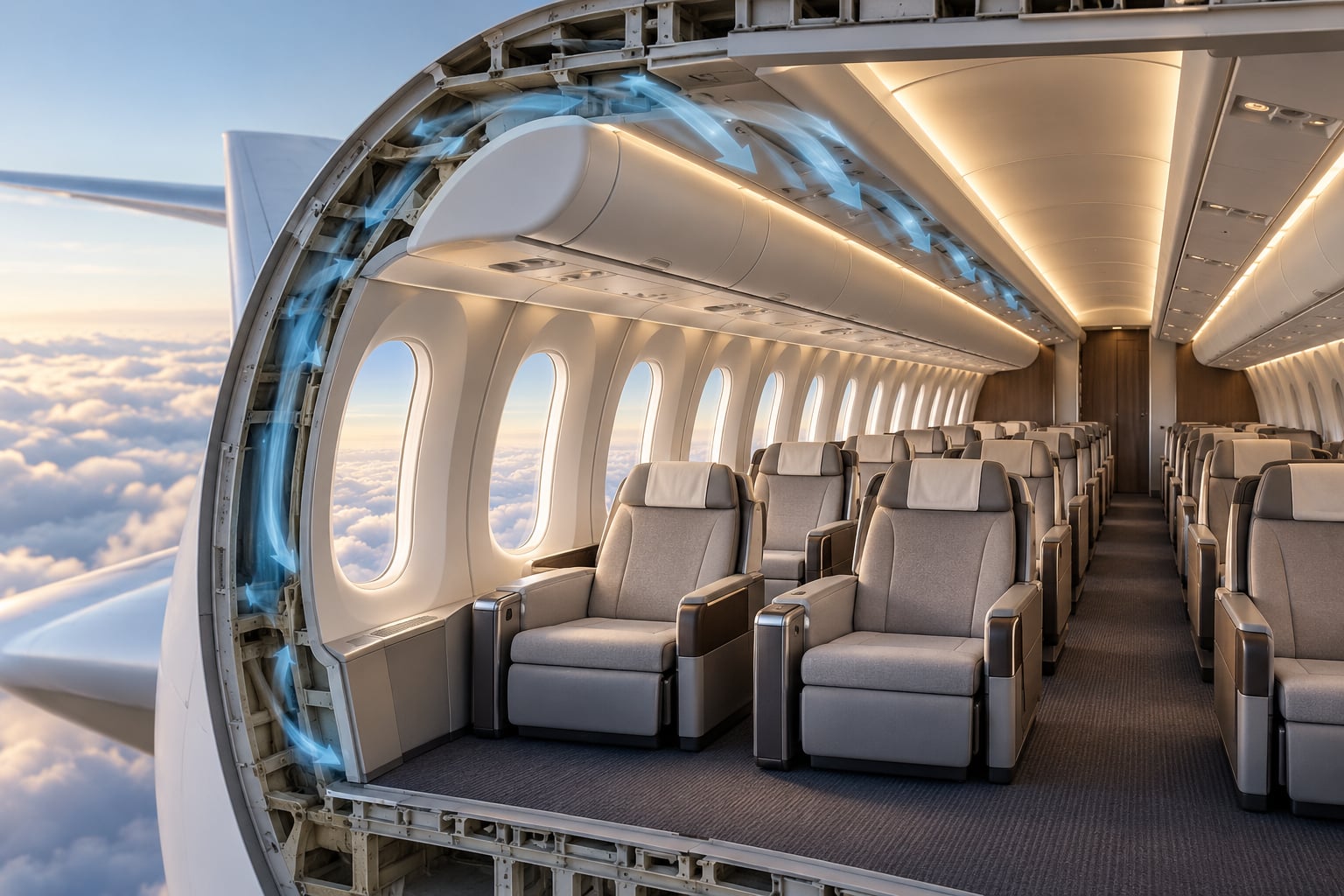
Three features do the work, and it helps to keep them separate. Cabin altitude sets how much oxygen your blood can pick up. Humidity decides how hard your airways and skin have to work. Fresh-air delivery decides how stuffy and stale the cabin smells by hour six.
- Lower cabin altitude. The 787 cabin is pressurised to around 6,000 feet, roughly the air pressure of a town at 6,000 feet. Older airliners cruise at about 8,000 feet cabin equivalent. Less altitude means a higher partial pressure of oxygen, which is why passengers report fewer headaches and less of that heavy, foggy feeling on long sectors.
- Higher cabin humidity. Around 25 percent relative humidity is still objectively dry, but it is roughly double what most conventional cabins manage. Dry cabins pull moisture out of your skin, throat and eyes within the first couple of hours, and that dryness is what people mean when they say they feel exhausted after a flight.
- More fresh, filtered air. The 787 uses a bleedless air system and circulates more outside air per passenger than older jets, with filtration that catches most particles. Heavier recirculation is the main cause of that stuffy, recycled feeling on long flights.
| Cabin feature | What it is | Likely effect on how you feel |
|---|---|---|
| Lower cabin altitude | Pressurised to about 6,000 feet instead of 8,000 | Fewer headaches, less heaviness, clearer thinking on arrival |
| Higher relative humidity | Around 25 percent instead of 10 to 15 percent | Less dry skin, throat and mouth; less perceived exhaustion |
| Bleedless air system | Cabin air drawn and conditioned without engine bleed | More fresh air per passenger, fewer odours |
| Air filtration | High-efficiency filters on recirculated air | Cleaner-feeling air, less smell build-up over 10+ hours |
| LED mood lighting | Programmable lighting scenes, including sunrise and sunset | Cues that can support sleep timing and reduce eye strain |
| Large dimmable windows | Electrochromic glass with five dimming settings | Real darkness for sleep, or light without looking out |
| Larger windows overall | Taller glass panels than earlier widebodies | Brighter cabin, better sense of space when awake |
What Is Jet Lag, and Why Does It Happen?
Jet lag is the tiredness, poor sleep and fuzzy thinking that follows moving your body clock across one or more time zones faster than it can adjust. Your internal clock runs on roughly a 24-hour cycle and anchors itself to light, meals and activity. Change those three things abruptly and the clock keeps firing on the old schedule while you are trying to sleep on the new one.
Eastward travel hurts more than westward. When you fly east, your day ends earlier by your body clock’s reckoning, so you meet a shortened evening and a bedtime that arrives before you feel tired. Flying west stretches the day instead, which is why many people cope with it better even though they wake at odd hours.
Worth separating jet lag from the things people often lump in with it. Dry air and mild dehydration produce thirst, dry eyes and a headache but do not reset your clock. Broken sleep on a reclined seat produces ordinary tiredness. Tight muscles and stiff legs come from sitting still for ten hours. All of these travel with jet lag on the same trip, which is exactly why the 787 makes people feel better without reversing the time-zone effect.
How the 787 Cabin’s Air Quality Helps You Feel Less Washed Out
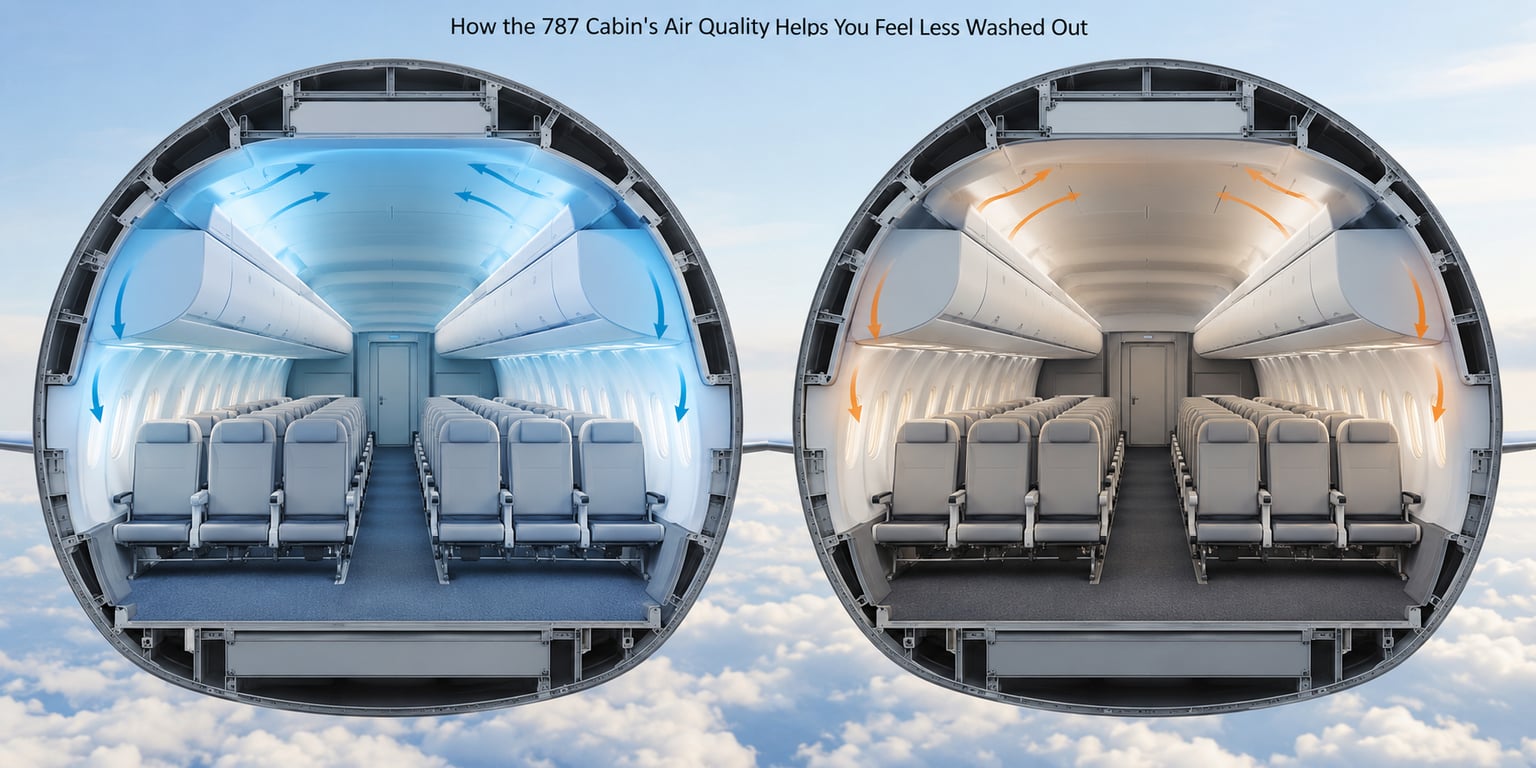
Cabin altitude is the one term to hold on to. The aircraft cruises at roughly 35,000 to 41,000 feet, and the cabin is pressurised to the equivalent of about 6,000 feet. On most older aircraft that equivalent is about 8,000 feet. At 8,000 feet the air pressure equals what you would get standing on a mountain, and oxygen saturation in the blood falls a few points. Most people feel nothing from that drop. On a 13-hour flight, though, a few points can be the difference between arriving tired and arriving merely sleepy.
The composite fuselage is what makes the lower figure affordable. Composite structure lets the airframe carry pressurisation loads without the weight of a heavy metal barrel, so the aircraft can hold a lower cabin altitude and a higher humidity setpoint without paying a large fuel penalty. An aircraft with an aluminium fuselage would struggle to do the same at the same weight.
The 6,000 foot figure is a deliberate compromise rather than a physical limit. Pressurising closer to sea level would burn noticeably more fuel, which is why the number has not moved much since the aircraft entered service. Lowering cabin altitude reduces cabin pressure stress, and cabin pressure stress on a long flight is cumulative. It also cuts the temperature swing some cabins show when they decompress, which is where a lot of that mid-flight chill comes from.
Humidity is the quieter win. Twenty-five percent still counts as dry air, and it would still bother a person with asthma. What changes is the rate at which moisture leaves your body. In a 10 to 15 percent cabin you can feel dry within an hour; in a 25 percent cabin the same ten hours are much easier on your skin and throat.
| Aircraft | Cabin altitude | Relative humidity | Fuselage | Typical cabins |
|---|---|---|---|---|
| Boeing 787-9 | About 6,000 feet | Around 25 percent | Composite | Economy, premium economy, business, first on some carriers |
| Airbus A350-900 | About 6,000 feet | Around 25 percent | Composite | Economy, premium economy, business |
| Boeing 777-300ER | About 8,000 feet | About 10 to 15 percent | Aluminium | Very wide economy on some layouts |
| Airbus A330-300 | About 8,000 feet | About 10 to 15 percent | Aluminium | Economy, premium economy, business |
The A350 is the closest match to the 787 here, since it pairs a similar composite fuselage with a similar pressurisation and humidity target. A 777-300ER can be roomier in economy on some layouts, with wider seats or more of them, and it wins on sheer cabin volume. For cabin-altitude fatigue specifically, the composite pair have the advantage.
Higher humidity has a cost that gets discussed less. Moist air at cabin temperature condenses on cold surfaces, and sustained condensation on interior panels and ducts is a corrosion risk. That is the practical reason airlines do not simply push the setpoint higher, and one reason the figure sits near 25 percent rather than climbing toward 40.
Aircraft type is not the whole picture, either. Every operator configures a 787 differently, and seat width, pitch and cabin zoning vary far more between two airlines than the pressurisation does. A frequent flyer on long-haul delivery flights told an executive traveller forum that he steps off a 13-hour 787 flight feeling the way he would after a short hop, crediting the lower cabin altitude, higher humidity and fresher filtered air. A United MileagePlus poster on FlyerTalk put it differently, saying their skin, throat and mouth simply feel less dry. Both describe the same cabin doing modest work.
Why Lighting, Windows and Sleep Matter More Than Most People Expect
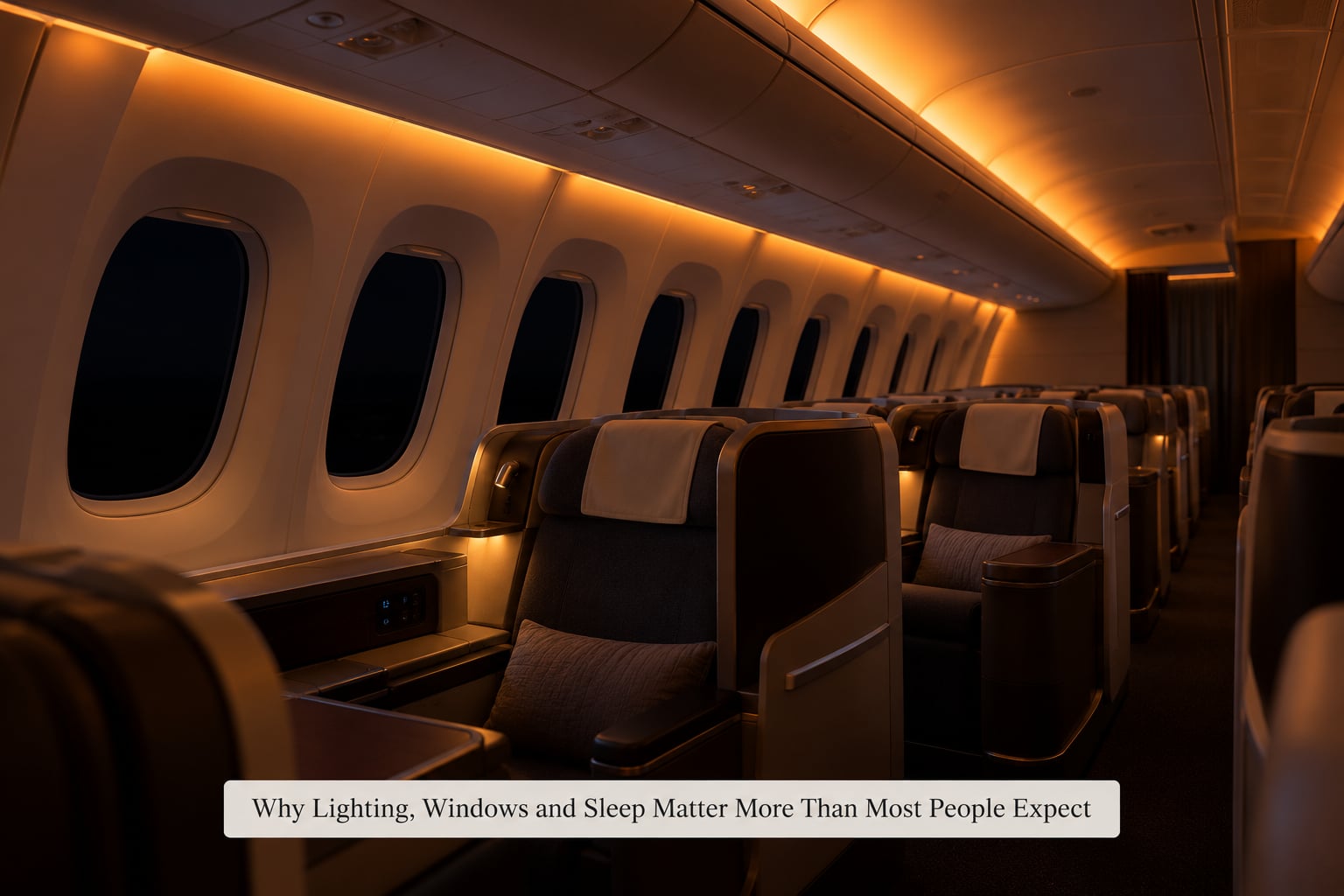
Your body clock takes light seriously. The electrochromic windows on the 787 dim through several settings rather than going fully clear or fully dark, so you can get a room-dark cabin for an overnight leg without a sleeping mask, or keep the glass partly lit if you want to look out. On a daytime flight they let more light in than the small windows of older jets, which helps you stay awake.
The mood lighting runs programmed scenes through the flight, including sunrise and sunset sequences. It is a small input, but it is timed, and your clock responds to timed light. Treat it as a cue rather than a cure.
On eastward flights, aim to sleep during the window that matches destination night and stay awake through destination daytime, even when your body protests. On westward flights, do the opposite where you can, and expect a normal night at the destination to do more work than anything you do on board.
What Seats Do for Comfort on Long-Haul 787 Flights
Aircraft type matters less to your sleep than the seat does. Seat pitch, width, how far the seat reclines without the row behind objecting, noise from the galley and lavatories, and how easy the seat is to get out of all shape your night far more directly than cabin altitude does.
Window seats give you a wall to lean on and darkness control. Aisle seats give you freedom to walk, which is genuinely useful on a long flight for circulation and for getting up to use the lavatory without waking anyone. Mid-cabin bulkhead rows give you legroom but no window and, on some aircraft, a seat that will not recline. Exit-row seats give the most space and the deepest recline, with a stricter eligibility rule attached.
Cabin layout varies by airline even on the same aircraft, so a 787 can be a very different experience depending on who operates it. Check the seat map for your specific flight rather than relying on the aircraft type.
- Check the aircraft type in the booking details before you book, not after.
- Look up that specific cabin layout for the operating airline, since seat width and pitch differ between carriers.
- Avoid rows directly next to galleys or lavatories if sleep is the goal.
- Pick a window seat for darkness, or an aisle seat for movement, and pick deliberately.
- If reclining, recline gradually and check the seat behind is not a tall person’s.
- Bring an eye mask anyway, because even dimmable windows leak light at the edges.
- Plan to stand up and walk at least once an hour on any flight over three hours.
How Much Can a 787 Cabin Really Help?
Set expectations carefully. On a route with a small time-zone change, the cabin features are most of what you have going for you. On an eastbound red-eye across nine time zones, the cabin is the easy part and your body clock is the fight.
| Symptom on arrival | How much the cabin helps | What actually helps |
|---|---|---|
| Headache and head heaviness | A fair amount, because cabin altitude is lower | Drink water during the flight, then caffeine at your normal local time after landing |
| Dry skin, throat and eyes | A fair amount, humidity is roughly double | Limit alcohol, use eye drops if you need them |
| Legs that feel like concrete | Very little, seats do not fix circulation | Walk the aisle every hour or two, flex your ankles while seated |
| Arriving unable to fall asleep | Some, through darkness and lighting cues | Light exposure timed to destination time, no naps in the first day |
| Waking at 3 a.m. wide awake | Almost none, this is circadian | Stay in dim light, avoid bright screens early, expect a few nights of adjustment |
| Day-one exhaustion that outlasts the flight | Some, less physical debt to repay | An early night, a real meal, and no nap even if you feel wrecked |
Two situations where the Dreamliner will not save you. First, short routes under four or five hours: a time-zone change that small takes a fraction of the adjustment time, and the cabin barely gets a chance to matter. Second, sleep that never happened. A poster in the FlyerTalk thread said it plainly, that sleeping well at the right time during the flight is what reduces their jet lag regardless of aircraft type. No pressurisation system substitutes for choosing your sleep window carefully.
The honest summary is that a 787 reduces the physical part of long-haul travel fatigue and does nothing to the clock. Forum sceptics are half right. The aircraft is not magic, and passengers who deride Dreamliner obsession are not imagining a marketing story. They are just noticing that the promise was oversold.
How to Use the 787 Cabin’s Features Well
Before you fly, set your watch to destination time on the boarding pass and decide your sleep window now rather than at 40,000 feet. It is much harder to plan a body clock when you are tired, hungry and dimmed.
At boarding, pick your water first and drink steadily through the flight. Alcohol works against both hydration and sleep, so if you drink it, front-load it before dinner service. Eat to your normal mealtimes rather than the airline’s clock, especially on eastbound legs.
In flight, use the dimming settings and the lighting scenes rather than fighting them. Keep your screen brightness low for the last hour before you intend to sleep. Walk the aisle when you are awake, and use the air vents to keep your own micro-climate comfortable, since cabin temperature is set for the whole cabin rather than for you.
After landing, do not nap on arrival day even if you feel terrible. Get light exposure, eat a real meal, and go to bed at destination bedtime. The physical fatigue a 787 leaves behind usually clears within a day; the clock takes longer, and only your schedule decides how long that is.
Frequently Asked Questions
Does the 787 cabin actually prevent jet lag?
No. The Dreamliner reduces the physical side of long-haul travel fatigue, namely headache, dryness and cabin-altitude stress, by running at a lower cabin altitude with more humidity. It does not touch circadian disruption, which is the part of jet lag caused by crossing time zones. Expect to arrive less worn down, not adjusted to the new clock.
Is the 787 cabin altitude lower than on other planes?
Yes. The cabin is pressurised to roughly 6,000 feet while most conventional widebodies sit near 8,000 feet. Note that this is the cabin equivalent, not the flight altitude, since the aircraft itself cruises around 35,000 to 41,000 feet. The Airbus A350 XWB works at a similar cabin altitude.
Is cabin humidity really higher on a 787?
It runs at roughly 25 percent relative humidity against the 10 to 15 percent typical of older jets, so passengers genuinely notice less dry skin, mouth and throat on the same route. Airlines stop there rather than going higher because moist air condenses on cold interior surfaces, which is a maintenance concern. It is still dry air by desert standards.
Which seat is best on a 787 if I want to sleep?
A window seat with a working dimmable window usually wins, since you can create real darkness and lean against a wall. An aisle seat is the better pick if you value standing up and walking during the flight. Avoid galley and lavatory-adjacent rows, and check the specific airline layout, since cabins are configured differently on the same aircraft.
What should I do in the first 24 hours after landing?
Skip the nap even if you feel exhausted, get light exposure early in the destination day, eat a normal meal at local mealtime, and go to bed at destination bedtime. Staying awake resets your clock faster than sleeping off the flight. Cabin features help you arrive less drained, but your schedule on the ground is what shifts the clock.
Conclusion
The 787 cabin reduces the part of jet lag you can engineer around: lower cabin altitude, higher humidity, cleaner and fresher air. Those three things mean fewer headaches, less dryness and less general heaviness after a long sector, and passengers notice the difference on routes where a 777 or A330 would leave them more worn down.
Start with the three that need planning. Confirm your flight is actually a 787 and check that airline’s layout, then pick a seat that suits whether you want darkness or movement. Decide your sleep window against destination time before boarding, use the dimmable windows and lighting scenes rather than ignoring them, and skip the nap on arrival day. Treat the Dreamliner as a lighter start to the adjustment, not the end of it.
Updated for October 2026.