Where to sit on a plane to avoid turbulence? Sit in the wing section or just ahead of it, and skip the back third of the cabin. Regular flyers describe the ride as noticeably steadier over and slightly forward of the wing, while passengers in the rear rows report the roughest movement and the most tail bob. No seat choice removes turbulence, and a bumpy flight can and does happen in the best seat on the aircraft. What a good seat does is soften how much of that movement you feel, and give you a position you can brace in and get out of quickly if your nerves need it.
The interesting part is how little the seat can actually do, and why what you feel in row 60 can be so different from what your neighbour felt in row 22 on the same flight. The useful part is knowing how to read a seat map that gives you nothing but numbers and a diagram, and what to do with your body when the air gets rough.
Last updated October 2026.
One note before we start: this is about comfort and how bumps feel to you, not about safety. Turbulence is uncomfortable rather than dangerous, and the injuries that do happen in cabin almost always involve unbelted passengers standing up or reaching for something. Your job is to be strapped in and calm, and the seat is a small part of that.
Table of Contents
- Can a Seat Choice Really Reduce Turbulence?
- Where to Sit on a Plane to Avoid the Strongest Feeling of Bumps
- Where to sit on a plane to avoid turbulence: finding the wing rows
- Window vs. Aisle vs. Middle Seat for Turbulence Comfort
- Why the Front and Rear Seats Feel Different
- Where to Sit on a Plane When Turbulence Makes You Nervous
- Do Exit Rows, Bulkhead Rows, and Wing Seats Help?
- How to Make Any Seat Feel Less Bumpy
- What the Research Does and Does Not Prove
- Frequently Asked Questions
- What is the best seat on a plane to avoid turbulence?
- Is the front of the plane smoother than the back?
- Are seats over the wings better during turbulence?
- Can turbulence be prevented by choosing a particular seat?
- Should I sit near a wing during a bumpy flight?
Can a Seat Choice Really Reduce Turbulence?
Short answer: no. A seat cannot change the air outside, so it cannot change whether turbulence is happening or how strong it is officially rated. It changes how much of the movement reaches you, and how much of that movement bothers you.
Turbulence comes from irregular air: convective weather like thunderstorms, wind shear where winds change sharply with altitude, mountain wave, or clear-air turbulence from eddies in the jet stream. The crew adjusts route, altitude and speed to dodge the first three. Clear-air turbulence is the awkward one, because it can be invisible to onboard radar and unpredictable from a forecast.
Everything else that shapes your experience is personal. Noise, seat pitch, how much you can brace, how anxious you already feel, whether the armrests dig in, and whether the person next to you decides to gasp loudly all do a lot of work in how rough a flight feels to you. Passengers consistently rate turbulence as worse than pilots would classify the same ride, and the same flight can read as severe in row 69 and as average over the wing.
The official scale used for pilot reports divides choppy air from genuinely rough air, and it is worth knowing the four levels so you can put a name to what you felt:
| Reported level | What it usually feels like in the cabin | Cabin risk |
|---|---|---|
| Light | Small, irregular changes in level, like driving over a rippled road. Drinks ripple. | None if belted |
| Moderate | Noticeable jolts, brief dips, small items sliding in the seat pocket. | None if belted |
| Severe | Firm bumps, standing passengers thrown, unsecured items airborne. | Unbelted passengers |
| Extreme | Rough enough that anyone who is not strapped in risks real injury. | Unbelted passengers |
Keep the seat belt fastened whenever you are seated, even in light chop. The belt does more for your comfort during a bad patch than any row you could have picked.
Where to Sit on a Plane to Avoid the Strongest Feeling of Bumps
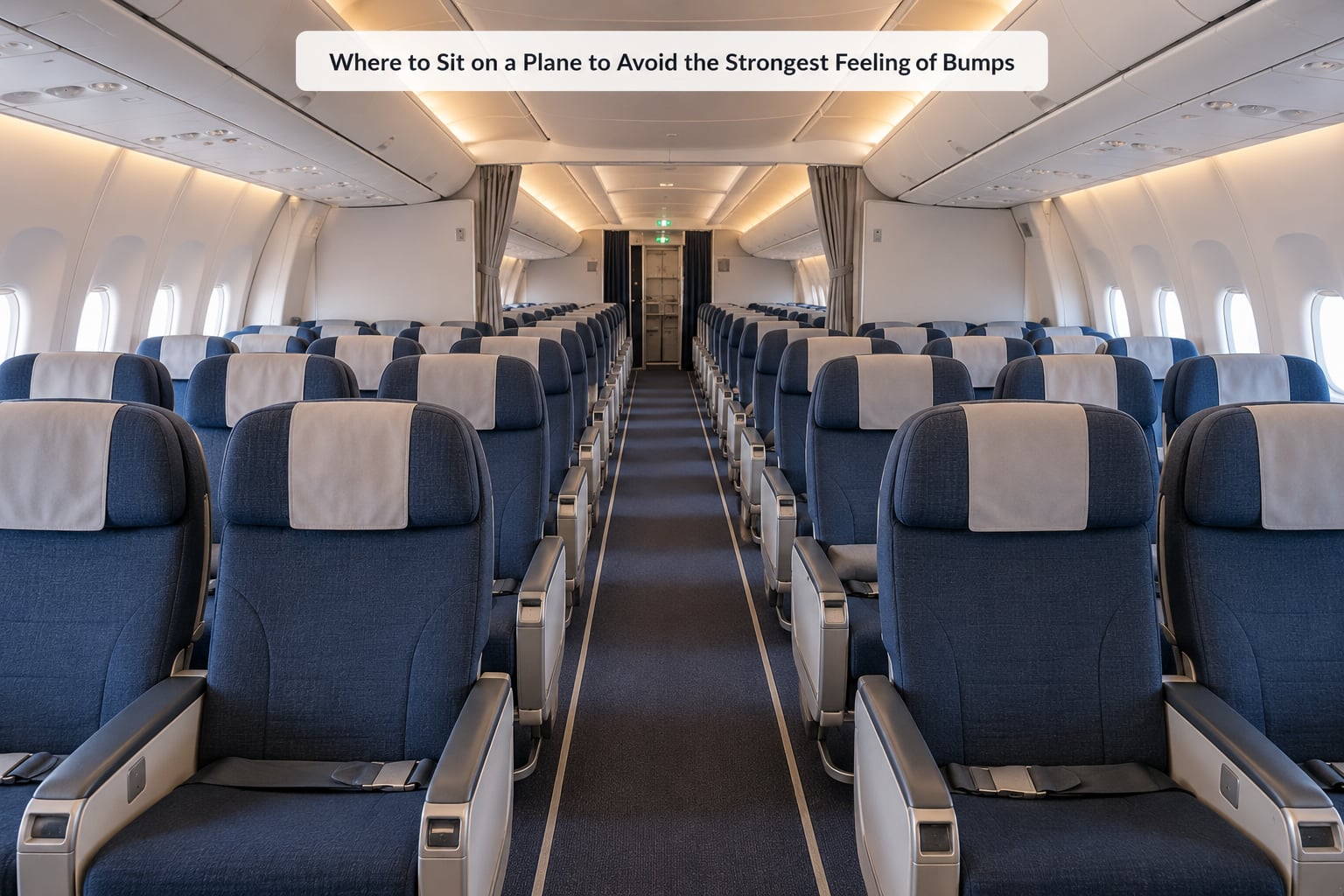
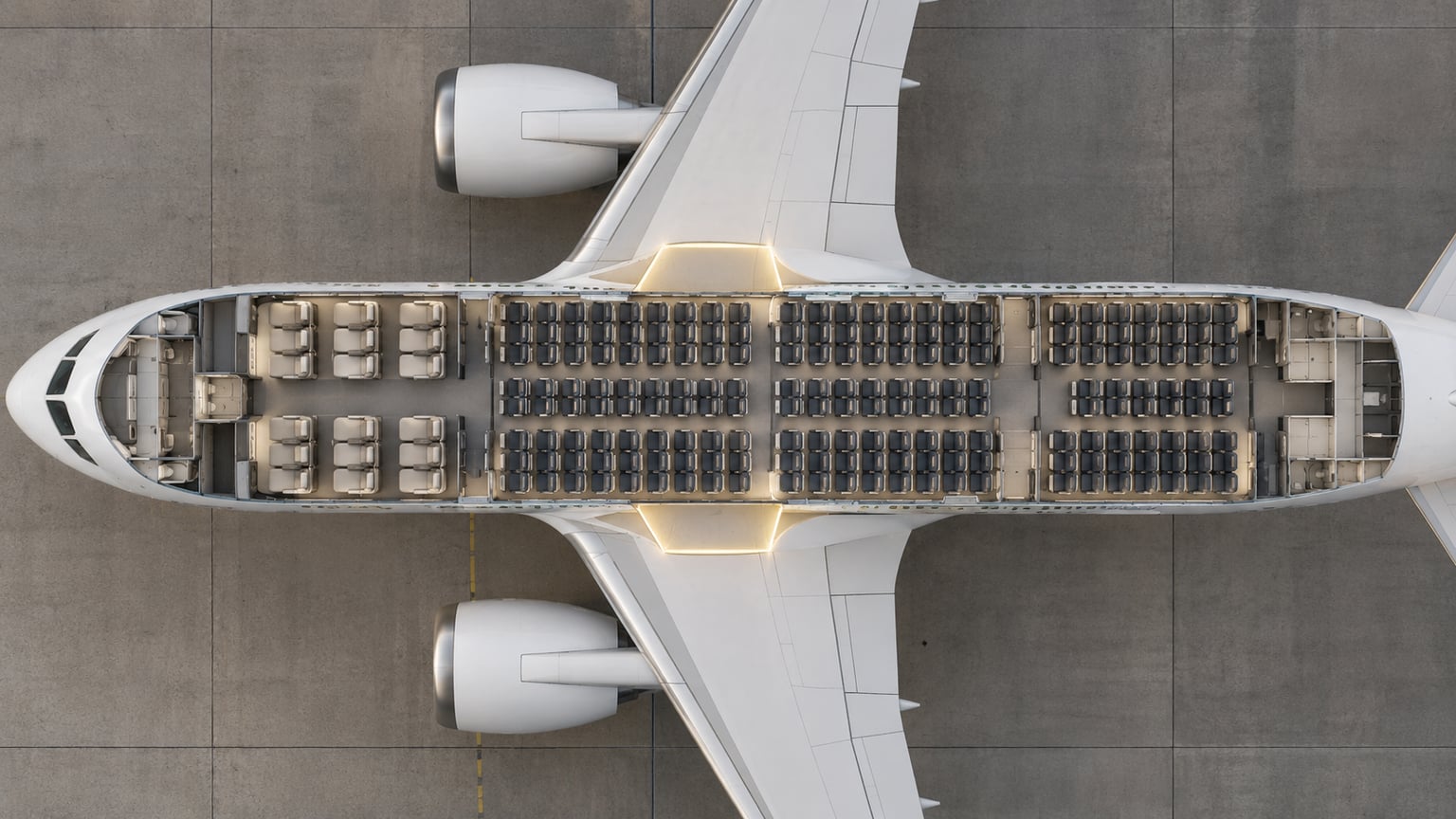
An airplane wing is a cantilever. It is held on at the fuselage and it flexes, and the tail is the point furthest from that support, so it traces the widest arc and moves the most. Near the wing root the structure is at its stiffest, which is why the wing section and the rows just ahead of it are the steadiest place to sit.
| Cabin zone | How bumps tend to feel | Book this if |
|---|---|---|
| Nose and first few rows | Calmest forward position, closest to the nose, least tail movement | You want the strongest sense of control and easy lavatory access |
| Forward cabin | Very steady, quiet, close to crew and galley | You are easily startled by noise and wake turbulence |
| Just ahead of the wing | The steadiest stretch on most aircraft, stiff structure, low motion | Turbulence comfort is your main goal |
| Over the wings | Structurally stiffest, though a long row can be hot and engine-adjacent | You want the calmest ride and can handle a tighter pitch |
| Aft wing | Movement starts to build, wing flex is now behind you | You accept more movement for the wider seat options |
| Last third and tail | Roughest, most tail bob, cargo hold directly below the rear floor | Price and availability won, and you are not bothered by movement |
That is a perceived-motion ranking, not a safety ranking. Every row on the aircraft is equally safe, and the official category of turbulence does not change because of where you are sitting.
Where to sit on a plane to avoid turbulence: finding the wing rows
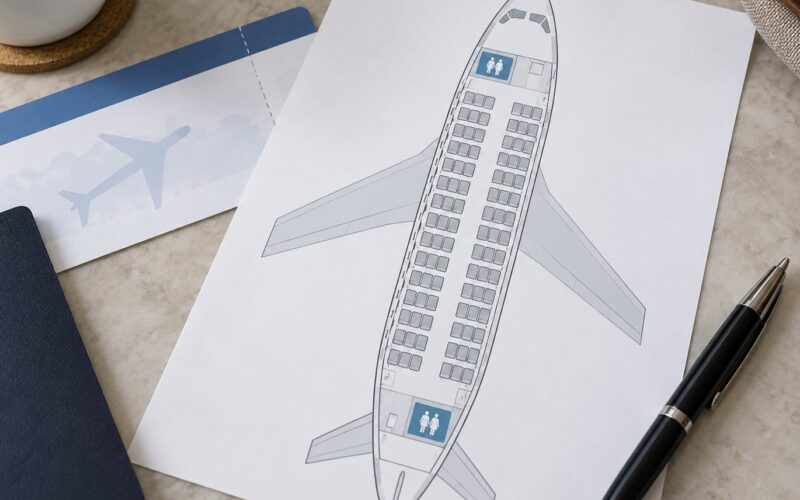
Plenty of advice tells you to sit over the wings and almost none of it tells you how to find them, because row numbers change with every aircraft type and cabin layout. A Boeing 737, an Airbus A320, a Boeing 787, a Boeing 777 and an Airbus A350 all put the wing in a different place in the row count. Here is the method instead of a list that would be wrong by your next booking:
- Open the seat map for your exact flight, not the generic aircraft page, because cabins get reconfigured.
- Find the two overwing exit rows. On most seat maps they are labelled, and they are the rows the wing passes beneath.
- Look at the row between those two exits, or the one just ahead of the first of them. That is your target.
- Check for galley and lavatory icons in the same block. Calm middle-of-cabin seat next to a service hatch is a different experience.
- Re-check the map at online check-in, usually a day before departure. Airlines shuffle passengers and release better seats closer to the gate.
If your seat map has no exit rows at all, count from the front: on a typical single-aisle narrowbody the wing sits in the middle third, and on a widebody it sits in the middle third as well, just lower down the list because there are more rows in front of it.
Window vs. Aisle vs. Middle Seat for Turbulence Comfort
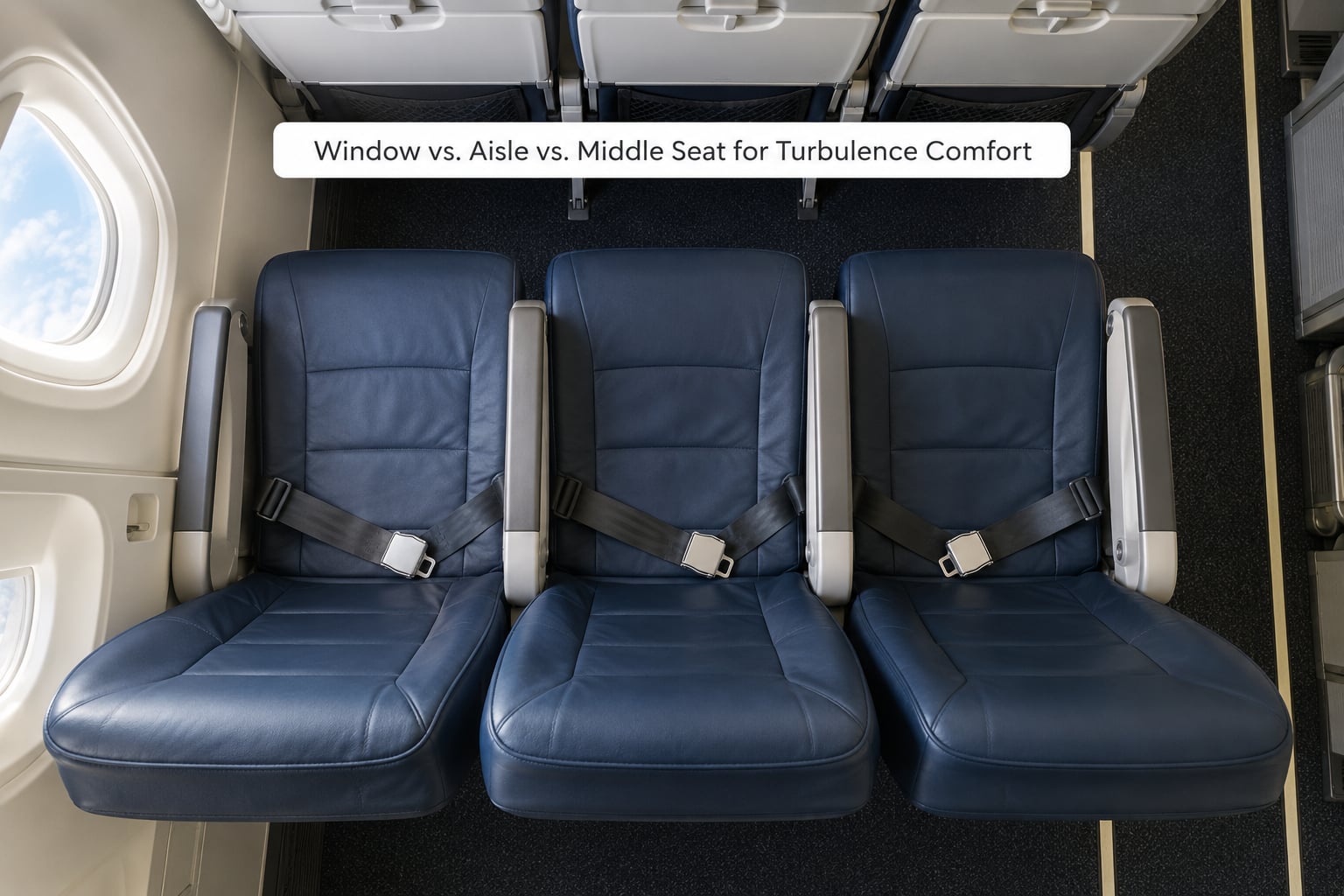
All three positions in the same row move the same amount. The difference is what you can do about it and how much you can lean on the frame while it happens.
| Position | During a bump | Best for | Trade-off |
|---|---|---|---|
| Window | Wall to lean into on the bump side, armrest hard against your hip | Bracing, sleep, looking out, not being bumped in the aisle | Must climb over two people for the lavatory |
| Middle | Two armrests, strongest bracing of the three, least able to move | Short flights where you will not need the lavatory | Widest seat, but no room to shift your weight |
| Aisle | Free legroom to brace with your feet, easy to stand on a stable floor | Nervous flyers, frequent lavatory trips, long-haul comfort | Service carts, dropped phones, aisle walking traffic |
For a nervous flyer the aisle wins, because escape and standing room matter more than a view. The window seat wins if your main worry is the bump itself, since the fuselage side is a solid point of contact. The middle seat is the least likely to be shocked, because nobody crosses it, and it is the worst choice if you get nauseated, since you cannot get out.
If motion sickness is the real concern, window or aisle both beat the middle, and fix your gaze on a fixed point on the horizon rather than on a book or a screen.
Why the Front and Rear Seats Feel Different
The front of the plane is steadier than the back, and the reason is structural rather than magical. The nose is the shortest distance from the wing root, so it moves least, and the flight deck is right there, which most nervous passengers read as control.
The front also gives you faster lavatory access, which matters more than seat guides usually admit, and forward cabins tend to be quieter because they are farther from the main galleys. The costs are real though. Rows near the forward galley get the noise of carts, coffee urns, and crew restocking, and many front-cabin seats recline only a few degrees or not at all because of the exit rows behind them. Front-row and bulkhead seats add legroom but usually come with a non-reclining seat or a tray table that is effectively in your knees.
The rear cabin moves the most, and the gap is wider than most people expect. A flight that one passenger in the last rows calls severe can be described as merely average by someone sitting over the wing. Same aircraft, same minutes in the air, very different memory of it.
Rear seats are not without merits. The windows are often noticeably larger, the cabin is quieter, and the last row or two is usually the easiest to get into. The last row also frequently will not recline, and the floor over the cargo hold can feel different in rough air, which some passengers describe as a low rumble. Rear rows also have the least demand, which is why they are the easiest to get at short notice.
Where to Sit on a Plane When Turbulence Makes You Nervous
Take an aisle seat in the middle third of the cabin, ideally between the overwing exits, and away from galleys and lavatories. Aisle access matters more for anxious flyers than any perceived smoothness, because being able to stand, walk, or reach the lavatory without asking anyone is a large part of feeling in control.
Keep the seat belt snug over your lap whenever you are in the seat, even if the sign is off. It is the single thing that turns a bad moment into a manageable one, and it removes the temptation to stand during a bump.
Reduce visual and sensory load. Put the window shade up if the flashes and shadows bother you, skip the alcohol, and be careful with heavy sedatives, which dull your reaction and leave you groggy for the whole flight. Keep water within reach. If you feel nausea starting, look at a fixed point far away, keep your head still, and breathe slowly and deliberately rather than fast and shallow.
During a bump, stay in your seat, press your feet into the floor, keep your forearms on the armrests without locking your elbows so you can move with the aircraft rather than against it, and let your breath out slowly. Expect one rough patch and know that it passes.
For most people, anticipation is the bigger problem than the flight itself. If the fear is showing up weeks ahead, keeping you from booking, or driving panic, that is worth taking to a therapist who treats fear of flying, because the seat advice only goes so far.
Do Exit Rows, Bulkhead Rows, and Wing Seats Help?
Exit rows give you extra legroom, and bulkhead rows can too, but neither is a turbulence advantage. What they often come with is a non-reclining seat if the row is directly in front of an exit, and that matters far more on a long flight than a few extra centimeters of shin room.
Exit rows also need a second adult travelling with you and no child at your side, and they sit right where the wing is most strongly flexing, so some of the most turbulence-sensitive passengers prefer a row or two back from the opening.
Wing seats are the best choice for calm and the worst choice for comfort in some layouts. The pitch over the wing is often the tightest on the aircraft because the seat is in the way of the emergency exit design, and the rows nearest the engines are loud, with a hum that makes bumps feel bigger because you can hear the airframe working. Galley traffic is also heavier in the middle of the cabin than people expect.
If you want both calm and space, take the row just ahead of the wing rather than over it. You still get the stiff structure, and you usually get better pitch and a little less noise.
How to Make Any Seat Feel Less Bumpy
Some of the useful work happens before you board. Pick a seat with a firm back and enough pitch that your feet reach the floor, because a short seat puts your legs in a bad position and every jolt is more noticeable from a cramped posture. On a narrowbody, paying for a seat in the forward cabin or the row ahead of the wing is often the only real lever you have.
Before takeoff, stow loose items in the seat pocket and the overhead bin, zip your bag shut, and clear the tray table. Small objects on the floor become projectiles in rough air, and reaching for one is how people get hurt.
Once airborne, keep the belt fastened at the sign and while seated, unfasten only to get up, and set your phone and drink down before the aircraft starts moving rather than during.
Skip the turbulence apps and the refresh of the weather radar. Watching a red band approach for an hour does not change the flight, and it reliably makes the anticipation worse. What helps is a boring plan: something to watch, something to eat, water in the cup holder, and a decision that you will handle the next ten minutes and nothing beyond that.
What the Research Does and Does Not Prove
Most ranking pages repeat one line: over the wings is the center of the plane and also the center of gravity and lift. That is roughly true about the middle of the plane and wrong about the center of gravity. On a conventional airliner the center of gravity normally sits ahead of the wing, not at it, and pilots and load controllers manage it carefully with weight and balance limits. You cannot influence it from a seat.
The real reason the wing section feels better is structural. The wing root is where the structure is stiffest, and the section of cabin right around it transmits less motion than the rear, where the tail traces a much wider arc. That is also why the answer is not sit in the exact middle every time, but sit in the wing section, or slightly ahead of it.
The second myth worth retiring is that a bigger plane is automatically smoother. Wing loading matters more than size: an aircraft with smaller wings carrying a heavy load can ride better than a large one flying light. Bigger jets do help in one indirect way, because they cruise higher and can route around weather, but plenty of rough rides happen on very large aircraft, and plenty of regional jets surprise people by being calm.
Finally, a seat map cannot predict turbulence. It shows you where the wing is and where the galley is. What the air is doing at 38,000 feet is a forecast, a radar picture, and a crew decision made in the cockpit, and no row in the cabin is part of that decision. Anyone promising a turbulence-free seat is selling something.
That is not a defeat. Knowing the wing section is steadier, knowing the back is not, and knowing that your belt is the actual safety measure means you book the calmest seat you can get and then stop worrying about the air.
Frequently Asked Questions
What is the best seat on a plane to avoid turbulence?
The best seat for feeling the least turbulence is in the wing section or the row just ahead of it, since that is where the airframe is stiffest. The last third of the cabin moves the most. No seat prevents turbulence, but if you are booking with calm as the goal, take an aisle seat between the two overwing exit rows.
Is the front of the plane smoother than the back?
Yes, the front of the plane feels calmer than the back. The nose is the shortest distance from the wing root, so it moves least, and the rear cabin traces the widest arc as the tail bobs. The trade-offs are galley noise and seats that often do not recline far, and many nervous passengers like having the flight deck close by.
Are seats over the wings better during turbulence?
Usually yes, and it is a matter of structure rather than luck. The wing root is the stiffest part of the airframe, so the cabin around it transmits the least motion. The catch is that wing rows often have the tightest pitch on the aircraft and can sit near the engines, so the row just ahead of the wing is a good compromise.
Can turbulence be prevented by choosing a particular seat?
No. Turbulence is a condition of the air, and a seat cannot change it. Seat choice changes how much movement reaches you and how much of it you notice, which is a real benefit, but rough air will reach every row of the aircraft. Keeping your seat belt fastened whenever you are seated is what actually keeps you safe.
Should I sit near a wing during a bumpy flight?
Near the wing, yes, but not directly under it if your main concern is a steady ride. The rows just ahead of the wing combine the stiffest structure with better legroom and less engine noise. If your worry is panic rather than bumps, choose an aisle seat there instead, since easy access to the lavatory and to standing room matters more during a rough patch.
Coming back to where to sit on a plane to avoid turbulence: book a seat in the wing section or the row just ahead of it, and skip the back of the cabin. If control is what you want, sit toward the front or in the middle; if legroom and quick access to the lavatory matter more, take an aisle seat. Whatever you choose, keep the seat belt fastened whenever you are seated, and treat a rough patch as a few uncomfortable minutes rather than a bad flight.