If you need the bathroom often, pick an aisle seat, and pick it on the row directly in front of or behind a lavatory rather than the first aisle seat you see. Check the seat map for your exact aircraft, aim for a spot a few rows clear of the door itself so you dodge the queue and the smells, and move up or down a few rows if a service cart parks there. That is the whole method. It takes about five minutes before you book and again at check-in.
The awkward part is that everyone says the same two things and they contradict each other. One camp says sit as far forward as possible because the walk is shorter. The other says sit at the back where the beverage cart is not blocking the aisle. Both are right about their own aircraft, which is why a generic rule fails you. Row 8 on a 3-3 narrow-body and row 8 on a 2-4-2 wide-body are not the same distance from anything.
So this guide works from the specific outward: where the lavatories actually sit on the aircraft you are booked on, which rows touch them, and how to pick between them without paying attention, safety rules or your own comfort getting in the way.
Table of Contents
- What You Need
- Step-by-Step: How to Pick a Seat If You Need the Bathroom Often
- Start With Proximity, Not Just an Aisle Seat
- Check the Aircraft and Lavatory Layout
- Choose the Best Seat Position
- Account for Overnight Flights and Mobility
- Confirm Before You Book
- Common Mistakes
- Frequently Asked Questions
- Is an aisle seat always best for someone who needs the bathroom often?
- Should I choose a seat near the front or the rear of the plane for easier bathroom access?
- What seat is best on an overnight flight if I need to use the lavatory frequently?
- Can I choose a seat next to an accessible bathroom on an airplane?
- How far apart are airplane lavatories, and are there usually more at the front or back?
- What should I do if the aircraft changes after I select my seat?
- Final Advice for Bathroom-Friendly Seating
What You Need
Before you open the seat map, have four things in front of you.
Your flight itinerary, including the operating carrier. A codeshare on a short-haul route can be flown by a completely different aircraft with a different lavatory layout, and the middle seat you were assigned on paper tells you nothing about the plane you board.
The seat map for that specific aircraft. Every airline publishes one in its app or on its website, and a seat map tool like SeatGuru shows the same map plus notes on legroom, missing windows and unusual restrictions. This is the single most useful thing you can pull up.
Seat-selection timing for your fare. Standard seat selection often opens the moment you book, roughly 24 hours before departure at check-in for everyone else, and some low-cost fares charge separately or assign seats automatically at the gate.
And a note of any medical or mobility consideration that affects how often you need to move. Pregnancy, prostate or bladder conditions, gastrointestinal issues, diabetes medication schedules, diuretics and travelling with a young child all change what the right seat looks like. Mentioning it at check-in changes what help you get.
Step-by-Step: How to Pick a Seat If You Need the Bathroom Often
Start With Proximity, Not Just an Aisle Seat
Aisle access is necessary but not sufficient. Two aisle seats can be twenty rows apart in walking distance to the nearest lavatory, and the seat that looks best on the seat map might be the one furthest from every door.
Measure in rows, not in feeling. Count how many rows separate your seat from the nearest lavatory door and treat anything under four rows as a short trip. Between four and eight rows is manageable. More than eight and you are budgeting real minutes each time, which matters more on a nine-hour flight than on a one-hour hop.
Then step back two or three rows from the door. A seat directly beside a lavatory is fast and then it is a queue line, a door that opens and closes in your ear, and a scent you cannot escape for four hours. Two rows back gives you most of the speed and none of the noise. This is the compromise most guides miss.
Check the Aircraft and Lavatory Layout
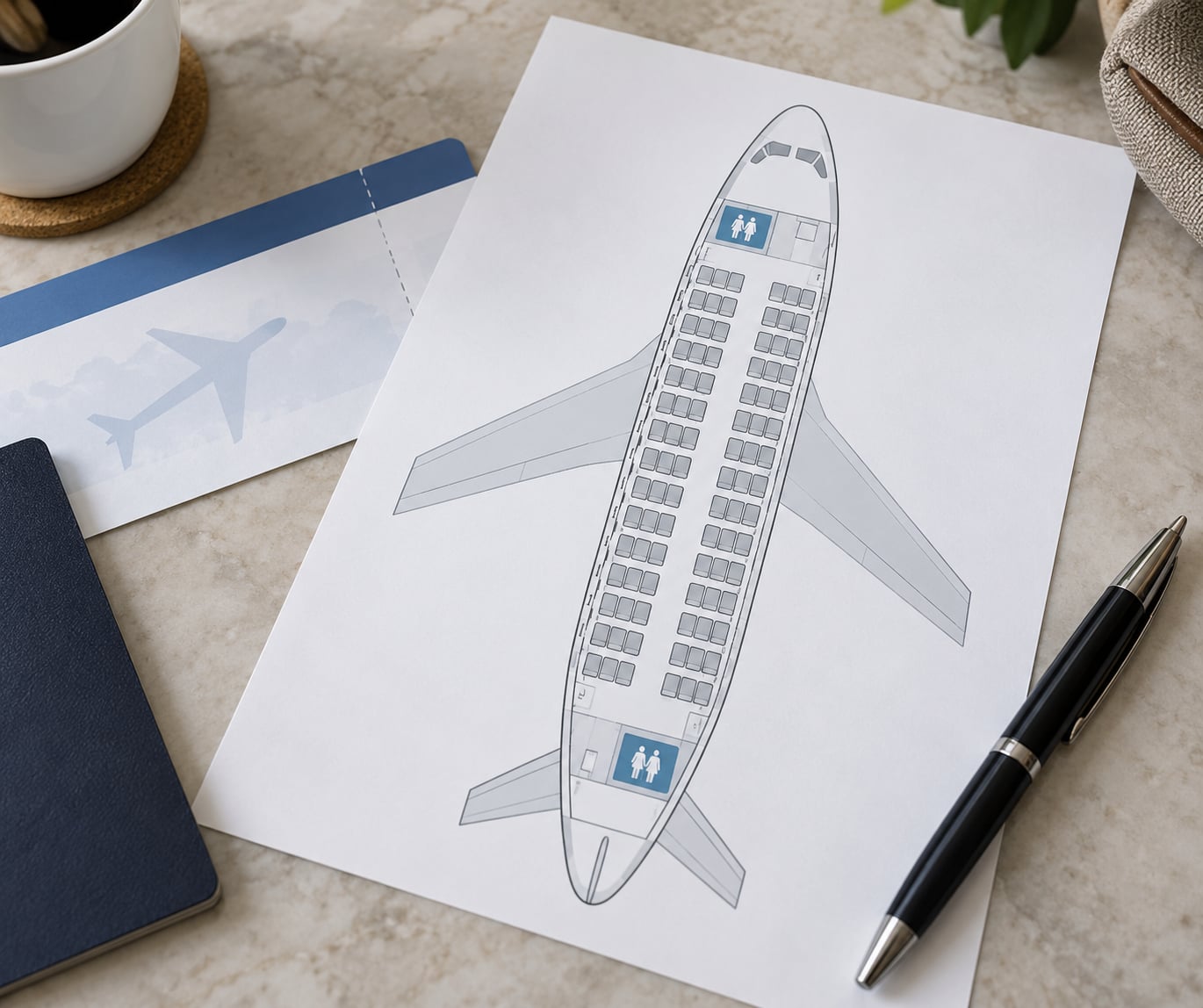
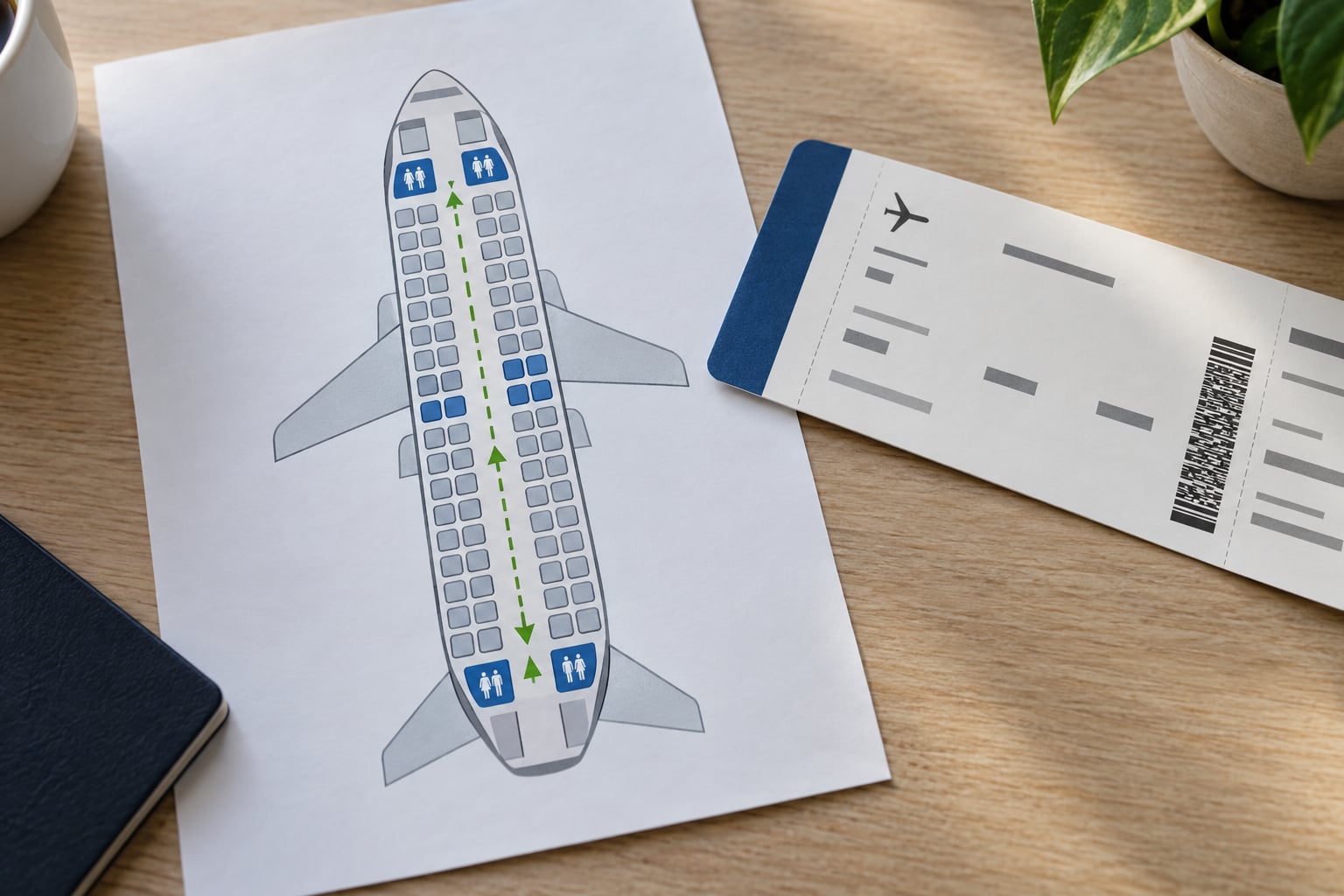
Lavatories sit in a small number of places, and where they sit tells you which rows to look at. On a single-aisle narrow-body in a 3-3 layout there are usually two, one toward the front behind the cockpit and one at the rear behind the last row, and the entire middle section of the cabin has no door at all. That single fact matters enormously. On a 787, 777 or A350 in a 2-4-2 or 2-3-3 layout, there is usually a bank of lavatories in the middle of the cabin as well, so the middle rows are viable. On a regional jet with a single lavatory at the back, the whole cabin is one long walk.
Identify the aircraft type in your booking confirmation, then open that aircraft’s map rather than the generic one. Look for the two symbols or the labelled blocks that mark the toilets. The rows to shortlist are the two or three immediately before and after each one.
Watch for the layout quirk that catches people out: row numbers reset between cabin sections on most wide-bodies, so a main cabin seat can be numbered higher than the premium cabin behind it. Read the section label, not just the number.
Choose the Best Seat Position
Once you know where the doors are, the front-versus-back question resolves itself. Front of the cabin wins on raw walking distance, and on a narrow-body with no mid-cabin lavatory that advantage is large. Back of the cabin wins when you care about the walk actually being clear, because the service carts run from the front down the aisle and the last twenty rows are usually the least disrupted once service is over.
There is a timing dimension most advice ignores. If your trips cluster around a specific point, look at when the carts run. The meal service usually works front to back, and the drink service often follows a similar path, so a seat near the front is most obstructed early and a seat near the back is most obstructed later. On an overnight flight with service out of the way, the front aisle is the better pick. On a daytime flight with a full meal service, a mid-cabin or rear aisle is calmer.
Two more position effects worth knowing. Rows near the galleys and bulkheads get more foot traffic, which is a mild version of the same problem as the lavatory door. And over-the-wing rows sit near the aircraft’s centre of gravity, so they move less in turbulence, which is worth something if bathroom urgency rises when the cabin shakes.
Give up on the middle seat entirely for this need. It is the worst of the three positions and the only one where every trip means climbing over two people. If a middle seat is all that is left, sit on the side toward the aisle and accept that you will be apologising to strangers.
Account for Overnight Flights and Mobility
On a red-eye, darkness changes the problem. Getting up in a dim cabin means stepping over a stranger’s knees, finding the aisle lights by feel, and waiting in a queue where nobody can see you. Aisle access still wins, but add a preference for a seat that lets you move without crossing anyone even if you are slightly further from the door, and try not to schedule a heavy drink before lying down. Most people who wake up at 3am needing the lavatory are fighting dehydration as much as a full bladder.
Hydration matters here. The usual advice to drink plenty on a long flight is good for jet lag and circulation, and it is also the reason most people need the lavatory three times after dark. Drink steadily through the daytime portion, keep the bottle on the aisle-side armrest or in a bag at your feet, and back off in the last two hours if overnight sleep is the priority.
If you need to move around for medical reasons, tell the airline when you book or at check-in rather than waiting for the gate. Pre-boarding, an aisle chair for anyone who cannot walk the aisle unassisted, and a request for a seat near a door are all standard requests that crews handle routinely when they are flagged in advance. Gate agents are also often willing to move someone from a middle seat to an open aisle seat on a lightly loaded flight, provided you ask plainly and accept either answer.
Confirm Before You Book
Do the seat check at three points. At booking, choose the aisle seat closest to a lavatory and pay or confirm it as part of the reservation. At roughly 24 hours before departure, re-open the seat map, because seat assignments shift with aircraft swaps and the map on your boarding pass is the one that counts. And at the gate, glance at the posted seat chart before boarding to see whether your row has changed.
Verify three things while you are looking. That the seat is genuinely an aisle seat on the map, not a seat labelled A or D in a layout where that letter is not on the aisle. That the row has no restriction attached, since exit rows need an able-bodied adult and some rows have bassinet or lie-flat fittings that remove the seat entirely. And that the aircraft type has not changed since you selected.
If every aisle seat is gone, buy the window seat, not the middle. A window seat beside an aisle is one person to step around rather than two, and you can ask the aisle passenger to stand. If you must take a middle seat, take the side nearest the aisle and go early in the flight when both seatmates are awake and more likely to move.
Common Mistakes
Assuming the front aisle seat is always closest. On a narrow-body with lavatories only at the front and rear, the front of the cabin wins. On a wide-body with a mid-cabin bank, a middle aisle seat is closer than any front seat. Check the map instead of assuming.
Sitting directly beside the lavatory door. It is the fastest seat on the plane and the noisiest. Two or three rows back keeps nearly all of the benefit.
Ignoring the service cart. A blocked aisle can add a minute to every trip, twice an hour, for the whole meal service. Choose a seat where the carts are not parked, or pick your travel time around when they run.
Booking the last row or a bulkhead row without checking. The last row backs onto a wall or a bulkhead, which is fine for quiet but often sits beside the rear lavatory and the galley. Bulkhead rows have no in-flight entertainment screen in front of you, so infants are placed there and a family may end up beside you.
Taking a middle seat because it is the only one left. A window seat in the same row is almost always the better compromise, since it means crossing one person instead of two.
Waiting to ask for help. Anyone needing regular aisle access can say so at check-in, and it costs nothing. Passengers report that crew are generally accommodating when the request arrives in advance rather than as an interruption in the aisle. On the question of whether frequent trips annoy anyone, aisle passengers tend to be relaxed about it and expect to be asked to stand; the complaints come from window passengers, not from the crew.
Frequently Asked Questions
Is an aisle seat always best for someone who needs the bathroom often?
Nearly always, but not automatically the closest. An aisle seat in the back of a wide-body can be further from a lavatory than a front window seat if that aircraft has no mid-cabin toilet. What matters is the row count between your seat and the nearest door, so read the map for your aircraft rather than trusting the seat type alone.
Should I choose a seat near the front or the rear of the plane for easier bathroom access?
Front wins on walking distance when the aircraft has lavatories only at the front and rear, which is common on narrow-bodies. The rear aisle wins on clear walking because the service carts work front to back and the last rows are least disturbed after service. On a wide-body with a mid-cabin lavatory bank, a middle aisle seat beats both.
What seat is best on an overnight flight if I need to use the lavatory frequently?
An aisle seat, ideally mid-cabin or slightly back of the front galley, so the kitchen is quiet and the aisle is clear once service is finished. Back off two or three rows from the lavatory door so the queue and door noise stay behind you. Drink steadily during daylight hours and cut back in the final two hours to protect sleep.
Can I choose a seat next to an accessible bathroom on an airplane?
You cannot reserve a lavatory-adjacent seat as such, since aircraft maps do not label restrooms as selectable features. What you can do is pick an aisle seat two or three rows from the lavatory on the seat map, and if you have a mobility need, request pre-boarding and an aisle chair when you book or at check-in so the crew can plan the trip with you.
How far apart are airplane lavatories, and are there usually more at the front or back?
On a narrow-body in a 3-3 layout there are typically two, one forward and one aft, with nothing between them. Wide-bodies in 2-4-2 or 2-3-3 layouts add a mid-cabin bank, which is why middle rows are worth considering there. Regional jets usually have a single lavatory at the rear, which makes the back rows the best option on those aircraft.
What should I do if the aircraft changes after I select my seat?
Re-check the seat map about 24 hours before departure and again at the gate against the boarding pass. A change of aircraft can move every lavatory in the cabin and shift the seat numbers. If your aisle seat became a poor position, ask the gate agent whether an aisle seat closer to a lavatory is open, and accept either answer politely.
Final Advice for Bathroom-Friendly Seating
Start by opening the seat map for the exact aircraft on your booking and finding where the lavatories are. Then choose the aisle seat two or three rows clear of the nearest door, favouring the front of the cabin on a narrow-body and the middle on a wide-body that has a mid-cabin bank.
Check it again at check-in, because an aircraft change moves everything. If there is a medical or mobility reason behind the frequency, say so at booking rather than at the gate, and you will usually be offered pre-boarding and an aisle chair without needing to explain twice.