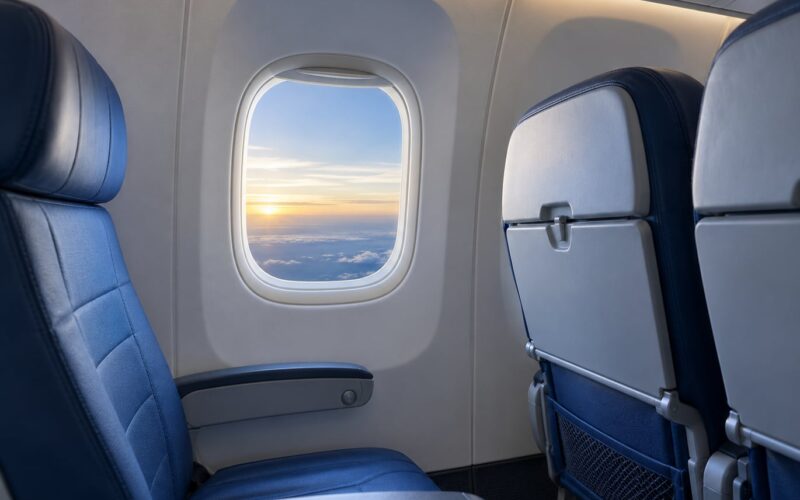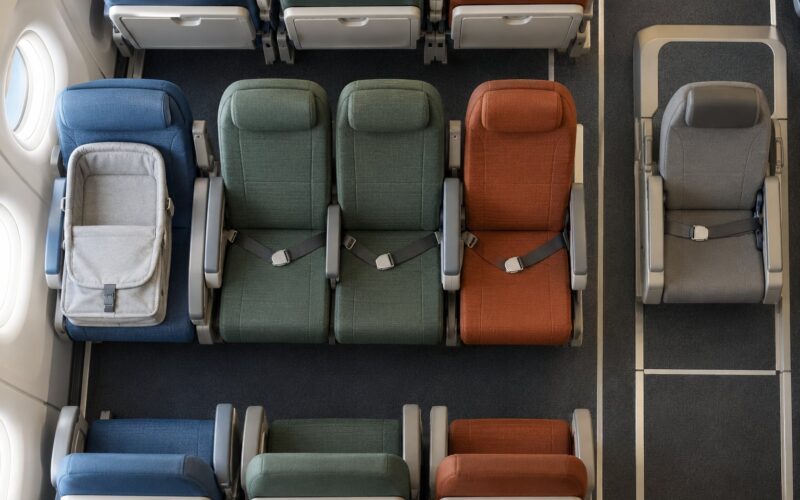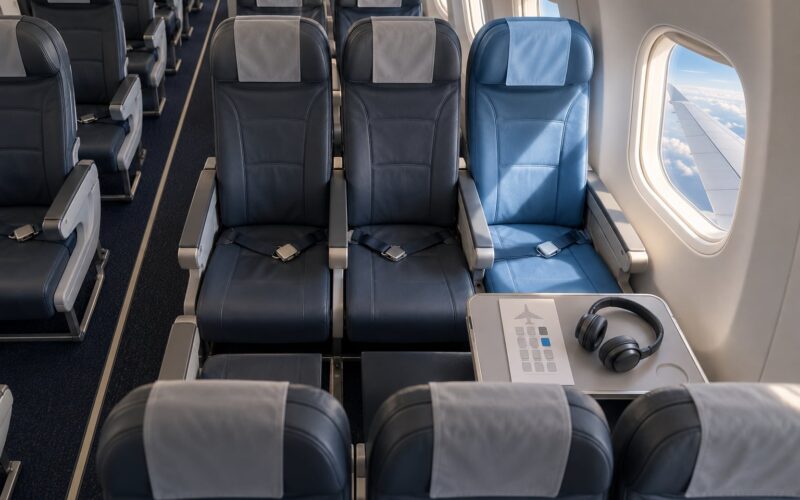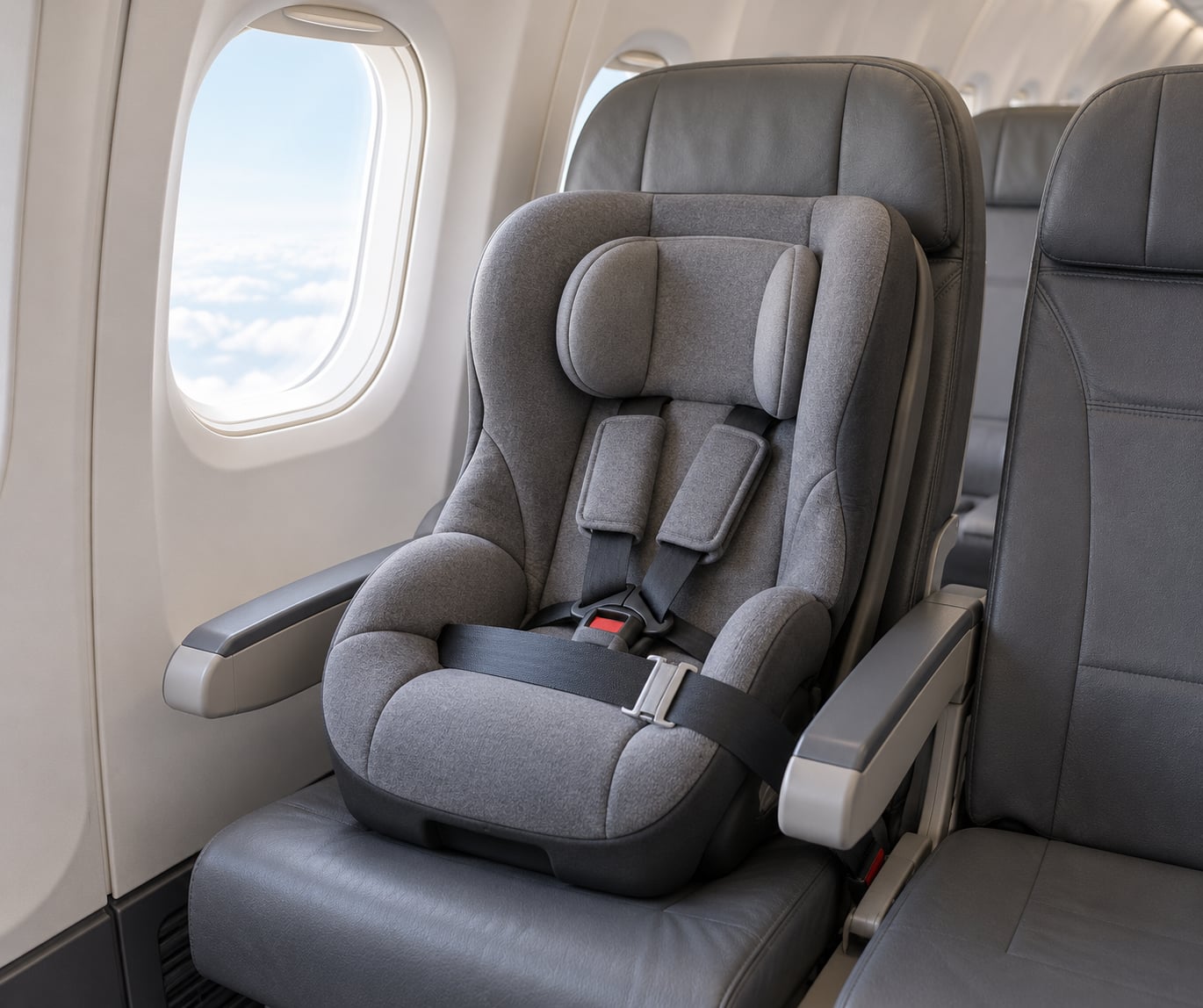
To pick a seat with a car seat on a plane, book a window seat, stay clear of exit rows and of the row directly in front of or behind one, and get the operating airline to confirm your exact seat model fits that aircraft before you pay. The rule that trips parents up is simple: the FAA calls a window seat preferred, not mandatory, and airlines tighten that into a hard requirement.
That gap between what the regulator says and what the crew enforces is where most gate arguments come from. A certified child passenger safety technician quoted FAA Advisory Circular 120-87A on the DISboards forum: a window seat is the preferred location, and other locations may be acceptable provided the child restraint does not block the egress of any passenger. In practice, on most US carriers, that means window only.
The whole process takes maybe twenty minutes before you book, plus a phone call. What you are trying to avoid is the version where you pick a middle seat on a regional jet, arrive early, and get reassigned at the gate while your child carries the seat down the aisle.
Table of Contents
- What You Need
- Step-by-Step: How to Pick a Seat With a Car Seat on a Plane
- How to pick a seat with a car seat on a plane: check the seat map
- Confirm the aircraft and airline rules
- Ask the airline to confirm seat compatibility
- Choose the right row and nearby alternatives
- Install, secure, and verify the setup before departure
- Common Mistakes
- Frequently Asked Questions
- Where should a child car seat be installed on a plane?
- Can a lap infant use a car seat on an airplane?
- Does the adult holding an infant also need a seat belt?
- What happens if my car seat does not fit in the selected airplane seat?
- Should I buy my airplane seat with a car seat or select one for free?
- Conclusion: Confirm Compatibility Before You Book
What You Need
Gather these before you open the seat map. Without them you cannot have a useful conversation with the airline, and you will end up guessing.
- Your flight number and date, plus the connecting flights if the trip has any. Aircraft can change between segments.
- The aircraft type for each segment. A regional jet, a narrowbody and a widebody have different seat widths, armrests and layouts.
- The operating carrier. Codeshares mean the aircraft and crew belong to someone other than the airline you booked with.
- Your child’s age and current weight, because a seat’s label sets a forward-facing minimum and a rear-facing maximum.
- The exact car-seat model and its widest measurement, taken across the widest point including any hardware.
- The red-lettered aircraft certification label on the seat, which states the restraint is certified for use in motor vehicles and aircraft. Seats built before the 1985 cutoff date are not eligible.
- The current seat map for that aircraft, from the airline’s own site rather than a third-party seat map tool.
- A way to reach the airline: the reservations line, the accessibility desk, or the special assistance number listed on the airline’s car seat page.
Step-by-Step: How to Pick a Seat With a Car Seat on a Plane
Five steps, in order. The rule that holds all of them together: do not pay for a specific row until the airline has confirmed, in writing or on the phone, that your restraint can be installed there.
How to pick a seat with a car seat on a plane: check the seat map
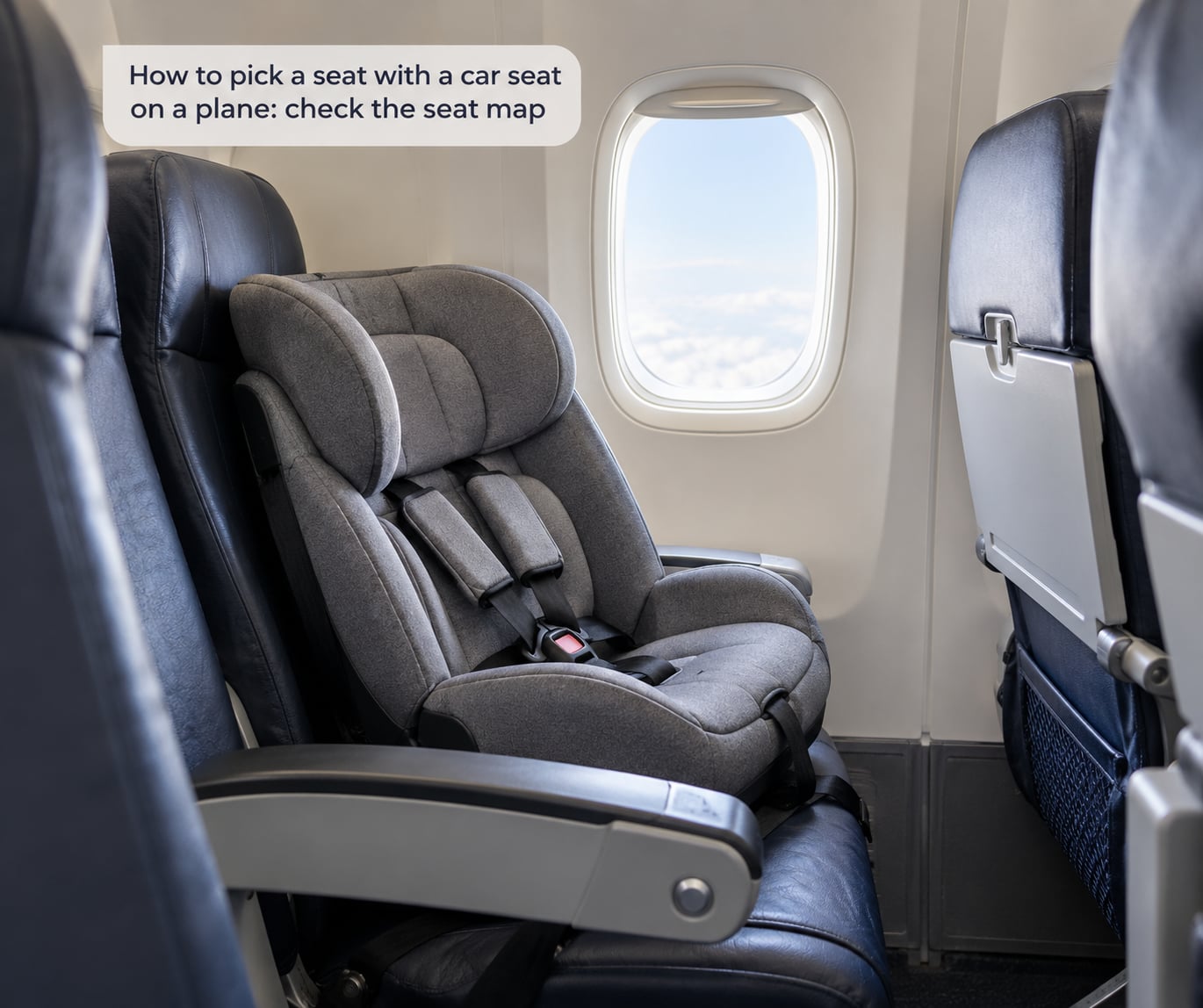
Start with the airline’s own seat map for your exact flight. The first thing you are looking for is not a seat, it is the exit rows. Those are drawn as wider gaps in the row sequence, often with a door icon or a heavier outline, and they come with a rule that surprises people: the row immediately fore and aft of an overwing exit is also off limits for a child restraint.
On a narrowbody the exit pair usually sits around rows 10 to 13, and on a Boeing 737 it can be nearer the front. The numbers move by aircraft and by cabin layout, so read the map instead of memorising a row.
Now be honest with yourself about what the map cannot tell you. It does not show seat width in inches, how far a seat reclines, whether the armrest retracts, whether the tray table drops fully with a child seat in place, or whether the seat next to yours will be occupied. Third-party seat maps are worse still, because they often carry outdated maps for a retired aircraft. A parent on r/toddlers reported installing a Cosco Scenera in a United seat where the retractable armrest would not go up and the buckle pressed into the child’s back, while another parent in the same thread flew 20-plus United flights with the same seat model without a problem. That is fleet-level variance, not a defect in the seat.
Confirm the aircraft and airline rules
With the map in hand, confirm who is actually flying the aircraft and what their published policy says. Every major US carrier publishes a car seat or special assistance page, and those pages carry the carrier’s real placement rules, including anything stricter than the federal baseline.
Two details change the answer more than parents expect. The first is fare class: some basic economy fares block seat selection entirely, which means you cannot arrange adjacent seats at all unless you pay. The second is the operating carrier, which on a codeshare is not the brand you booked.
Keep two situations separate in your head. A child in an installed car seat needs a purchased seat, sits in a forward-facing aircraft seat, and faces placement rules. A lap infant is governed by different rules entirely, including rows without an extra oxygen mask, so the row you would tolerate for a restrained child may not work for a lap infant.
Ask the airline to confirm seat compatibility
This is the step that actually decides things. Ask the questions yourself rather than accepting a yes to a vague one. Useful questions include:
- Which rows on this aircraft are designated for child restraints, and is a window seat required or only preferred?
- Can my child travel rear-facing in the cabin, and does the restraint’s label set a forward-facing minimum I need to respect?
- What is the maximum width and depth you will accept for an installed restraint, and how do you measure it?
- Do you supply a restraint or harness for this flight, or must my own be installed?
- Does a confirmation for this flight cover the aircraft, or only this specific flight number?
- Which fare classes can pre-select adjacent seats for a family with restraints?
Ask for confirmation that is tied to a flight and an aircraft. A general answer about your car seat model tells you the model is welcome, not that row 14C will take it on a specific tail number. Enforce nothing at this stage, but write the answer down with the agent’s name.
Choose the right row and nearby alternatives
Now, and only now, pick the row. This table is the short version of the decision:
| Seat position | With a car seat | Why |
|---|---|---|
| Window | Yes, preferred everywhere | Keeps the child seat out of the aisle path during an evacuation |
| Middle, with adjacent seats empty | Sometimes, at the crew’s discretion | Permitted only when nothing blocks a passenger’s egress |
| Middle, with neighbours occupied | No | The restraint blocks the route to the aisle |
| Aisle | No | The seat itself obstructs the aisle |
| Exit row | No | Blocked outright; the child is not old enough to perform an exit duty |
| Row fore or aft of an exit row | No | Kept clear so passengers can reach the exit without climbing past a seat |
| Bulkhead row | Usually yes, in a window position | Extra legroom, no seat in front, which suits a rear-facing seat |
A few real tradeoffs sit behind that table. A window seat away from the galley and lavatories means fewer people stepping over you during a long flight, though it also means a harder aisle transfer when a sleeping toddler needs to go. A bulkhead row has no seat in front, which removes the recline conflict that rear-facing seats cause, but bulkheads sometimes carry stricter bassinet and car seat conditions, so read the carrier’s fine print.
Buying an aisle seat for an adult who wants quick legroom does nothing for the child seat, and paying for an adjacent seat does not buy approval. Selection and permission are two separate decisions made by two different people.
Install, secure, and verify the setup before departure
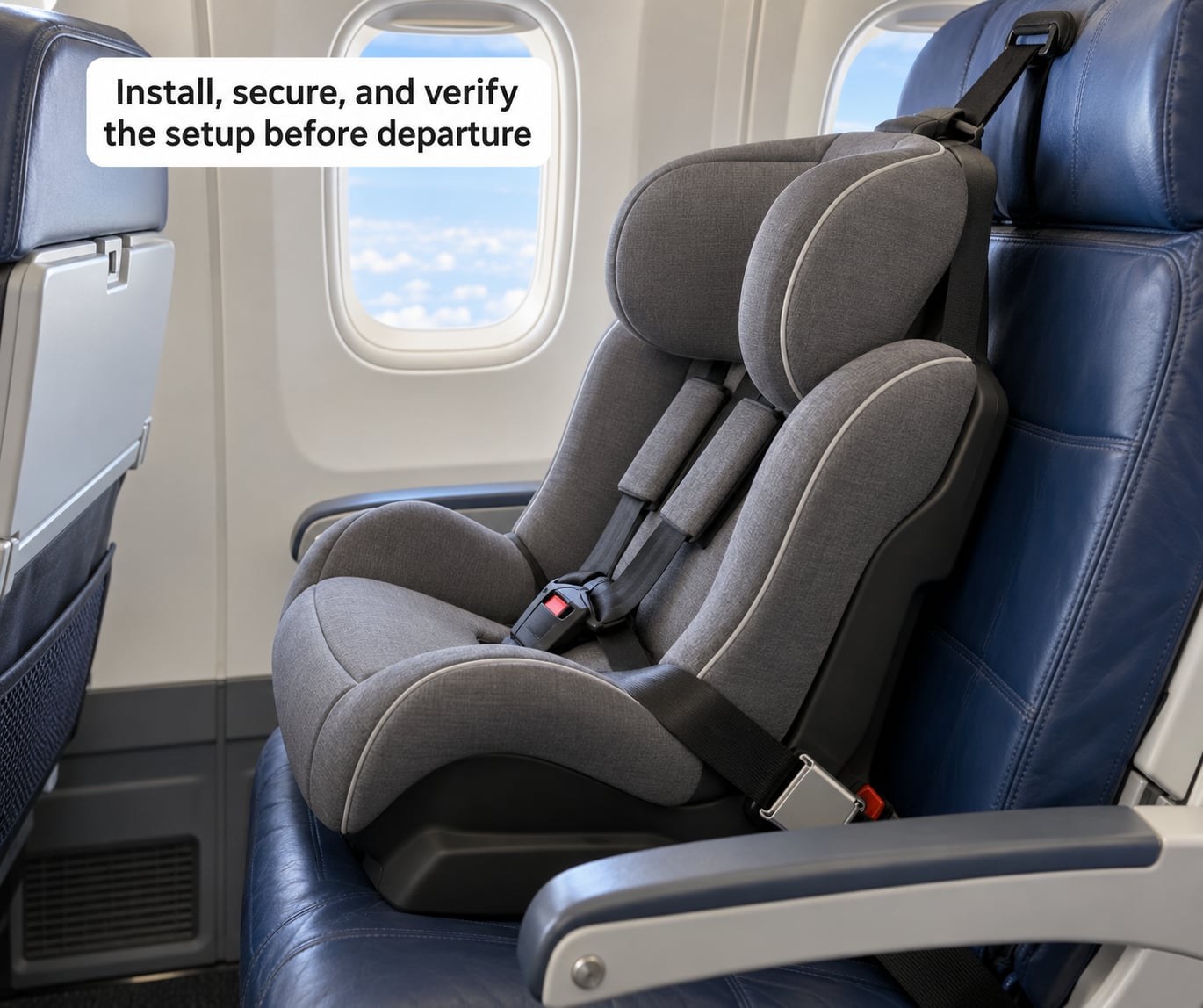
On board, follow both instruction sets: the restraint manufacturer’s manual for how the seat attaches, and the aircraft seat belt instructions for which belt paths are approved. Never improvise a belt route that the restraint manufacturer did not list, and never use an inflatable seatbelt as a top tether.
Then ask a flight attendant to check the installation before pushback, while there is still time to fix it. That request is routine and it is the single highest-value thirty seconds of the whole trip. Ask the passenger in front to keep their tray table up until you are settled, since a tray table that will not drop fully is a common complaint with rear-facing seats.
Rear-facing seats add one more variable. Several parents on DISboards report that a rear-facing convertible works fine in the cabin but takes the seat in front’s ability to recline, and agents have used that as grounds to demand the seat go forward-facing. If you hit that, the restraint’s own label decides the question, not the crew’s preference. The American Academy of Pediatrics recommends that infants and toddlers travel in their own restraint with a purchased seat rather than on an adult’s lap.
Common Mistakes
- Trusting a third-party seat map. It may show an aircraft that has been retired from your airline’s fleet. Use the airline’s own map, then confirm the aircraft.
- Booking on age or weight alone. The label’s forward-facing minimum and rear-facing maximum decide orientation, and the seat’s physical width decides whether it fits at all.
- Choosing a row without airline confirmation. Exit rows and the rows fore and aft of them are the most common expensive mistake, because they look perfectly normal in a seat map.
- Treating a paid seat as permission. Paying for three adjacent seats does not approve a middle-seat car seat, though it helps if a middle seat is granted.
- Confusing a lap infant with a restrained child. Different rules, different rows, different risk. A poster on the Tripadvisor Air Travel Forum pointed out that lap children need a row with an extra oxygen mask, which rules out some rows.
- Using an unapproved belt path. Only the belt paths printed in the restraint manual count.
Before you book, do four quick things: confirm the aircraft on each segment, read the carrier’s own placement policy, ask them to confirm your seat model on that aircraft, and pick a window seat that is not an exit row or its neighbour. Add a reminder to re-check about a week out, because fleets get swapped and policies change during 2026.
Frequently Asked Questions
Where should a child car seat be installed on a plane?
In a window seat, as close to level as you can manage. FAA guidance calls a window seat the preferred location and allows other positions only when the restraint does not block any passenger’s egress to the aisle. That means no aisle seats, no exit rows, and no row directly in front of or behind an exit. Airlines apply the preference as a firm rule and add their own restrictions.
Can a lap infant use a car seat on an airplane?
A lap infant is an infant held on an adult’s lap and buckled in with the adult’s belt, which is a different arrangement entirely. If you want the infant in a car seat, you buy a seat for them and the car seat is installed on it like any other passenger. Pediatric bodies recommend a purchased seat rather than lap travel for as long as the child is small enough to be held.
Does the adult holding an infant also need a seat belt?
Yes. A lap infant rides on an adult who is properly buckled, with the infant sharing that belt. The adult needs their own seat and their own belt fastened, and the infant’s weight and length count against the adult’s seat belt rating. If the adult’s belt cannot be worn low and tight over both of them, the child needs a purchased seat instead.
What happens if my car seat does not fit in the selected airplane seat?
The crew can move you to a seat the restraint does fit, but do not count on the replacement row being one you chose or being near your party. That is why fit is confirmed before you buy the assignment. If nothing on board will take the restraint, the seat can be gate-checked in its bag, though you lose the restraint for the most safety-critical phases of the flight.
Should I buy my airplane seat with a car seat or select one for free?
A child using a car seat needs a purchased seat; airlines do not treat a child restraint as a free seat add-on. Child seats and strollers are generally not counted as checked baggage, so bringing one costs nothing in baggage allowance. On fare classes that block seat selection, buying up is often the only way to place a family in adjacent seats in the same row.
Conclusion: Confirm Compatibility Before You Book
To pick a seat with a car seat on a plane, work in this order. Confirm the aircraft for every segment, confirm the car-seat model with the operating carrier, then choose a window seat that is not an exit row and not the row directly in front of or behind one.
Nothing on a seat map settles fit. Width, armrest, tray table and recline only reveal themselves on the aircraft, which is why the phone call comes before the payment. On board, follow the restraint manual, use only approved belt paths, and ask a flight attendant to look at the installation before pushback.