Zone boarding is a staged boarding process where an airline sorts passengers into numbered groups and calls them to the jet bridge one group at a time instead of lining everyone up at once. Your zone is printed on your boarding pass, and it decides when you walk down the aisle and how likely you are to find an open overhead bin.
It sounds bureaucratic until your first crowded flight, when an hour of standing at the gate turns into a scramble for bag space. Zone boarding is mostly the fix for that scramble, and it also happens to be the mechanism airlines use to hand out perks to people who paid more.
Below is what each zone means, who lands in it, and what to do when things do not go to plan at the gate.
Table of Contents
- What Is Zone Boarding?
- How Does Airline Zone Boarding Work?
- What happens when your group is called?
- What Determines Your Boarding Zone?
- How Many Boarding Zones Are Common?
- Do All Airports and Airlines Use Zone Boarding?
- How Do You Find Your Boarding Zone?
- Why Do Airlines Board Passengers in Groups?
- Can You Board in a Different Zone?
- What Happens If You Miss Your Boarding Zone?
- Does Boarding by Zone Guarantee Overhead Space?
- Frequently Asked Questions
- What does it mean when my zone is called?
- Is boarding zone 1 always first?
- Can I board before my assigned zone?
- What if I arrive at the gate after my zone boards?
- Does zone boarding guarantee a seat near the front?
- Why did my boarding zone change at the airport?
What Is Zone Boarding?
Zone boarding is a system airlines use to board a flight in stages. Passengers are assigned a numbered group based on ticket type, cabin, loyalty status or seat location, and the gate agent calls those groups in order. Zone 1 boards first, higher numbers board last. Preboarding, when it exists, happens before any number.
The usual sequence looks like this:
- Preboarding — passengers needing assistance, unaccompanied minors, and families with small children
- Zone 1 — first class, business class, and top-tier elite members
- Zone 2 — premium economy and other high-priority passengers
- Zone 3 — most main cabin passengers with overhead bin access
- Zone 4 — main cabin passengers, often with a standard carry-on
- Final group — the remainder, frequently including basic economy and passengers who bought carry-on space on a low-cost carrier
Southwest is the standard outlier. With open seating it uses lettered groups rather than numbered zones.
How Does Airline Zone Boarding Work?
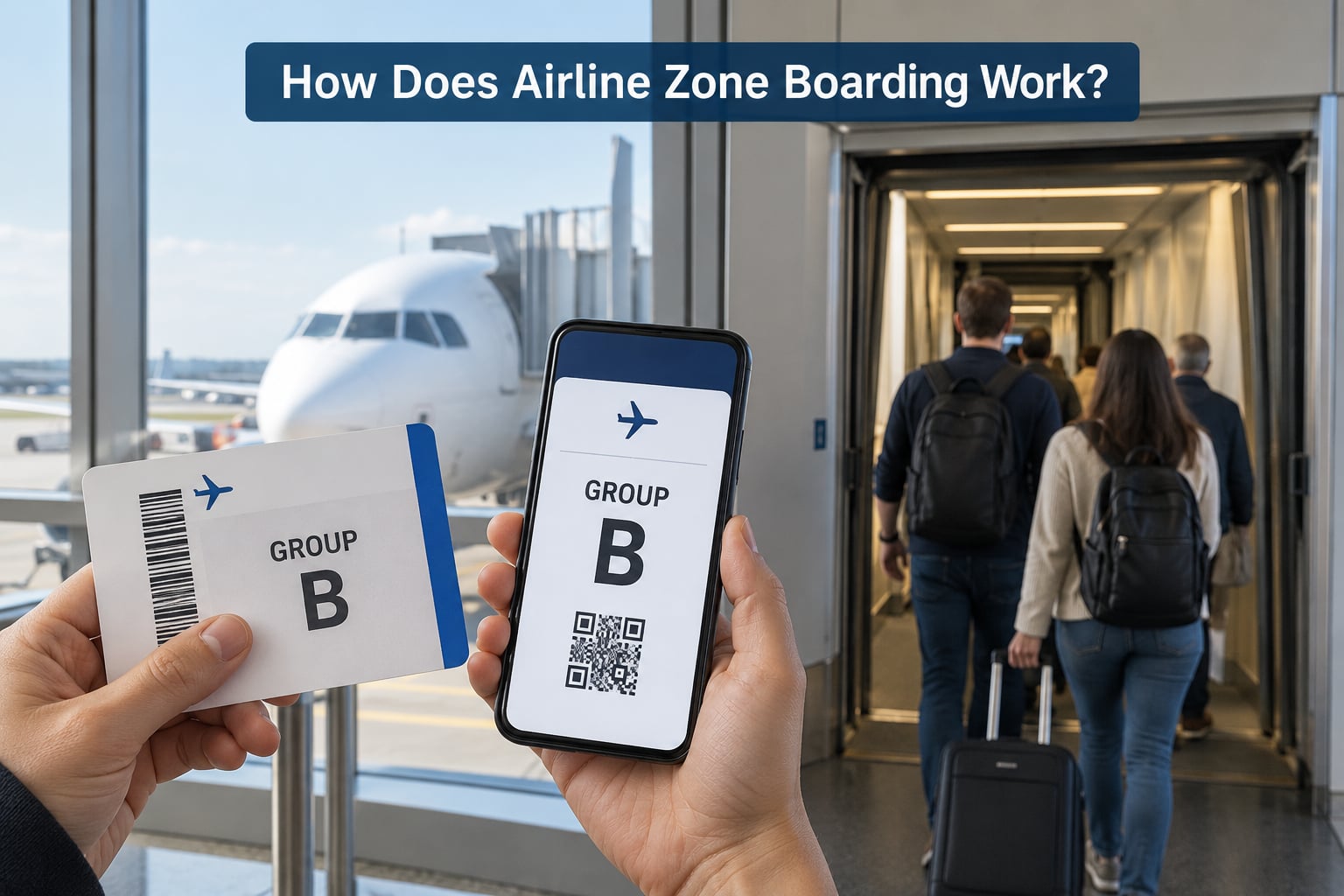
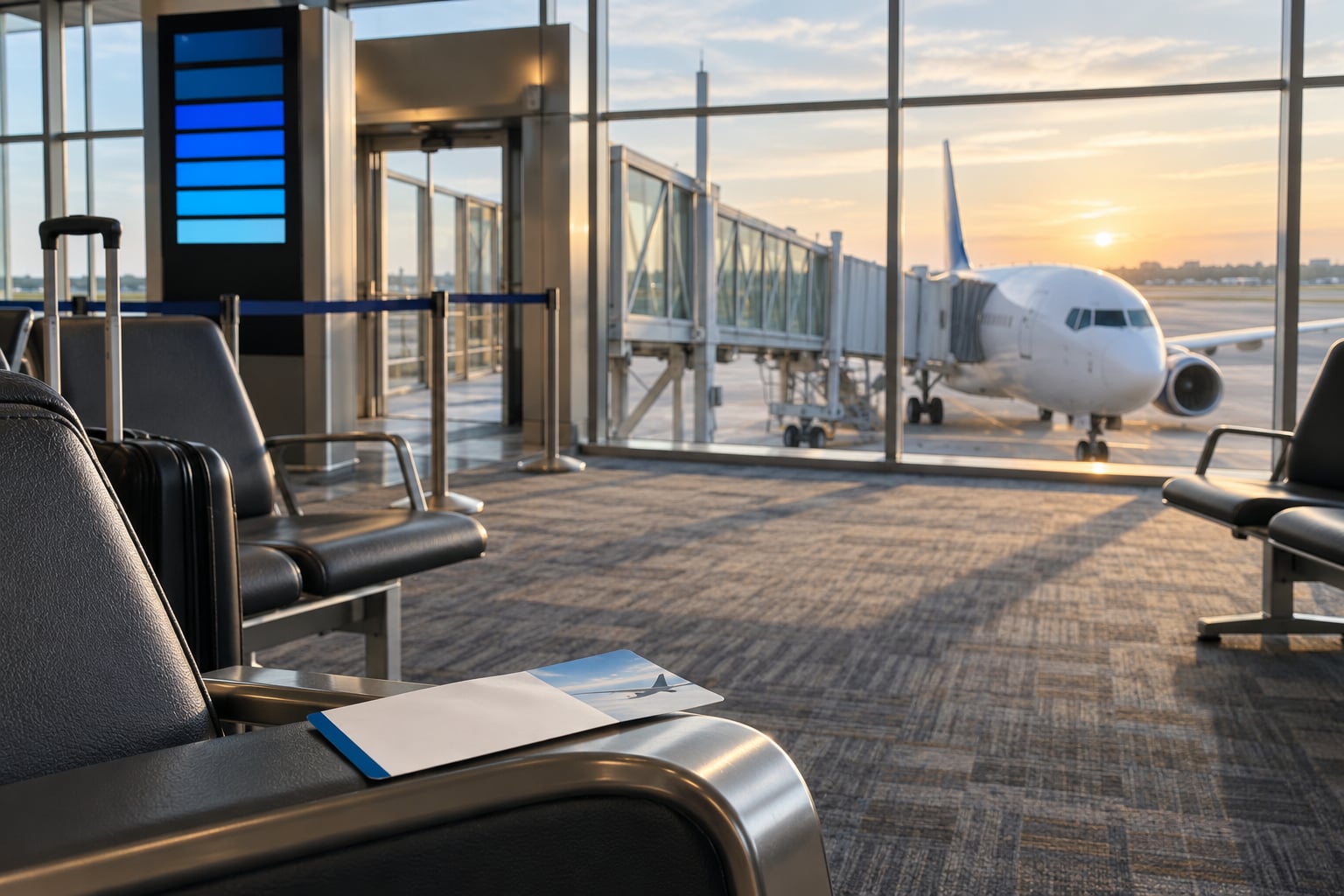
The gate display shows the group currently boarding along with the groups in line behind it. When your group comes up, you walk to the scanner, have your boarding pass scanned, and continue into the jet bridge.
Boarding usually opens somewhere around 30 to 50 minutes before the scheduled departure time on a domestic flight, and it can start earlier on larger aircraft. That window is also when the gate gets busiest, so arriving early at the gate pays off even if your group is far down the list.
What happens when your group is called?
Stand up when your group appears on the screen, not when the agent reads it out. Agents repeat announcements for the group currently boarding and the one after it, so listening for a single call is an easy way to miss your turn.
Have your boarding pass ready and your bag packed before the call. That is genuinely all the technique there is.
Keep in mind that the door closes before the takeoff time, not after. Airlines cut off the jet bridge several minutes ahead of departure so bags can be loaded and doors closed on schedule.
What Determines Your Boarding Zone?
Your zone comes from one or more of five things: your cabin, your fare type, your loyalty status, your seat location, or your eligibility for preboarding. The order varies by airline, which is why two people on the same flight can have very different groups for very similar tickets.
| Factor | How it usually affects your group | Example |
|---|---|---|
| Cabin | Higher cabins board first | Business class before main cabin |
| Fare type | Restricted fares board later | Basic economy in the final group |
| Loyalty status | Elite members move up a zone or two | Top-tier member boarding ahead of general members |
| Seat location | Aisle and window rows can move up | Exit row and window seats earlier than middle seats |
| Assistance needs | Preboarding, ahead of all numbered zones | Wheelchair or mobility assistance |
On carriers that sort by seat letter, an aisle seat in the back can board later than a middle seat in the front row. Nobody has explained that one to me yet, and it has annoyed more than one passenger on flights I have taken.
Passengers with disabilities board first as a matter of federal accessibility rules, ahead of every numbered group. Airlines handle this through preboarding rather than a zone.
How Many Boarding Zones Are Common?
There is no standard number of boarding zones. Most flights you will see use between two and five groups, and plenty of airlines use letters instead of numbers.
A typical four-zone domestic flight might run: first and business class first, then premium economy and elite members, then the bulk of main cabin, then everyone else. Some carriers run more granular numbering, with separate main cabin groups of one and two that are not tied to where you sit in the plane.
International flights often use different labels again, with main cabin groups numbered one, two and three that are the same idea wearing different clothes.
Do All Airports and Airlines Use Zone Boarding?
The underlying process is nearly universal, but the visible zone labels are not. Some airlines and some airports skip the numbered system entirely and simply board by cabin, or call a single general line.
Southwest with open seating has no classic zone hierarchy at all. You get an A, B or C group, but your seating is not tied to your boarding order, so boarding early has a much smaller payoff.
Even on a flight that does display zones, treat the label as a courtesy for most of the cabin. The gate agent can change what they call and when.
How Do You Find Your Boarding Zone?
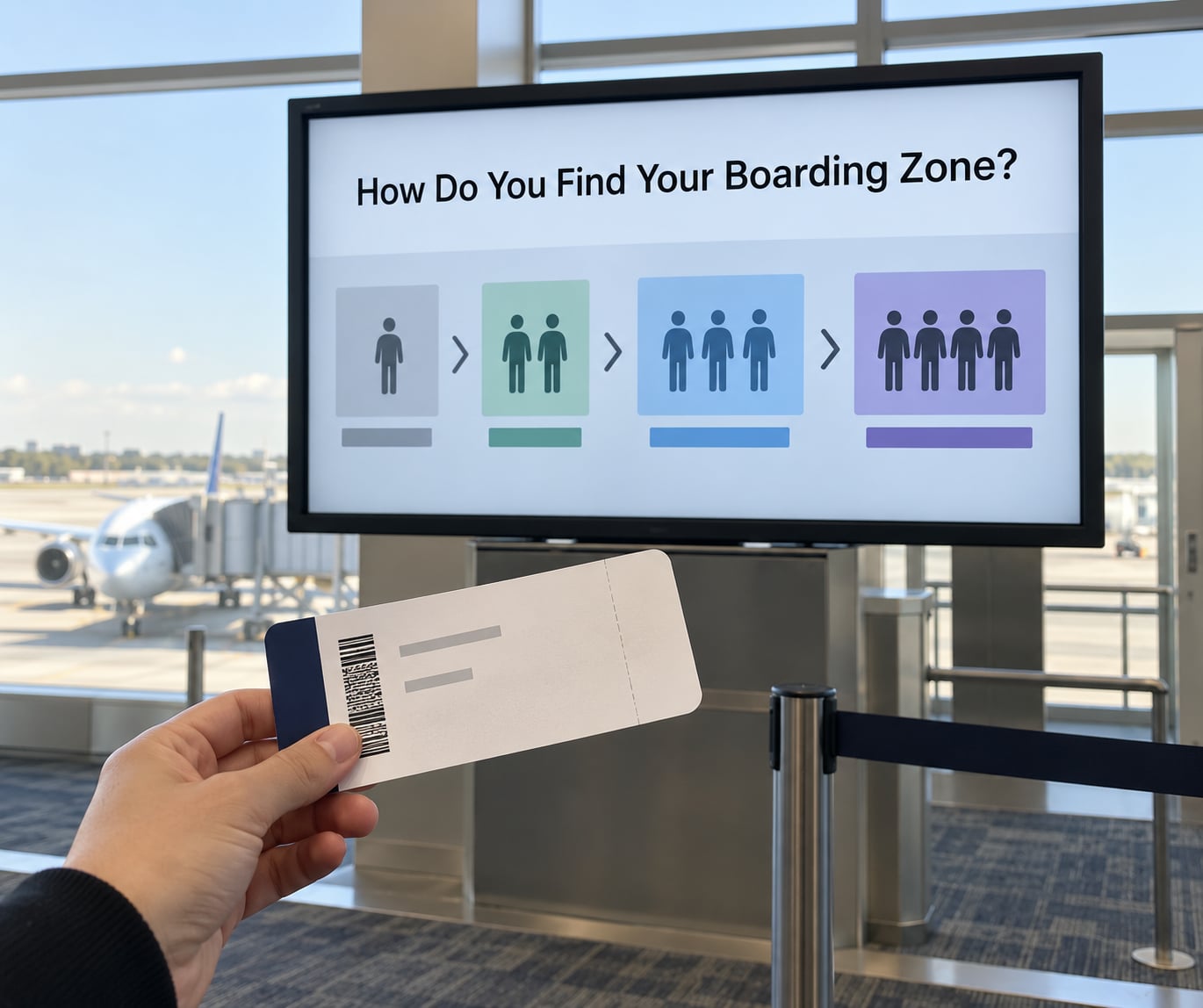
Check your boarding pass first. The group or zone appears on it, usually near the gate or seat information, and on an electronic pass it shows in the app as well.
Then check the airline app, which mirrors the same information and updates faster than a printed paper pass. The gate display at the departure gate is the final word, and it is also where changes show up first.
Listen for announcements too. On a busy flight the agent will call the boarding group and the next one after it, and those calls are where last-minute changes get announced.
Boarding information can change before departure. Airlines reassign groups when the aircraft swaps, when a family is split up, or when an operational issue means a different loading plan. If your zone looks different from what you expected, ask the gate agent rather than the person in line beside you.
Why Do Airlines Board Passengers in Groups?
Boarding in groups exists for three practical reasons and one commercial one, and the commercial one is the reason the first three exist.
- Congestion — one group at a time keeps aisles from turning into a standing crowd, which is what you see when a whole plane is called at once
- Overhead bin space — earlier groups load bags before later groups fill the same bins
- On-time departures — a predictable order means bags get into the hold faster and the door closes on schedule
- Revenue — priority boarding is a purchasable product, and a zone system is how it gets delivered
The counterargument is that zones can create the exact crowd they were meant to prevent. A group of sixty people all standing up at once produces a bottleneck that is worse than a single orderly line. Passenger forums fill up with arguments about carriers trialling stricter enforcement, and flyers rarely agree on whether that helps.
Some airlines have looked at boarding back to front instead, and a body of infection-exposure research has been used to argue for it. Most carriers have kept the standard front-to-middle order, partly because frequent flyers push against any change that slows their own boarding.
Can You Board in a Different Zone?
Usually you board when your group is called, but a gate agent has discretion. Flyers on forums describe a wide range of real behaviour: one agent waves through anyone who volunteers to gate-check a roller bag, the next agent holds the line strictly to order.
Requests are more likely to be accepted when there is an operational reason. Travellers with assistance needs, families with small children, passengers with a tight onward connection, and anyone who has been delayed earlier on the day are the cases most often accommodated.
Do not plan around an exception. Ask politely, once, early, and accept the answer.
What Happens If You Miss Your Boarding Zone?
Go to the gate agent immediately and explain what happened. That is the whole playbook. A long line, a phone that died, a bathroom stop. Gate agents handle these situations every day, and you will get a far better response than the stranger who starts pushing into the jet bridge.
Realistically there are three outcomes. You board after the current group finishes, which is common. You board only if there is space and the agent allows it, which is less predictable on an overbooked flight. Or you do not board at all.
Flyers consistently report that arriving roughly five minutes before the gate closes is usually fine. That margin disappears on a full flight, and basic economy passengers have less room than anyone, since boarding outside the ticketed group can come with a change fee on some fares.
If your bag was gate-checked, it may be handed back at the jet bridge rather than the carousel. People find this genuinely stressful when they are already late, so check the bag tag before you leave the gate area.
Does Boarding by Zone Guarantee Overhead Space?
No. Zone boarding makes overhead space more likely, not certain. Earlier groups get first pick, but on a full flight the bins can be gone before Zone 3 is called.
Agents also ask later groups to gate-check larger bags, and a roller that goes down at the jet bridge is faster for everyone than a thirty-second argument over the last overhead space. If your bag has wheels and a handle and you can lift it into a bin yourself, the odds are on your side.
The passenger with the guaranteed empty seat has the same problem. Sitting down first helps until a whole row arrives and the bins above them fill anyway.
Frequently Asked Questions
What does it mean when my zone is called?
It means the gate agent is now inviting your group to board. Stand up, have your boarding pass ready, and walk to the jet bridge when your group shows on the screen. Agents usually call the boarding group and the one after it, so keep listening even if your number has not appeared yet.
Is boarding zone 1 always first?
Almost, but not always. Most airlines run preboarding before any numbered zone, and that group covers passengers needing assistance, unaccompanied minors, and families with small children. Zone 1 follows preboarding and is usually first class, business class, and top-tier elite members.
Can I board before my assigned zone?
You can ask, and the gate agent decides. In practice, requests are more often granted when there is an operational reason such as an assistance need, a tight connection, or a family with a small child. Volunteers who agree to gate-check a bag are sometimes waved through. Never rely on it as a plan.
What if I arrive at the gate after my zone boards?
Go straight to the gate agent and explain the situation rather than joining the line. You will often board after the current group finishes, but on a full flight there is no guarantee of space. The jet bridge door closes several minutes before departure, so five minutes of margin is usually workable and ten is not.
Does zone boarding guarantee a seat near the front?
No. Zone boarding and seat assignment are two separate systems. On most airlines your seat is fixed when you book, and your zone is assigned later based on cabin, fare type, loyalty status, and seat location. A later zone does not move you forward, but it does change how long you stand in the aisle.
Why did my boarding zone change at the airport?
Zones get reassigned for ordinary reasons: a different aircraft, a family split across cabins, a schedule change, or a new loading plan decided by the gate agent. It can also happen when your app has not refreshed. The gate display and the agent at the podium are more reliable than the version on your phone.
The first thing to do is simple: check your boarding pass and put your bag away before your group is called. Everything else about zone boarding is detail, and the details change airline by airline.