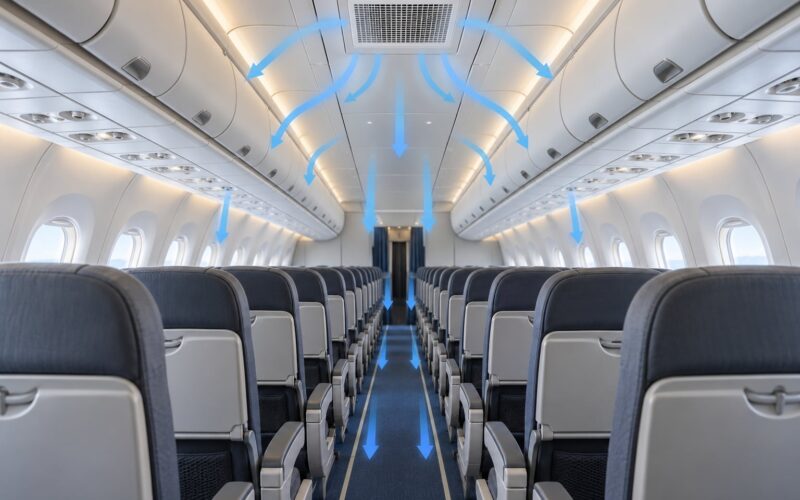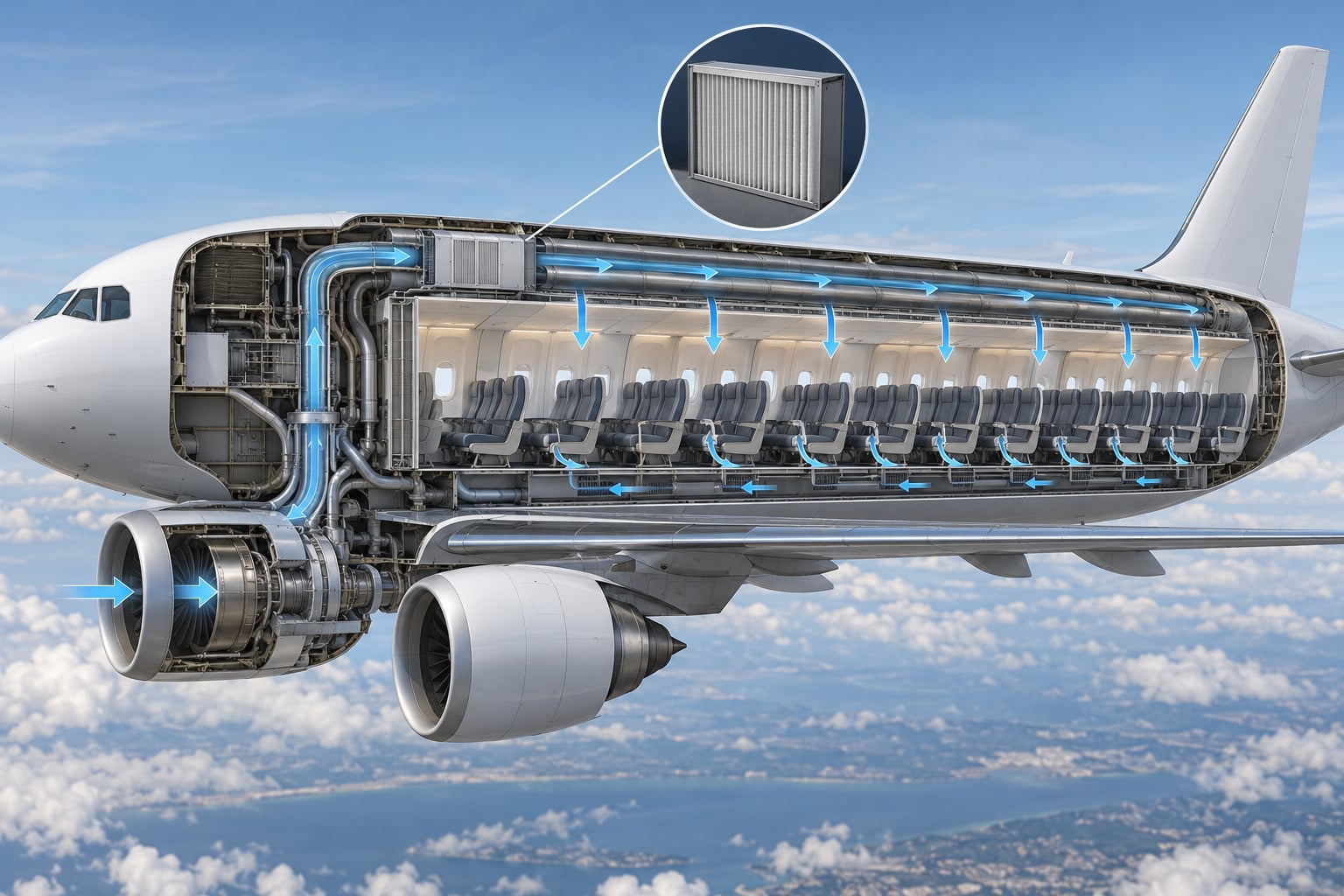
Airplane cabin air filtration works by mixing fresh air drawn from outside the aircraft with recirculated cabin air, cooling the mixture, then pushing it through HEPA-grade filters before delivering it to the cabin through overhead outlets. Clean air flows straight down, returns through floor grilles near your seat row, and gets filtered again. Roughly 40 percent of the supply is recirculated cabin air; the other 60 percent is fresh outside air added on every cycle.
That is the whole system in three sentences. What follows is what happens to the air along the way, how the filters actually catch particles, and where the system stops being able to help you.
Most of the confusion comes from one assumption: that HEPA means all the air is cleaned. It is not all the air, and even the parts that are filtered only deal with particles.
Table of Contents
- What Happens Before Air Enters the Cabin?
- How Does HEPA Filtering Clean the Air?
- How Airplane Cabin Air Filtration Works from Intake to Return Vents
- How Much Fresh Air Reaches the Cabin?
- Does Cabin Air Filtration Remove Germs and Viruses?
- Why Do Airports and Aircraft Use Different Airflow Settings?
- What Can Passengers Do About Cabin Air?
- Frequently Asked Questions
- Do airplanes use HEPA filters for all cabin air?
- How often is the air inside an airplane completely replaced?
- Can HEPA filters stop me from catching a virus on a flight?
- Should I use an airplane vent if I am worried about air quality?
- Is the air cleaner in business class than in economy?
- What are the downsides of using a portable HEPA air purifier on a flight?
- Bottom Line
What Happens Before Air Enters the Cabin?
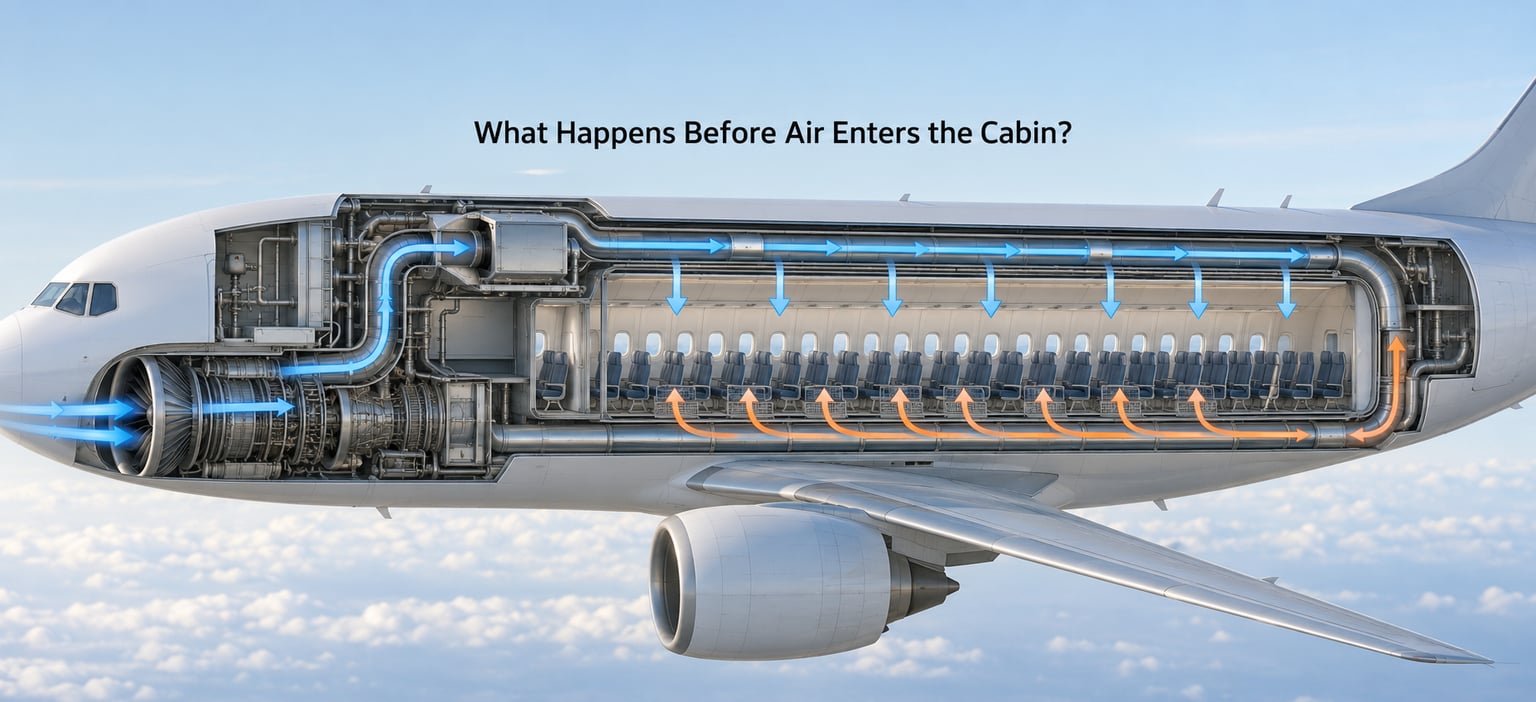
Cabin air starts as outside air, and there are two ways it gets aboard. On most jetliners the air is bled off the engine compressor, upstream of the turbines where the air is hottest and dirtiest. That bleed air is then cooled, and on some aircraft heated again, into the hundreds of degrees Fahrenheit. On a handful of designs, including some turboprops, a ram air intake scoops air directly through a cowl inlet instead.
The “sterile” description you hear applies to this stage. Bleed air is treated as free of the dust, pollen and microorganisms that live at ground level, because it arrives either compressed and very hot or scooped from clean upper-atmosphere air. That word is doing a lot of work in marketing and rather less in physics. Heat and pressure do not reliably destroy pollen proteins or other allergens, which is exactly why people with seasonal allergies can still have a reaction on an over-water flight where the ground pollen count is near zero. A 2019 thread on r/Allergies described repeatable symptoms starting 15 to 20 minutes into flights, and the poster’s own conclusion, that the filtered and unfiltered paths are not the same air, was correct.
Next comes the mixing step. Fresh outside air is blended with air pulled back out of the cabin, at roughly 60/40 in favour of outside air. On some aircraft the filter sits upstream of the mixing point, which means the outside portion travels through it as well. On others it sits downstream, so only recirculated cabin air passes through the HEPA section. Aircraft manuals describe both arrangements, so the exact split of what gets filtered varies by type.
Ground conditions change the picture too. While parked, most of the outside air comes from the auxiliary power unit running in the tail, which supplies air but not the same airflow rate as the engines in flight. That is the main reason cabin air feels warm and close at the gate and noticeably better once you are airborne. It is a change in source and volume, not a failure of the filters.
How Does HEPA Filtering Clean the Air?
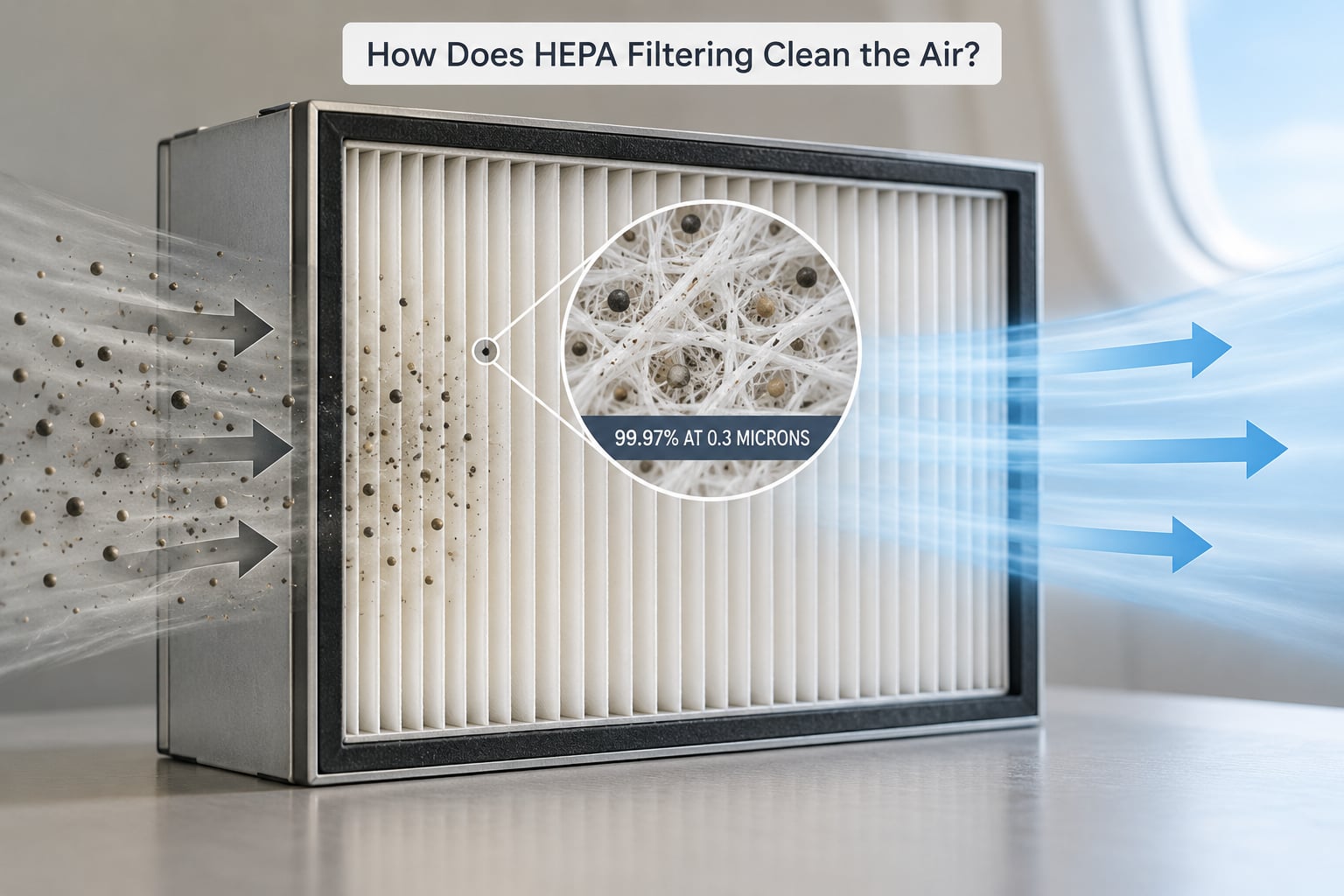
HEPA filters capture particles on a bed of very fine fibres, and they do it in three ways at once. Inertial impaction catches larger particles, roughly 10 microns and up, which cannot follow the curve of air bending around a fibre. Interception catches medium particles between about 1 and 10 microns that happen to travel straight into a fibre. Diffusion catches the smallest particles, those below 1 micron, which get jostled constantly by air molecules and wander into fibres by chance.
The famous efficiency figure, 99.97 percent, is measured at 0.3 microns. That is not because 0.3 micron particles are the most dangerous. It is the most penetrating particle size, the one that slips past the other two mechanisms most efficiently, so it is the conservative test point for a standard. The US convention is ASME, and the European classification is ISO 29463, which grades filters as H13 or H14 at the same particle size. Aircraft filters sit at the H13 or H14 end.
For scale, a human hair is roughly 70 microns across. A particle at 0.3 microns is about 230 times thinner.
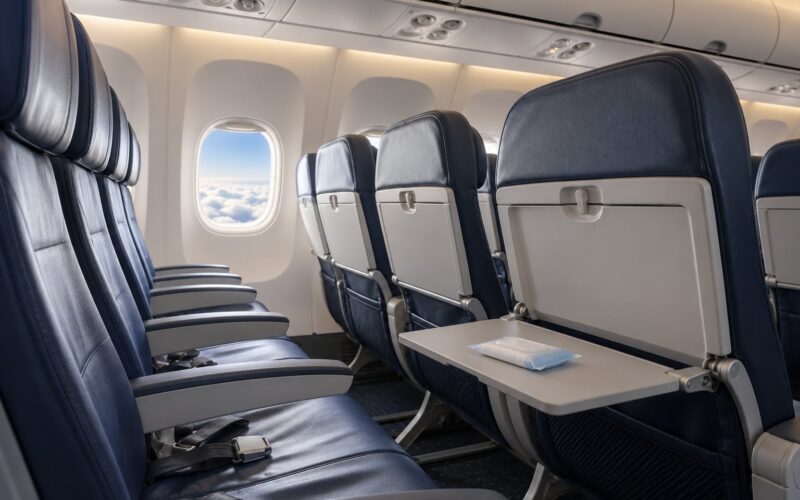
Here is the limit, and it matters. HEPA filtration removes particulate matter. It does not remove carbon dioxide, carbon monoxide, most gases, odours, or volatile organic compounds, and it does not sterilise the air. It also cannot filter anything that has already settled out of the air stream onto a tray table or a seat arm. Fresh air has to actually pass through the media to be cleaned by it.
How Airplane Cabin Air Filtration Works from Intake to Return Vents
Here is the full path in sequence, which is the clearest way to hold the whole system in your head:
- Outside air is drawn in through the engine bleed system, or through a ram air cowl inlet on some designs.
- It is conditioned, then mixed with air returning from the cabin in the mixing manifold.
- The mixed stream passes through the air conditioning packs, which cool it and control cabin pressure and temperature.
- The recirculated portion, and sometimes the outside portion too depending on the type, runs through the HEPA filter section in the recirculation ducting.
- Filtered air travels through ceiling ducts to the overhead outlets and drops into the cabin, typically at around 1 metre per second.
- Air returns through floor grilles and lower-wall sidewall vents near the seat rows, then recirculates or is exhausted.
The pattern in steps five and six is the part people rarely know. Supply comes from the ceiling and extraction happens low, near your feet, so the airflow runs top to bottom in a sheet. Almost none of it travels sideways between rows, which means the air you are breathing is largely the air that was just delivered directly above or beside your seat rather than air that has been travelling across the cabin from another passenger.
How Much Fresh Air Reaches the Cabin?
The cabin’s air is exchanged roughly every two to three minutes, which works out to somewhere around 20 to 30 air changes per hour. Those are typical figures rather than fixed ones. The rate shifts with aircraft type, cabin zone, phase of flight, pack settings and how many people are aboard, which is why two seats on the same aircraft can measure differently.
| Figure | Typical value | What it means |
|---|---|---|
| Air change rate | 20 to 30 per hour | Cabin volume exchanged every 2 to 3 minutes |
| Air split | About 60% outside, 40% recirculated | Recirculated portion is filtered; outside treatment varies by type |
| Filter efficiency | 99.97% at 0.3 microns | US ASME convention, the most penetrating particle size |
| Filter class | H13 or H14 | ISO 29463 grading used on aircraft |
| Supply velocity | About 1 m/s | Downward flow from overhead outlets |
| Filter location | Recirculation ducting | Either upstream or downstream of the outside-air mixing point |
| Change interval | Around 7,500 flight hours | Roughly one major check cycle to the next |
A useful cross-check is carbon dioxide. Because outside air is added continuously and CO2 is a gas that HEPA media cannot touch, cabin CO2 tracks the ventilation rate rather than the filter condition. It also rises with the number of occupants. It is one of the better indirect indicators of how much fresh air you are actually getting.
Does Cabin Air Filtration Remove Germs and Viruses?
Filtration reduces your exposure to airborne particles, including respiratory viruses, and the airflow pattern limits how far a droplet travels sideways. What it cannot do is stop you catching an infection. A 2018 modelling study of in-flight transmission found spread beyond two seats either side or one row fore and aft was unlikely under typical conditions. The counter-example is instructive: in a 2009 H3N2 case on a flight that sat on the ground for nearly two hours with ventilation effectively inoperative, transmission did occur.
That points at the real pattern. The window where ventilation is weakest is taxi, boarding and the terminal, not cruise. Filtration is a strong layer during the hours it is fully running. It is not a substitute for staying home when you are unwell, for vaccination, for hand hygiene around your face, or for the guidance your national public-health authority publishes for travel. If you are immunocompromised, pregnant, travelling with an infant too young to mask, or simply anxious about exposure, talk to your clinician about what is appropriate for your specific situation rather than treating any article, including this one, as medical advice.
It also helps to keep perspective on what gets through. The combination of rapid air exchange, HEPA-grade filtration and a top-down airflow pattern is why cabin air is routinely measured as comparable to or cleaner than the air in a modern office building. That is a genuinely strong result. It is simply not the same claim as protection from infection.
Why Do Airports and Aircraft Use Different Airflow Settings?
Airflow is turned up for takeoff and landing and trimmed back in cruise, mostly to manage noise, fuel use and temperature rather than filtration. Taxiing on the ground with only the auxiliary power unit running also means a lower supply rate. Cabin zones run at different settings, with forward and rear sections often on independent packs, and galleys and service areas draw differently from passenger rows.
This is why two sections of the same cabin can feel different, and why the same seat feels different on the same route depending on the day. It is normal behaviour for the system, not a sign that something has failed.
The personal overhead vent is separate from the cabin supply duct. It draws from the conditioned air already delivered to that row, so it gives you a local stream of the same filtered air at a slightly cooler temperature. Turning it does not change what the aircraft system does. The reasonable view is that a closed vent slightly reduces the local circulation around your face while an open one gives you a personal flow of air that keeps your skin and eyes comfortable and dilutes any smell in your immediate area.
What Can Passengers Do About Cabin Air?
Most of the cabin system is out of your hands. A few things within them are worth knowing.
- Prefer a seat near the aircraft door when the practical choice allows it. Air moves in from the outside at the doors and exits there too, so rows near a door see the freshest supply.
- Aim for a well-ventilated position rather than a warm one. Near an aisle or a galley there is more activity and more air movement than in a middle seat, though that cuts both ways for noise and smell.
- Use the overhead vent if dryness or warmth bothers you, and aim it away from your face if you find directed airflow irritating.
- Carry antihistamines or your usual allergy medication if pollen or dust triggers your symptoms. This matters because the filtered stream cleans recirculated air only; outside air entering the system is not fully deallergenised.
- Mask when you are symptomatic, and consider a well-fitting respirator if you are high risk and your clinician recommends it. Masks protect the wearer; the cabin filter protects everyone else.
- Do not expect a portable personal HEPA purifier to transform the cabin. Once the aircraft filtration is running, a small personal unit adds very little for a whole cabin. There are real drawbacks: noise, a dead battery by mid-flight, one more device to charge, and a sense of security that the science does not support. If you use one anyway, use it as a comfort measure, not a protective one.
Frequently Asked Questions
Do airplanes use HEPA filters for all cabin air?
No. Most large jetliners filter the recirculated portion of the cabin air, around 40 percent, and that air is also the part already inside the cabin. On many aircraft the filter sits upstream of the outside-air mixing point, so some outside air passes through it too, but on other types it sits downstream and does not. That difference is why a filter specification alone does not tell you exactly what you are breathing.
How often is the air inside an airplane completely replaced?
Typically every two to three minutes, which works out to about 20 to 30 air changes per hour. The exact figure varies by aircraft type, cabin zone and phase of flight, since supply rate rises during taxi and takeoff and drops slightly in cruise. Cabin carbon dioxide is a useful indirect measure of the real ventilation rate, because gases pass straight through HEPA media.
Can HEPA filters stop me from catching a virus on a flight?
No. They reduce exposure to airborne particles, and a 2018 modelling study found transmission beyond two seats either side or one row fore and aft was unlikely under normal conditions. They cannot make infection impossible, and they do nothing for the terminal and boarding window, when cabin airflow is at its lowest. Stay home when you are unwell, and follow current public-health guidance.
Should I use an airplane vent if I am worried about air quality?
It will not change the aircraft system. The overhead vent draws from the conditioned, filtered air already supplied to that row, so it delivers the same air at a slightly cooler temperature. It helps with dryness, warmth and any nearby odour. If directed airflow bothers your eyes or sinuses, aim it away from your face rather than shutting it, since a small flow around your head is generally more comfortable than still air.
Is the air cleaner in business class than in economy?
There is no separate filtration tier for premium cabins. The same supply ducts, packs and filters serve both, usually by zone rather than by class. The practical differences are volume of cabin per passenger and how many people are sharing that volume, so a smaller premium cabin with fewer occupants can feel fresher. In a full economy row next to a crowded galley, you will feel the difference for reasons that have nothing to do with filter quality.
What are the downsides of using a portable HEPA air purifier on a flight?
Noise, an extra battery to charge, one more thing to pack, and a false sense of security. Once the aircraft filtration system is at full rate, a small personal unit adds little to a whole cabin. Some units also reduce the airflow around you slightly if they draw air from the room rather than cleaning and returning it. Treat one as a comfort measure for your own bubble of air, not as protection against infection.
Bottom Line
Aircraft cabin air filtration is a mixing, cooling and filtering system rather than a purifying one. Fresh outside air is blended with filtered recirculated cabin air, the whole stream is pushed down from the ceiling and pulled out through floor grilles near your row, and roughly every two to three minutes the cabin volume is exchanged. That works well against particles, viruses included, and it is why cruise air measures better than most people expect.
The two things it cannot do are clear. It does not touch gases, odours or carbon dioxide, and it does not filter the unfiltered portion of the outside air, which is where pollen and other allergens survive. So the practical priority is simple: keep your own medication handy, use the vent if the air feels dry or warm, and put your effort into the terminal and the first hour after boarding, which is where the ventilation is weakest. If you are worried about your own health, ask your clinician rather than an article.