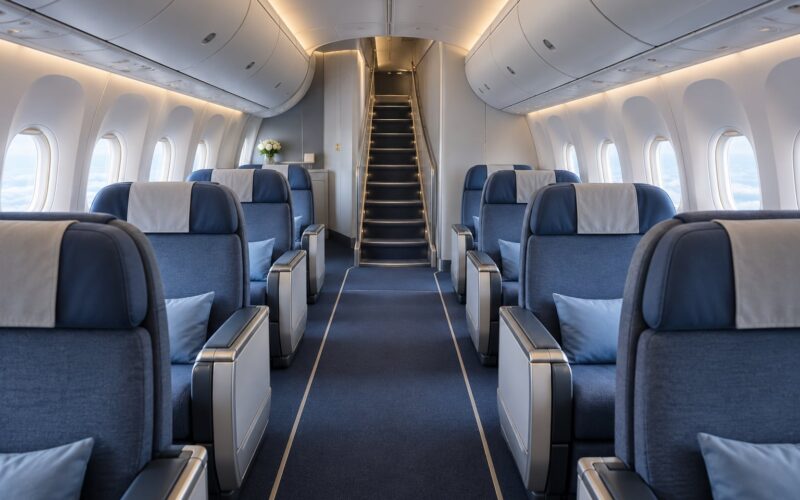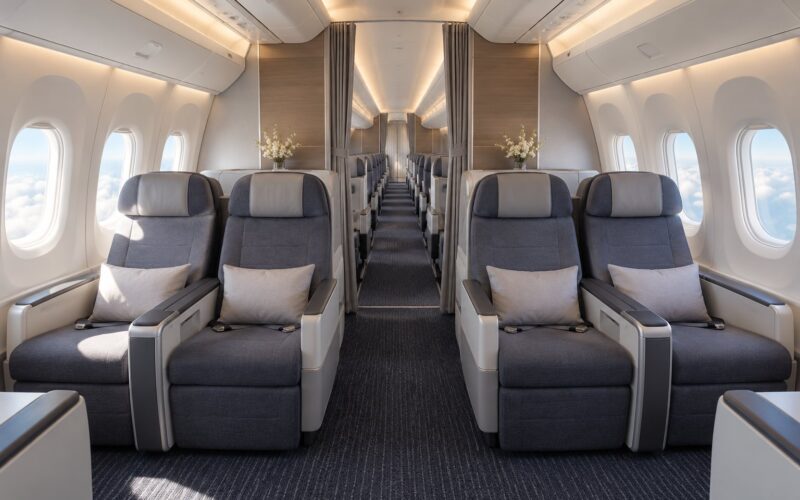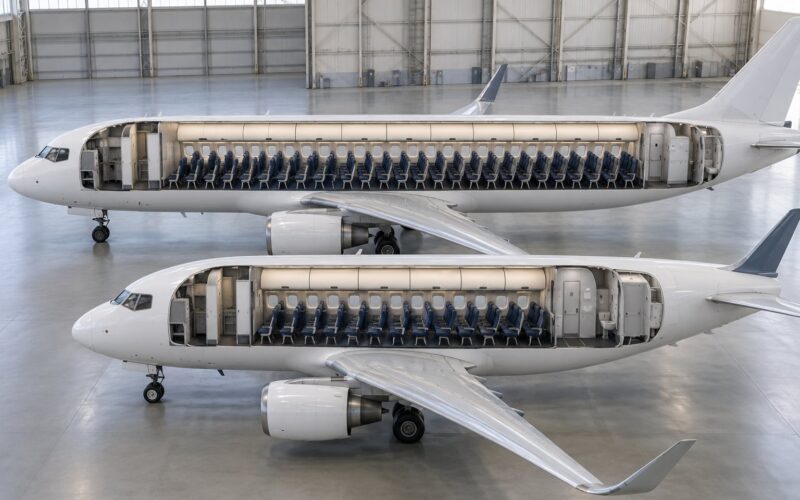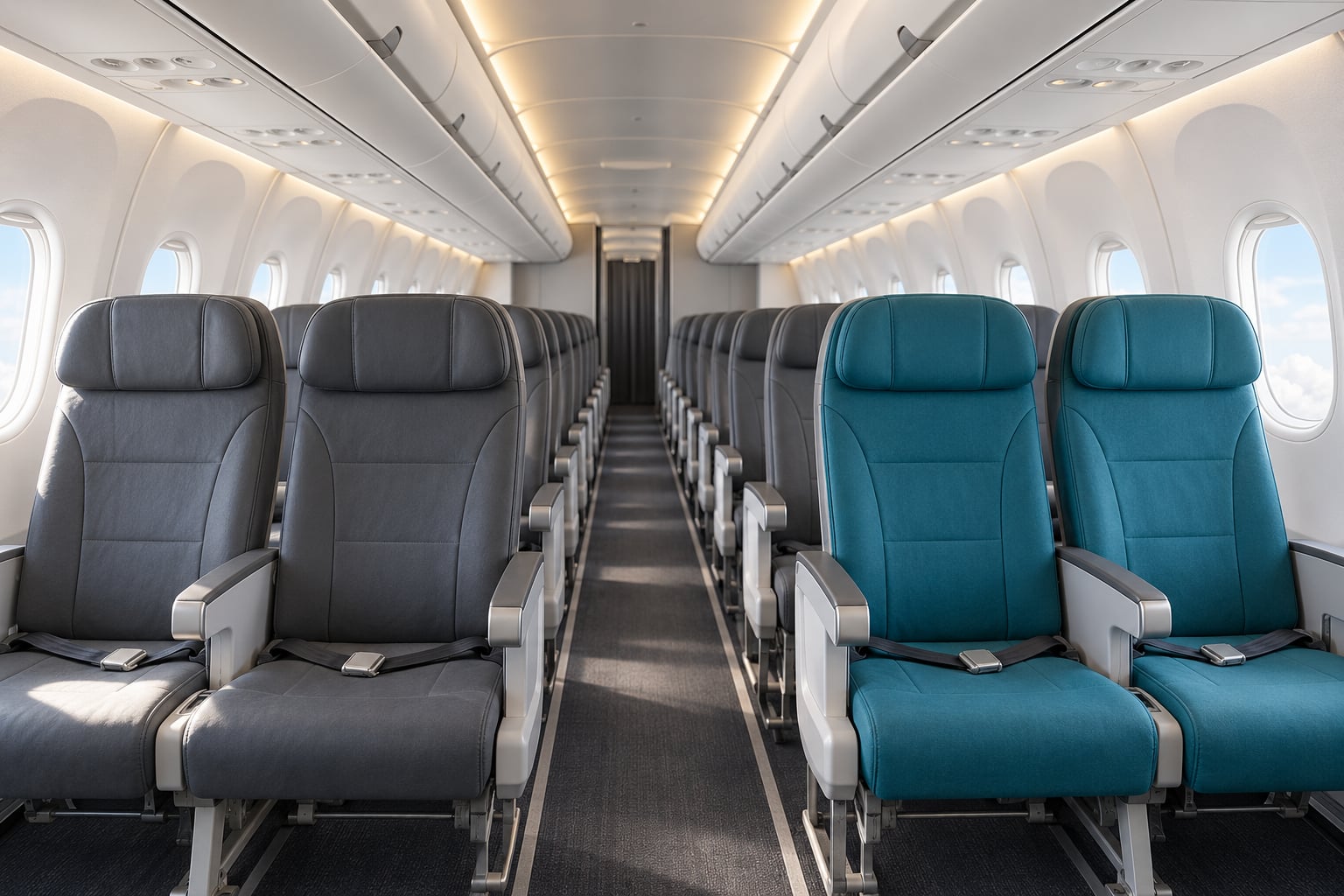
A 2-2 seat layout means two seats on each side of a single central aisle, so a row holds four seats and no one has to squeeze past anybody to get out. Every seat is either a window seat or an aisle seat.
That single fact changes how a short regional flight feels. Passengers on r/aviation and r/Flights point out the same thing repeatedly: in a 2-2 cabin there is no middle seat to fight over on a two-hour hop, and every passenger already has direct aisle access. The trade-off sits on the other side of the fuselage, where a 2-2 cabin means fewer seats per row than a 3-3 economy cabin can fit.
Here is a quick orientation before the detail.
Where you find 2-2
- Regional jets such as the Embraer E170, E175 and E190, and the Bombardier CRJ700 and CRJ900
- Turboprops like the ATR 72 and the Dash 8
- First class on single-aisle narrow-bodies, including 737 and A320 family aircraft
- Premium and business class products on narrow-bodies, where airlines give up seats to give everyone an aisle
- The 2-2-2 heritage layout still found in some wide-body first class cabins
Pros and cons in short
- Pros: no middle seat, direct aisle access for everyone, wider seats for the same cabin width, quieter cabin, usually more room for two than for three
- Cons: fewer seats per row, tighter overhead bins on small regional aircraft, slower boarding through a single aisle, and shared armrest space that makes the aisle seat feel narrower
Table of Contents
- What Is a 2-2 Airplane Seat Layout?
- How Does 2-2 Seating Work?
- Staggered vs. aligned seating
- 2-2 vs. 3-3 Airplane Seating
- Is a 2-2 layout better than a 3-3 economy cabin?
- How the other configuration codes decode
- Which Airplanes Use a 2-2 Seat Layout?
- What Does a 2-2 Layout Feel Like?
- Is a 2-2 Seat Layout More Comfortable?
- How to Choose the Best Seat in a 2-2 Cabin
- Frequently Asked Questions
- Does a 2-2 seat layout mean business class?
- Which plane has a 2-3-2 seat configuration?
- What is the 2-5-2 seat configuration on a plane?
- Why do airlines keep blocking middle seats instead of switching to 2-2?
- Does booking a 2-2 seat layout guarantee I avoid the middle seat?
- What does 2 2 mean for cars?
- Conclusion
What Is a 2-2 Airplane Seat Layout?
A 2-2 seat layout is a cabin configuration with two seats on the left of one central aisle and two on the right, giving four seats per row. It describes the arrangement either side of the aisle, so every passenger gets either a window or an aisle seat, and there is no middle seat anywhere in the cabin.
One caveat worth keeping in mind: the notation counts seats beside the aisle, not necessarily every seat in the row. On a small aircraft with no overwing exits, some 2-2 rows are short and seat only a handful of passengers. The term also describes the arrangement rather than the comfort level, so you will see it used for a budget turboprop row and for a lie-flat premium seat.
How Does 2-2 Seating Work?
Cabin configuration codes are read left to right, and each number counts the seats on one side of an aisle. In a 2-2, both numbers are two.
Window   A   B  | aisle |  C   D   Window
        2 seats  |  2 seats
Seats A and B sit on the port side, C and D on the starboard side. A is a window seat, B is the port aisle seat, C is the starboard aisle seat, and D is a window seat. That is the A-D lettering frequent flyers see on an E175 or CRJ900, and it is why there is no seat E or seat F in that cabin.
Contrast that with the 3-3 cabin you get on most 737 and A320 economy rows, where the letters run A B C on the port side and D E F on the starboard side. There, C and D sit in the middle and F is the right-hand window. Seeing letters stop at D is a fast visual cue that you are in a 2-2 cabin.
Staggered vs. aligned seating
Seats in a 2-2 cabin are either aligned in straight rows or staggered, where each seat sits slightly ahead of or behind the one beside it. Staggering exists because it gives the passenger behind a place to put their feet when the seat in front reclines. Regional jet cabins are usually aligned because the fuselage is narrow and the rows are tight, while premium 2-2 products on larger aircraft often stagger to soften the recline argument.
2-2 vs. 3-3 Airplane Seating
2-2 and 3-3 are the same idea applied to two different cabin widths. Both use one central aisle. The difference is how many seats crowd each side of it, and that cascades into width, privacy and how many rows the aircraft carries.
| Factor | 2-2 layout | 3-3 layout |
|---|---|---|
| Seats per row | 4 | 6 |
| Aisles | 1 | 1 |
| Middle seat | None | Two per row |
| Window seats per row | 2 | 2 |
| Aisle seats per row | 2 | 2 |
| Typical seat width | Wider, often 19 inches or more in premium cabins | Narrower, commonly around 17 to 18.5 inches in economy |
| Seat pitch | Usually deeper for the same cabin product | Tighter to fit extra rows |
| Privacy | Every seat is on an edge | Middle seats are boxed in on both sides |
| Total cabin seats | Fewer rows and seats overall | More seats, more rows |
| Where it appears | Regional jets, turboprops, narrow-body first class, premium narrow-body products | Mainline narrow-body economy and most low-cost carriers |
Is a 2-2 layout better than a 3-3 economy cabin?
On a short flight, almost always yes, and the reason is simple: 3-3 has six seats competing for the same width, so each one is narrower. In a 2-2 cabin nobody is ever asked to take the middle seat, which is the part passengers complain about most on a three-hour sector. The 3-3 cabin wins on capacity and on price, and on a long flight with a good seat product a properly spaced middle seat is survivable. Where 3-3 falls down is boarding speed on a full flight, because you load six bodies through one aisle instead of four.
How the other configuration codes decode
Once you know the rule, every code reads the same way. Here are the common ones.
| Code | Aisles | Seats per row | Typical use |
|---|---|---|---|
| 1-2-1 | 2 | 4 | Business and first class on wide-bodies |
| 2-2 | 1 | 4 | Regional jets, turboprops, narrow-body premium cabins |
| 2-2-2 | 2 | 6 | Older wide-body first class and some premium economy |
| 2-3-2 | 2 | 7 | Wide-body economy and business class |
| 2-4-2 | 2 | 8 | High-density wide-body economy |
| 2-5-2 | 2 | 9 | Very high density wide-body economy on some carriers |
| 3-3 | 1 | 6 | Narrow-body economy |
| 3-4-3 | 2 | 10 | Dense wide-body economy, including low-cost long-haul |
Notice the trade running through that table. Every extra aisle buys more seats per row and costs a cabin some width. A 2-3-2 fits seven people where a 2-2 fits four, and it needs two aisles to do it, which is exactly the reason airlines cannot simply convert narrow-body economy to 2-2 without giving up a lot of capacity.
Which Airplanes Use a 2-2 Seat Layout?
2-2 shows up wherever an operator wants four comfortable seats across a cabin that is too narrow for six.
- Regional jets. The Embraer E170, E175 and E190 and the Bombardier CRJ700 and CRJ900 are the classic cases. These aircraft are sized for thin regional routes, and a 2-2 economy cabin is how they keep seat width reasonable while still carrying enough passengers.
- Turboprops. The ATR 72 and the Dash 8 run short regional hops with a 2-2 cabin, sometimes with no seat-back screens at all.
- Narrow-body first class. On 737 and A320 family aircraft, airlines that offer a first class cabin usually put two seats on each side of the aisle, often with a blocked middle seat and a curtain rather than a full premium product.
- Premium narrow-body products. Business class on a single-aisle jet is frequently 2-2, because a lie-flat or recliner product needs width that a 3-seat row cannot offer.
- Wide-body heritage. The 2-2-2 arrangement on 777 and A340 aircraft gave passengers direct aisle access but left them climbing over their neighbours’ legs. Most of those cabins have since been rebuilt to 1-2-1.
On US domestic routes, Delta, United, American and jetBlue all put you in a 2-2 cabin at some point, most often on regional jet equipment out of a hub. International carriers use it in short-haul business class on narrow-bodies. Exact fittings change, so treat aircraft type as a guide rather than a guarantee and check the seat map for your flight.
What Does a 2-2 Layout Feel Like?
Stepping into a 2-2 regional jet feels roomier than the same narrow-body in a 3-3 cabin. The aisle feels wider because there is no seat-back structure pinching it, the armrests have room to fall into, and the cabin is quieter with two fewer conversations per row.
Two other things stand out. Boarding from the front is smoother because passengers do not shuffle past a middle seat, and deplaning at the back of the aircraft is faster for the same reason. Frequent flyers also point out that nobody has to ask for an aisle seat, because everybody already has one.
The less pleasant side is operational. Overhead bin space on a regional aircraft is tight enough that gate-checked carry-ons are common, and boarding through one aisle takes longer when the flight is full. On an aircraft with no overwing exit, a short cabin also means almost everyone shares the same row of overhead bins.
Then there is the armrest. In a 2-2 cabin the aisle seat and the window seat share one armrest, and a neighbour leaning into it genuinely makes the aisle seat feel narrower. That is the most common complaint in the forum threads about this layout, and it is unavoidable rather than a fault.
Is a 2-2 Seat Layout More Comfortable?
Comfort comes from the seat product and the cabin service, not from the notation by itself. A 2-2 regional jet economy row is still a narrow-body economy row with limited pitch, and it can be less comfortable than a well-spaced 3-3 cabin with good legroom and recline.
What the layout reliably delivers is width. When an airline sells you 2-2, it is committing to fewer seats sharing the same fuselage width, which usually shows up as a wider seat, a shallower recline that the passenger behind will not punish you for, or a seat that lies flat. Add privacy, a pillow and a meal, and you can end up with a product better than a dense 3-3 premium economy row.
So the answer depends on who is sitting there. A passenger who values getting up, stretching, or choosing the window over the aisle will like almost any 2-2 cabin. A passenger who only cares about arriving on a budget ticket may prefer the extra capacity and lower cost of a 3-3. Travellers with reduced mobility usually prefer a 2-2 as well, because an aisle seat in that layout has nobody to climb over.
One warning from the forums worth repeating: airlines blocking middle seats in a 3-3 cabin is not the same thing as a 2-2 cabin. You still have three seats across and a narrower seat, you just have an empty space beside you.
How to Choose the Best Seat in a 2-2 Cabin
Because every seat is on an edge, the choice comes down to window or aisle, which side of the aircraft, and which row.
- Pick the pair, not just the letter. Seat B comes with A, and C comes with D. Book B or C if you want to get up easily. Book A or D if the view is the point. Buying two seats together gives you the window and the aisle on the same side, which is usually the best available outcome in this cabin.
- Decide which side you prefer. On twin-engine aircraft the left side is quieter, and the right side gets sun. Pick the left on an early morning or late evening flight if noise bothers you.
- Avoid galley and lavatory rows. The rows directly ahead of and behind the galleys and the toilets deal with noise, smells and queues. Seat maps mark these, and they are worth crossing the aircraft for.
- Look at the engines, not the exit row. Rows just ahead of or behind the wing over the engine are loud on a climb. Bulkhead rows are quiet because nobody sits behind you, but the tray table and the seat in front of you do not move.
- Check the seat map before you book. Look up the aircraft type on the airline’s site or on a dedicated seat map database. If the letters stop at D, you are in a 2-2 cabin. If they run A to F, it is a 3-3 and the middle seats are C and D.
- Book early on the routes that fill up. Regional jets are small, and a preferred seat pair can disappear quickly on a weekday morning.
On a 2-2 regional flight, a bulkhead row in a quiet section near the front is close to the best seat the aircraft offers, and plenty of flyers ask for exactly that.
Frequently Asked Questions
Does a 2-2 seat layout mean business class?
No. A 2-2 layout describes the arrangement of seats either side of a single aisle, not the class of service. You will find it in regional jet economy, in narrow-body first class, and in business class on single-aisle aircraft. The cabin product, not the notation, tells you what you are getting.
Which plane has a 2-3-2 seat configuration?
Most twin-aisle wide-bodies use 2-3-2 in their main cabin. The Boeing 777, 787 and Airbus A330 are the classic examples, where two window seats sit outboard, three seats sit between the two aisles, and two more sit outboard on the other side. Boeing 777-300ER and 787-9 are the frequent answers in practice.
What is the 2-5-2 seat configuration on a plane?
A 2-5-2 configuration is a high-density wide-body economy cabin with two aisles and nine seats per row. Two seats sit at each wall and five sit between the aisles. Carriers that favour very high seat counts use it, and the middle five-abreast block is narrow, so most passengers book a window or aisle seat instead.
Why do airlines keep blocking middle seats instead of switching to 2-2?
Because it costs them far less. A 3-3 cabin carries six seats per row and a 2-2 carries four, so converting a whole economy cabin to 2-2 would mean removing a large share of the seats an airline is paid for. Blocking one middle seat narrows the gap for the remaining passengers without shrinking the cabin.
Does booking a 2-2 seat layout guarantee I avoid the middle seat?
Yes, in a genuine 2-2 cabin there is no middle seat at any row, so every seat is either a window or an aisle seat. You can confirm it before you book by checking the seat map: if the letters run A to D with one aisle, it is a 2-2. If they run A to F, it is a 3-3 with middle seats at C and D.
What does 2 2 mean for cars?
Unrelated to aircraft. In cars, a 2+2 or 2-seater-plus-2 is a body style with two seats in the front and two smaller seats in the rear, so four people travel in a two-door coupe or roadster. It is a common search term for this question because both notations are written the same way.
Conclusion
A 2-2 seat layout puts two seats on each side of one aisle, four per row, and no middle seat anywhere. Before you book, check the seat map for your exact flight: letters ending at D mean 2-2, letters running A to F mean a 3-3 cabin with middle seats at C and D.