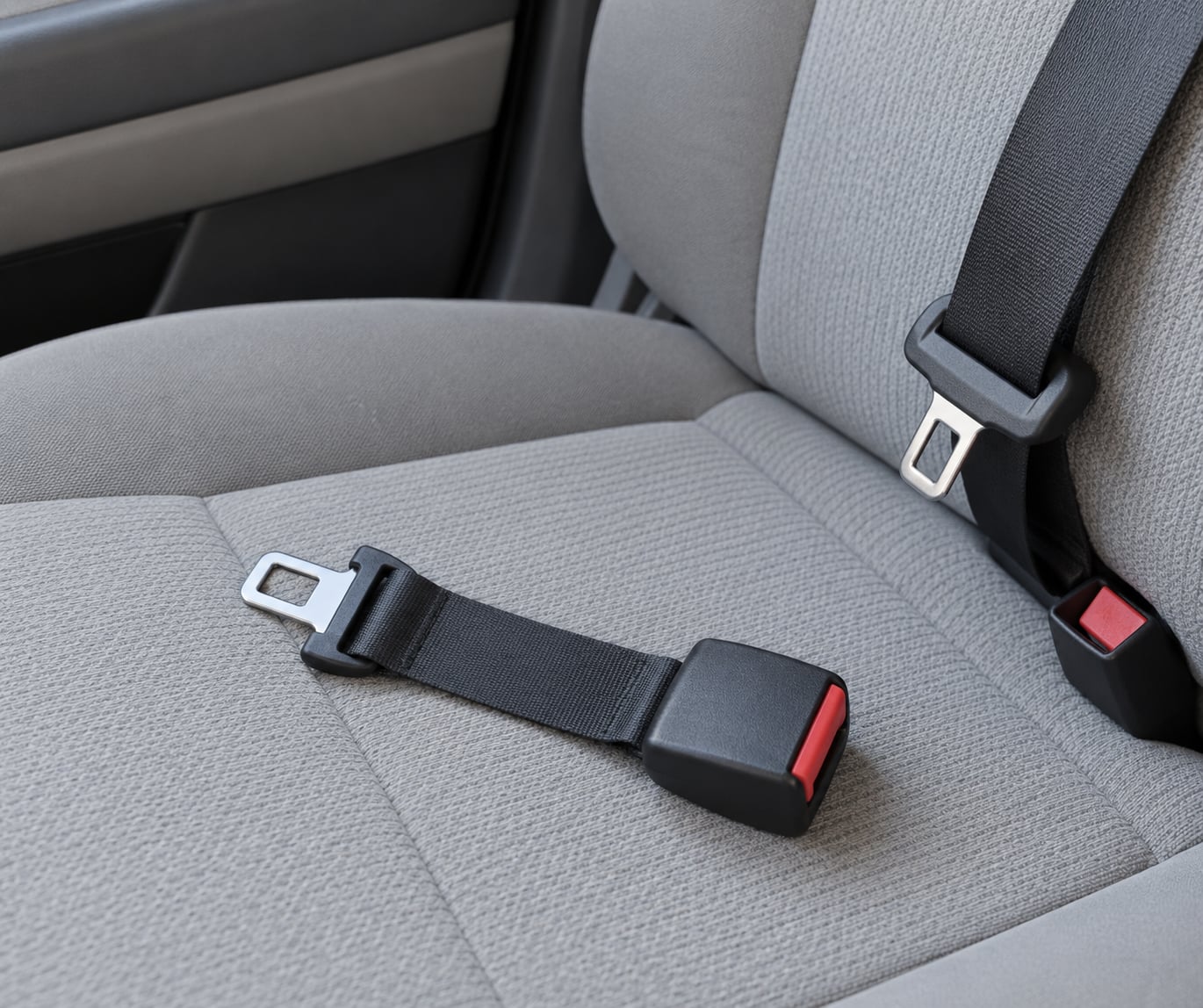
To use a seat belt extender, click the extender’s metal tongue into your vehicle’s existing buckle, then click your car belt’s own tongue into the extender’s buckle. That makes one continuous lengthened loop across your chest and hips. It takes about thirty seconds, needs no tools, and comes apart just as fast.
The catch is doing it in the right order, with a device that fits your buckle, and checking the result before you pull away. Get any of those wrong and you end up with slack webbing across your stomach, which is worse than a short belt.
Two things to clear up first. A seat belt extender is for adults and older children in vehicles, not for securing a child car seat or booster. And there are three different meanings floating around the phrase: a car extender you buy for your vehicle, an airplane extender you request from an airline, and a factory-installed seat belt extender built into some luxury cars. This guide covers the car device, with a section on flying at the end.
Table of Contents
- What You Need
- How to Use a Seat Belt Extender: Step-by-Step
- 1. Check That a Seat Belt Extender Is the Right Solution
- 2. Inspect the Seat Belt Extender and the Vehicle Belt
- 3. Park and Set Up the Vehicle Safely
- 4. Attach the Extender to the Correct Belt Point
- 5. Buckle and Route the Seat Belt Normally
- 6. Check the Fit and Retest Before Driving
- Common Mistakes
- The Same Term on a Plane
- Frequently Asked Questions
- Are seat belt extenders legal for adults?
- How do I know which seat belt extender fits my car?
- Can I use a seat belt extender while pregnant?
- What is the difference between a seat belt extender and a child booster?
- What should I do if the seat belt will not tighten with the extender attached?
- Can I reuse a seat belt extender after a car crash?
- Conclusion
What You Need
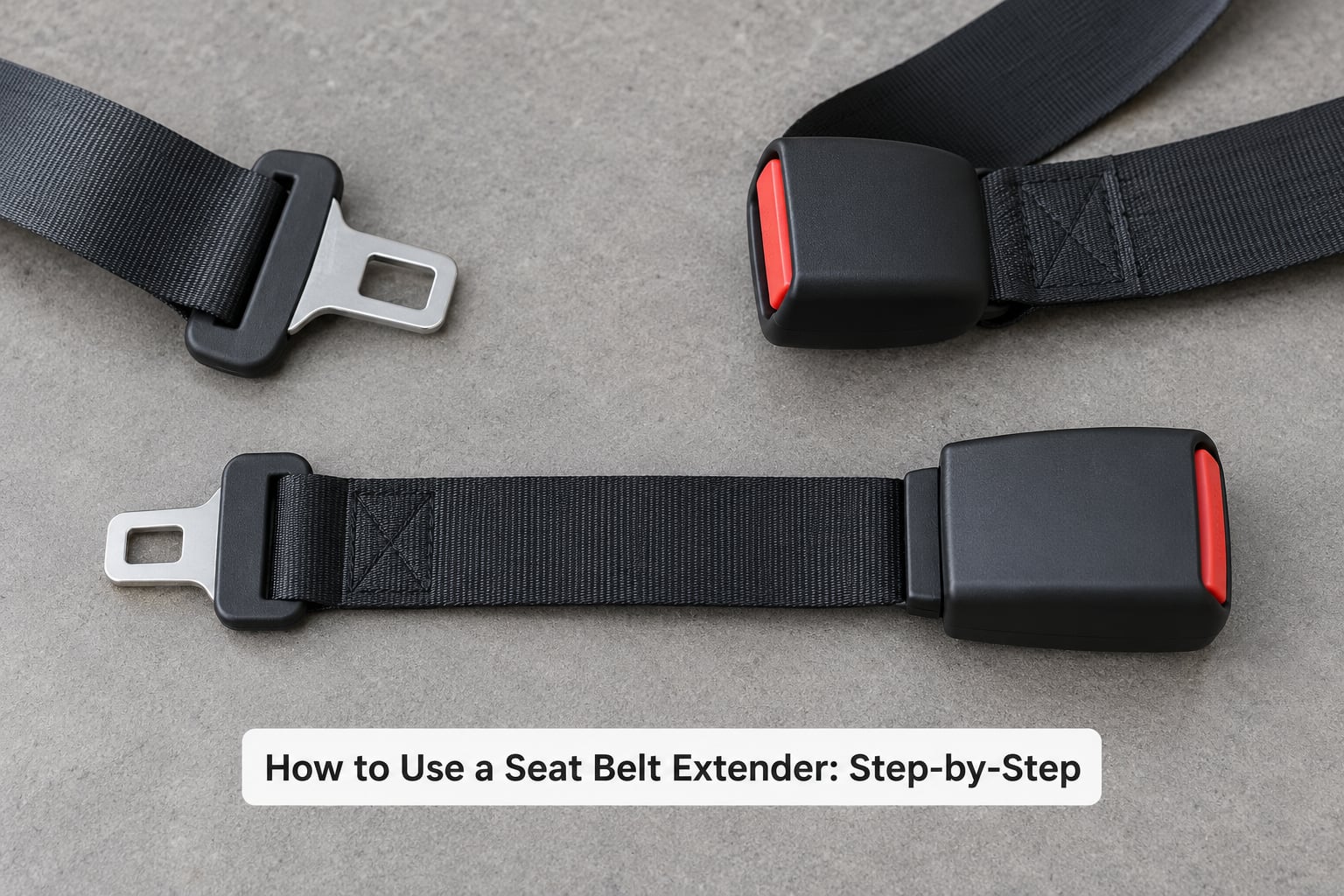
A seat belt extender is a short auxiliary strap with a metal tongue on one end and a buckle receptacle on the other. It does not replace your belt. It splices into the belt you already have, adding roughly six to fifteen inches of length depending on the model.
Four parts matter when you pick one up. The metal tongue plugs into your car’s buckle. The buckle receptacle receives your car’s own tongue. The webbing between them is what adds the length. Some models also have a small adjuster that shortens the loop once the extra length is in place.
Who actually benefits? Adults and older children whose factory belt will not reach across the shoulder and hips. That includes plus-size adults, tall or long-torso drivers, pregnant passengers, older adults with limited shoulder reach, and anyone in an RV, a lifted truck, or a high-backed seat where the belt falls short. People in the middle seat of a smaller car often run into the same problem.
What it is not for: infants, toddlers, or any child still using a car seat or booster seat. Never use an extender with a child restraint. The restraint has its own certified installation method, and an extender changes the geometry of the belt in ways the restraint was never tested for. A qualified child passenger safety technician can sort out a proper fit.
Before you buy anything, check your vehicle owner’s manual for the manufacturer’s guidance and look up your local rules. Requirements differ by state and by country, and a belt that is too short for you may be a design point rather than a fault. If your seat has been modified, or the belt webbing has been cut or re-routed by a previous owner, talk to the manufacturer or a qualified repair professional rather than working around it.
How to Use a Seat Belt Extender: Step-by-Step
1. Check That a Seat Belt Extender Is the Right Solution
Two quick checks tell you whether you need one. Sit in your normal driving or passenger position with the belt buckled, then slide two fingers between the shoulder belt and your collarbone. If you cannot, the belt is too tight. Next, look at the lap portion in a mirror. It should sit low on the hip bones, roughly level from one hip to the other, not across your stomach.
If the shoulder belt rides up onto your neck or the lap belt sits on your abdomen, the belt is not restraining you where it was designed to. That is the case an extender solves.
It is not the solution if the belt is frayed, cracked, torn, or does not retract. No device makes a damaged belt safe. Nor is it the answer if the buckle is stuck, or if the webbing has been spliced, shortened, or routed around a seat modification. Get the belt repaired or replaced first.
2. Inspect the Seat Belt Extender and the Vehicle Belt
Look at the approval marking on the extender’s label before anything else. E4 and E8 marks, with an ECE R16 reference, mean the device has been tested against the UN regulation covering restraint systems and seat belt assemblies. That marking is the single most-repeated trust signal in owner discussions, and it is the one worth checking.
Run your fingers along the webbing. Look for fraying, cuts, flattened or glossy spots, or stitching that has pulled apart. Check the metal tongue and the buckle receptacle for bends, gouges, corrosion, or a ratchet that feels loose. A spring-loaded latch should click firmly into your car’s buckle without being forced.
Confirm the device matches your vehicle. Extenders are usually made for a specific make and model because buckle geometry, anchor placement, and retractor travel differ from one vehicle to another. A generic universal-fit extender that does not click cleanly into your buckle is not a pass. Tesla and some Japanese domestic model owners report larger, deeper buckles than expected, so check the fit before you rely on it.
On length, shorter is better. Owners of vehicles with unusually deep buckles often advise the short rigid model over a long flexible strap, because extra length lets the buckle end up sitting on your lap instead of at your hip.
3. Park and Set Up the Vehicle Safely
Park on level ground, in park, with the parking brake set, before you work. Sit in the seat the way you will actually ride in it, then move it forward until your back is against the seat back and your knees are bent comfortably. Adjust the seat back and the belt’s height adjuster on the door pillar now rather than after the extender is on.
Give yourself room to work. If you have to twist hard to reach the buckle, you will introduce a twist into the webbing, and a twisted belt can pull the shoulder section off your shoulder.
4. Attach the Extender to the Correct Belt Point
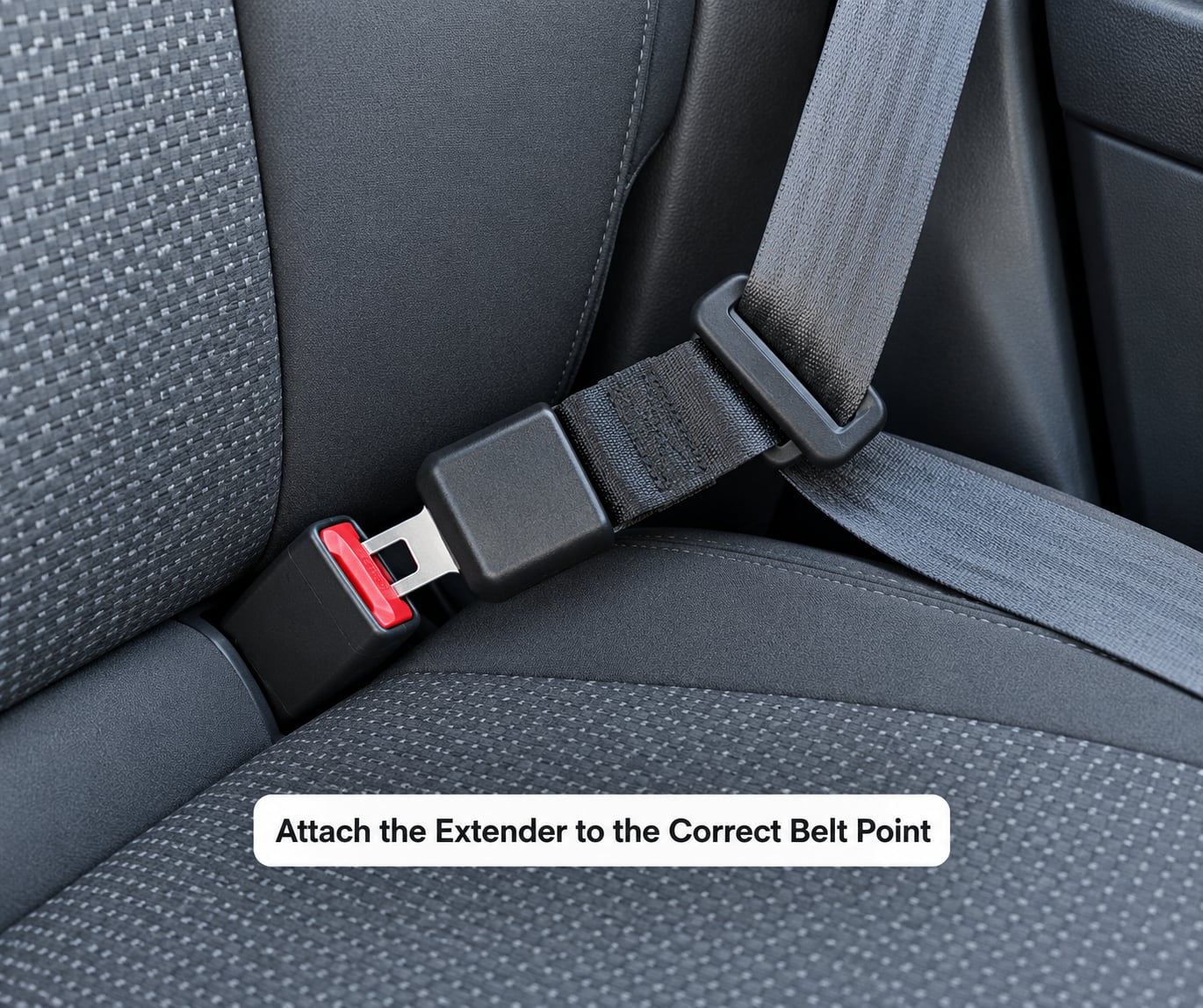
Reach down and press the extender’s metal tongue into your vehicle’s existing buckle until it clicks. That is click one. This is the latch point the manufacturer designed the system around. Do not improvise an anchor point, hook the extender onto a headrest post, or thread it through a seat gap. That was never part of the design.
Then take the metal tongue on your vehicle’s own belt and click it into the extender’s buckle receptacle. That is click two. The two clicks are the whole installation. Each piece has to be fully seated, and you should be able to pull the assembly snug without any part feeling loose.
Note which car the extender came from. Extenders are not transferable between vehicles, and the buckle on your passenger side may sit at a different height and angle than the one you just tested.
5. Buckle and Route the Seat Belt Normally
The belt still routes the way the vehicle designer intended. Shoulder section across your chest and collarbone, lap section low across the hip bones, buckle on the side you normally use. Do not thread the vehicle belt through the extender’s webbing, and do not route it around the extender’s body. The extender sits inline, not around the strap.
Pull the free end of the shoulder belt until the slack is gone. The assembly should feel snug, with your weight pulling the lap section down onto your hips. If the extender has its own adjuster, use it to take up the extra length rather than leaving a loop of loose strap hanging.
Use the shortest workable length. Every extra inch of extension moves the buckle further from its anchor point, and too much length can let you slide forward during hard braking.
Worth saying plainly: the safety case for extenders is genuinely debated. Some owners point out that a vehicle’s restraint system was not engineered with an extender in mind, and they are not wrong to raise it. The counter-argument is that a certified extender restores the chest-and-hip placement the belt was designed for, while an out-of-position belt does little. Both positions are reasonable, and neither one argues for skipping the belt.
6. Check the Fit and Retest Before Driving
With everything clicked in, move your hips forward slightly. The lap belt should stay low on your hip bones and the shoulder belt should stay on your collarbone, not slip toward your arm. If the belt slides back into place after you move, the fit is right.
Then check the retractor. Let the belt out slowly and confirm it draws back in cleanly without the extender catching on anything, the webbing chafing on the buckle stem, or the latch riding on the extender’s edge. Listen for the click, then tug firmly on the shoulder section. A real latch does not release under a hard pull.
Repeat this check whenever your seating position changes, whenever you move to a different seat, and every time you get into a different vehicle. Two clicks take thirty seconds. A belt that was snug on the drive to work is not automatically snug on the drive back.
Common Mistakes
Leaving slack in the loop. The most common fault, and the easiest to fix. Pull the free end of the belt until the assembly sits snug, and use the extender’s adjuster if it has one. Slack across the stomach is where the belt does nothing for you.
Twisting the webbing. A twist can throw the shoulder section off your shoulder in a crash. Undo the clicks and start again if anything is crossed, and give yourself room to work before you attach it.
Clipping onto something other than the latch point. Only your vehicle’s buckle counts. Headrest posts, seat rails, and seat gaps are not anchors, and an extender hooked to one is not a restraint.
Using a universal-fit extender that does not latch cleanly. If the tongue needs forcing or sits loose in the receptacle, stop. Get a device matched to your make and model.
Using the longest extender you can find. Longer is not safer. A rigid, short device keeps the buckle close to your hip; a long flexible one lets it drift onto your lap. Pick the shortest length that makes the belt reach.
Using it with a child car seat or booster. Never. The restraint has its own certified fit, and the belt geometry changes underneath it. If a child cannot buckle properly, have a certified child passenger safety technician check the installation.
Ignoring damage or a recall. A cracked buckle housing, a bent tongue, or frayed webbing ends the service life of the device. Manufacturers issue recalls on safety equipment, and it is worth searching the model or brand before you fit a used one.
Driving with a damaged factory belt. An extender cannot rescue a belt that is torn or will not retract. Repair or replace the belt first.
To remove it, unclip both connections in any order, pull the extender free, and stow it where it will not tangle or take a load in the boot. Keeping it with the vehicle documents makes it easier to check the fit next time, and a soft pouch stops the buckle receptacle picking up grit in a work bag.
The Same Term on a Plane
Airlines use the phrase for something else entirely, and it is worth separating the two so nobody buys a car device for a flight. On an aircraft, “seat belt extender” usually means a harness-style belt you request from a flight attendant for a child who cannot use the standard lap belt on their own, generally on a longer or wider seat such as a bulkhead row or a seat with a bassinet or lie-flat option. The crew fits it, it stays with the seat rather than with you, and you return it before landing. A purchased car extender is not an aviation-certified harness, is not sized for a cabin seat, and should not be used in one. If you need one, ask the cabin crew after boarding, ideally at the gate, since availability depends on the aircraft and the seat you are booked in.
Frequently Asked Questions
Are seat belt extenders legal for adults?
There is no single national answer in the US, and rules differ by state and country. An extender does not replace a certified factory belt, so you still wear the belt itself, and your state may require it to meet federal standards. Check your state’s vehicle code and your insurer’s guidance before relying on one, and keep the E4 or E8 marking with ECE R16 on the device as proof of testing.
How do I know which seat belt extender fits my car?
Match the extender to your make, model, and model year, and confirm the buckle side. Extenders are usually built for one vehicle because buckle geometry, anchor position, and retractor travel differ. Check for an E4 or E8 approval marking with an ECE R16 reference, then test that the tongue clicks firmly into your buckle without being forced. A universal-fit listing that clicks loosely is not a fit.
Can I use a seat belt extender while pregnant?
An extender is commonly used during pregnancy because the growing abdomen can leave the lap belt riding above the hip bones and the shoulder belt uncomfortable. Position the lap section as low on the hips as it will go, under the abdomen, with the shoulder section across your chest, and use the shortest length that gives a snug fit. Your clinician or midwife can advise further, and a badly fitted belt is worth having checked.
What is the difference between a seat belt extender and a child booster?
They do completely different jobs. An extender lengthens an existing adult belt for an adult or older child who cannot reach it. A booster seat raises a child so the vehicle’s lap and shoulder belt fits them properly, and it is a child restraint with its own weight limits, fit requirements, and installation rules. Never use an extender with a car seat or booster seat.
What should I do if the seat belt will not tighten with the extender attached?
Stop driving and undo the clicks rather than working around it. Common causes are an extra loop of slack left in the assembly, a threaded or twisted webbing path, a belt that does not retract properly, or an extender whose length is far longer than you need. Retest with a shorter device, and if the factory retractor still will not pull the belt in, have the vehicle belt inspected.
Can I reuse a seat belt extender after a car crash?
Treat any extender that was worn, loaded, or present during a crash as damaged, even if it looks fine. Belt hardware can deform in ways that are not visible, and the webbing can be stretched past its useful length. Replace it rather than reusing it, and check your vehicle’s own belts and buckles at the same time, since those took the same impact.
Conclusion
Start by confirming the device is the right answer: the factory belt itself should be undamaged and in normal working order, and it should be reach that is the problem rather than a fault or a seat modification. From there, inspect the extender and the belt together, check for an E4 or E8 marking with an ECE R16 reference, and follow the manufacturer’s instructions exactly.
Then fit it the way it works, one click into the factory buckle and one click into the extender. Keep the lap belt low on your hips, the shoulder belt on your collarbone, and the assembly snug with no slack. Thirty seconds of checking is the difference between a belt that helps you and a belt that rides above your stomach.