Short answer up front: the CRJ 700 and CRJ 900 share the same 2.55 m (8 ft 4 in) cabin width and the same 2-2 seat module, so CRJ 700 vs CRJ 900 cabin differences come almost entirely from length. The 900 is roughly 3.7 m (12 ft) longer, adds about 12 seats, a second forward lavatory, and sits about two inches lower at the floor. Nothing about the seat itself gets bigger.
That one fact changes how you should read every other spec. When an airline sells you a “bigger” regional jet, it sold you more rows and an extra bathroom, not more elbow room.
I have flown both types often enough to know which complaints belong to which jet, and most of them are about length, not width. Below is the breakdown, followed by how to pick your seat on either one.
Table of Contents
- CRJ 700 vs CRJ 900 Cabin Differences at a Glance
- How Cabin Size and Seating Differ
- What the extra length adds
- Aircraft substitution is normal
- Legroom and Seat Comfort
- Legroom and seat comfort on the CRJ 700 vs CRJ 900
- Which rows give you the most space
- Rows regulars avoid
- Windows, Ceiling Height, and Cabin Width
- Storage, Overhead Bins, and Carry-On Space
- Lavatories, Galleys, and Passenger Amenities
- Noise, Vibration, and the Feeling of Comfort
- Which CRJ Should You Choose?
- What to check before you book
- Frequently Asked Questions
- Is the CRJ 900 always more comfortable than the CRJ 700?
- Does the CRJ 900 have more legroom than the CRJ 700?
- Which CRJ aircraft has more windows and a roomier cabin?
- Are CRJ 700 and CRJ 900 cabins equally quiet?
- Which aircraft is better for a long flight or a family trip?
- How can I confirm whether my flight uses a CRJ 700 or CRJ 900?
- Conclusion
CRJ 700 vs CRJ 900 Cabin Differences at a Glance
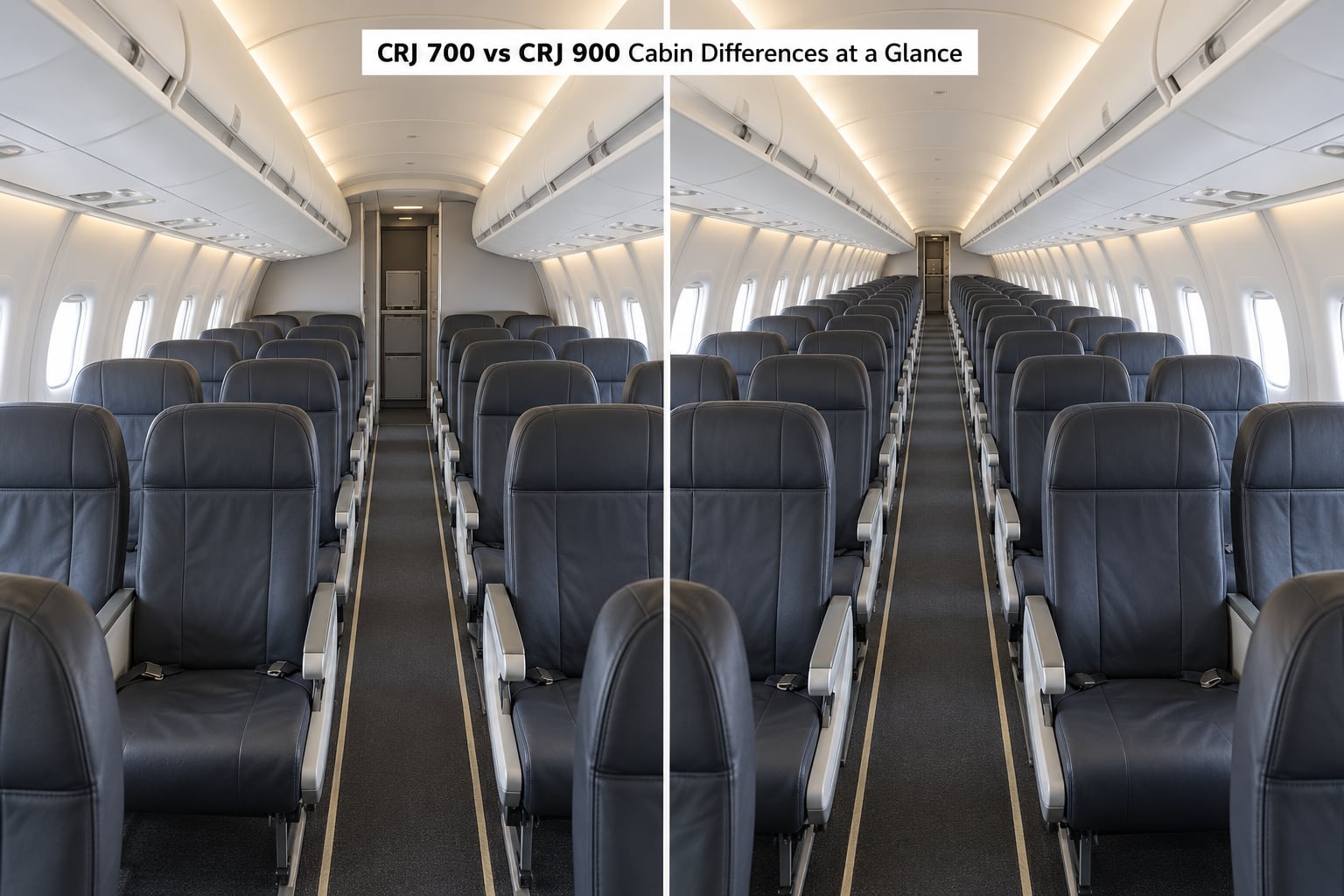
The CRJ 700 is the shorter of the pair, usually carrying 65 to 78 passengers. The CRJ 900 is the stretched version, usually carrying 76 to 90. Both seat four abreast in a 2-2 arrangement with a centre aisle, both have the same cabin width, and both use the same seat module. Airline configuration is where the real differences show up, so treat any number below as a range rather than a promise.
| Feature | CRJ 700 | CRJ 900 | What it means for you |
|---|---|---|---|
| Overall length | About 36.2 m (118 ft 10 in) | About 3.7 m (12 ft) longer | More rows, more walking past strangers |
| Cabin width | 2.55 m (8 ft 4 in) | 2.55 m (8 ft 4 in) | Identical. No width advantage on either jet |
| Typical seating | 65 to 78 seats | 76 to 90 seats | The 900 has roughly 12 more rows of people |
| Maximum seating | 78 seats | 90 seats | Dense layouts are only used on the longest sectors |
| Seating layout | 2-2, four-abreast | 2-2, four-abreast | Aisle or window only, never a middle seat |
| Lavatories | One forward | Two forward | Half the queue on the 900 |
| Cabin floor | Standard height | Roughly two inches lower | Slightly better downward view from a window seat |
| Cabin height | About 6 ft 2 in at the centre | About 6 ft 2 in at the centre | Low ceiling, low window line on both |
| Engines | GE CF34-8C5 | GE CF34-8C5 | Same noise signature, same rear mounting |
| Max takeoff weight | Baseline | About 5.3 t (16%) higher | Carries more people, or people and more fuel |
| Range variants | Standard published range slightly higher in some databases | ER and LR stretch to about 1,800 nm | The 900 covers the longer regional sectors |
One caution on range figures. Some databases publish a higher range number for the CRJ 700 than for the standard CRJ 900, which looks strange until you account for the ER and LR variants of the 900 that stretch to roughly 1,800 nautical miles. Version numbers and variant names matter more here than model names do.
How Cabin Size and Seating Differ
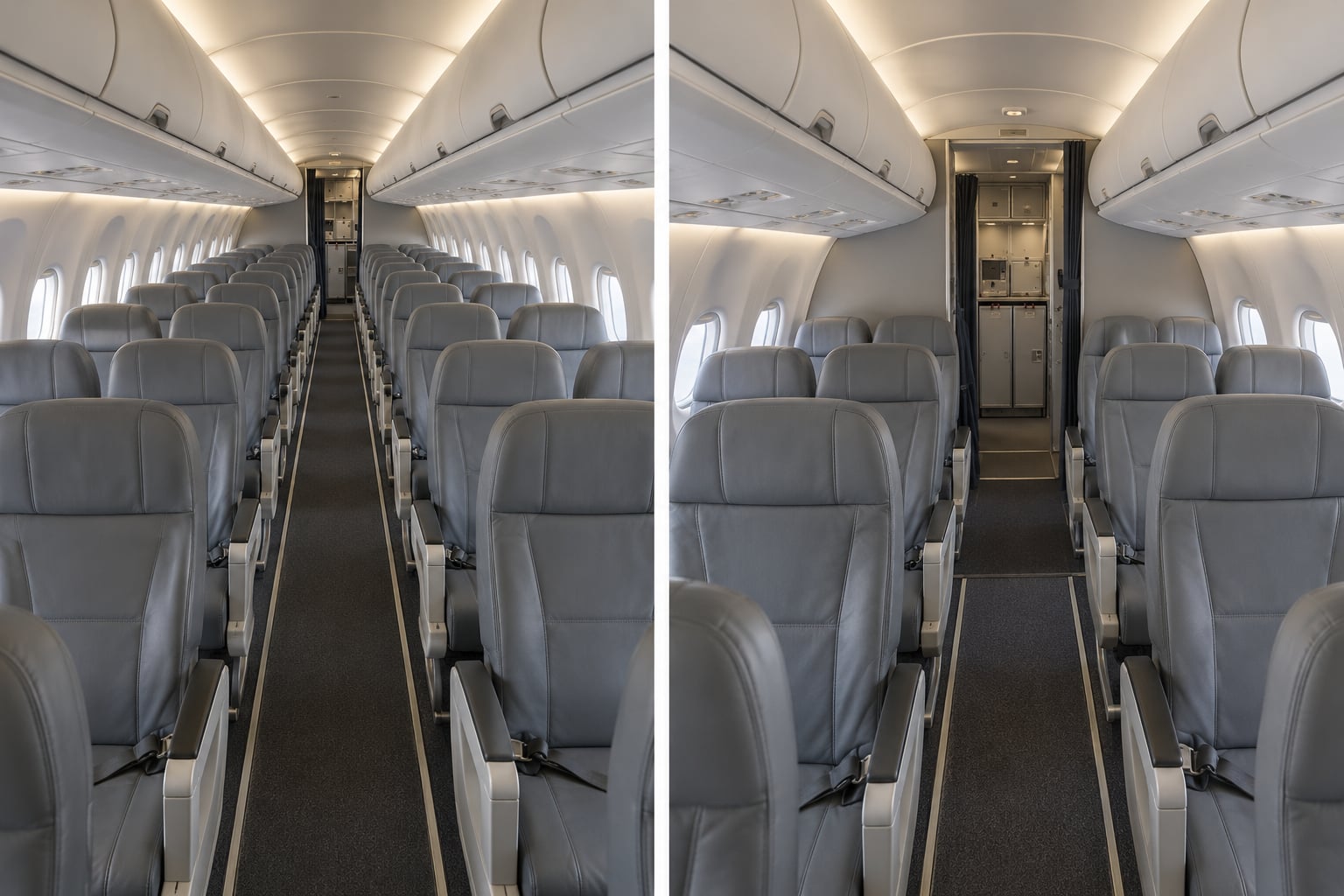
The CRJ 900 is the CRJ 700 stretched by 3.7 m, and the extra length comes from fuselage plugs placed fore and aft of the wing. That is why the cabin cross-section looks the same but the floor plan looks longer.
Both jets use the same 2-2 four-abreast seating module. Two seats on each side of a single centre aisle, no middle seat, no third seat to squeeze past. Passengers frequently ask what the cabin layout of a CRJ actually looks like, and the honest answer is that it is the arrangement most people picture when they think “old regional jet.”
What the extra length adds
On a 900 you get roughly 12 more seats, one additional row at the front in many configurations, and a second forward lavatory. Airlines fill those extra seats in whatever mix they sell. American’s three-class 900 layout runs 12 First, 24 Main Cabin Extra and 40 Main Cabin for 76 seats, while Delta runs 12 Business, 20 Premium Economy and 44 Economy for the same 76.
On a 700 the same airlines typically drop a row or two and either shrink the premium cabin or fly an all-economy layout. The 700 is therefore the jet most often used on thinner routes where the airline would rather not sell a premium cabin at all.
Aircraft substitution is normal
A booking on a 900 can be flown on a 700, or the reverse, and it is not always flagged clearly. Forum threads on the American Airlines CRJ seating guide are full of this, and the standard advice there is to check the seat map a couple of days before departure rather than trusting what you saw when you booked. If a wider-bodied mainline flight was your plan, a swap down to a 700 changes the trip more than any other factor in this article.
Legroom and Seat Comfort
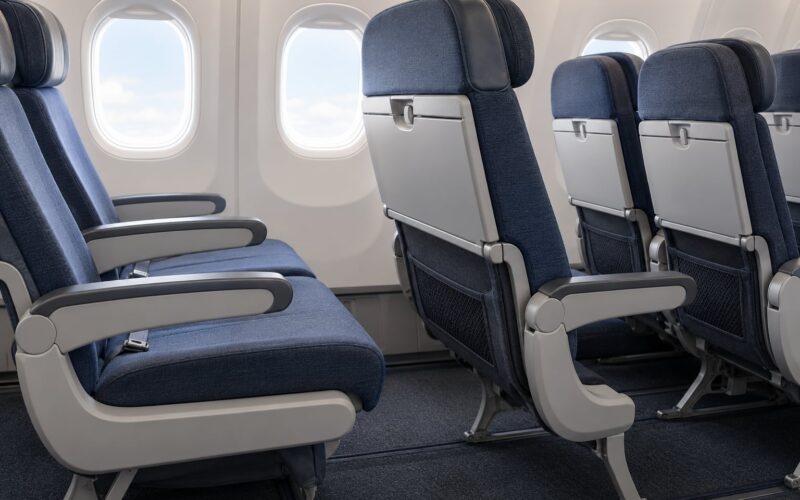
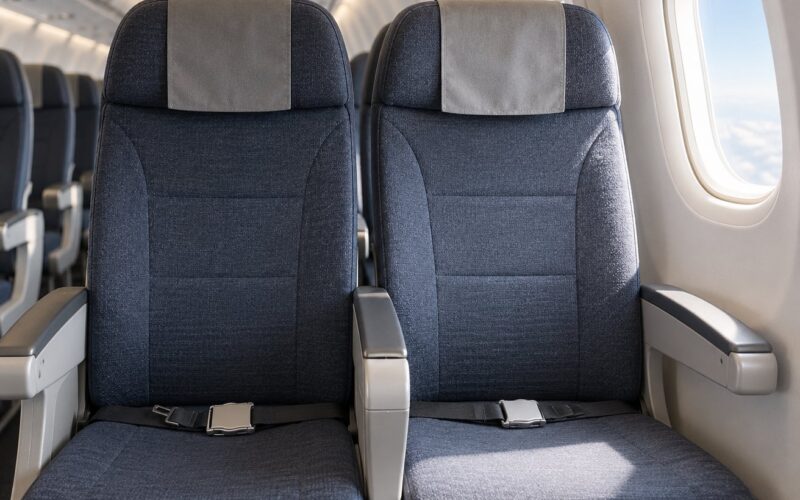
Here is the part that surprises most people. The seat is the same on both aircraft. Seat width, cushion shape, pitch in the main cabin, recline and tray table are identical parts. That means any real legroom difference between the CRJ 700 and CRJ 900 comes from which rows exist, not from how those rows are built.
Legroom and seat comfort on the CRJ 700 vs CRJ 900
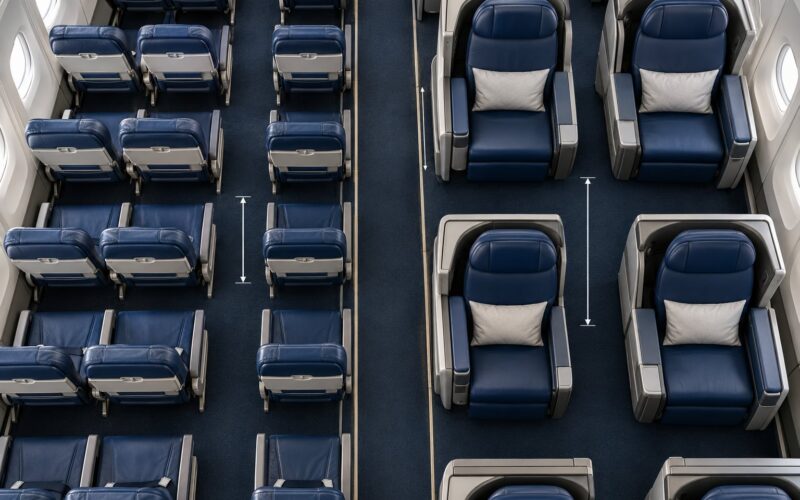
Typical main cabin pitch sits around 31 inches, with Main Cabin Extra at roughly 34 inches on American’s 900. First Class on that aircraft is quoted at about 19.7 inches wide with 37 to 38 inches of pitch. Compare those numbers to a mainline narrowbody and you will see immediately why a regional jet feels tight: a standard mainline economy seat is wider than anything in a regional cabin.
What varies is where the good rows land. Because the 900 has more rows, it more often carries a bulkhead row at the front and a proper exit row. Both of those trade-offs are identical between the two jets.
Which rows give you the most space
Bulkhead rows give you a seat that reclines fully and a tray table that folds away, since there is no seat in front to catch it. The cost is no underseat storage and a bassinet fitting taking up part of the space on some aircraft.
Exit rows give you several extra inches of pitch, which matters most on a longer sector. The catch is the seat cushion itself, which is noticeably smaller. FlyerTalk’s American Airlines CRJ700 and CRJ900 seating guide describes the trade-off plainly: a little more legroom, a smaller cushion. On a two-hour hop most people take the cushion.
Preferred and front rows are the compromise, usually one or two extra inches of pitch without the small-cushion penalty. They cost a little more or require status, and on the 700 they are rarer simply because the plane is shorter.
Rows regulars avoid
On Delta’s CRJ900, travelers in r/delta recommend avoiding row 5 and favouring row 7. Row 5 is the row immediately behind the added structure around the lavatory and galley area, and it is narrower. That narrowness shows up on both aircraft types whenever a galley or lavatory curve is nearby.
One more thing from those same threads: CRJ900s on American often carry a “4C” seat, a fourth seat position that can be sold at the last minute. If you booked a window or aisle seat and find a 4C beside you on departure, that is what happened. Frequent flyers who value predictability tend to prefer the 700, where there are fewer rows and fewer chances for a last-minute seat to appear next to them.
Windows, Ceiling Height, and Cabin Width
The 900 has more windows than the 700 because it is longer, roughly in proportion to the added rows. That is the whole width-and-light difference: more of the same window, not a bigger window.
The more important detail for comfort is height. Both cabins sit at roughly 6 ft 2 in at the centre line, and the window line sits low. Passengers on r/delta describe remembering small regional jets for having windows “much lower than most planes,” and they single out the window height rather than seat width as the thing that makes the cabin feel enclosed. If you feel claustrophobic in enclosed spaces, that is the factor to plan around, and it applies equally to both jets.
So when someone asks how much wider a CRJ 900 is than a CRJ 700, the answer is not a number, because there is none. The two cabins are the same width to the centimetre. What the 900 adds is length, and length changes the feel in ways that are easy to notice and hard to measure: more windows to look out of, a longer walk, and less of a “everyone is right here” atmosphere.
Storage, Overhead Bins, and Carry-On Space
The overhead bins are the same design on both jets, sized to the same cross-section, so the bins are not bigger on the 900. There are simply more of them along a longer fuselage, which is what determines how many bags fit before the bins need to be closed and tagged for gate-checking.
This is where passengers most often get caught out. Carry-on bins on the CRJ family are small, and the boarding agent’s judgement on whether a bag fits is the operative rule, not the published allowance. American has valet-checked larger roller bags at the jet bridge on CRJ flights, meaning you queue again on arrival to collect it. If your bag has side pockets, a rigid shell, or wheels that stick out, expect it to be checked.
Two practical habits fix most of this. Board early if the airline lets you, because the bin space goes fast on a 76-seat 900 where many people have the same bag size. And travel with a bag that fits a United Airlines mainline cabin, because anything that works there works here with room to spare.
Underseat storage is present on both aircraft but is more likely to be missing in the first row behind a bulkhead, where the seat frame sits forward.
Lavatories, Galleys, and Passenger Amenities
The clearest passenger-facing gain from the extra 3.7 m is the second forward lavatory on the CRJ 900. The CRJ 700 carries one forward, and the 900 carries two, which divides the queue and matters most on flights where people are getting up anyway.
The galley sits at the front of the cabin on both aircraft. On the 700 it takes a larger share of the total length, which is part of why the aircraft carries fewer seats despite similar dimensions on paper. A 700 with a full service galley can drop to the mid-60s in seats; the same airline’s 900 with the same galley still lands in the mid-70s.
Amenities are an airline decision rather than an aircraft decision, so do not expect consistency between two CRJ900s on two different carriers.
On-board entertainment on most regional CRJs is streaming over Wi-Fi rather than a seat-back screen, and in-seat power is not guaranteed on many 900s. Air Canada and Lufthansa CityLine tend to fit physical screens on their CRJ fleets, while US carriers largely depend on the streaming model. Check the specific aircraft page for your booking rather than the airline’s fleet page.
Cabin altitude and airflow feel similar on both aircraft because the pressurisation system is the same. The one thing worth noting is that a longer cabin means the front rows are a few minutes further from the temperature swings near the galley and doors.
Noise, Vibration, and the Feeling of Comfort
Both aircraft mount their GE CF34-8C5 engines on the rear fuselage, which puts the loudest, most noticeable part of the jet behind you. That is the biggest comfort complaint on the CRJ family and it is identical on the 700 and the 900. Rows 1 through 3 hear the engines most clearly because there is no fuselage between you and them.
Where the two aircraft diverge is the shape of the noise field. On the shorter 700 the engine is closer to more of your body, and the cabin is quiet enough in the middle that you notice the pitch of the engines as a constant background. On the 900 the same engines sit further back relative to the front rows, and a longer cabin gives the noise more distance to spread out. The difference is subtle and most people only register it when they have flown both.
Three practical seat rules apply on either jet. Window seats in row 1 and 2 are the loudest. Aisle seats just ahead of the wing are the smoothest ride because the structure is absorbing vibration there. Rows at the very front and the very back get the least airflow, since the galley and the lavatory queues push air around them.
Aircraft age and maintenance record matter more than model choice here. A newer 700 in good condition is quiet, and an older 900 with tired cabin fittings is not. If noise is your priority, check the tail number and the operator rather than the jet name.
Which CRJ Should You Choose?
Pick the CRJ 700 if you are on a short sector, if the airline does not sell a premium cabin on that route, or if you prefer a smaller, shorter cabin where nobody is seated behind you for 20 rows. Regulars who fly these jets constantly tend to come back to the 700 for exactly that reason, and they are the crowd most likely to have a preferred seat already picked.
Pick the CRJ 900 if you are flying two hours or longer, if a second bathroom matters, if you are redeyeing and want to curl up, or if the airline sells a lie-flat-adjacent business class on regional routes. It is also the safer bet for a long family trip, since a toilet queue with a toddler is a real variable.
Neither choice fixes a narrow cabin. If your body needs a genuinely wide seat, neither regional jet will do it, and you should look at the mainline aircraft on the same route instead.
What to check before you book
Five things decide whether the flight feels good, and the aircraft model is only one of them.
- The airline. Two CRJ900s on two carriers can feel nothing alike.
- The aircraft variant and tail number, when the airline publishes them.
- The seat map, rechecked a few days before departure for any substitution.
- The fare class, since pitch differences between main cabin and premium are larger than anything between the two jets.
- Your seat number, using the row rules above rather than “front” or “back.”
Frequently Asked Questions
Is the CRJ 900 always more comfortable than the CRJ 700?
No. Both aircraft use the same seat module, so the CRJ 900 gives you no wider or longer seat. It gives you a longer cabin, a second forward lavatory, and a slightly better downward view from the window because the floor sits about two inches lower. On sectors under an hour, many frequent flyers prefer the shorter, less crowded CRJ 700.
Does the CRJ 900 have more legroom than the CRJ 700?
Not in any row that exists on both aircraft. Main cabin pitch is around 31 inches on both, with wider-pitch cabins around 34 inches. The CRJ 900 simply offers more rows, so it is more likely to have a bulkhead row or a genuine exit row available. The difference is availability, not seat geometry.
Which CRJ aircraft has more windows and a roomier cabin?
The CRJ 900 has more windows, simply because it is about 3.7 m longer. Roomier is misleading, though. Cabin width is identical at 2.55 m on both aircraft, the ceiling height is the same, and the window line sits low on both. What changes is length, which alters the feel of the cabin rather than the amount of space per passenger.
Are CRJ 700 and CRJ 900 cabins equally quiet?
Roughly, yes. Both use rear-mounted GE CF34-8C5 engines and identical cabin fittings, so the noise character is the same. Front rows hear the engines most clearly on either jet, and rows near the wing are the smoothest. Aircraft age and maintenance record affect cabin noise more than the model does, so check the tail number if quiet matters to you.
Which aircraft is better for a long flight or a family trip?
The CRJ 900 is the better pick for both. Longer sectors are easier in a cabin with a second forward lavatory, and families specifically feel that difference when one person needs the toilet mid-flight. Neither aircraft solves a narrow-seat problem, so a plus-size traveller travelling together should check seat width first and consider the mainline option.
How can I confirm whether my flight uses a CRJ 700 or CRJ 900?
Start with the seat map on the airline’s booking, then recheck it a few days before departure, because regional aircraft are substituted often and the map is usually updated late. The row count is the fastest clue: roughly 19 rows for a 76-seat 900 against about 16 to 17 for a comparable 700. A 90-seat listing points to a 900.
Conclusion
The CRJ 900 is the CRJ 700 with more of it. Same 2.55 m cabin, same seats, same 31-inch main cabin pitch, same low window line and the same rear-mounted engines. What the extra 3.7 m buys is roughly 12 seats, a second forward lavatory, more overhead bins along a longer fuselage, and a floor about two inches lower.
So CRJ 700 vs CRJ 900 cabin differences are worth understanding mainly as a question of trip length. Short sector, prefer the tighter, quicker-feeling 700. Two hours or more, or a family with a bathroom-bound passenger, take the 900. Neither one fixes a seat that is too narrow for you.
Before you book, check the airline first, then the seat map a couple of days before departure, then the fare class, then the row number. Your aircraft preference matters far less than your seat choice does.