The best simple exercises to do on a long flight are small seated movements that keep blood moving through your calves and ankles: ankle pumps, calf raises, seated marches, knee extensions, and slow neck and shoulder rolls. Do a few of them every 30 to 60 minutes, and walk the aisle every hour or two if you can. None of them need equipment, a change of clothes, or more than a couple of minutes.
Long-haul sitting is dull for your legs in two ways at once. Your calf muscles stop contracting, so blood that has pooled in your lower legs has less help getting back to your heart, and your hips, hamstrings, and back shorten into the shape of the seat. Public health guidance from the CDC and the American Society of Hematology ties clot risk to immobility, with risk climbing once you have been seated more than four hours and flights over eight hours carrying the most risk. Moving your legs helps. It reduces risk, it does not remove it.
Here is a seated routine you can do in an economy seat without disturbing the person beside you. Every move below is quiet, slow, and works in a window, aisle, or middle seat, though the middle seat is the tightest and gets the smallest versions.
Table of Contents
- Simple Exercises to Do on a Long Flight at a Glance
- 1. Seated Ankle Pumps for Better Circulation
- How to keep ankle pumps small enough for a middle seat
- 2. Seated Calf Raises to Wake Up Your Legs
- 3. Seated Marching to Move Your Hips
- 4. Seated Knee Extensions for Your Thighs
- 5. Quad Sets to Activate Your Thigh Muscles
- 6. Ankle Alphabet Tracing for Mobility
- 7. Seated Spinal Twists for Mid-Back Mobility
- 8. Seated Side Bends to Reduce Stiffness
- 9. Shoulder Rolls for a Tired Upper Body
- The 20-second posture reset after a phone scroll
- 10. Seated Neck Glides for Gentle Range of Motion
- 11. Wrist and Finger Mobility for Screen Time
- 12. Seated Deep Breathing to Settle In
- Frequently Asked Questions
- How often should I do exercises during a long flight?
- What exercises are safe in an airplane seat?
- Can in-flight exercises treat swollen ankles or a blood clot?
- Should I walk around during a long flight?
- What if I feel dizzy, painful, or short of breath while exercising?
- Are breathing exercises safe if I feel anxious during the flight?
- A Simple Routine to Start Your Next Flight
Simple Exercises to Do on a Long Flight at a Glance
| Exercise | Target area | Reps or hold | Seated or standing | Equipment |
|---|---|---|---|---|
| 1. Ankle pumps | Calves and ankles | 20-30 reps | Seated | None |
| 2. Seated calf raises | Calves | 10-15 reps | Seated | None |
| 3. Seated marching | Hips and legs | 30-60 seconds | Seated | None |
| 4. Knee extensions | Thighs | 10-12 per leg | Seated | None |
| 5. Quad sets | Thighs | 10 reps, 5-second hold | Seated | None |
| 6. Ankle alphabet | Ankle mobility | A to Z per foot | Seated | None |
| 7. Spinal twists | Mid back | 5-8 per side | Seated | None |
| 8. Side bends | Sides and back | 5-6 per side | Seated | None |
| 9. Shoulder rolls | Shoulders and upper back | 10 backward, 10 forward | Seated | None |
| 10. Neck glides | Neck | 5-6 glides | Seated | None |
| 11. Wrist and finger mobility | Wrists and hands | 30-60 seconds | Seated | None |
| 12. Deep breathing | Diaphragm and stress | 5 slow cycles | Seated | None |
1. Seated Ankle Pumps for Better Circulation
Ankle pumps are the single most useful move on this list, because they get the calf muscle pump working without needing legroom. Point your toes up toward the shins, then press them down away from you, and let the calf muscle tighten as you go. That squeeze is what pushes blood back up the leg.
Aim for 20 to 30 repetitions, moving through a comfortable range rather than the maximum your ankle allows. You can do this with your heels planted or with your feet slightly lifted, depending on how much space you have under the seat in front.
How to keep ankle pumps small enough for a middle seat
Keep your heels on the floor and move only the front of your foot. That version takes up no horizontal space at all, so it works with a seat tray down or a passenger’s knee right in front of you. If your ankles feel swollen after a few hours, raise the foot higher whenever you can, and pump gently rather than forcefully. Pushing through pain can aggravate an already irritated joint, and the point of the movement is a gentle rhythm, not a stretch contest.
2. Seated Calf Raises to Wake Up Your Legs
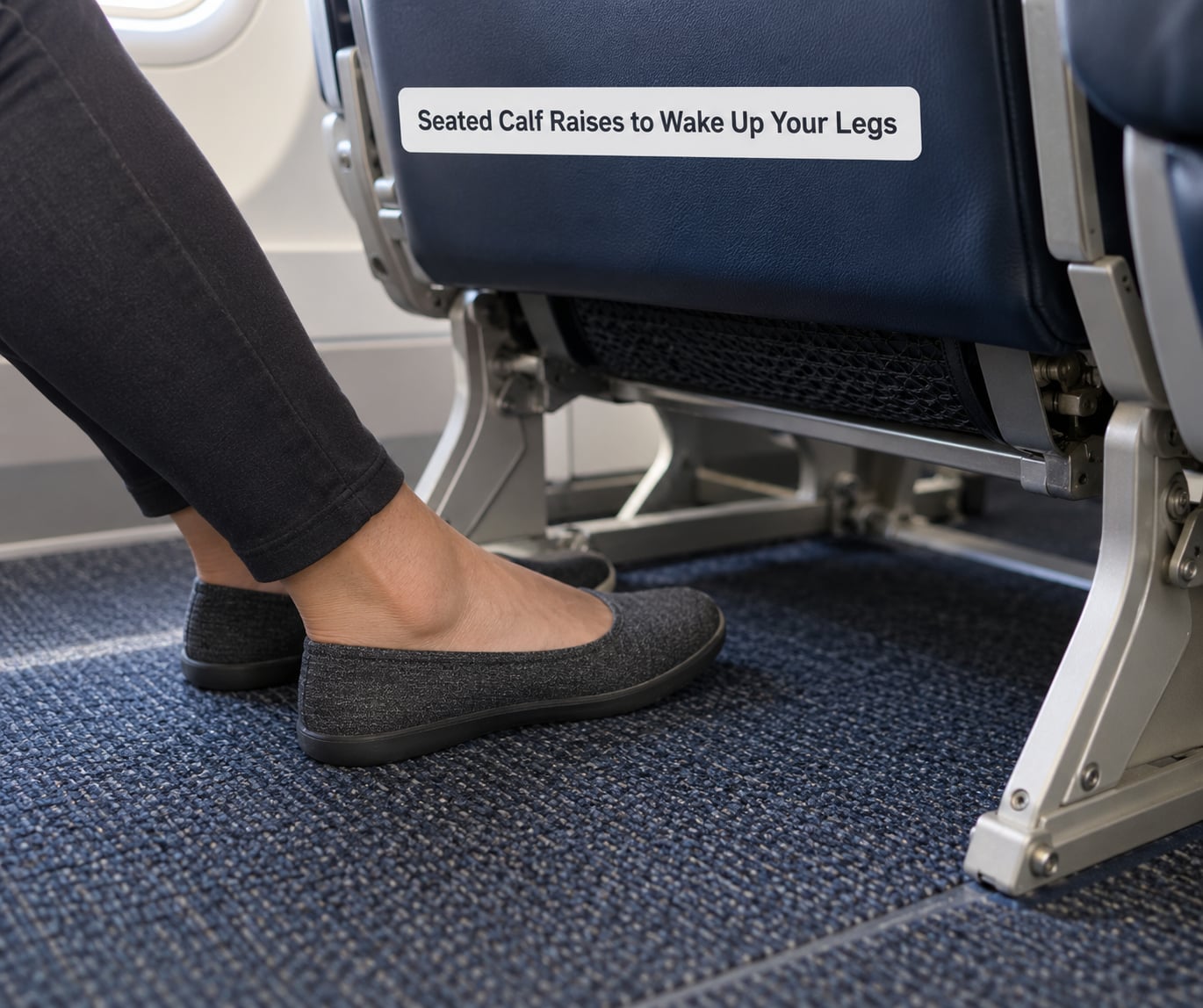
Calf raises are the move experienced fliers mention most often, because they work the same muscle as walking while you stay put. Keep both feet flat on the floor, press through the balls of your feet, and lift your heels until only the front of your foot is in contact with the ground. Hold for a second, then lower slowly.
Do 10 to 15 of them. Lowering with control matters more than the height you reach, and the working knee stays comfortable and slightly soft rather than locked. On a red-eye, this is a good move to do quietly because it does not disturb anyone.
3. Seated Marching to Move Your Hips
A seated march brings movement to the hips and upper legs, which have been folded into one position for hours. Lift one knee a few inches, set it down, then lift the other, keeping your back against the seat and your shoulders relaxed. Thirty to sixty seconds of slow alternating lifts is plenty.
For a lower-intensity version in tight legroom, lift the toes and heels alternately with the knees still pointing down, or march with only a few inches of travel. On a window seat, lift the knee toward the armrest so you do not knock the wall. Most people feel this one in the hip flexors within the first ten lifts, which is exactly the point.
4. Seated Knee Extensions for Your Thighs
Knee extensions target the front of the thigh, a muscle that does almost no work in a seated position. Sit tall, straighten one leg until the knee is nearly level with your hip, hold for two seconds, and lower under control. Do 10 to 12 on each side.
Stop if the movement causes a sharp pain at the front of the knee or behind it, and keep the range smaller rather than forcing full extension. Lower legroom makes full extension impossible anyway, and a partial straighten still gives the thigh muscle something to do. Some travelers extend the leg and hold the ankle for balance; others rest the heel on the footrest of the seat in front, which turns this into a supported hold.
5. Quad Sets to Activate Your Thigh Muscles
A quad set is the most low-effort thigh exercise there is, and it needs almost no space. Press the back of your knee gently down into the seat cushion and tighten the muscle on the front of your thigh at the same time. Hold the squeeze for five seconds, release, and repeat ten times.
Nothing moves except the muscle, which makes this the right exercise for a middle seat, a red-eye, or any moment when you do not want to be seen moving at all. You can do it with your eyes closed.
6. Ankle Alphabet Tracing for Mobility
Drawing letters with your foot is a simple way to take an ankle through its full range without thinking about angles. Lift the foot slightly and trace the letter A in the air, then B, then C, continuing to Z. Do one foot, then the other.
Work inside a range that feels easy rather than a range you force. If you are stiff after a long sitting block, use smaller letters until the joint loosens, then let them grow. Passengers with limited ankle mobility often get more from the first few letters than from the whole alphabet, and stopping before discomfort is the right call.
7. Seated Spinal Twists for Mid-Back Mobility
Your mid back rounds forward over a laptop, a book, or a tray table, and it rarely gets moved again until landing. A seated twist brings it back. Sit tall with both feet flat, place one hand on the opposite knee or the armrest, and rotate your upper body slowly to that side. Keep your hips facing forward. Hold for two to three seconds, return to center, and repeat five to eight times per side.
Do not pull yourself around using the seat belt, and do not push against a neighbouring passenger to get further. Rotate as far as your own shoulder and spine allow, which is usually less than you think and plenty.
8. Seated Side Bends to Reduce Stiffness
Side bends open up the ribs and the muscles down the side of the torso, which get compressed for the whole flight. Reach one arm slightly overhead, lean gently to that side for two to three seconds, and come back up. Do five or six on each side, breathing normally the whole way through.
Keep the movement small and stay within your own seat space rather than leaning into the passenger next to you. A window seat gives you a wall to be careful of instead. If reaching overhead makes you lightheaded, reach only as high as your elbow and skip the breath-hold that some people instinctively add.
9. Shoulder Rolls for a Tired Upper Body
Shoulder rolls are the fix for the hunched posture that comes from looking down at a phone. Lift your shoulders toward your ears, roll them back, then down, and let them come forward again. Do ten backward rolls followed by ten forward rolls, moving slowly enough that you feel the shoulder blades move rather than just the skin.
The 20-second posture reset after a phone scroll
After a long stretch of scrolling, do a quick check before the rolls: slide your shoulders back and down away from your ears, lengthen the crown of your head toward the ceiling, and let your hands rest loosely on your thighs. Breathe out for a count of three, then start the circles. This shortens tight pecs and reminds your neck where it is supposed to sit.
10. Seated Neck Glides for Gentle Range of Motion
Neck glides are a controlled forward-and-back movement, and they are a better choice than fast neck circles on a moving aircraft. Sit back into the seat, let your chin drop slightly toward your chest without dipping the head forward, hold for two seconds, and glide back up. Repeat five or six times in a slow, even rhythm.
Skip this one entirely if you have current neck pain, dizziness, a recent head or neck injury, or a history of cervical problems, and get advice from a doctor before trying it. Stop immediately if you feel lightheaded, see flashing lights, or develop a headache, and never force the range. A slow, small glide is a mobility exercise, not a stretch to push through.
11. Wrist and Finger Mobility for Screen Time
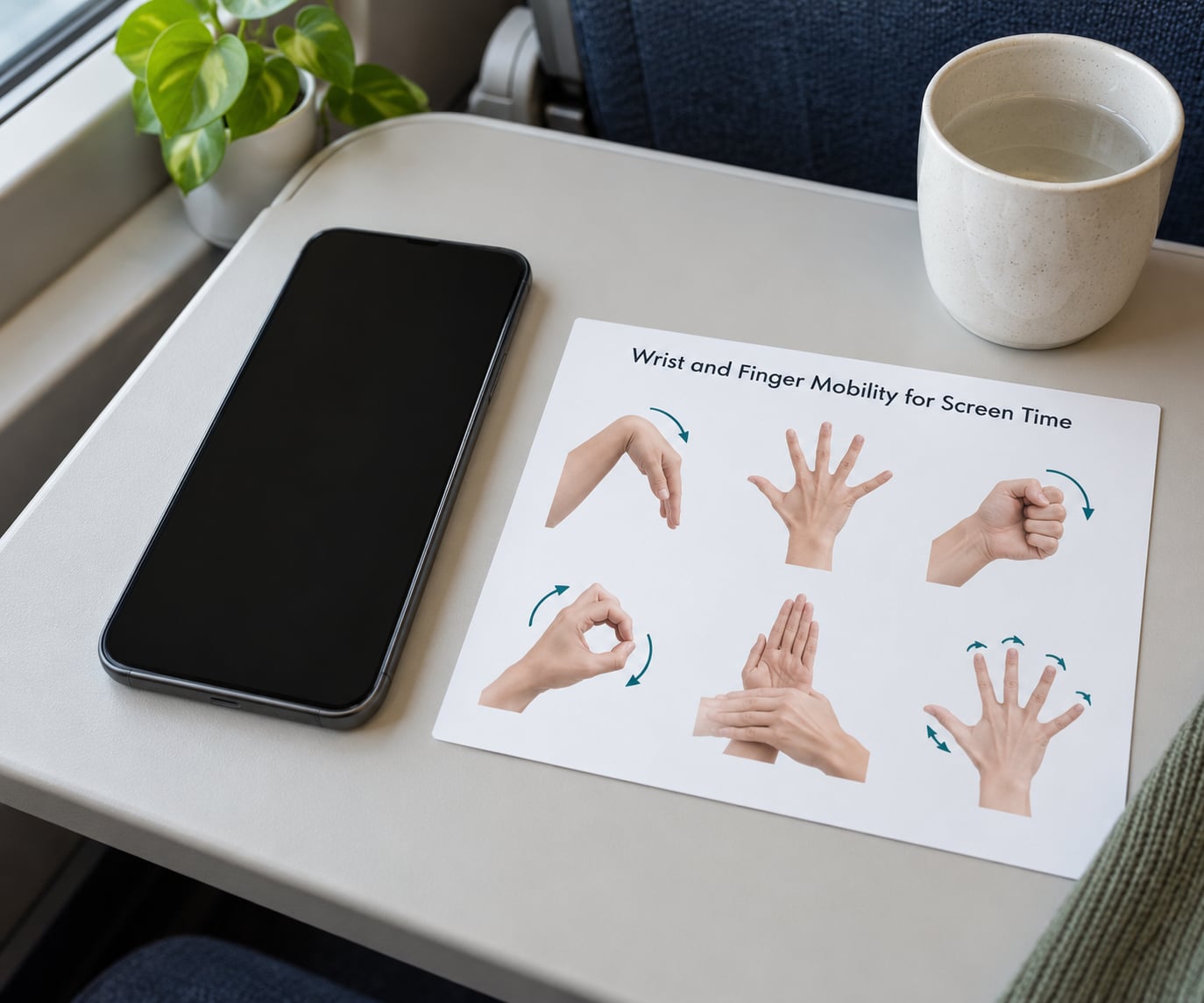
Wrists and hands take a beating in a seat, because you type, scroll, and grip a phone with your arms held in front of you for hours. Rest your forearms on the armrests or on your thighs, then gently bend one wrist so the fingers point toward you, and the other so they point away. Move slowly, without pushing through a sharp point of tightness. Add slow wrist circles in both directions, then spread and close your fingers ten times.
Thirty to sixty seconds of this is plenty, and it is one of the few exercises here you can do completely unnoticed. Uncrossing your legs and letting your hands rest open rather than curled in a fist is the simplest version of all.
12. Seated Deep Breathing to Settle In
Slow breathing is the one move that helps with everything from anxiety to that foggy, uncomfortable feeling of sitting still too long. Sit back in your seat, place one hand on your belly and one on your chest, and breathe in through your nose for a count of four, feeling the lower hand rise while the upper hand stays fairly still. Exhale slowly through your mouth for a count of six. Five cycles is a good starting set.
There are no breath holds in this pattern, and the exhale is longer than the inhale, which is the part that calms the nervous system. If you feel nauseated, anxious to the point of panic, or short of breath, shorten the counts rather than forcing the ratio. Breathe at whatever pace feels natural, and if you are struggling to breathe comfortably, stop and speak to a crew member rather than continuing a breathing drill.
Frequently Asked Questions
How often should I do exercises during a long flight?
Aim for some movement every 30 to 60 minutes while you are awake, and an aisle walk every one to two hours if your seat allows it. On an eight-hour flight, that is roughly three walks, which matches the advice experienced travellers give. Set a phone reminder so you do not lose track of time in a film. Seated moves are a supplement to walking, not a replacement for it.
What exercises are safe in an airplane seat?
Low-intensity seated moves are generally safe for most passengers: ankle pumps, calf raises, quad sets, shoulder rolls, wrist mobility, and slow breathing. These are small, controlled, and repeatable without straining. Skip anything that involves forcing a range, twisting hard against a seat belt, or pushing against a neighbouring passenger. If you have had recent surgery, an injury, or a clotting condition, ask your doctor before exercising in flight.
Can in-flight exercises treat swollen ankles or a blood clot?
No. In-flight movement helps circulation and reduces discomfort, but it does not treat a blood clot, and no exercise prevents one with certainty. A clot that has already formed needs medical attention, not movement. Seek help promptly for swelling or pain in one leg, skin that feels warm or discoloured, chest pain, or sudden breathlessness, and tell the crew member you are travelling. Blood thinners and compression socks are medical decisions for your doctor.
Should I walk around during a long flight?
Yes, walking is the most useful single habit on a long flight, and it works in situations where seated exercises cannot. Walk the aisle or the length of the cabin every one to two hours, or at least three times on an eight-hour flight. Walking and seated moves complement each other rather than competing: the walk moves large muscle masses and the seated moves keep your ankles and calves active between walks.
What if I feel dizzy, painful, or short of breath while exercising?
Stop the exercise straight away and sit back into a supported position. Dizziness during seated movement can come from holding your breath or from standing too quickly, so slow your breathing and lower your head between your knees if you feel faint. Chest pain, severe breathlessness, or a painful swollen leg is a different situation entirely: tell a crew member immediately rather than waiting to see if it settles.
Are breathing exercises safe if I feel anxious during the flight?
Yes, slow breathing is one of the safer things you can do in a seat, provided you never strain or hold your breath. A longer, slower exhale generally helps you settle, and the exercise needs no equipment and can be done with your eyes closed. If you are so short of breath that counting your breaths is difficult, that is not the time to practise a pattern. Talk to a crew member, who can move you to the front or the empty middle seat if one exists.
A Simple Routine to Start Your Next Flight
Start with this and nothing else: one set of 20 ankle pumps, five seated calf raises, five sets of shoulder rolls, and five slow breathing cycles. It takes about three minutes, and you can do it before the meal service arrives.
Then repeat a few of those between the hours you would normally spend looking at a screen, and walk the aisle each time you would otherwise go to the bathroom. Keep water within reach, since staying hydrated makes every one of these moves more comfortable. Pay attention to how your legs actually feel. Swelling that settles after a walk is a different situation from pain in one leg, and the second one deserves a doctor, not another set of calf raises.