A free seat upgrade happens when a fare qualifies, a premium seat goes unsold, and your name is near the top of the airline’s list when the gate agent works through it. That is the whole game. Learning how to get a free seat upgrade on a flight is about understanding that list, then putting yourself on it early without becoming the passenger everyone dreads at the gate.
This guide is updated for October 2026 and covers what actually works across the major US carriers, including the parts most “hack” articles leave out: why a first-class ticket is not automatically a candidate, why basic economy is a dead end, and why pushing too hard has ended with passengers banned from flying.
No method here is guaranteed. If that matters to you, skip to the conclusion and read it first.
Table of Contents
- What You Need
- Step-by-Step
- 1. Check Whether Your Fare Is Eligible
- 2. How to Get a Free Seat Upgrade on a Flight by Booking Strategically
- 3. Build Your Airline and Alliance Status
- 4. Use the Airline’s Upgrade Tools at the Right Time
- 5. Check In Late and Look for Operational Upgrades
- 6. Ask at the Gate Politely and Briefly
- 7. Ask About Service Recovery When There Is a Disruption
- Common Mistakes
- Frequently Asked Questions
- Can I get a free seat upgrade just because I have a first-class ticket?
- Do airline elite members always receive a free upgrade?
- Is a last-minute gate upgrade more likely than one when booking?
- Can a basic-economy passenger receive a complimentary upgrade?
- Does an airline have to offer an upgrade after a delay or cancellation?
- Conclusion
What You Need
There is no entitlement to a complimentary upgrade for the vast majority of passengers, and anyone who tells you otherwise is selling something. What you need is information, and most of it lives in things you already have access to.
- Your booking confirmation. Look for the fare family name, not just the cabin. “Main Cabin,” “Main Classic,” “Economy Flexible,” “Saver,” “Basic” and similar labels carry different upgrade rules.
- The fare rules for your ticket. Airlines publish these on their own site under the fare’s terms, and they spell out whether a seat change or cabin change is included, chargeable, or not permitted online.
- Your seat selection history. Airlines notice passengers who skip paid seat selection. That works in your favour.
- Your loyalty standing. Tier name, not just membership. Enrolled means nothing; Gold, Silver, Diamond and their equivalents mean something.
- Your boarding time and gate habits. Upgrade conversations happen during a narrow window you need to be present for.
- The carrier’s published upgrade policy. Check it a few days before you fly, not the night of.
Before anything else, get the four upgrade types straight, because readers routinely confuse them and then feel cheated.
- Complimentary upgrade. A better seat or cabin given at no cost, usually from unsold space-available inventory. This is what this guide is about.
- Paid upgrade. A cabin change you pay for, either at booking, online, at check-in, or at the gate when a seat is released. Not free.
- Points or certificate upgrade. Miles, a system-wide upgrade certificate, or a carrier-specific certificate. Also not free, just different.
- Operational change. Equipment swap, rebooking after a cancellation, or a courtesy move because something went wrong. This is irregular operations, not an upgrade program.
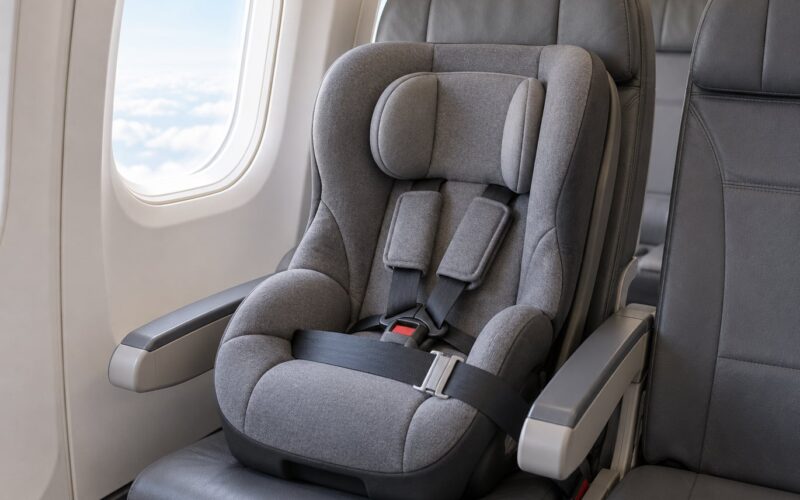
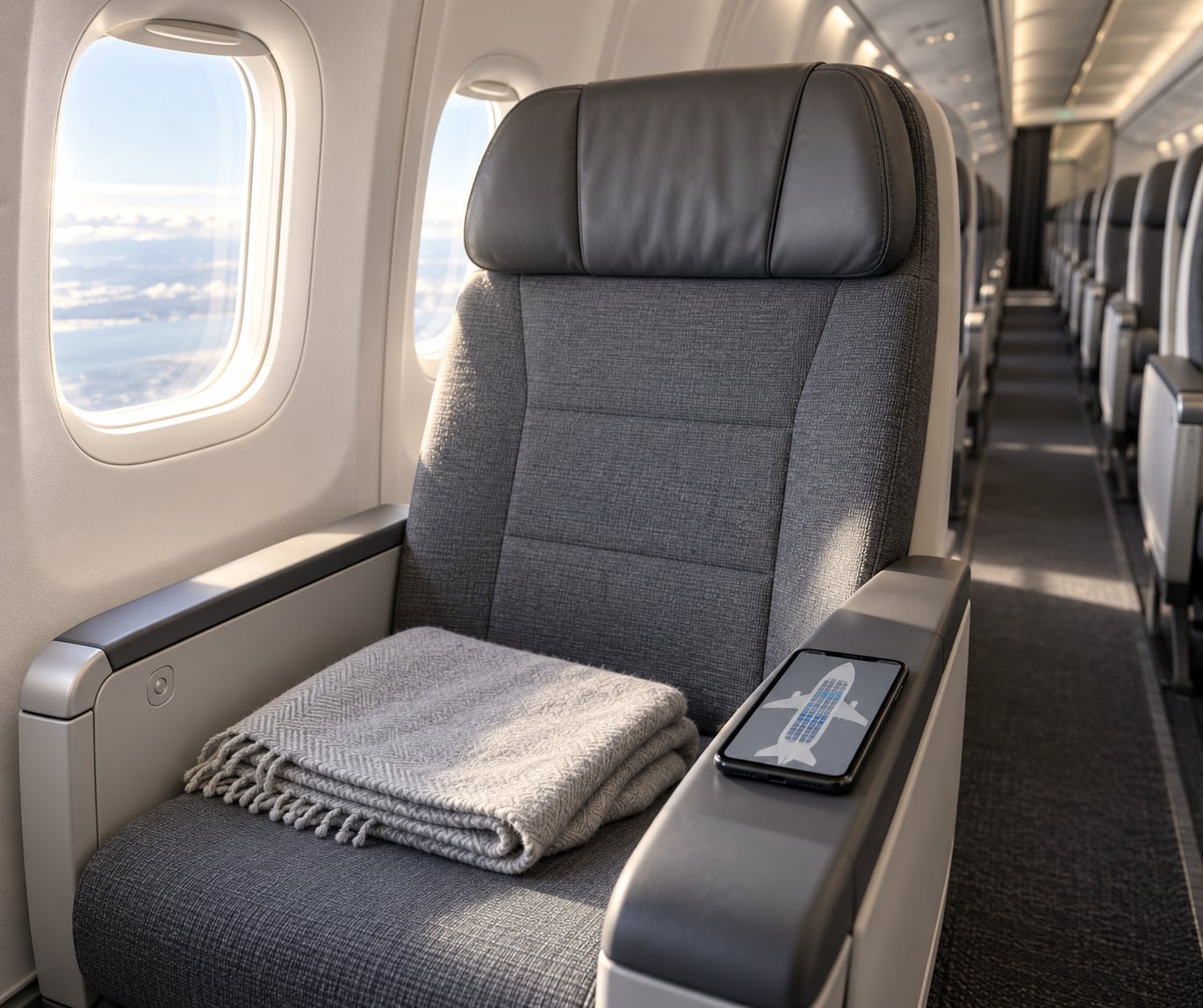
One more distinction matters for anyone who hates middle seats. A seat-level upgrade keeps you in economy and simply puts you somewhere better: an exit row, a bulkhead, a two-abreast pair on a narrowbody, a window with no neighbour. A cabin-level upgrade moves you up a class. Both can be free, they follow different rules, and no guide in this search results page separates them clearly. We cover both.
Step-by-Step
1. Check Whether Your Fare Is Eligible
Buy a first-class ticket and you are not automatically a candidate for anything. You already have the cabin. What you are really asking is whether your fare class sits high enough in the cabin to be considered when an agent works the upgrade list, and the answer is in the fare letter and the fare family name.
The cheapest fares in any cabin are the hardest to move. Restricted fares, basic economy, and most “Saver”-style products carry conditions that block complimentary changes entirely, and the airline can downgrade you as easily as upgrade you. Flexible and full-fare tickets are the realistic candidates because they carry fewer restrictions on changes.
Basic economy deserves its own warning because it is the single biggest dead end. Flyers report that Delta Main Basic purchases get no advance seat selection at all, with seats assigned at check-in or at the gate, and that seats are otherwise assigned automatically rather than upgraded on request. If your fare is the bottom rung, work on changing fares before you work on anything else.
Here is roughly how the priority list gets built when a premium seat opens. The exact order varies by carrier and by the agent on shift, but this is the shape most travellers and airline workers describe:
- Passengers with operational need: unaccompanied minors, anyone requiring assistance, passengers needing to stay with a travelling companion.
- Elite members, highest tier first, on fares that qualify for the cabin in question.
- Customers with a paid premium seat whose aircraft or cabin changed, when the agent is resolving disruption.
- Families who would otherwise be split across cabins.
- Solo travellers, who are trivially easy to move.
- Everyone else, if any seats remain.
Two things follow from that order. A full flight has nothing to give, so an upgrade is impossible rather than unlikely. And a group travelling together almost never moves as a unit, because a single open seat cannot seat four people. Flyers on r/unitedairlines describe agents splitting a reservation and moving one person; that is the normal outcome, not a failure.
| Airline | Who typically qualifies | Cabins involved | Common restriction |
|---|---|---|---|
| Delta | Medallion members on qualifying fares | Comfort+ and Premium Select | Main Basic fares block advance seat selection; FlyerTalk discussion reports Delta One and Premium Select upgrades are rarely issued on international itineraries even for Diamond |
| United | MileagePlus elite members, highest tier first | Premium economy and international business, where the aircraft has them | United flyers report Gold status rarely produces upgrades on domestic main-cabin flights, where a premium-economy cabin may not exist at all |
| American | AAdvantage status members | Premium economy, business and first where fitted | AAdvantage publishes automatic complimentary upgrades to status members when those opportunities exist, so availability is the limiting factor, not eligibility |
| Southwest | No blanket automatic upgrade program | Assigned seating, not cabin classes on most routes | Open seating means agents can move you to a better seat at check-in without any cabin change involved |
| JetBlue | Status holders, particularly on long-haul | Mint and business on transatlantic and transcon routes | Premium inventory is limited on many aircraft, so there is often nothing unsold to give |
| Alaska | Elite members, order set by cabin load | Premium economy and first class | First class may not exist on your aircraft, which makes the question moot |
Read that table as a direction of travel rather than a promise. Policy pages change, and the operative rule is always the one on your fare and your flight.
2. How to Get a Free Seat Upgrade on a Flight by Booking Strategically
You control more before you book than you do at the airport. Three levers matter: which fare you buy, when you fly, and whether you fly alone.
Buy a fare with fewer restrictions. Not necessarily a more expensive fare, but one whose terms allow a cabin change. Read the fare rules before paying, not after. A refundable or flexible ticket in economy is a stronger candidate than a non-refundable fare in the same seat, and the price difference is often smaller than the value of a premium seat on a long-haul route.
Fly when the plane is emptier. Free upgrades are a supply problem: unsold seats. Tuesday, Wednesday and Saturday are the quiet days on most domestic routes, and early morning and late evening departures on long-haul routes tend to carry fewer passengers than the midday bank. Around holiday peaks the calculus reverses completely, and that is exactly when the upgrade supply disappears.
Fly solo. A single empty seat can be moved into in seconds. A family of four needs four empty seats in one cabin, which is a different and much rarer event. If you have any control over it, separate reservations and travel in shifts.
Split the reservation when you are a couple. Two passengers on one booking get treated as one unit and get moved together or not at all. Two separate reservations let one of you take an open seat. Flyers on r/unitedairlines describe exactly this being done at the gate.
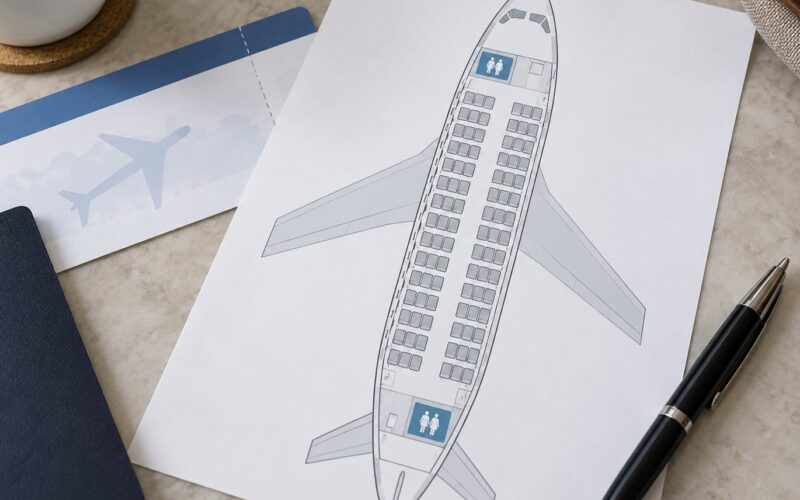
Check the aircraft, not just the route. A route served by a narrowbody with no premium cabin has nothing to offer no matter who you are. Longer routes on larger aircraft carry more premium inventory, which means more chance of something going unsold.
None of this guarantees anything. It improves the odds, which is the only thing available to you.
3. Build Your Airline and Alliance Status
Elite status is the one lever that genuinely changes your position in the list rather than your luck. Airlines prioritise their own members, and the higher the tier the earlier you sit.
Joining a frequent flyer programme is free and takes minutes, and members get first claim on unsold space-available inventory before non-members. The tiers that matter are named things: Medallion on Delta, MileagePlus on United, AAdvantage on American, SkyMiles on Alaska. Enrolment is step one; qualifying flights or status-match requests are step two.
A co-branded airline credit card does not buy an upgrade on its own, but it accelerates status and usually adds things the free tier does not, such as priority boarding, free bags or lounge access. Treat it as a faster route to a better list position, not as an upgrade machine.
Status has real limits, and pretending otherwise wastes your time. On a fully booked domestic main-cabin flight there is no premium cabin to move you into, and the fare still has to qualify. Delta discussion threads repeatedly report that even Diamond members are not offered Delta One or Premium Select on most international itineraries. United flyers report Gold members upgrading on domestic flights is unlikely enough that they simply take a better seat at check-in and stop trying.
Two traps catch loyal customers. First, codeshare bookings. A reservation marketed by a partner carrier is often only eligible on the day of departure, and even then rarely, so check whether your flight is operated and ticketed by the carrier whose status you hold. Second, alliance membership does not mean alliance upgrades. Star Alliance and SkyTeam let you earn and redeem across carriers; whether you get bumped onto a partner’s premium cabin at the gate is a separate question the member must ask the operating carrier.
4. Use the Airline’s Upgrade Tools at the Right Time
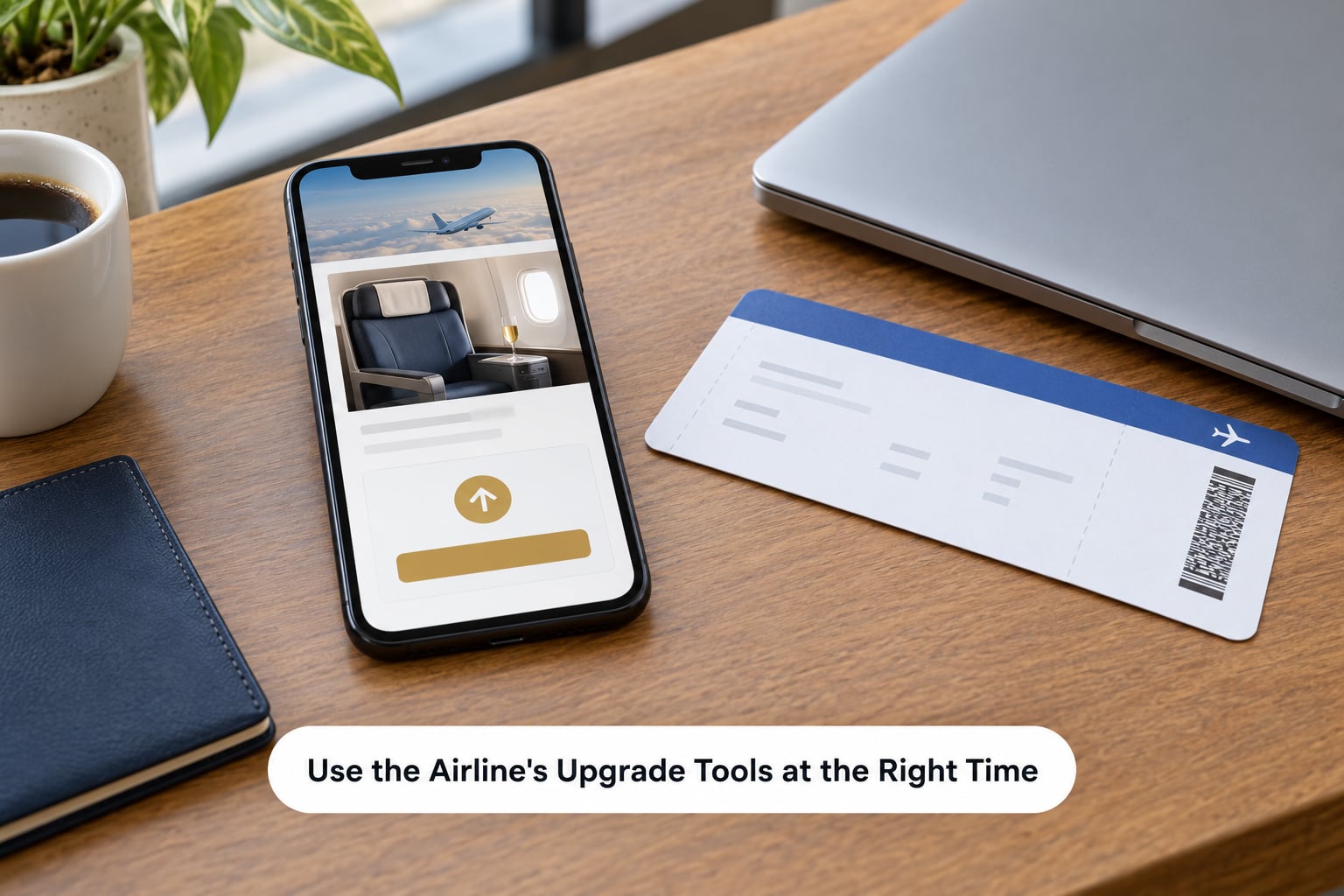
Before you leave for the airport, open the airline’s app or website and check the four places an upgrade can hide.
- Manage booking. Upgrade offers, fare class information, and sometimes a no-cost cabin change appear here first, sometimes weeks ahead of departure.
- The upgrade or fare-filter tools. Filtering your search by “upgradeable” or by available premium inventory shows what is genuinely open at the time of booking.
- Email and app notifications. Airlines target unsold inventory in waves. A targeted offer is a better deal than a gate request because the seat is confirmed before you travel.
- The check-in page. Some carriers surface an upgrade offer during online check-in, before you ever reach the gate. Delta flyers report that this is often the only moment an upgrade is issued.
Compare any offer against the alternatives before accepting. A system-wide upgrade certificate you already hold may be worth more than an on-the-day offer, and redeeming miles is sometimes cheaper than paying the upgrade fee on the same flight. Work out which of the three you are spending.
One genuine last-minute route is the bid upgrade program offered by carriers including KLM and Lufthansa. Travellers report setting a reminder around 72 hours before departure, searching for the airline’s bid upgrade page, and placing the minimum bid while unsold premium seats exist. It works most often on European long-haul, it is a bid rather than a purchase, and you keep your original seat if you lose. Check your operating carrier, since not every airline or every fare participates.
5. Check In Late and Look for Operational Upgrades
Checking in late is not a magic trick, but it changes what you see. Late check-in and gate changes often release a different seat map, and seats that were blocked or held can appear as available. It also means you are closer to the boarding decision and more likely to be standing at the counter when the upgrade list starts.
Be clear about what this can and cannot deliver. Assigned premium seats can open at boarding when a passenger ahead of you does not board. A cabin can be downsized and premium inventory adjusted. A last-minute aircraft change can reshape the whole cabin layout.
None of that is controllable from your side, and treating it as a strategy is how people talk themselves into entitlement. Flyers on r/delta describe a different reality: upgrades issued at online check-in or not at all, with seats otherwise assigned automatically. The reasonable outcome is to be present, be flexible, and accept that an operational upgrade is luck with a schedule attached.
6. Ask at the Gate Politely and Briefly
Asking is fine. Demanding is not. The difference is tone, brevity, and timing, and gate agents deal with several hundred passengers in a compressed window.
Three moments work better than one. Ask once when boarding begins and the queue is moving. Ask again after the premium cabin has been seated and space is genuinely available. If both pass without a yes, stop.
A script that works sounds like this: mention your status or fare if you have one, thank the agent, and ask the question once. Something close to “Good morning, I know you’re busy. I’m [tier] with [airline] if that helps. Are there any no-cost upgrades available on this flight?” is complete in one breath. If the answer is no, “No problem, thanks for checking” ends it cleanly.
Know who actually holds the authority. Gate agents and customer service agents can change a ticket. Flight attendants cannot. Asking a flight attendant for a cabin upgrade wastes the one moment you had, and airline workers discuss this openly in forum threads.
Do not repeat the ask, do not explain why you deserve it twice, and do not mention a competitor’s offer or an upgrade you saw elsewhere. Agents can see the upgrade list. Repeating yourself does not move you up it.
7. Ask About Service Recovery When There Is a Disruption
This is the one path where an upgrade is genuinely common, and it is not really an upgrade program at all. When a flight is delayed, cancelled, or you are moved to a later aircraft, an agent may rebook you, offer a voucher, extend a membership, or move you up a cabin as a service recovery gesture. A United flyer was upgraded to first class after a bag failed to make the flight, with no request made at all.
Know what you are actually owed versus what is being offered. Reasonable options after a significant disruption include rebooking on the same carrier at no charge, meal or hotel vouchers when you are stranded overnight, a future flight voucher, and carrier-specific mileage credits. A courtesy move to a better cabin is a gesture on top of that, not a substitute for it.
Volunteering to be bumped works the same way. Gate agents negotiate compensation with passengers who give up their seat on an oversold flight, and the compensation is usually a voucher, a rebooking, or points rather than a cabin upgrade. Agree to the terms in writing before you hand over your seat, and check whether your travel insurance covers a voluntarily missed connection, since most standard policies treat a voluntary bump differently from an involuntary one.
A significant delay does not create a universal right to a specific cabin. It creates a conversation. Treat any offer as good luck rather than entitlement.
Common Mistakes
Most upgrade stories that go wrong are not failed upgrades. They are people who misread their situation.
Treating a paid upgrade as a free one. An agent quoting you a price is running a normal transaction, not refusing you. Fix: decide your real ceiling before you fly and stop treating a priced offer as a rejection.
Believing status guarantees a specific cabin. Elite members sit near the front of a list that may be empty. Fix: use status for the benefits that are real, like baggage, boarding order and lounge access, and treat the upgrade as a bonus.
Demanding before you have said hello. The tone is set in the first sentence. Fix: greet the agent, state your status if you have any, ask once, accept the answer.
Paying for a pricier fare on an unverified promise. No one outside the airline knows your future load factor. Fix: read the fare rules and buy flexibility if you want it, but do not buy an upgrade on faith.
Assuming a courtesy gesture is a rule. A one-off is not a policy. Fix: enjoy it, do not plan around it.
Escalating. A poster on r/travel described a gate agent rebooking a passenger’s coach flight to the next day and upgrading him to first class entirely on his own initiative, with the passenger banned from the airline the following day. Whatever he did in that interaction, it was not something to repeat. Fix: never pressure staff, never argue at the counter, and walk away if the answer is no.
Inventing a disability or an injury to ask for a seat. Airline workers discuss this openly and it is grounds for removal from the flight, not just the upgrade list. Fix: if you genuinely need assistance, request it through the airline’s accessibility channels before you travel, where it is documented and legitimate.
Offering money or a tip to a gate agent. Tipping gate staff is not a recognised practice and it turns a neutral request into an awkward one. Fix: drop it entirely.
Asking the flight attendant. They cannot change your ticket. Fix: gate agent or customer service, once.
Frequently Asked Questions
Can I get a free seat upgrade just because I have a first-class ticket?
No. A first-class ticket is already the top cabin, so there is nothing above it to move you into, and the fare does not create upgrade priority. If you mean premium economy to business, the answer depends on the fare family and whether a higher cabin exists on your aircraft. Even an eligible fare only moves you when a seat goes unsold and your name comes up.
Do airline elite members always receive a free upgrade?
No, and the gap between expectation and reality is where most disappointment comes from. Elite members sit near the top of the upgrade list, but a list only matters if seats are available, if the aircraft has a higher cabin, and if the fare qualifies. Flyers on r/unitedairlines report Gold members rarely upgrading on domestic flights, and FlyerTalk threads show even Diamond members rarely moved to Delta One internationally.
Is a last-minute gate upgrade more likely than one when booking?
Gate and check-in moments do produce more upgrades than booking-time offers, because unsold seats are released in waves and some carry restrictions that prevent an online change. Delta flyers report upgrades are typically issued at online check-in rather than at the gate. That said, the timing helps only when premium inventory exists, and far more people ask at the gate than get moved.
Can a basic-economy passenger receive a complimentary upgrade?
Rarely, and the fare is working against you the whole way. Basic fares usually block advance seat selection entirely, so seats get assigned at check-in or at the gate, and their restrictions can prevent a change altogether. Flyers report Delta Main Basic purchases getting automatic seat assignment rather than any upgrade consideration. If you fly this fare often, upgrading the fare itself is the only lever that reliably works.
Does an airline have to offer an upgrade after a delay or cancellation?
No. After a disruption you are owed rebooking, and often vouchers, meals or hotel when stranded overnight. Moving you to a better cabin is a courtesy some agents extend and others do not, and it depends on what inventory exists. If you are given a voucher rather than an upgrade, the voucher is usually the more valuable outcome anyway, so ask for what you actually want.
Conclusion
Review the fare and the airline’s upgrade rules first, because everything downstream depends on them. Then use your status, check the airline’s own tools before you travel, and make one brief, polite request at the gate. If the answer is no, you have lost nothing but thirty seconds.
Before you leave for the airport, open your booking confirmation and find the fare family name. That single line tells you whether any of the seven strategies above is even open to you, and it is where learning how to get a free seat upgrade on a flight actually begins and ends.