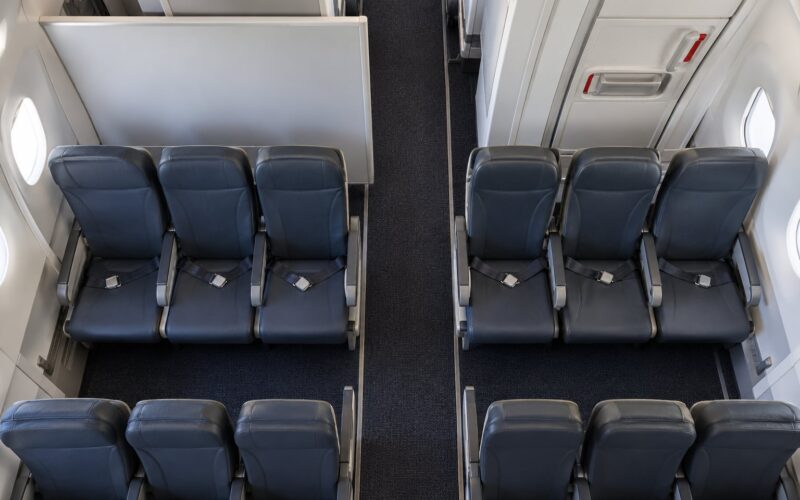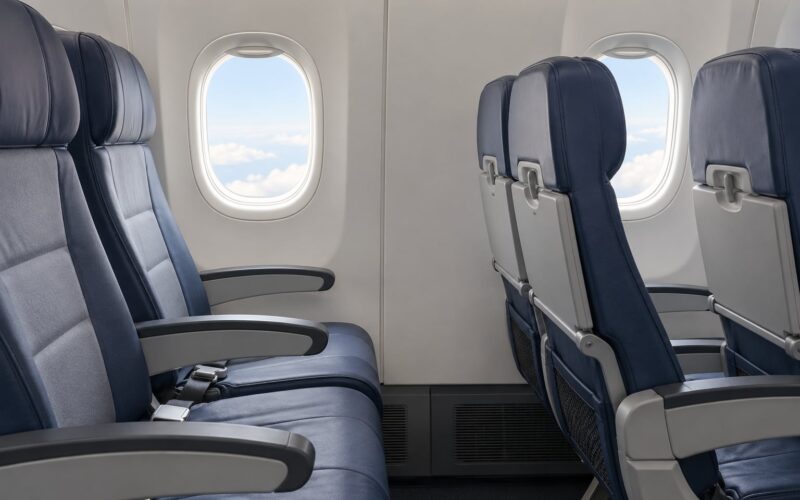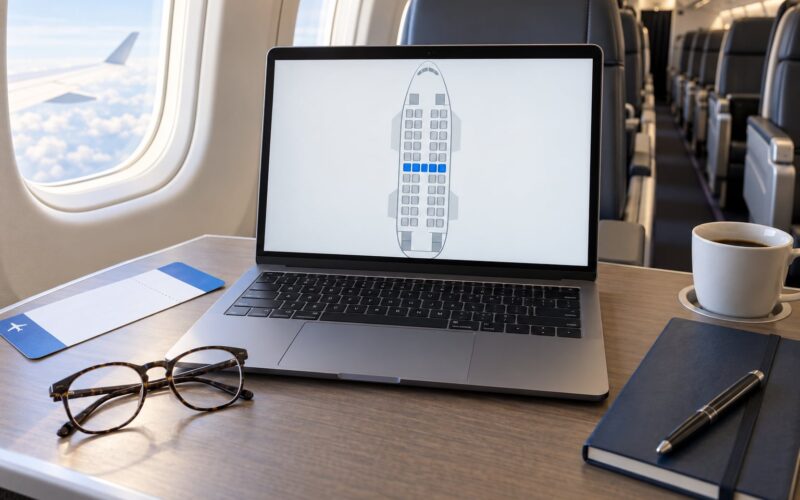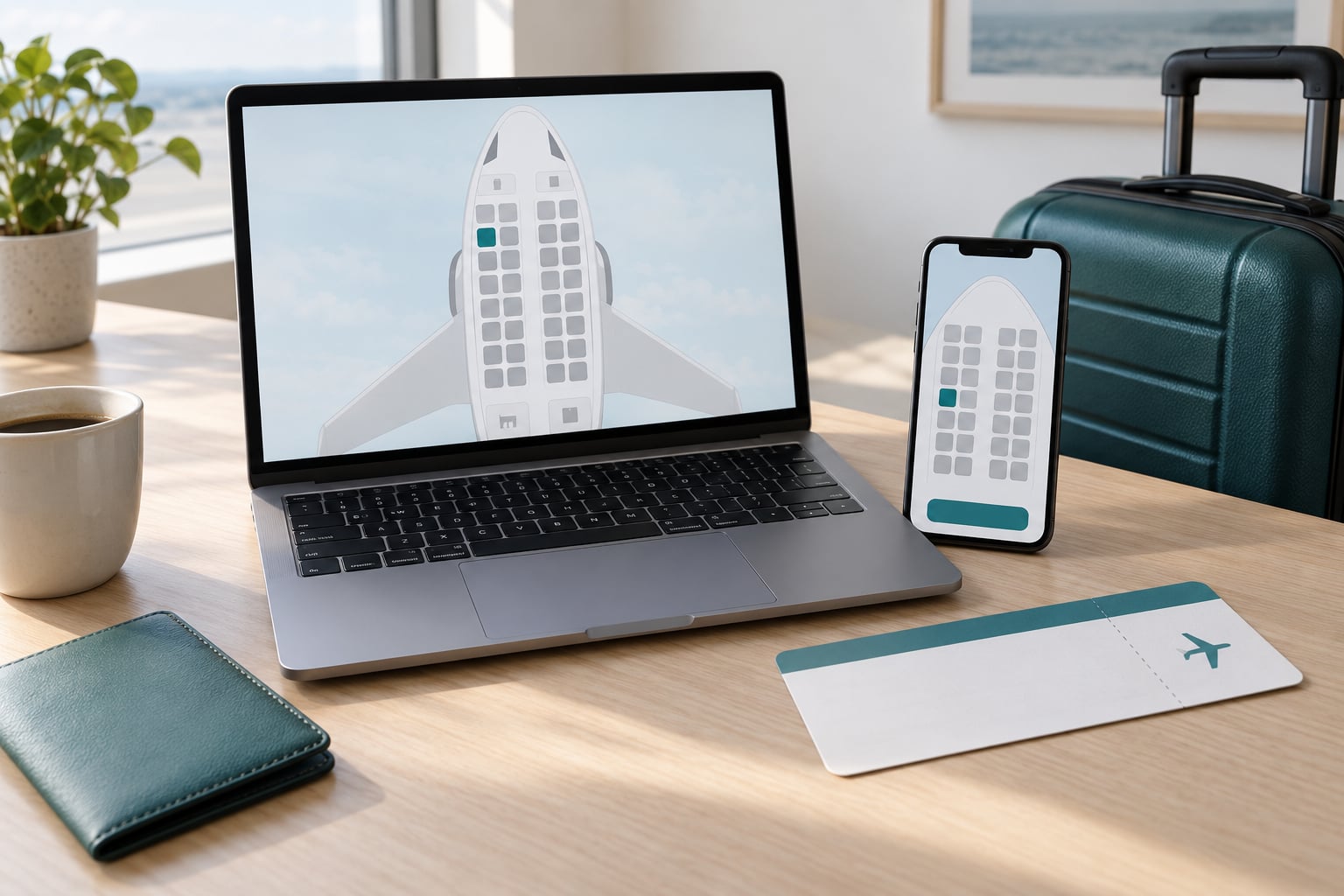
To find a seat with a window, pick the outermost letter in the row: A on the left side of the aircraft, and the last letter of the row on the right, which is usually F, D, K or L depending on the cabin layout. Seat selection usually opens at check-in, 24 hours before departure, so the trick is knowing which letter to click before the good rows disappear.
Most of the confusion here comes from seat lettering. People assume C is the window seat because it looks close to the edge on a phone screen, or they pay for a window selection and end up between two windows. Both problems disappear once you know the letters run left to right across the aircraft and reset after each aisle.
This guide covers the letter rules, how to check what your aircraft looks like before you commit, and what to do when every window seat is already taken.
Table of Contents
- What You Need
- Step-by-Step: How to Find a Seat with a Window
- Read the Seat Map to Find the Window Column
- Check the Aircraft Layout Before You Book
- Select and Confirm the Right Seat
- What to Do If Window Seats Are Unavailable
- Common Mistakes
- Tips for the Best Window-Seat Experience
- Frequently Asked Questions
- Is seat A or C by the window?
- Which seat letters are window seats in a row?
- How do I know if my window seat actually has a window?
- How to get a window seat for free
- Why avoid seat 11A on a plane?
- Which window seat is best for the view?
What You Need
You do not need much beyond your booking. You do need the flight number and the airline you booked with, since the seat map lives in the airline app or website rather than on a third-party site.
Before you open the seat map, gather these:
- Your confirmation number and the flight number, so you can pull up the right booking.
- The aircraft type for the flight, shown in the confirmation email or the itinerary screen. It decides the seat letters.
- A note of when seat selection opens. For most US airlines that is check-in, roughly 24 hours before departure. British Airways and other full-service carriers usually open seat selection at booking.
- Your fare rules. Basic economy tickets on several US carriers do not include seat choice at all, so the seat is assigned free at check-in.
- A few minutes at check-in time with the app open and your payment details saved.
Seat reference tools help with the aircraft side of this. SeatGuru shows seat pitch, width, legroom and which seats are bulkhead or exit rows. Aerolopa offers 3D cabin views of a specific airframe. Neither one reliably shows exactly where the physical window panel sits relative to a given seat, which is the one question the maps leave unanswered.
Step-by-Step: How to Find a Seat with a Window
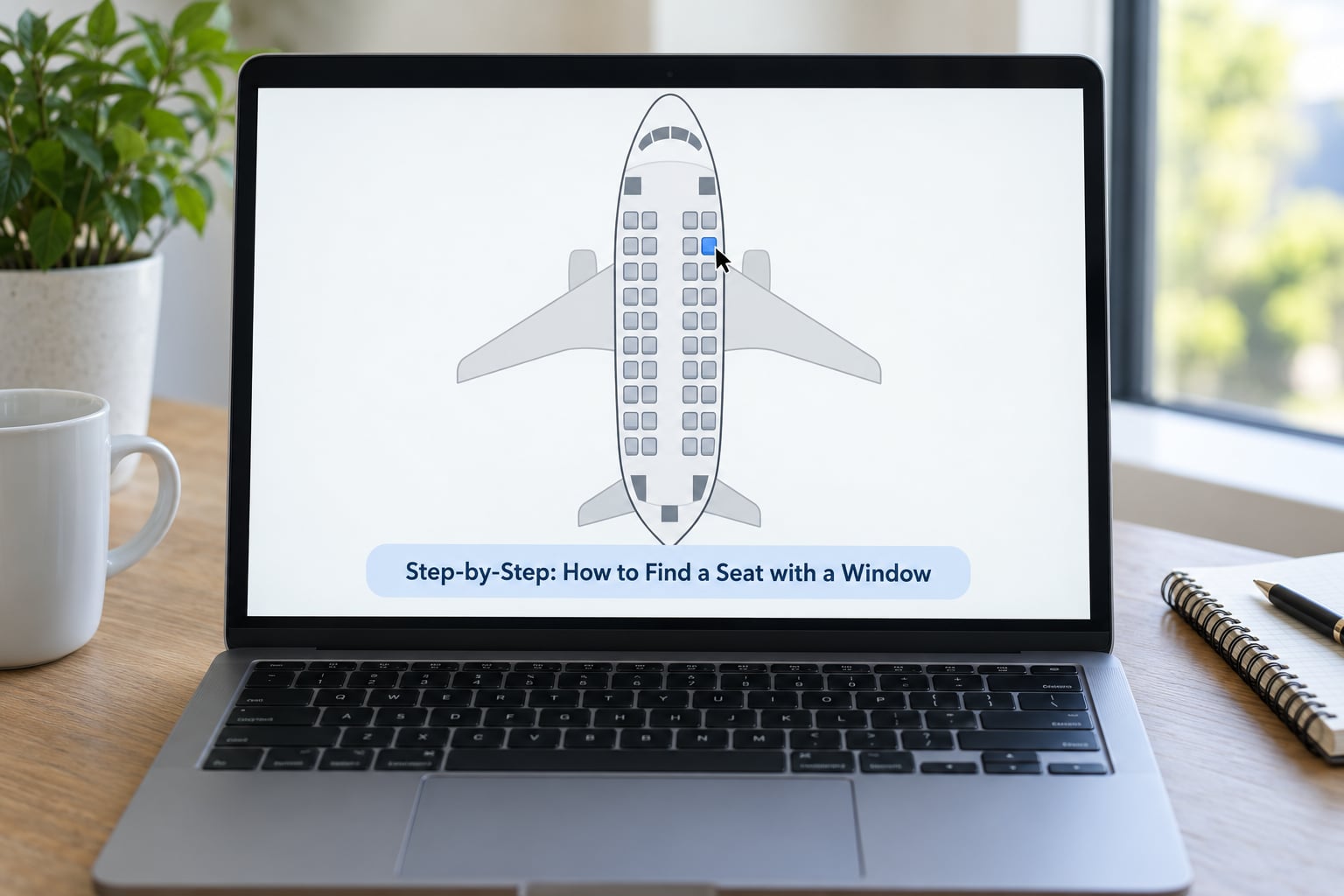
Read the Seat Map to Find the Window Column
The window seat is always the outermost letter on each side of the cabin. Letters run from left to right as you face forward, and they restart on the far side of the aisle in larger cabins. So the count of columns is the whole rule.
Here is the seat-letter reference by configuration:
- 2-2 regional jet (letters A C | D F): window seats are A and F. Both seats in the row are window seats.
- 2-3 widebody (A B C | D E F G, 777 or 787): window seats are A and K. Some airlines label the right side H instead of K.
- 3-3 narrowbody (A B C | D E F, 737 or A320): window seats are A and F. B and E are the middle seats.
- 3-3-3 widebody (A B C | D E F | G H J): window seats are A and J, aisle seats are C, D and G.
- 2-4-2 (used on some widebody cabins): window seats are A and K or A and H depending on the airline’s lettering.
- 1-2-1 premium cabin: the single seat on each side is the window seat, usually labelled A and K, A and G, or A and H.
- 3-4-3 (777, 787, A350): window seats are A and K.
On the airline’s own seat map, look for the aircraft outline rather than a plain grid. If the map is a straight rectangle with no outline, the outermost column of icons on each side is still your window. Window icons, aisle gaps and greyed-out blocked seats all help you read it.
Check the Aircraft Layout Before You Book
The configuration tells you the letters, but the aircraft type tells you what you will actually experience. A seat can be a window seat and still sit beside a blank panel, so it is worth checking before you book a paid selection.
- Row 1 and front bulkhead rows sometimes have no window at all on certain types, because the fuselage curves inward and the panel is omitted.
- Lavatory and galley-adjacent rows trade the window for foot traffic. On some aircraft the window is there but partially behind a service panel.
- Emergency exit rows have a real window, but boarding is often later and the seat does not recline.
- Rows over the wing have the window but the view is mostly wing and engine, and the ride is bumpier than rows ahead of or behind it.
- Staggered rows mean the window does not sit directly beside the same numbered row the way it appears on a simplified diagram.
To check your specific flight, look up the aircraft type on the itinerary, then look up that type on a seat reference tool. SeatGuru marks missing windows and misaligned rows on many airframes, and Aerolopa’s cabin views show the actual wall curve.
Select and Confirm the Right Seat
Open seat selection as soon as it unlocks and pick the outermost letter. If you are choosing between left and right, the side matters less than the row.
There are usually two or three categories of seat to choose from:
- Standard seats in the main cabin. On many US carriers these are free at check-in and cost extra if you pick earlier.
- Preferred, front cabin or exit row seats, which carry an extra fee and sit near the front or at an exit.
- Extra-legroom or comfort products such as United Economy Plus, Delta Economy Comfort or American Main Cabin Extra, which bundle extra pitch with a seat choice.
Confirm the choice in the airline app right after you select it, and check the boarding pass again once it is issued. The assignment on the boarding pass is the one that counts at the gate. If you have status or a card that credits seat fees, make sure the credit has actually posted before you assume you owe nothing.
What to Do If Window Seats Are Unavailable
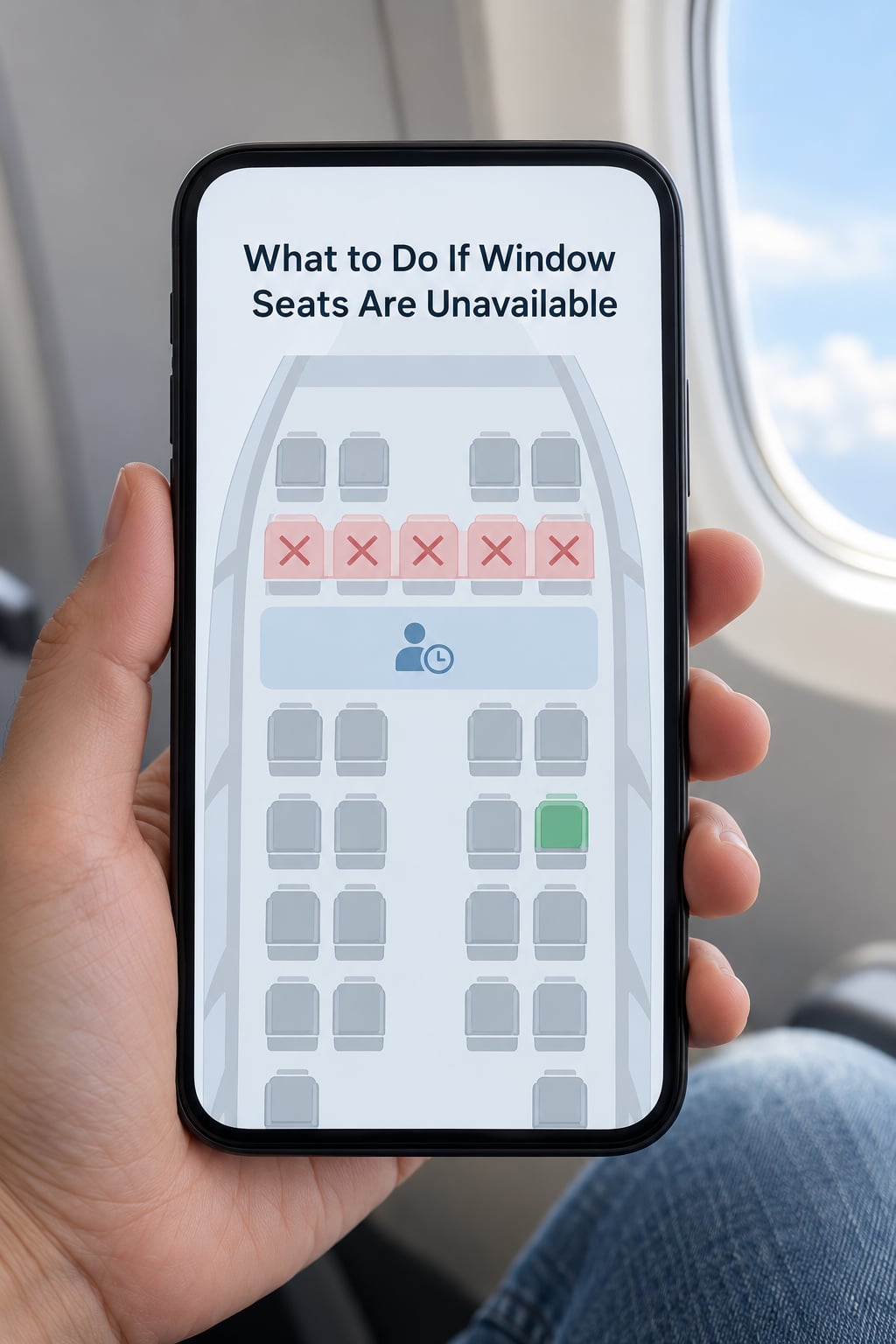
Window seats go first, usually within minutes of selection opening on a popular route. When the map is already blocked out, work through these in order.
- Check again right after check-in opens. Seats held for elite members and cardholders are released back into the pool at that moment, and it is the single most reliable time to look.
- Use the airline’s waitlist or seat-alert feature. Many carriers will notify you when a specific seat releases, and you get a short window to claim it.
- Look at nearby flights. A departure an hour later on the same route often has window inventory left.
- Ask at the gate when boarding starts. Gate agents move families and passengers with mobility needs first, so arriving early and asking politely works more often than people expect.
- Ask a flight attendant once on board. Middle seats sometimes stay empty on a less full flight, and a seated passenger will often move for a polite request.
If you end up in an aisle seat on a 3-3 narrowbody, you often still get a partial view by leaning, which is a reasonable fallback on a daytime flight. On a 3-4-3 widebody, an aisle seat in the four-seat middle block sits far from any window at all.
Common Mistakes
Assuming every window seat has a clear view. Some rows have a window panel that sits slightly forward or behind the seat, so you end up looking at the edge of the frame or a blank section of wall. This is more common on narrowbody types than people expect, and it is the complaint that shows up again and again on flying forums.
Picking a row without checking the configuration. Assuming K is the window seat on a 3-3 narrowbody is the most common error of all. There is no K on a small cabin.
Believing the seat next to a window has a window. The middle seat in a 3-3 row is next to a window but has no view. If you are booking for a child, that middle seat is the one to avoid.
Overlooking fare restrictions. On basic economy fares at several US airlines, seat choice is not available before check-in at all. If you paid attention to the seat map earlier and assumed a seat was held for you, that assumption is wrong.
Not verifying the final assignment. Seats can change during check-in if the aircraft is swapped. Check the boarding pass the night before and again in the morning.
Ignoring what sits beside the window. A row beside a lavatory or galley can mean noise all flight, a queue of standing passengers, and a service cart parking in your view.
Tips for the Best Window-Seat Experience
Aim for the row just ahead of the wing. Riders on forums consistently point to this band as the smoothest part of the flight, and you still get a view without the wing filling it. The row behind the wing works too.
Choose the shaded side for daytime flights. On routes where the sun stays on one side of the aircraft for the morning or afternoon, pick the other side for a lit cabin and an easier view.
Know the trade-offs before you commit. A window seat gives you the view and a wall to lean on, but you cannot stretch your legs into the aisle during the cruise, and on a night flight the window is just a black rectangle. People with long legs often prefer an aisle seat for that reason.
Turn the shade for the person next to you. Raising or dropping a window shade affects the whole row. A quick look across before you touch it saves an awkward conversation in a dark cabin.
Book the window plus aisle pair if you are travelling together. On a 3-3 row, taking A and D or C and F leaves the middle open, and on a full flight the odds of it staying empty are slim. Families on forums still do it because the alternative is three people in a 3-3 with a stranger in the middle.
Put children in the window seat. It keeps them occupied and it stops crew from passing hot drinks and carts over a sleeping child. Travelling with someone who needs to get up often, put that person on the aisle side.
Frequently Asked Questions
Is seat A or C by the window?
Seat A is the window seat. Seat letters run from left to right as you face forward, and the window seat is always the outermost letter on that side, which is A in a standard cabin. C is the aisle seat on a 3-3 layout. The same rule gives you F, D, J or K depending on how many columns the aircraft has.
Which seat letters are window seats in a row?
On a 3-3 narrowbody they are A and F. On a 3-3-3 widebody they are A and J. On a 3-4-3 or 2-3 widebody they are A and K. On a 2-2 regional jet both seats in the row are window seats, labelled A and F. The rule never changes: window seats are the outermost letter on each side of the cabin.
How do I know if my window seat actually has a window?
Check the aircraft type on your itinerary, then look that airframe up on a seat reference tool or a 3D cabin view. Look for rows flagged as missing a window, and check row 1 and bulkhead rows especially. If you cannot confirm it, bring it up with the gate agent before boarding and ask whether that row has a panel.
How to get a window seat for free
Check in at the moment seat selection opens, which is 24 hours before departure on most US airlines, because held seats are released then. Use the airline waitlist or seat alert to catch a cancellation. Elite status and certain airline credit cards cover seat fees, and some carriers assign a free window seat at check-in on basic economy tickets.
Why avoid seat 11A on a plane?
Row 11 is often close to an emergency exit on narrowbody aircraft, and exit row seats usually do not recline and may board later than the rest of the cabin. On some airframes row 11 also sits right where the wing root begins, so the view is partly blocked and the ride is rougher. Always check the specific aircraft type before ruling a row in or out.
Which window seat is best for the view?
Rows just ahead of the wing give a clean view without the wing in frame, and rows one or two behind the wing work too. Avoid rows directly over the wing, rows beside a lavatory or galley, and first rows on types where the window panel is omitted. On daytime flights pick the side away from the sun for a brighter cabin.
Do this first: note the aircraft type for your flight and work out whether your window seat is A or the last letter of the row. Then set an alarm for check-in time, open the seat map the moment it unlocks, and click that outermost letter. Everything else on this page is a refinement on that one move.