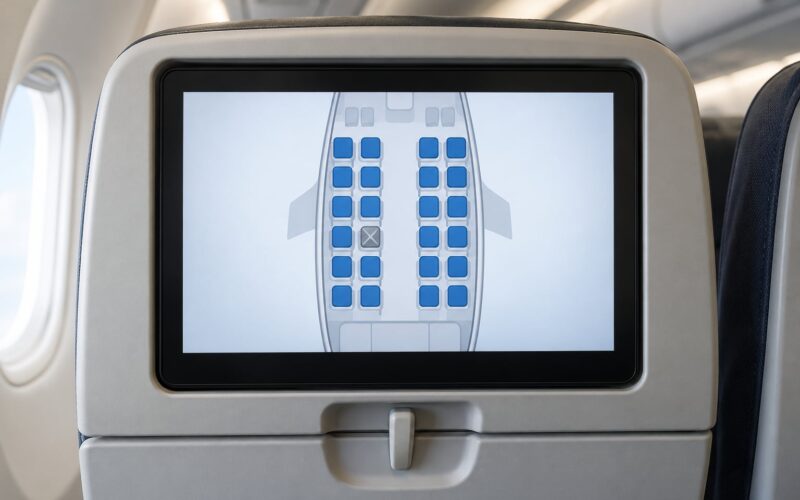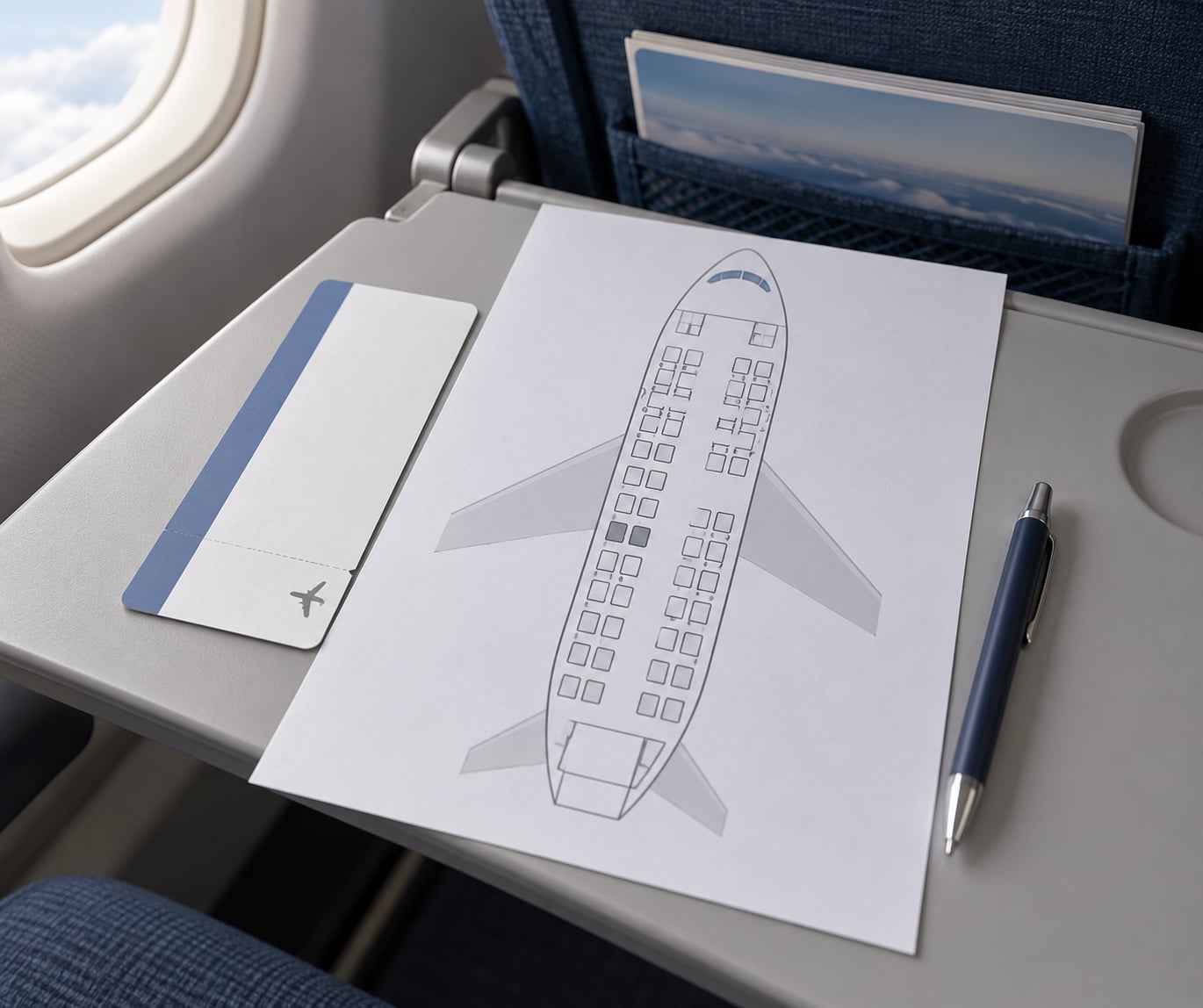
A blocked seat is a seat your airline will not let you book, even though the seat map shows a physical seat in that spot. The airline’s booking system is holding it back: sometimes because no seat physically exists there, and sometimes because the airline is managing inventory and has not released it yet.
That second part is where most confusion comes from. People assume a blocked seat means a broken chair or a permanently sold-out row, then spend hours refreshing an app that was never going to change. Knowing whether a block is hard or soft tells you whether waiting helps.
Ask one question before you start refreshing: is there physically a seat where the map shows a blocked position? That single check resolves most cases.
Table of Contents
- What Is a Blocked Seat and Why Is It Blocked?
- What Are the Most Common Reasons a Seat Is Blocked?
- Why Are Seats Near Galleys and Lavatories Blocked?
- Why Are Some Rows Blocked for Crew or Special Equipment?
- Why Do Airlines Block Seats for Capacity Control?
- Why Are All the Middle Seats Blocked on 3-3 Airliners?
- What Hidden Triggers Block Seats Without Warning?
- Which Aircraft Layouts Come With Blocked Rows?
- Why Does a Seat Map Show a Blocked Seat Before It Is Bookable?
- Is a Blocked Seat Always Uncomfortable or Unservable?
- What Can You Do If Your Preferred Seat Is Blocked?
- Frequently Asked Questions
- What does a blocked seat mean on Virgin Atlantic?
- Why do seats show as blocked on Delta?
- Will blocked seats open up before my flight?
- Can I get a blocked seat released?
- What is the middle seat trick on a plane?
- Are blocked seats sold to other passengers?
- Conclusion
What Is a Blocked Seat and Why Is It Blocked?
Blocked seats fall into two families, and the distinction is the single most useful thing to understand.
A hard block means there is no seat to sell. A galley cart, a lavatory, a crew rest compartment or a missing or broken seat back occupies that position. No amount of waiting changes it, and no amount of status gets it released.
A soft block means the seat exists and is usable, but the booking engine is not offering it right now. Revenue management systems hold inventory back in stages, protect certain rows for premium and frequent flyer passengers, and keep seats available so groups can be seated together. Soft blocks move throughout the day.
FlyerTalk regulars call the soft-block practice theoretical seating, which is a fair description: the airline is selling against inventory it has not released yet.
A few terms show up constantly in this conversation and are worth pinning down:
- Seat inventory — the pool of sellable seats on one flight, which changes with every booking, cancellation and schedule change.
- Load cap — a ceiling the airline places on how many passengers a flight will carry, set for aircraft weight limits or commercial reasons.
- Load factor — the share of seats actually filled, a metric airlines track obsessively.
- PNR — the passenger name record, the reservation file. Grouping logic works on PNRs, not on individual travellers.
- Cabin zoning — treating sections of the cabin differently so premium seats and exit rows stay available to the passengers who paid for them.
Seat map symbols are not standardised across carriers. A greyed seat, a seat with a diagonal line and a seat missing from the row entirely can each mean something different on different airlines, which is why a screenshot from one booking site rarely explains another.
What Are the Most Common Reasons a Seat Is Blocked?
Ranked roughly by how often travellers run into them, the causes look like this.
Why Are Seats Near Galleys and Lavatories Blocked?
Service areas take up floor space that the seat map has to represent somehow. Depending on the aircraft, the airline blocks the row outright, sells it with a reduced pitch and no recline, or leaves it out of the map.
There are operational reasons too. Crew need to reach exits and service panels quickly, and a seat that reclines into a galley aisle is a problem at pushback. Rows behind a bulkhead also see the lavatory queue all flight long.
Why Are Some Rows Blocked for Crew or Special Equipment?
Long-haul aircraft carry crew rest areas, and some of them occupy a cabin row position during part of the flight. On a 787 or a 777 those may be converted door areas rather than passenger rows, but on smaller and single-aisle aircraft the space behind a bulkhead sometimes maps as unavailable.
Other equipment-driven blocks include bassinet positions, which must sit near the galley so attendants can reach them, and wheelchair-accessible rows, which hold a specific number of positions for the aircraft and cannot simply be sold as standard seats.
Why Do Airlines Block Seats for Capacity Control?
This is the commercial reason, and it is the one airlines discuss most openly. Holding seats back lets the airline protect the value of premium inventory and manage how full a flight gets.
The pattern travellers notice most is the cabin zone: a block of extra-legroom or wing seats held while ordinary rows are already down to a handful. FlyerTalk members call this protecting the seats next to the best frequent fliers, which is exactly what it looks like from the outside.
Most airlines also use cabin zoning to keep an exit row or bulkhead row from being filled by an unaccompanied minor or a passenger who cannot meet the exit-row requirements.
Behaviour differs more between carriers than most people expect. Delta and United are the two most commonly asked about, and both continue to hold inventory in the front of the cabin. Delta’s blocking attracted attention because of the revenue it protects, while United’s cabin changes have gone further and removed middle seats from some short-haul economy layouts rather than sell them.
American and Alaska sit somewhere in between, with heavier use of bulkhead and extra-legroom holds. JetBlue and Southwest tend to keep inventory looser, and Southwest’s open seating removes the seat-map question almost entirely. British Airways, Virgin Atlantic, Singapore Airlines and Lufthansa all run the classic front-of-cabin protection on long-haul, where the premium cabin boundary makes the zoning visually obvious.
Long-haul aircraft also give you a reliable shortcut. Look at where premium cabin ends. The rows immediately behind that boundary are blocked more often than anywhere else on the aircraft, because that is exactly where the airline’s cabin split sits.
Families hit this harder than anyone. Splitting a family across the cabin is the most repeated complaint on every aviation forum, and cabin zoning is often why it happens: the adults are assigned seats in one zone and the children in another.
There is a booking-channel effect worth understanding too. Grouping logic works on the PNR, so a family booked in a single reservation can be shown as bookable together even before the seats are released. Two people searching separately see a different map for the same flight, which is why one member of a party sees an open row and the next sees it greyed out.
Why Are All the Middle Seats Blocked on 3-3 Airliners?
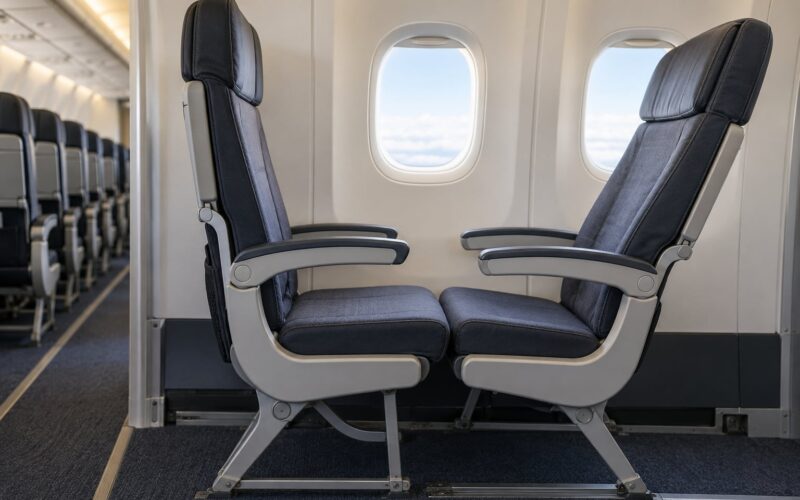
On a three-by-three narrowbody economy cabin, the middle seat has a deserved bad reputation. Travellers ask for it for two reasons at once, so airlines hold it back and let the aisle and window seats sell first.
This became a much more visible habit during the pandemic years of 2020 and 2021, when middle seats were blocked to keep adjacent passengers apart. That distancing policy has ended at the major carriers, but the middle-seat habit largely stayed, and several carriers have gone further and removed middle seats from some short-haul economy cabins altogether rather than sell them.
That is the honest answer to why United has been getting rid of some middle seats: the seat is not earning enough to justify existing.
What Hidden Triggers Block Seats Without Warning?
These are the ones that genuinely confuse people, because nothing on the screen explains them.
- In-cabin pets. A Reddit user on r/unitedairlines booking SFO to DTW found every middle seat blocked on an Airbus A319. The cause was the in-cabin pet they had added to the search. Pet seats are restricted to specific rows, and the search applied the restriction to the whole cabin. Removing the pet parameter brought the middle seats back.
- Accessibility requests. Adding a wheelchair or mobility need filters the map to accessible positions and hides everything else, which reads exactly like a blocked cabin.
- Unaccompanied minors. Bookings with minors are restricted to certain rows near the front, often with an adult seat required nearby.
- Code-share flights. The marketing carrier may show a map generated by the operating carrier’s system, and the two refresh at different times.
- Different booking channels. A basic-economy fare often shows a map with no assignable seats at all, which looks identical to a full cabin.
Which Aircraft Layouts Come With Blocked Rows?
The aircraft tells you a lot before you even look at the policy.
On a 757 or 753, the overwing exit rows have no standard row in front of them in some configurations, so whole row positions can map as unavailable or restricted. Two-four-two layouts in economy put a pair of seats in the centre, which changes the maths on groups. Widebody cabins carry crew rest, bassinets and galleys in more places than a narrowbody.
Seat 11A on a 737 gets searched constantly for a reason that has nothing to do with blocking: on many 737s it sits near a lavatory and can be a noisy, cramped position. Being blocked and being bad are separate problems.
Why Does a Seat Map Show a Blocked Seat Before It Is Bookable?
Because the seat map is a live inventory display, not a floor plan. Airlines manage seats through a seat inventory control system that releases inventory in stages, so a seat you cannot book today may become bookable later the same day without anything changing on your end.
Four things drive the timing. Booking pace and the load model recalculate as the flight fills. Check-in opens and passengers start taking seats. Schedule or equipment changes reassign your flight to a different aircraft with a different map. And seat map systems are not perfect, so stale and inconsistent displays are common.
There is no standard release hour. Travelers United, the consumer advocacy group, notes that no rule requires airlines to release held-back seats at any fixed point before departure. Middle seats blocked under distancing rules did have a predictable check-in release, but general cabin zoning never did.
One more wrinkle: you are not always seeing the airline’s real inventory. Some websites display a static map, and the seat can be free on the airline’s own app even when a third-party site greys it out.
Blocked seats also interact with overbooking. Carriers predict no-show rates and sell slightly more seats than the aircraft has, then rely on held inventory to keep the numbers honest. That is why a full-looking seat map is not the same as a full flight, and why travellers who assume inventory was withheld on purpose sometimes find themselves bumped when the hold was doing necessary work.
Is a Blocked Seat Always Uncomfortable or Unservable?
No. A soft block has no relationship at all to comfort. The row may be perfectly good and would be an excellent choice if the airline decided to release it.
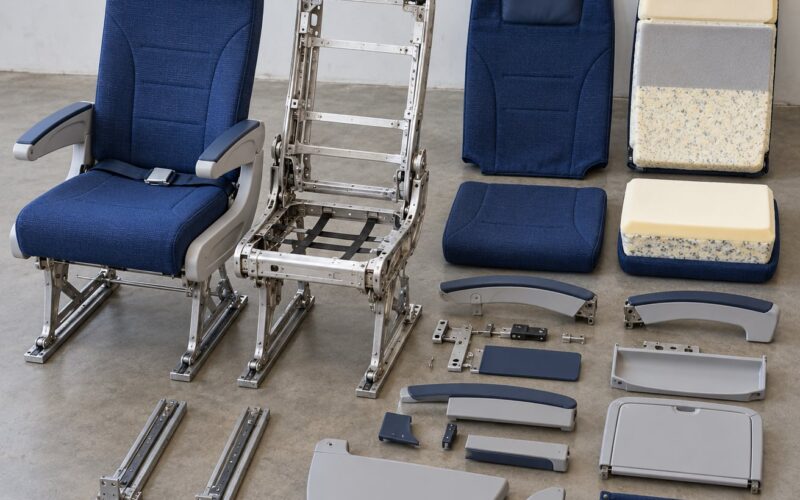
A hard block can still mean something about comfort even though you cannot book it. Rows with a fixed bulkhead seat or a non-reclining seat are often shown differently precisely so you know what you are getting. Rows near a lavatory are usable but loud. Rows that do not recline are marked as such on most maps now.
The one case where a blocked seat really is unservable is a missing or broken seat back. Forum posts on aircraft maintenance boards mention seats taken out of service for a broken recline mechanism and not repaired in time, which can leave a hole in the map that looks identical to a galley.
What Can You Do If Your Preferred Seat Is Blocked?
Start by working out which type of block you are looking at, because the fix depends entirely on that.
1. Check the aircraft on your reservation. Look up the aircraft type and confirm the seat map matches it. A 757 and an A320 have different blocked rows, and a code-share may show the wrong one.
2. Look for the seat number pattern. A missing row in the middle of the cabin usually means galley, lavatory or crew rest. Blocked aisle and window seats with open middle seats usually means commercial holding or cabin zoning.
3. Re-check the map later. Inventory moves. Re-checking in the evening and again when online check-in opens is what the community consensus actually comes down to.
4. Change the search parameters. If you added a pet, a service animal, a wheelchair request or a minor to the booking, search again without it and compare. This solves the mystery more often than people expect.
5. Ask the airline directly. A request through the app or website gets logged against your reservation. Ask specifically whether seat 21A is a hard or soft block, since the answer is usually more useful than a generic policy response.
6. Talk to the gate agent. Travellers United’s point about last-minute fixes is the practical one here: seating problems often resolve at the gate and at no cost, especially when cabins are not full.
7. Contact the airline immediately if the seat is a medical or accessibility need. A traveller needing an aisle seat for medical reasons should not rely on the map refreshing. Call, state the need plainly, and get a confirmation in writing if you can.
8. Do not sit in a seat that is not yours. A blocked seat on your map may already be assigned to another passenger or held for crew. Ask before moving.
Frequently Asked Questions
What does a blocked seat mean on Virgin Atlantic?
On Virgin Atlantic, as on most carriers, a blocked seat is one the booking engine is withholding rather than selling. It can be a hard block with no seat physically there, such as a galley or lavatory position, or a soft block where the seat exists and is held for cabin zoning, group seating or premium inventory protection. If a whole row is blocked, look at the aircraft type first, then ask the airline whether the block is hard or soft.
Why do seats show as blocked on Delta?
Delta blocks seats for the usual reasons: load and capacity control, protecting extra-legroom and wing seats in the cabin’s front zones, galley and lavatory positions that physically hold no seat, and holds for group bookings on the same PNR. Elite status does not release a hard block. What status tends to do is win the race for a soft block when seats are released.
Will blocked seats open up before my flight?
Soft blocks often open, and there is no fixed release time required by any rule. Inventory is released in stages as the flight fills, so re-checking the seat map later in the day and again when online check-in opens is worth doing. Hard blocks never open because no seat exists there. If you need a specific seat for medical or accessibility reasons, do not wait for the map to change, ask the airline directly instead.
Can I get a blocked seat released?
Sometimes. If the block is commercial, an airline may release it when the load model recalculates or at check-in, and asking at the gate often resolves it. If the block is physical, there is nothing to release. What does not work is assuming a hold will break on its own and booking your whole group around it. Ask the specific question, is this a hard or soft block, and you will get a useful answer.
What is the middle seat trick on a plane?
The middle seat trick is choosing a middle seat in a three-by-three economy cabin, usually next to an empty aisle or window seat, on the theory that the two window and aisle passengers will have been seated first and you will end up with the extra space. Airlines block middle seats because of exactly this demand pattern, which is why you often see every middle seat unavailable at once on a narrowbody.
Are blocked seats sold to other passengers?
Usually they are held rather than sold. A soft block sits in a protected pool that the booking system may release later or assign to a passenger on the same reservation. That is why a row can look blocked for you and already have a name against it for someone else. It is also why two people booking separately can see completely different maps for the same flight at the same moment.
Conclusion
A blocked seat is an inventory decision, not a verdict on the seat, and telling a hard block from a soft block is the only step that matters. Hard blocks around galleys, lavatories and crew rest areas will never move. Soft blocks for capacity control, cabin zoning and group seating can move, usually as the flight fills or check-in approaches.
So confirm the aircraft on your booking first, then ask the airline whether the specific seat is hard or soft. If it is a hard block, pick the nearest equivalent row. If it is soft, keep an eye on the map and raise it at the gate.