A bad airplane seat is one that fails on the basics: it will not fully recline, it gives you less knee room than the row in front, its window does not line up with your shoulder, or it sits next to the constant traffic of a galley and a lavatory. Seat comfort is decided by physical geometry, aerodynamics and cabin layout, and those three things change between aircraft models and even between two airline layouts of the same jet. Knowing what makes a seat a bad seat on a plane is really about learning to read those three things before you commit to a row.
That matters more than most people expect. Flights now run full or near full, so you usually get one shot at the seat. A row that looks identical to its neighbour can cost you four hours of sleep or a full flight of knees-up posture.
Below is the practical version: twelve warning signs, where to find them on a seat map, and how to pick the row that fits the trip you are actually taking.
Table of Contents
- What Makes a Seat a Bad Seat on a Plane?
- How to recognize a bad seat before you board
- What the seat map tells you before you pay
- How to read a LOPA diagram
- Free tools worth checking before you book
- When to lock in your seat
- What seat features create discomfort?
- Pitch and knee room
- Width and armrests
- Padding, headrests and recline range
- Which airplane locations are usually worst for comfort?
- How motion feels by cabin zone
- How do seat position and cabin class change the experience?
- Layout matters as much as class
- How to choose a better seat for your trip
- Matching the seat to your body and your trip
- Medical and mobility needs
- What to do when the aircraft gets swapped
- Frequently Asked Questions
- Why is seat 11A often called the worst seat on a plane?
- What seats should you avoid on a plane?
- What is considered the worst seat on a plane?
- Is sitting behind the exit row bad?
- Why do airlines block seats?
- How do I avoid getting a middle seat?
- Conclusion
What Makes a Seat a Bad Seat on a Plane?
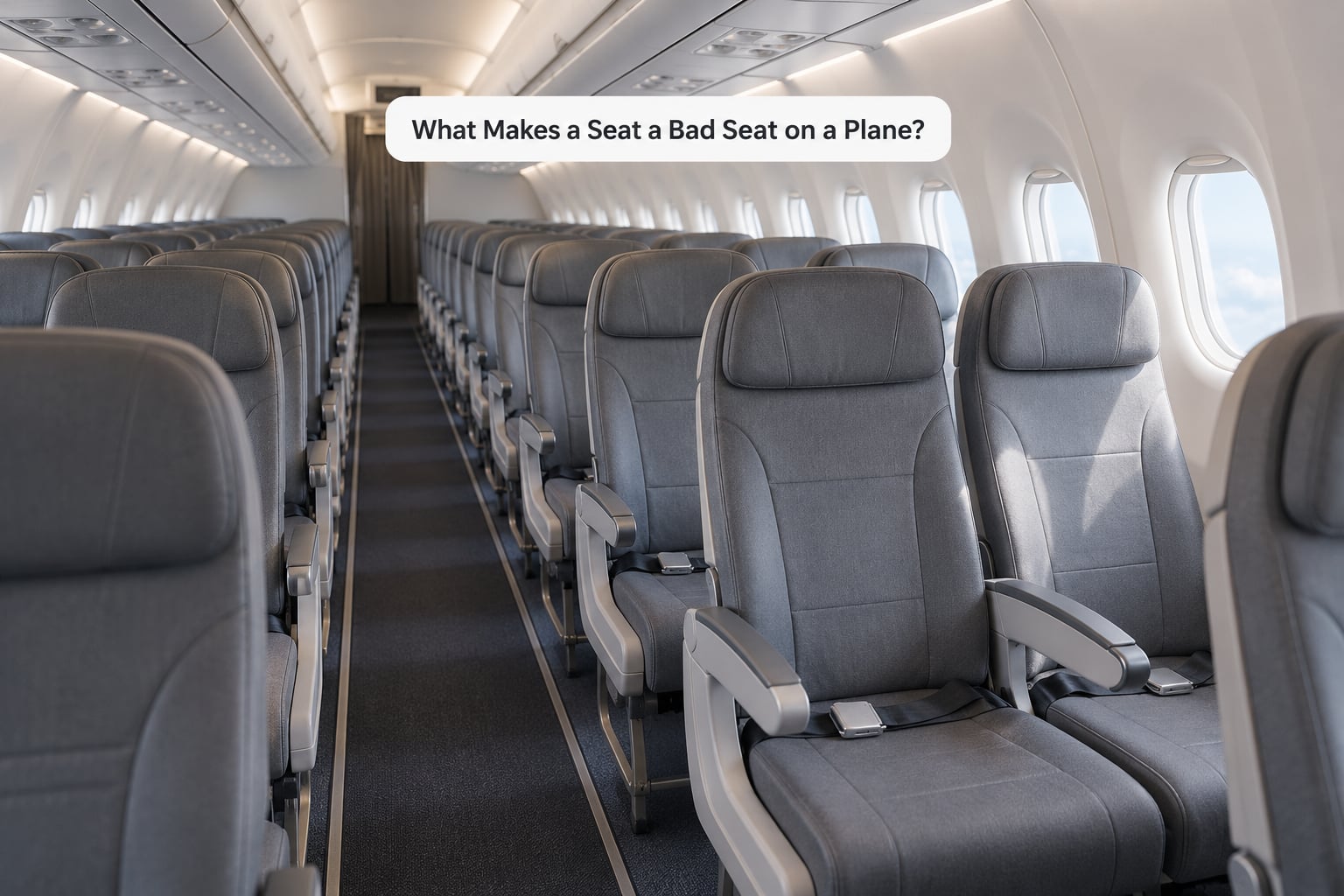
A seat becomes bad when one of five things goes wrong: your legs do not fit, your body cannot settle into a resting position, the seat cannot be reached without disturbing strangers, the surroundings are loud or drafty, or the layout traps you in an awkward posture for hours. Most bad seats combine two of those.
| Warning sign | What you notice | Who it bothers most |
|---|---|---|
| Pitch below the cabin average | Knees touching, feet flat on the seatback tray, no room to cross your legs | Tall passengers, anyone over five foot ten |
| Non-reclining seat | The seatback in front stays upright, so yours cannot move either | Sleepers, anyone on a red-eye or a long haul |
| Window that does not align | Your head rests on a plastic wall, or you lean forward to see out | Window-seat sleepers |
| Fixed armrest | No folding or sliding armrest, so you cannot spread out or share the space | Couples, anyone with a laptop to place |
| Thin or broken-down padding | Hard seat base, visible wear, a mechanism that will not catch | Long-haul passengers, anyone with back pain |
| No adjustable headrest | Middle seat with a fixed back and nothing to lean sideways onto | Middle-seat passengers trying to sleep |
| Lavatory or galley next door | Door swing, lids, footsteps, cart bumps, changing light and temperature | Light sleepers, anyone sensitive to smell |
| Bassinet row | Clips and fabric walls taking up the space, plus intermittent movement | Anyone hoping to sleep, small children |
| Tail-section last row | Wall behind, galley noise in front, often a fixed upright seatback | Everyone on a flight longer than two hours |
| Exit row you cannot use well | Must stay upright, no underseat storage, limited recline | Anyone who wants to work, eat or lie down |
| Wing row with an underseat box | Extra motion over the wing plus lost foot space in the same seat | Turbulence-sensitive flyers, anyone with long legs |
| High-traffic door or galley row | Aisle traffic funnels past your shoulder the whole flight | Anyone who plans to sleep or work |
How to recognize a bad seat before you board
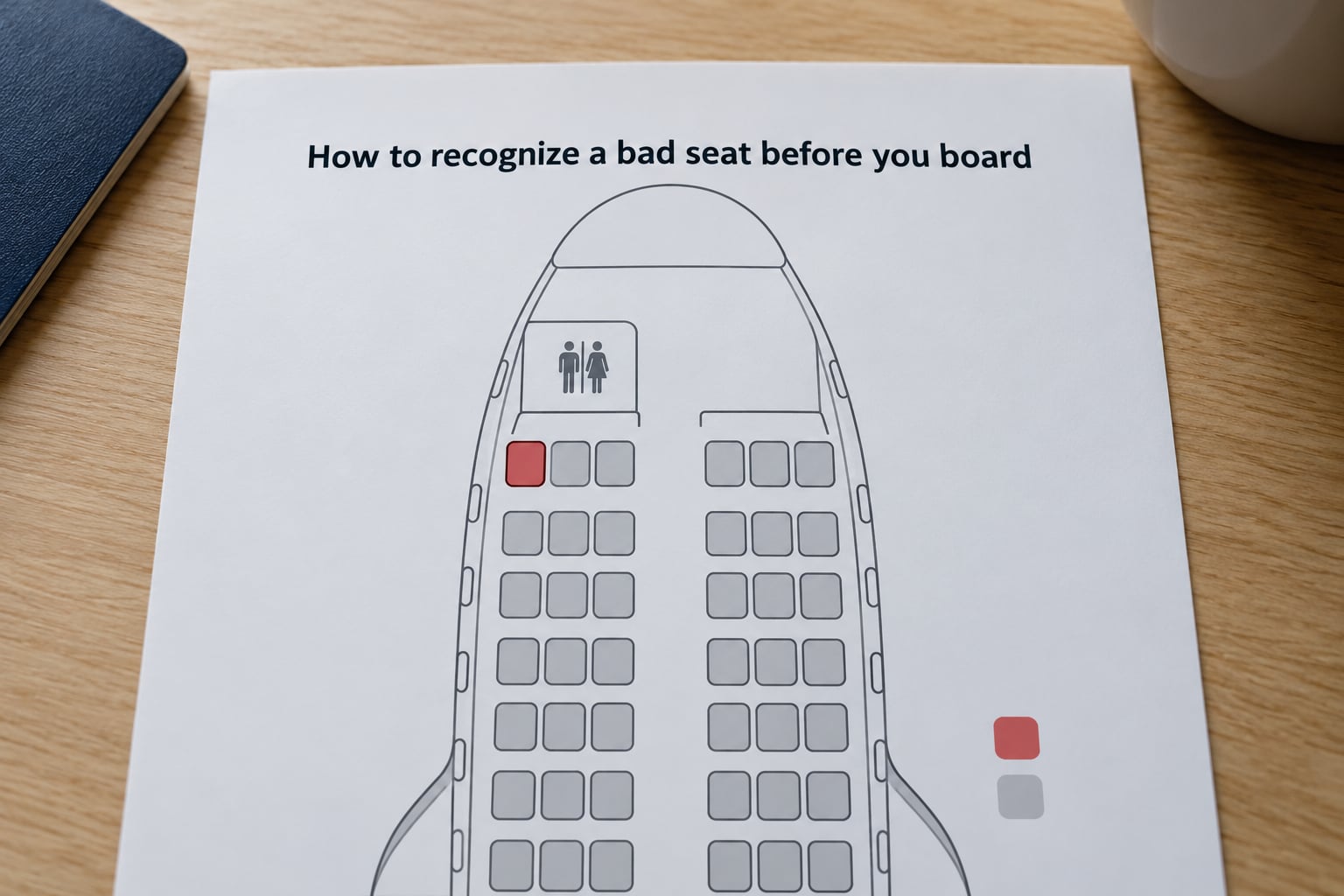
Almost every bad seat leaves a clue somewhere before you board. The clue is usually in the aircraft type, the row number and the seat letter, not in the cabin class name.
What the seat map tells you before you pay
Three letters carry most of the signal. A is usually the window side on a twin-aisle jet and the left-hand side of the cabin on a narrow-body. C is normally an aisle seat on a twin-aisle and a middle seat on a narrow-body. D is the mirror of A on a twin-aisle, and F is the mirror of C.
Row numbers do the rest. The first row behind a bulkhead often has a fixed upright seatback in front of it. The last row in a cabin section frequently has no window in the seatback and a galley or a door right behind it. A row marked as an exit row has its own rules about who can sit there and what you can do while seated.
How to read a LOPA diagram
A LOPA (Layout of Passenger Accommodations) diagram is the technical drawing cabin planners use to fit seats into a fuselage. It is more precise than any consumer seat map, and it shows the things that decide your comfort: seat pitch between rows, how many seats fit across, where galleys and exits sit, and which windows line up with which seat.
To read one, look for three numbers and two symbols. The pitch appears on the side of the drawing, usually in inches or millimetres. The exit and galley positions are obvious blocks on the outline. Seat numbering runs in columns, so you can see at a glance whether a given window seat is the first in its column, which is the seat most likely to line up with a window.
Free tools worth checking before you book
aeroLOPA is the closest free thing to a real LOPA, drawn from cabin configuration data and regularly updated when airlines reconfigure a jet. SeatGuru is easier to use and gives seat reviews, but its database ages and its aircraft swaps sometimes go unflagged. SeatMaestro and ExpertFlyer both cover the common wide-bodies well, and ExpertFlyer adds historical fare data if you also want to watch pricing.
The habit that helps most: look the flight up by flight number rather than by route, because a single route can be flown by three different aircraft on the same day.
When to lock in your seat
Choose a specific seat as soon as you book. Seat selection is usually part of the ticket, and choosing early is the only way to get a row with a real trade-off rather than whatever is left. Most carriers also let you pick or change a seat during online check-in, which opens around 24 hours before departure on domestic flights and closer to 48 hours on many international ones.
What seat features create discomfort?
Discomfort is physical before it is anything else. Once you know which measurements matter, you can look at a row and predict how it will feel.
Pitch and knee room
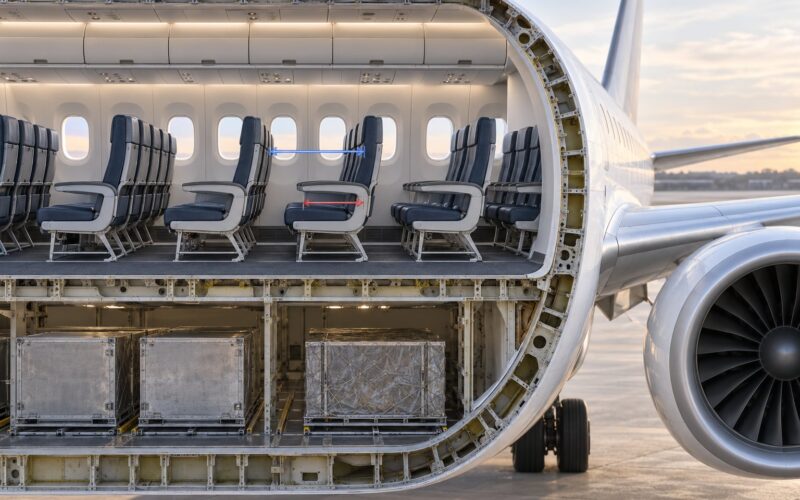
Pitch is the distance from the front of one seat to the front of the next, and it is the number most often used to sell a cabin. It is also the number that misleads you, because the space a passenger actually gets depends on the seat pan design, the angle of the seatback and whether there is a box under the seat in front.
Economy pitch on a narrow-body often sits around 30 to 32 inches, and it drops noticeably in rows where an entertainment unit is mounted under the seat in front or where the airline has added more rows to the same frame. Tall passengers feel this first: if you measure yourself from the back of your knees to the floor and it comes to more than 35 inches, you should assume economy will be tight and check that specific row.
Width and armrests
Seat width is narrower than most seat maps suggest. Standard economy on a wide-body is around 17 to 18 inches, and the middle seat loses a little more because the frame curves inward. A narrow-body is tighter again, and a middle seat there is genuinely narrow rather than merely cramped.
Armrests decide whether that width is usable. A shared, fixed armrest in the middle means you have half an armrest at your side and no way to reclaim it. Several Airbus models have non-folding armrests that cannot be raised, so a laptop table or a sleeping posture becomes a negotiation. This is a detail regular flyers argue about on travel forums for good reason: a row of four with two fixed armrests in the middle is a bad seat no matter how good the pitch is.
Padding, headrests and recline range
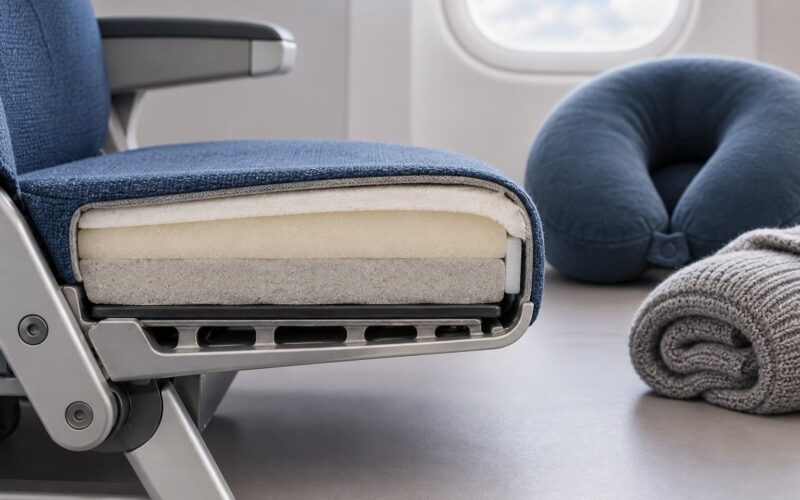
Padding matters more on long flights than short ones, and a seat with a visible dip or a catch that will not hold has probably had a few hundred thousand cycles behind it. Headrests matter enormously and almost nobody checks. An adjustable or winged headrest lets a middle-seat passenger sleep leaning sideways, which is the only real rest position in the middle. Without one, a night flight in the middle of the cabin is a night spent upright.
Recline range is the quiet one. Rows behind a bulkhead and the last row of a section frequently have a seatback that does not recline at all, because the design has to avoid conflicting with the wall or the structure behind. Add a passenger in front who wants a flat bed and you have a fixed 90-degree seat for five hours.
Which airplane locations are usually worst for comfort?
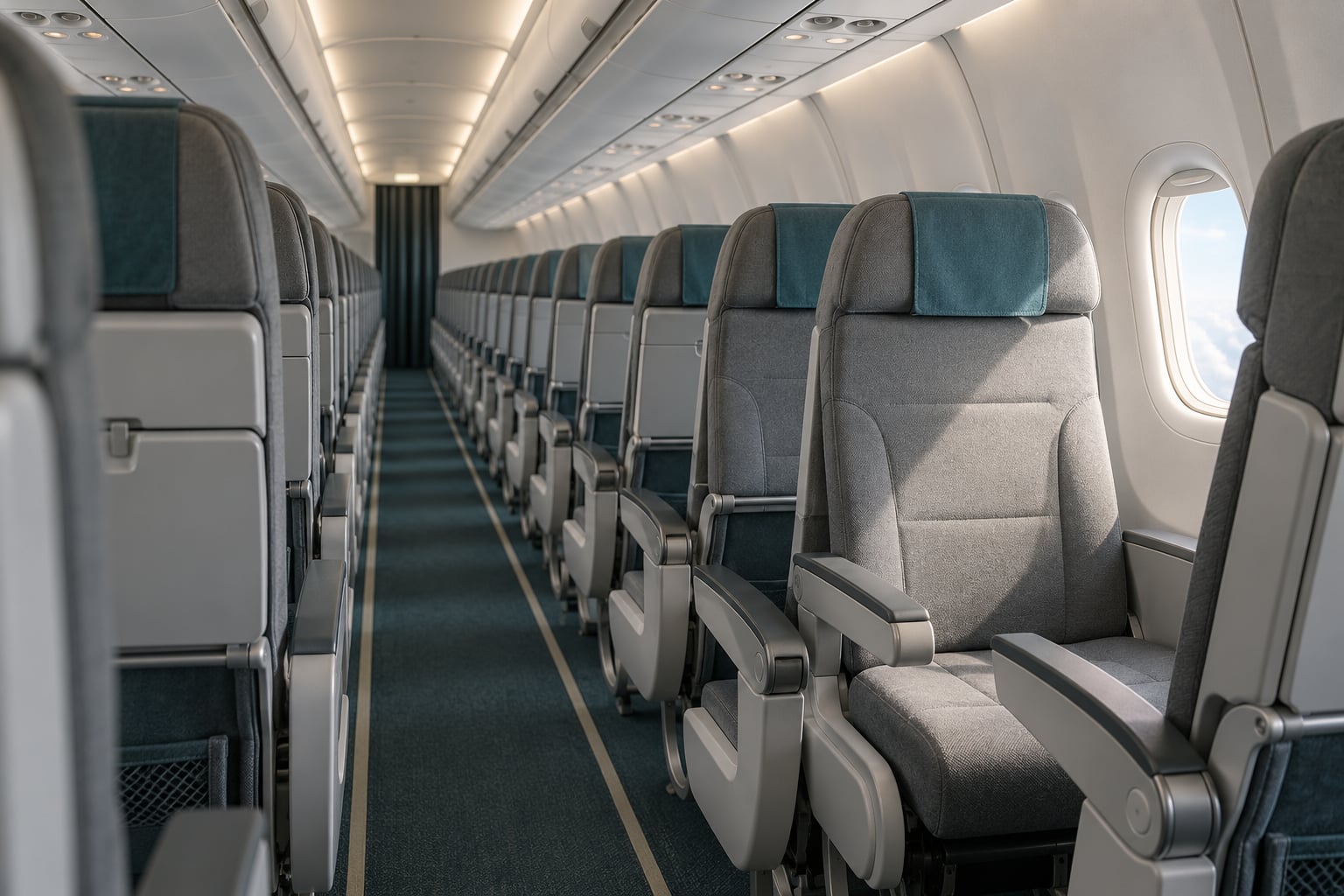
Location is the biggest factor you can still control at booking. The same seat, in the same cabin, feels different three rows away from a lavatory door.
| Location | What you get | Who it suits |
|---|---|---|
| Next to a lavatory | Door swings, queue traffic, odours, queues forming during service | Almost nobody on a flight over two hours |
| Galley row | Cart bumps, service noise, bright lights during the night service, no window in the seatback behind | Nobody who plans to sleep |
| Over the wing | The smoothest ride, the most noticeable motion, usually the tightest legroom | Travellers who get motion sick and want stability |
| First row behind a bulkhead | Often a fixed upright seatback, sometimes extra space, no tray table in some layouts | Travellers who value the extra legroom and do not need to recline |
| Emergency exit row | Extra legroom, no underseat storage, must remain upright, boarding rules vary by carrier | Adults who are comfortable sitting straight for the whole flight |
| Last row of a section | Usually no recline, wall behind, galley or door nearby, no view | Nobody, except travellers who want the empty-seat gamble |
| Front of economy | Quieter, quicker boarding, deeper galley noise on some types | Travellers who value quiet and easy exit over the view |
How motion feels by cabin zone
Rough air is a matter of where the aircraft is stiff and where it is allowed to move. Over the wing is the most rigid section, so it feels smooth even when the rest of the cabin is moving. The rear of the aircraft has the longest lever arm, so the tail section rocks and pitches most. The middle of the cabin, between the wings and the tail, is where lateral shaking is most noticeable.
That is why turbulence advice splits in two. People who get motion sick want the wing. People who are frightened by the movement want the wing for the same reason: it is the section that moves least, so there is less to see and less to react to. A note on the common safety claim: seat position does not change whether a seat is survivable in a serious emergency, so choose for comfort and do not let anyone tell you otherwise.
How do seat position and cabin class change the experience?
Class changes the baseline, but layout changes what the baseline feels like. A premium economy seat with a fixed armrest in a 2-4-2 cabin can be a worse experience than a standard economy aisle seat on a 3-3 narrow-body.
Layout matters as much as class
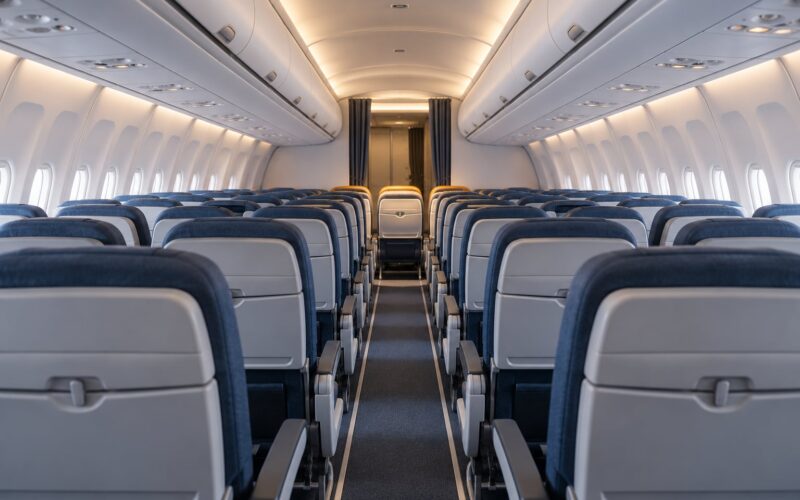
On a 3-3 narrow-body, a window or aisle seat is a good seat and the middle is genuinely bad: narrow, two shared armrests, no view, and two strangers to climb over for the lavatory. On a 3-4-3 wide-body the four-abreast block is where a good seat becomes hard to get, because the middle two sit in the dip of the fuselage. On a 2-4-2 cabin the four-abreast block is worse, since the two inner seats are the worst pairing in the aircraft and the two outer ones are the most contested.
That 2-4-2 point comes up constantly on travel forums. The standard advice from experienced flyers is to take a guaranteed outer pair rather than gamble on an empty middle, because flights are consistently full enough that the gamble rarely pays. The same forums make the point that a middle seat with an adjustable headrest is far more tolerable than it used to be, and that an aisle seat is the least confining option for a nervous traveller.
Moving up a class changes width, pitch and recline together. Premium economy typically adds several inches of pitch and a real recline, and business class adds a door or a partition for most rows. The seats people complain about in those cabins are rarely the standard seat: they are the bulkhead rows without a footrest, the last row where the seat does not lie flat, and the middle of a herringbone cabin where the seat faces a wall with no window.
How to choose a better seat for your trip
Work through this in order and you will get a good seat without buying a seat map course.
Matching the seat to your body and your trip
Start with length. Under two hours, almost any aisle seat works, and the galley and lavatory rows are survivable. Past four hours, pitch and recline dominate everything else, and that pushes you toward bulkhead rows, exit rows or rows with a real footwell.
Then check your body against the layout. Tall passengers should look for the longest pitch available and avoid anything with an underseat box. Anyone over six feet will get more out of an aisle seat than a window seat, since a middle seat forces a straddle. Travellers who sleep badly should take a window seat with a wall to lean on, and check first that the window actually lines up with that seat.
Noise sensitivity inverts the usual ranking. The quietest stretch of a jet is usually the front of the cabin, ahead of the wings and away from the engines, and the loudest zones are the over-wing and tail sections. For work, an aisle seat near the front beats a window seat at the back. For sleeping, a window seat beats an aisle seat anywhere.
Medical and mobility needs
If you have a history of blood clots, a clotting disorder, recent surgery, or a condition that limits your mobility, talk to your doctor before flying rather than relying on seat advice. A medical professional can tell you whether you need an aisle seat, whether you should walk regularly during the flight, and whether compression stockings make sense for you.
For mobility, request assistance through the airline when you book rather than at the gate, and choose a seat with a clear path to the aisle and close to a door. Note that exit-row seats have strict eligibility rules, and a seat beside a lavatory gives you a short walk if you need to move during the flight.
What to do when the aircraft gets swapped
Aircraft changes are the main reason a carefully chosen seat stops matching your ticket. Check your reservation every week or two before departure, especially on a multi-leg trip or a long-haul segment, because an equipment swap can move you from a window seat to a middle one without any change to your seat preference.
If you find a mismatch early, re-select the seat while the original map is still open. On the day, ask at online check-in first, because the seat map there is the one that counts. If the aircraft changed that morning, the gate agent is the person who can release a blocked or newly constrained seat, and a polite, specific request works better than a general one: ask whether the exit row is still available, or whether an aisle seat in the same row is open.
One more habit from the forums worth repeating: if you have a preference, set it every time you book, and pay for the seat if the fare is small. Choosing later means choosing from what is left, and what is left is rarely the row you wanted.
Frequently Asked Questions
Why is seat 11A often called the worst seat on a plane?
On many Boeing 737 and A320 layouts, row 11 is the last row in the economy cabin, right in front of a bulkhead. The seatback in front usually cannot recline, so you sit upright for the whole flight, and the wall behind blocks the view. It also sits next to a galley, which adds noise, and boarding starts from the back of the cabin, so you are usually last off.
What seats should you avoid on a plane?
Avoid rows beside a lavatory or galley, the last row of a cabin section, rows where the seat in front does not recline, the inner seats of a four-abreast block, and any row with an under-seat entertainment box if you are tall. Also skip window seats whose window does not line up with the seat, and any seat with a fixed armrest if you plan to work or share the space.
What is considered the worst seat on a plane?
The worst seat is usually a non-reclining seat in the last row of a section, or a middle seat in a four-abreast block on a twin-aisle. It combines the least legroom with no window, two shared armrests, and two strangers to climb over. In a 2-4-2 layout the two inner seats of the middle block are widely considered the worst pairing in the aircraft.
Is sitting behind the exit row bad?
The row behind an exit row is usually fine, sometimes even good, because exit rows are often built into a wider frame. Two things to check: if the exit row seat does not recline, the row behind it may not either, and some aircraft place the exit row directly above a lavatory or galley, which brings the noise back. Check the LOPA for that specific aircraft before choosing.
Why do airlines block seats?
Airlines block seats for operational reasons: exit rows have age and mobility rules, bassinet fittings take up an entire row on some aircraft, and seats needed for crew or for unaccompanied minors are held back. Blocked seats are not a sign of anything about comfort. Ask at check-in or at the gate, since agents can often release them once the passenger count is known.
How do I avoid getting a middle seat?
Pay for a specific aisle or window seat when you book rather than relying on free assignment, because free assignment hands out aisle seats first and middles last only on less crowded flights. Book early, choose your seat at the same time as the ticket, and re-check during online check-in, which usually opens around 24 hours before a domestic departure. Choosing a narrower aircraft also reduces middle-seat risk.
Conclusion
Start with the aircraft and the cabin, not with the seat number. Find the flight number in a LOPA diagram or a free aircraft lookup tool, check whether the row you want has a non-reclining seatback in front, an entertainment box or a galley behind it, and confirm that the window lines up if you want it. Then pick the location that matches the one thing you care most about: space, quiet, easy aisle access or a view.
Pick the seat at the moment you book, re-check the map a week or two before departure in case the aircraft changed, and treat online check-in as your last real chance to move.