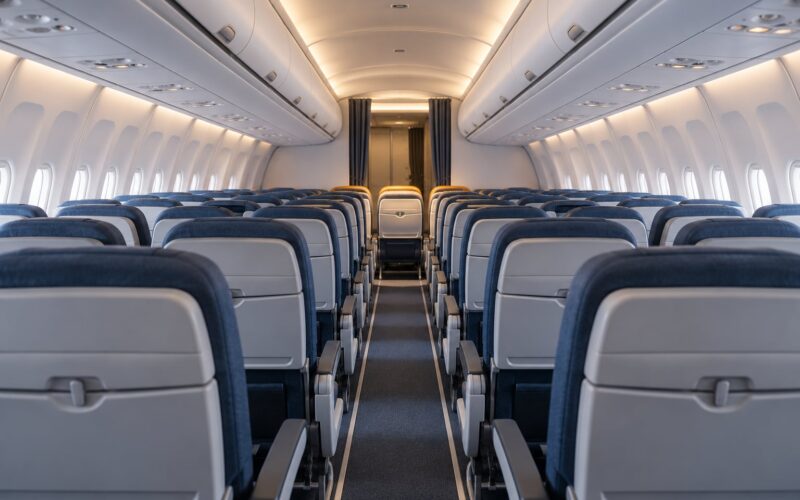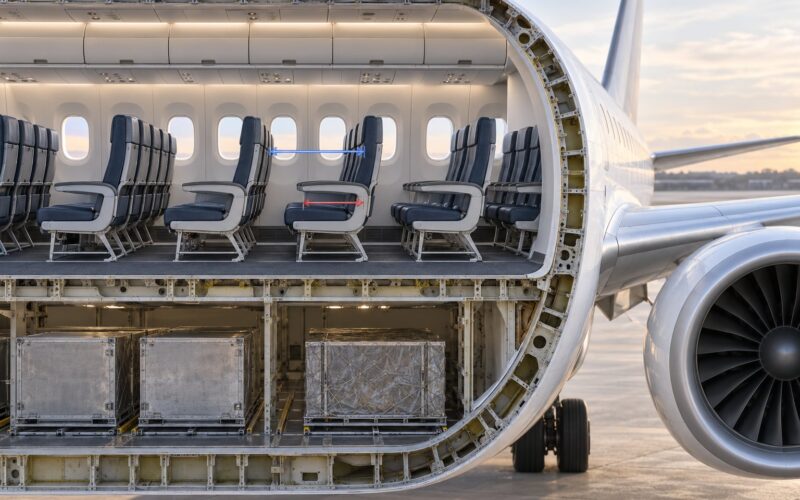
Airplane seats have thin cushions because every inch of padding adds weight, and weight on a full cabin is burned as fuel on every single flight. Airlines solve that with dense, compression-resistant foam that feels firm rather than plush. Add crash-survivability testing, cleaning rules and a cabin packed with extra rows, and a thin seat pan is the only sensible option. Most of the discomfort people blame on the cushion actually comes from pitch, recline angle and seat height.
Table of Contents
- Why Are Airplane Seat Cushions So Thin?
- What Makes an Airplane Cushion Different From a Home Chair?
- Density, not softness
- Layers you do not see
- Weight-limited upholstery
- Seat height and pitch
- How Aircraft Design Tradeoffs Lead to Thin Cushions
- The weight arithmetic
- Densification history
- Crash-survivability requirements
- Cleaning and turnaround
- Why premium cabins still feel firm
- What Types of Foam and Covering Are Used?
- Polyurethane foam, graded by density
- Fire-blocking layers
- Covers
- Premium toppers
- Why the specification flatters it
- Why Do Some Economy Seats Feel Harder Than Others?
- Seat pitch and seat width
- Cushion age
- Aircraft generation
- Where you sit
- Cabin class comparison
- How to Make a Thin Aircraft Cushion More Comfortable
- The three-seat economy trick
- Choosing an add-on cushion: what each type is good for
- Can you bring a cushion through security?
- When a thin seat is not the problem
- Frequently Asked Questions
- Are airplane seat cushions always thin?
- Why does an airplane seat feel harder than its cushion suggests?
- Can I bring a seat pad on a plane?
- Are thicker or denser seat cushions always more comfortable?
- Why do premium cabins still sometimes have thin cushions?
- Conclusion
Why Are Airplane Seat Cushions So Thin?
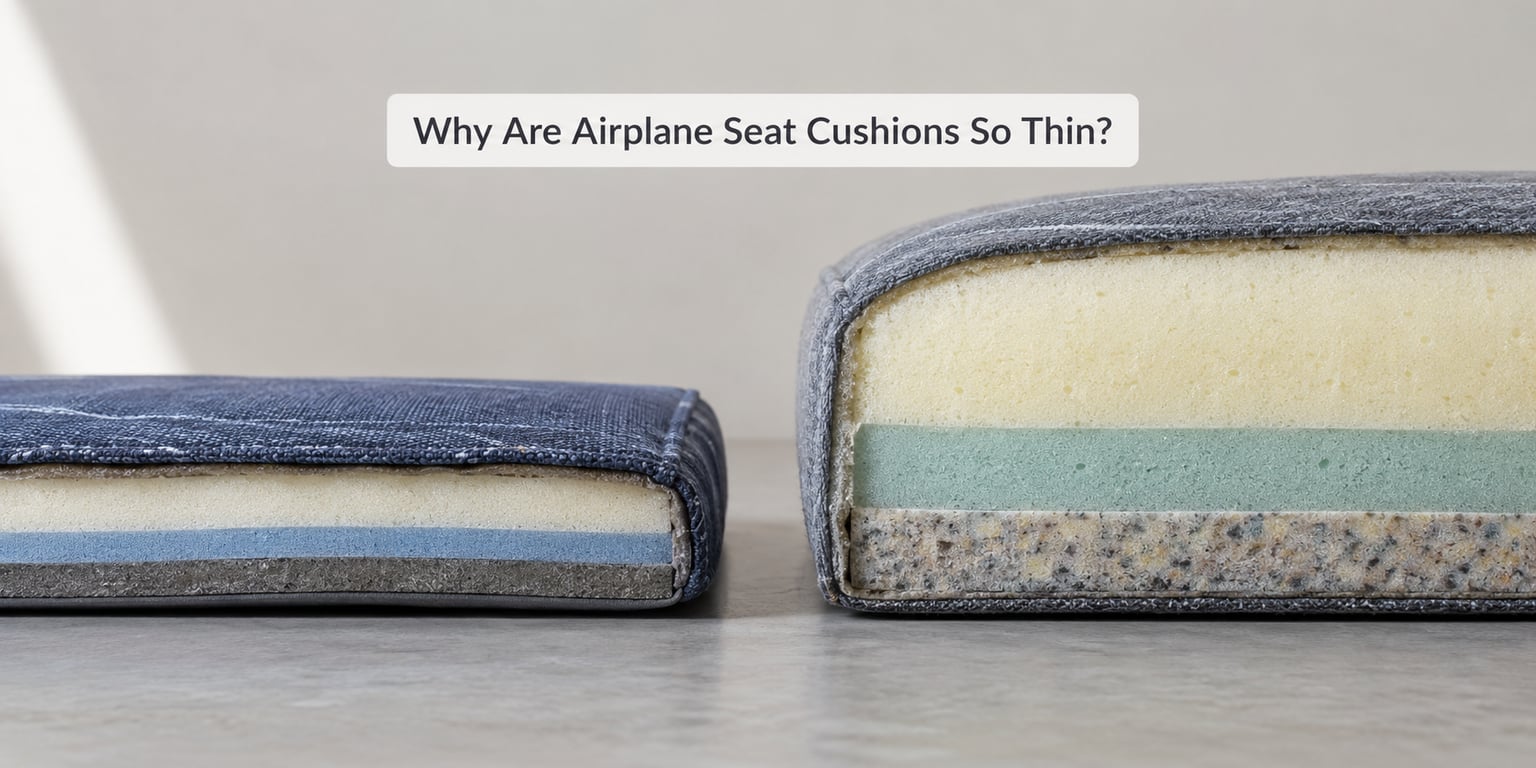
Airplane seat cushions are thin because cushion thickness, foam density and upholstery weight all translate directly into aircraft weight, and every extra pound on a full cabin costs fuel on every flight. Airlines use high-density foam that resists compression rather than soft foam that sinks, and on older aircraft years of service have compressed it further. Short version: thin is a deliberate engineering and economic choice, not an oversight.
The main reasons, roughly in order of how much they matter:
- Weight and fuel burn. Padding multiplied by 180 seats adds up to several tonnes, and fuel is the single biggest operating cost in aviation.
- Payload and range. Every kilogram of seat weight is a kilogram not available for passengers, cargo or fuel on long sectors.
- Seat width. A wider cushion steals the only thing economy passengers cannot get more of, and a thick pad can push you into the aisle.
- Crash-survivability rules. Federal rules require seats to survive dynamic emergency-landing conditions, which shapes how soft the pan can be.
- Foam density engineering. High-density polyurethane holds its shape under load and lasts, where low-density plush foam bottoms out after an hour.
- Cleaning and turnaround. Upholstery has to survive daily wiping, spills and thousands of passengers between deep cleans.
- Age. Foam loses resilience over years of service, so a seat designed thin in year one can feel thinner by year eight.
The result is a pad that measures something like 2 to 3 inches (5 to 8 cm) of finished cushion in most economy cabins, sitting on a rigid pan. That is enough to stop the frame pressing through, not enough to feel plush.
What Makes an Airplane Cushion Different From a Home Chair?
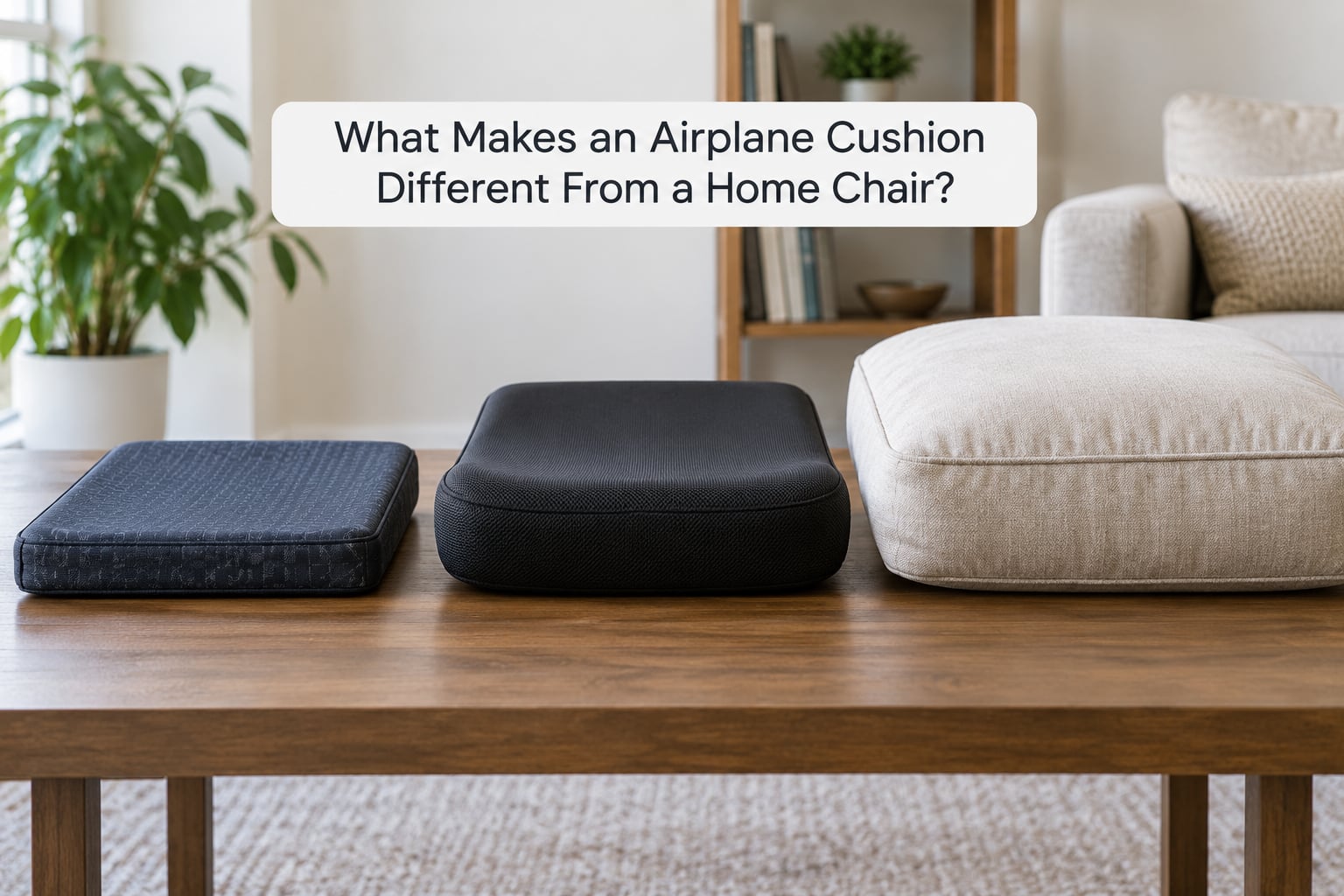
You sit in an aircraft seat for a few hours, then it flies. Your office chair is built for eight hours a day, and your sofa for months. That difference in intended duration drives everything else about the foam.
Density, not softness
A sofa uses low-density foam that feels welcoming the moment you sit down and collapses within minutes. Aircraft foam is denser and firmer, because low-density foam that far back compresses permanently after a handful of flights and would need replacing constantly.
Layers you do not see
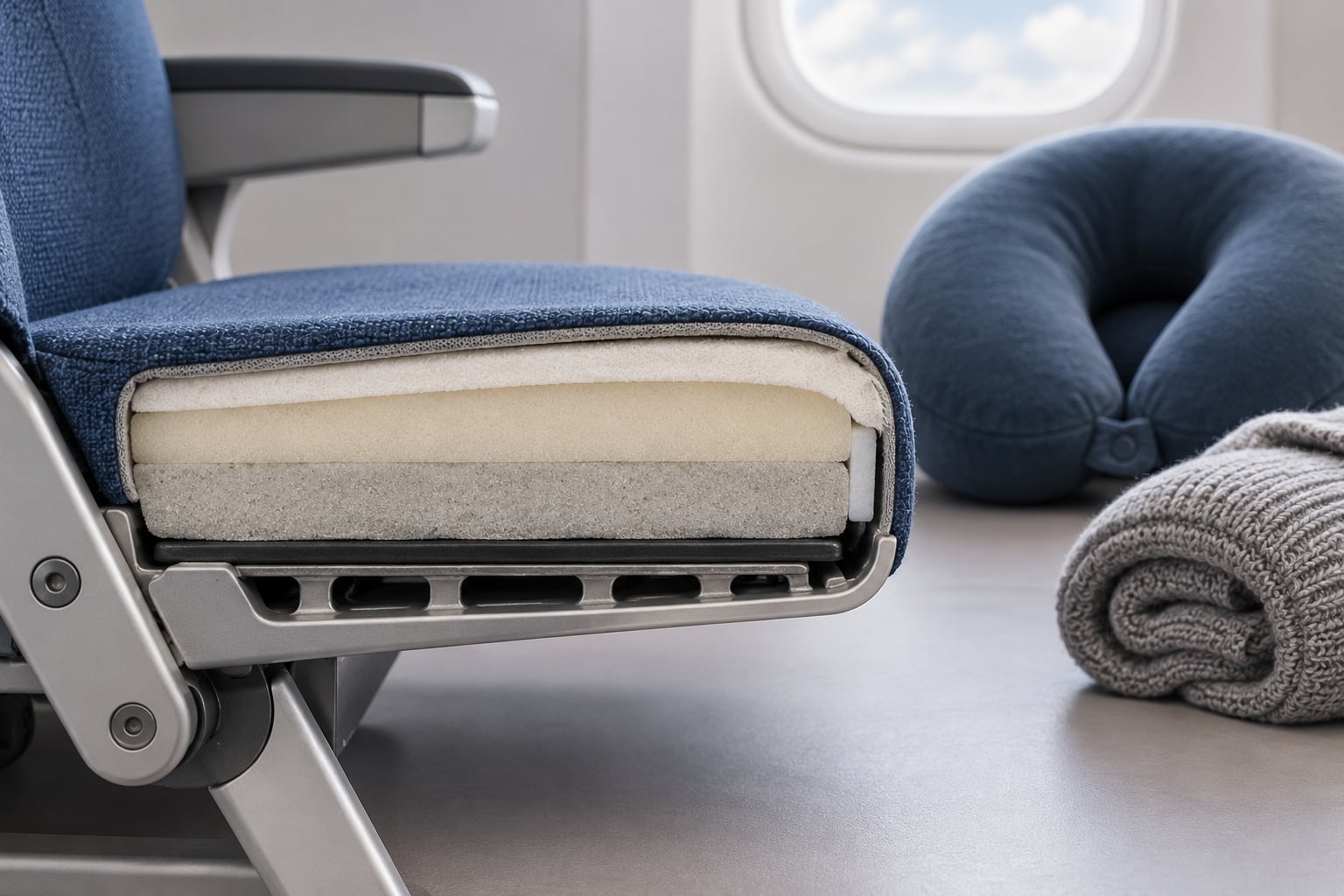
A typical cushion is a stack: a structural base, one or two foam layers, a fire-blocking layer between the foam and the cover, then a dress cover. Each layer adds thickness and weight, and the fire barrier cannot be skipped.
Weight-limited upholstery
Aviation leather is thinner and lighter than automotive leather, chosen specifically for weight reasons. Fabric covers are light but hold onto spills, so many cabins use a mix depending on the aircraft.
Seat height and pitch
Aircraft seats sit higher off the floor than most chairs and give you less foot room, which pushes your knees up and increases the load on your lower back. The cushion has to work harder for the same comfort score.
How Aircraft Design Tradeoffs Lead to Thin Cushions
The weight arithmetic
A modern economy seat with cushion, frame, tray table and screen weighs roughly 25 to 35 kg (55 to 75 lb). Across a 180-seat single-aisle cabin, that is around 10 to 12 tonnes of seats before anyone boards.
Run that across a typical year of short-haul rotations and the fuel figure becomes meaningful. Carrying an extra tonne of weight typically raises fuel burn by a couple of percent on a sector, and thin cushioning is one of the easiest places an airline can cut that weight without passengers noticing on boarding.
Densification history
Post-war piston airliners seated around 21 passengers where modern jets fit roughly 28 in similar cabin space. That template was set in the 1950s and every generation since has squeezed out a little more. When you add rows, the seat gets narrower and the pitch gets shorter, and cushion thickness gets squeezed out first.
Crash-survivability requirements
Federal Aviation Regulation 25.562 sets emergency-landing dynamic conditions: roughly 14 g downward and 16 g forward in a sled test. The seat must hold the occupant’s pelvis in place, keep head injury criterion values within limits and control lumbar load. A deep, soft pan deforms more under that loading and reduces the head clearance the seat gives you, so cushion geometry is designed around the test, not around comfort.
Cleaning and turnaround
Between deep cleans a cabin gets wiped down dozens of times a day. Foam with open cells absorbs fluid and odour; the covers are chosen to wipe clean and resist fire, and replacement cycles for a whole row are expensive. Thinner builds with fewer layers are cheaper to strip, clean and reinstall between checks.
Why premium cabins still feel firm
Extra depth in a business-class pan is affordable because the same thickness is spread over far fewer seats. The added bulk is also part of what makes a lie-flat seat expensive: a thick pan plus a footwell and a mattress layer competes directly with how many rows fit.
What Types of Foam and Covering Are Used?
Polyurethane foam, graded by density
Most seats use combustion-modified polyurethane foam. Density is measured in pounds per cubic foot, and aircraft grades run higher than furniture grades. High density is the point: it feels firm when you first sit down, then resists bottoming out on hour four.
Fire-blocking layers
Federal flammability rules require a barrier between the foam and the outer cover, typically a treated fabric or barrier film. It is thin, but it is mandatory and adds a layer you can feel when you press into the pan.
Covers
Fabric covers are lighter and cheaper but mark easily. Thin aviation leather or synthetic leather wipes clean and looks better, at the cost of weight and stickiness on long sectors. Perforation in the cover and the foam helps airflow, and many covers are treated for moisture.
Premium toppers
Some cabins add a thin memory foam layer or shaped lumbar pad on top of the base foam. That is usually a few centimetres, deliberately modest, because anything thicker lifts the occupant’s hips and changes the sightline over the seat in front.
Why the specification flatters it
Cushions are often quoted at their unloaded thickness. Under your weight the foam compresses, so the number on the spec sheet is what you get if nobody ever sits there. The feel after four hours is the loaded number, and that is the one lower.
Why Do Some Economy Seats Feel Harder Than Others?
Two economy seats on the same aircraft can feel completely different, and cushion thickness is only one of the reasons. These are the variables that actually change the experience.
Seat pitch and seat width
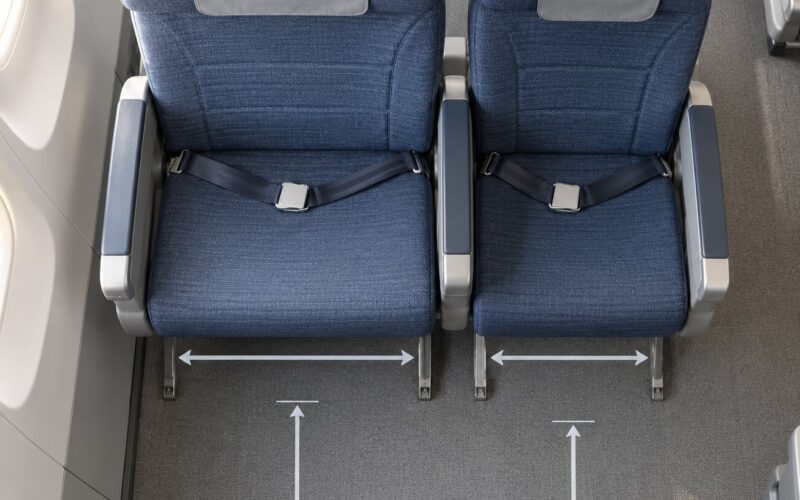
Pitch is the distance between seats, typically 30 to 34 inches (76 to 86 cm) in economy on a narrowbody. Width is the seat pan itself, usually around 17 to 18.5 inches (43 to 47 cm). A seat one inch narrower is the difference between resting against the armrests and being squeezed by them.
Cushion age
Foam loses resilience through compression set, which is the permanent deformation that happens when a soft material is held under load. A seat that felt firm but acceptable when it was new can feel noticeably harder after six years, which is why an older aircraft often gets blamed for its seating when the design never changed.
Aircraft generation
Newer narrowbody cabins generally pitch the comfort story around bigger screens, power and lighting rather than deeper foam. A current-generation cabin is better lit and quieter than the aircraft it replaced, but the seat pan itself is rarely thicker.
Where you sit
Row position matters as much as the seat. Rows at the galley and lavatories deal with noise and queues, rows near emergency exits have restricted recline, and rows behind a bulkhead gain or lose several inches of knee room depending on the aircraft. Window seats let you lean, which changes pressure points more than most people expect.
Cabin class comparison
| Cabin | Typical seat pitch | Typical cushion build | What you feel first |
|---|---|---|---|
| Economy | 30-34 in (76-86 cm) | About 2-3 in (5-8 cm) finished | Pressure at the tailbone past hour four |
| Premium economy | 36-40 in (91-102 cm) | About 3-4 in (8-10 cm), often with a shaped lumbar pad | The extra leg room, not the foam |
| Business | 40-47 in (102-119 cm) upright, far more reclined | About 4-6 in (10-15 cm) with memory foam layers | Recline range and footwell |
| First | 45-60 in (114-152 cm) | Typically the deepest build in the cabin | Width and lie-flat angle |
These are typical ranges, not guarantees. Configurations vary by airline and by aircraft type, and a low-cost carrier on the same jet type will sit a row closer than the full-service airline next door.
How to Make a Thin Aircraft Cushion More Comfortable
You cannot change the cushion, but you can change how you sit on it. Ranked by how much difference they actually make, most people first:
- Move every hour. Stand up, walk the aisle, stretch your ankles. Most of the pain people blame on the seat is really static posture, and no cushion fixes that.
- Fill the lumbar gap. A rolled sweater, a travel neck pillow deflated to a half, or a folded blanket behind your lower back restores the curve your spine expects. This is the single most effective change for most people.
- Use the seat-back pocket as a backrest stop. Keep a soft item in the pocket so it stops the seat reclining fully behind you, which stops the head-thumping that ruins long flights.
- Choose the seat before you board. Pick an aisle seat if you will move around, an exit row if you want the space and can meet the requirements, or a window seat if you will sleep and want to lean.
- Dress for it. Loose layers and thin socks make a measurable difference over 12 hours. Denim and a thick belt are the two things people most often regret.
- Try a slim add-on cushion. Something 1 to 2 inches (2.5 to 5 cm) thick that fits within the seat width, rather than a thick one.
- Give your feet somewhere to go. A footrest on the seat-back bar or an inflatable footrest reduces the load on your hips by changing your leg angle.
The three-seat economy trick
On a three-across row, the middle seat gives you one armrest instead of two, which widens your usable space by several centimetres. The trade-offs are no window and no aisle, plus two neighbours leaning in. For a long sector with an aisle seat already occupied next to you, it is often worth it.
Choosing an add-on cushion: what each type is good for
| Type | Typical thickness | Best for | Watch out for |
|---|---|---|---|
| Inflatable air-channel cushion | Adjustable when inflated | Firmness you control; deflates and packs into a bag | Loses pressure over a very long sector |
| High-density memory foam | About 1-2 in (2.5-5 cm) | Long-haul support, especially for the lower back | Can be too wide for a narrow seat pan |
| Gel cushion | About 1 in (2.5 cm) | Pressure relief for the tailbone | Often arrives flatter than the listing suggests |
| Inflatable lumbar pillow | Varies | Filling the lower back gap on a reclined seat | Only useful in reclined positions |
| Rolled jacket or sweater | Free | Everything above, at zero cost and zero bulk | Not much support if the fabric is thin |
Can you bring a cushion through security?
In the United States, TSA lists seat cushions and pads among items allowed in carry-on bags, and inflatable travel pillows and gel-filled cushions are generally permitted. Items containing liquid or gel beads, including some frozen gel packs, may need to be frozen solid at screening. Rules differ outside the US, so check your departure airport’s authority if you are flying internationally.
When a thin seat is not the problem
If your hips and lower back ache but the cushion feels fine, the real culprits are usually seat pitch, a recline angle that pushes your pelvis forward, or a seat too high off the floor for your legs. A cushion cannot fix any of those, and a thick cushion can make them worse by raising your hips and reducing knee clearance. If changing position solves the pain, the pad was never the problem.
Frequently Asked Questions
Are airplane seat cushions always thin?
Not always, but economy cushions are consistently thinner than what you have at home. Most finish at roughly 2 to 3 inches (5 to 8 cm) including the cover and fire barrier, because weight and seat width limit how much padding fits. Premium economy, business and first class add depth, usually as a separate memory foam layer rather than a deeper base.
Why does an airplane seat feel harder than its cushion suggests?
Cushion thickness is usually quoted unloaded. Once you sit on it, the foam compresses and the number you feel is the loaded one, which is noticeably lower. A firmer high-density foam also feels harder than a soft low-density foam of the same thickness, because it resists bottoming out instead of absorbing you. Pitch, seat height and recline angle make it feel harder still.
Can I bring a seat pad on a plane?
Yes, in the United States TSA allows seat cushions and pads in carry-on luggage, and inflatable travel pillows and gel-filled cushions are generally fine. Anything with liquid or gel beads inside may need to be frozen solid at the checkpoint. International rules vary by departure airport, so check locally before a long trip. Airlines may also ask you to stow bulky items during taxi.
Are thicker or denser seat cushions always more comfortable?
No. A thick cushion that is wider than your seat pan pushes you against the armrests and lifts your hips, which increases pressure on your lower back. For most long-haul passengers, a slim pad of about 1 to 2 inches that fills the lumbar gap works better than a deep one. Get up and move every hour regardless of what you sit on.
Why do premium cabins still sometimes have thin cushions?
Premium cabins allocate depth more carefully than you would expect. Extra bulk competes with the footwell, the lie-flat angle and how many rows fit, and a thicker pan also raises the passenger higher, changing the sightline over the seat in front. What you usually feel first in a premium seat is pitch, recline range and width rather than foam depth.
Conclusion
Thin cushions are not lazy design. They are the result of weight limits, cabin densification, crash-survivability testing and cleaning economics, all pulling in the same direction. The cushion you sit on is the one place airlines can save quietly.
So start with the free fix: put something rolled behind your lower back and get up every hour. Then pick your seat carefully, add a slim pad that fits within the seat width, and stop worrying about the foam. Pitch, recline and seat height will decide how your flight feels long before cushion thickness does.