A business class suite is an enclosed premium cabin seat built like a small private room. It usually has a sliding privacy door, direct aisle access and a fully flat bed, so you can stand, change, work or sleep without a stranger beside you. Airlines call it a suite because it is closer to a compact cabin than to a seat.
The word gets used loosely, though. Plenty of airlines sell business class without suites at all, and the same airline can have two completely different business class cabins depending on the aircraft flying your route. That mismatch is the single most common complaint people have about suites, so it is worth knowing exactly what you are buying before you pay for one.
Table of Contents
- What Is a Business Class Suite?
- Business Class Suite vs. Standard Business Class Seat
- What Makes a Business Class Suite Different?
- Direct aisle access is the feature that changes a suite
- Doors and screens instead of open rows
- A bed rather than a recliner
- Bed dimensions that actually matter
- Storage, power and controls
- Larger personal screens
- Dedicated service
- How Do Business Class Suites Work?
- Which Business Class Suite Layout Is Best?
- 1-2-1 layout
- 1-1-1 layout
- Herringbone and reverse herringbone
- Alternating forward and rear facing
- Which seat should you pick?
- What Amenities Are Usually Included?
- How to Choose a Business Class Suite for Your Trip
- Frequently Asked Questions
- Are business class suites actually private?
- Can you sleep flat in a business class suite?
- Which airlines offer business class suites?
- Do all business class flights have suites?
- Is a suite worth it on a shorter flight?
- Conclusion
What Is a Business Class Suite?
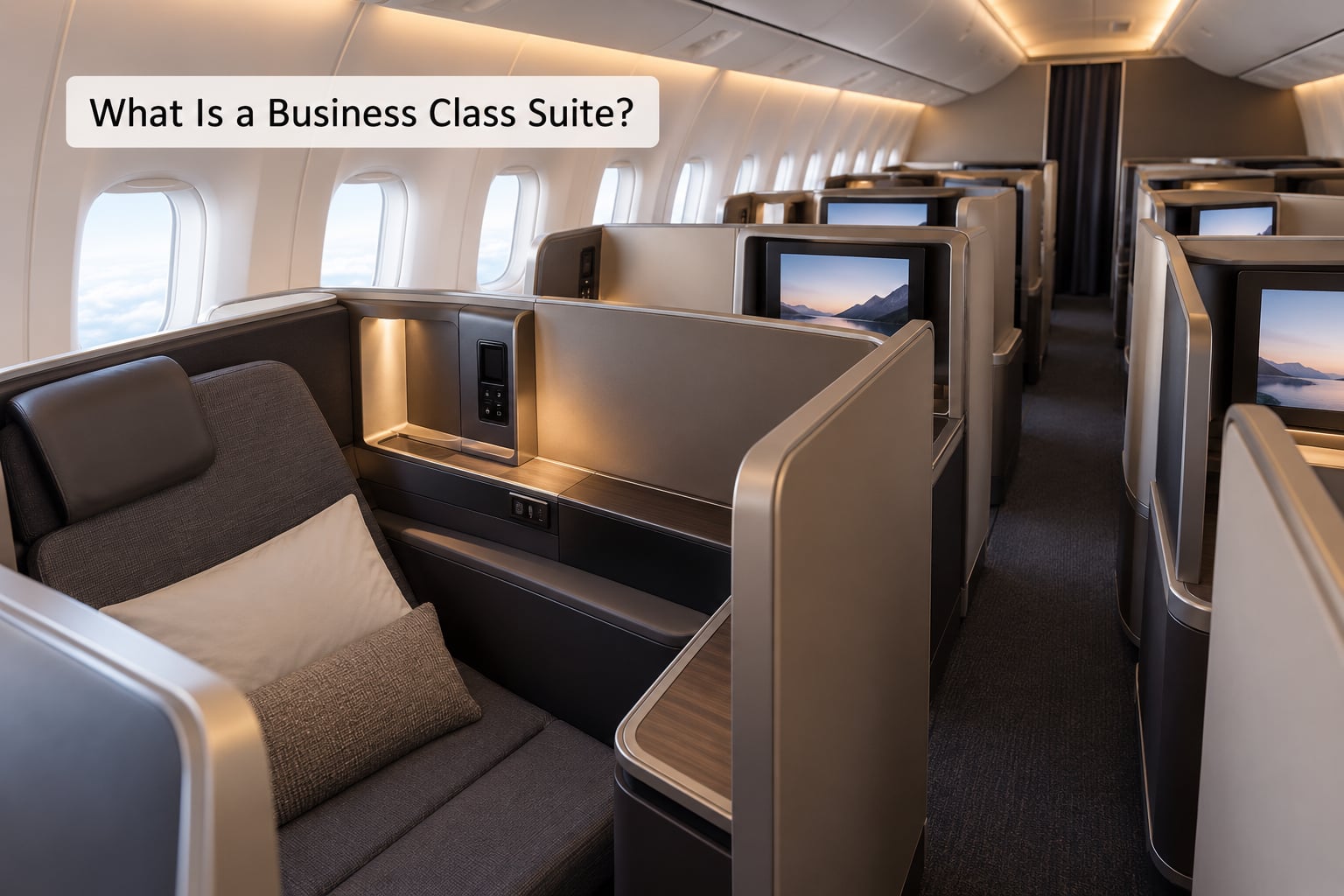
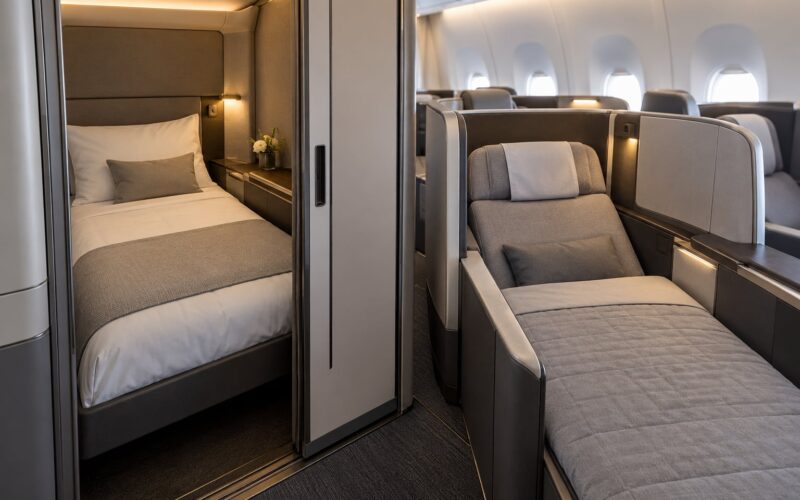
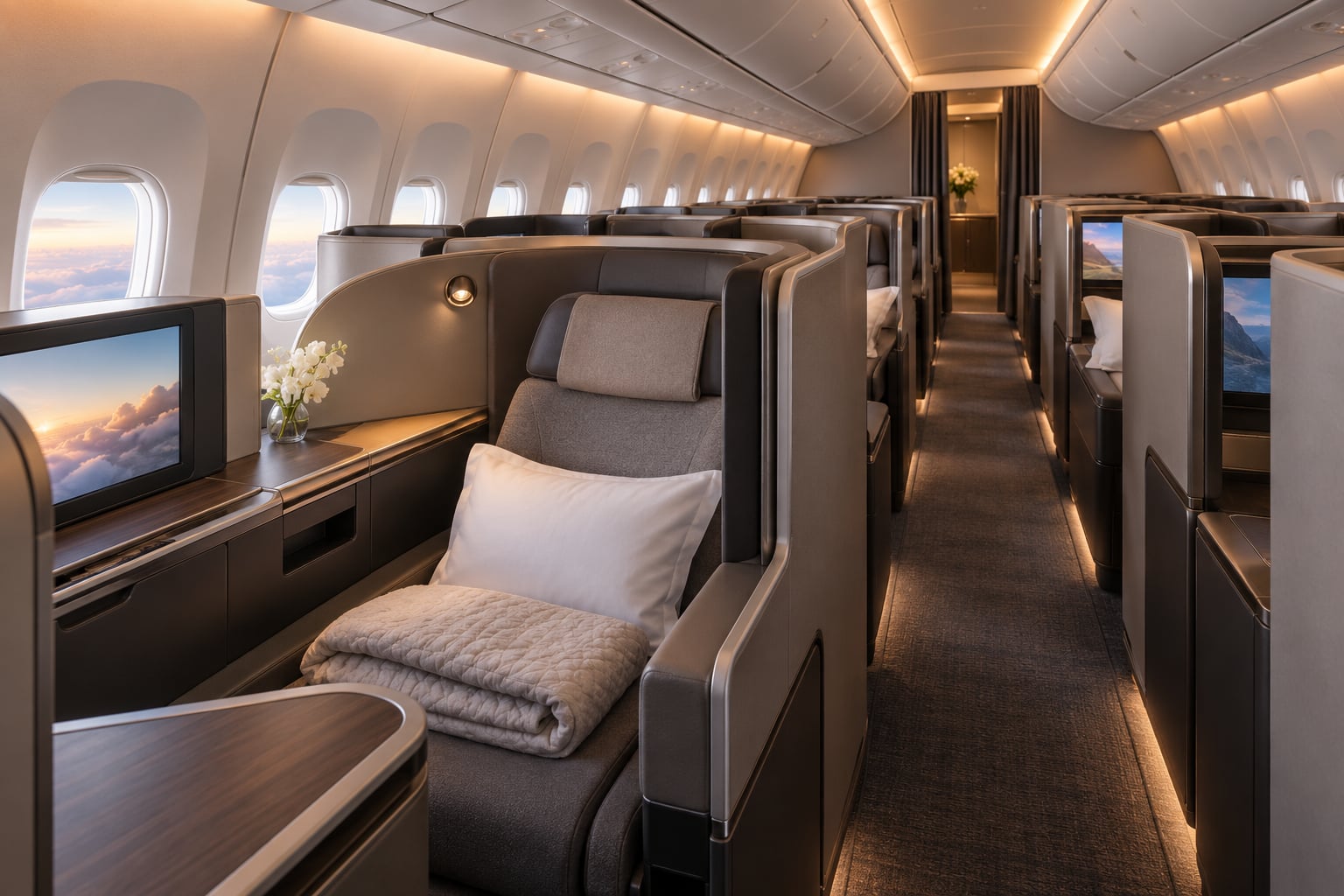
A business class suite is a premium cabin seat pod with high side walls, a closable privacy door or screen, a seat that converts fully flat, and its own storage, power and screen. The defining feature is not the seat. It is the enclosure: a suite turns one section of a cabin into something closer to a private room than an open row of seats.
To make the idea concrete, consider Qatar Airways’ version on the Boeing 787-9. The suite has direct aisle access, a sliding door, and a bed that extends to 79 inches when flat. On that aircraft the centre-row suites can be combined into a double bed, which is the most common layout trick that makes a suite work for two people.
A suite is not the same thing as first class, although the line has gotten blurry. A first class suite generally adds things like a longer bed, a larger meal served on tableware rather than in a tray, a private suite rather than a shared lounge, and a much higher fare. Some business class suites now match or beat certain first class products on bed length alone, which is exactly why the real distinction today has become price and service rather than hardware.
The core features you will see again and again:
- A sliding door or a tall fixed partition that separates you from the aisle
- Direct aisle access, meaning nobody has to climb over you to reach their row
- A fully flat lie-flat bed, typically in the 77 to 80 inch range on a standard suite
- High side walls and often a closing panel above the seat
- Storage for a small bag, plus a seat control panel and a personal screen
- Power outlets, often including USB-C, and dimmable mood lighting
Business Class Suite vs. Standard Business Class Seat
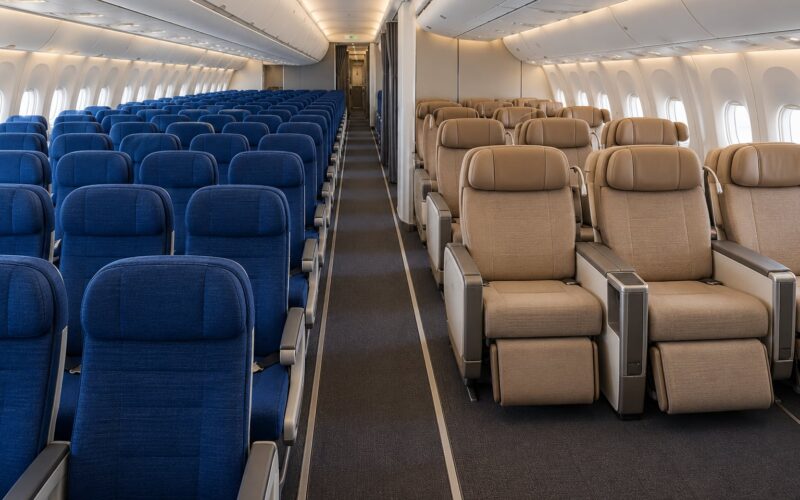
The gap between a suite and a standard business class seat is mostly about space and access. A standard seat reclines to a recliner angle, sits shoulder to shoulder with its neighbours, and has no walls. A suite is wider, isolates you, and lies flat on a real bed surface.
| Factor | Business class suite | Standard business class seat |
|---|---|---|
| Seat width | Wide, often around 22 to 25 inches in business class | Narrower, commonly 19 to 21 inches in a recliner-style seat |
| Recline | Fully flat bed with a mattress surface | Reclines back but stays at an angle, so you slide forward asleep |
| Privacy | Sliding door or tall partition, sometimes full height | Low shell divider, usually at shoulder level or lower |
| Aisle access | Every seat has a walk-in door | Seats in the middle are reached by climbing past others |
| Storage | Dedicated cubby and side console, room for a small bag | Under-seat space shared with the passenger behind |
| Work surface | Large tray table that opens across the bed or lap | Smaller tray that folds against the armrest |
| Service | Multi-course dining, often served on tableware, more attention from crew | Multi-course dining in a tighter space, tray service on most routes |
| Typical use | Overnight long-haul, work trips, privacy-sensitive travel | Daytime flights, shorter routes, light-haul sleeps |
Read across one row and the pattern is obvious: a suite buys you width, enclosure and a flat bed. Everything else is a bonus. That is also why a suite on a three-hour daytime flight often feels like a lot of money for a wide chair.
What Makes a Business Class Suite Different?
Seven things separate a real suite from a premium recliner with a marketing name. Some airlines deliver all seven, some deliver three, and that difference only becomes obvious once you are lying down at midnight.
Direct aisle access is the feature that changes a suite
Direct aisle access means your suite has its own door onto the cabin walkway, so you never squeeze past a stranger to get to your seat or to leave for the lavatory. In a 1-2-1 layout every seat in the cabin has it, including the middle seat. In older 2-2-2 configurations nobody does, which is why those cabins get described as premium economy in everything but name.
It also changes how the seat feels while you are in it. Without someone stepping over your legs to reach the aisle, the lie-flat position is genuinely usable. Passengers comparing carriers point at exactly that trade-off: better privacy on one airline’s 787s, but less overall width and space.
Doors and screens instead of open rows
A closing privacy door is the strongest signal you are in a suite. Doors vary a lot in quality. Flyers describing an Air France flight between San Francisco and Paris have noted that the suite gave very good privacy while seated but that the walls were not especially tall and the door felt thin. That is the honest version of the marketing claim, and it is a fair test to apply to any suite you are considering.
A bed rather than a recliner
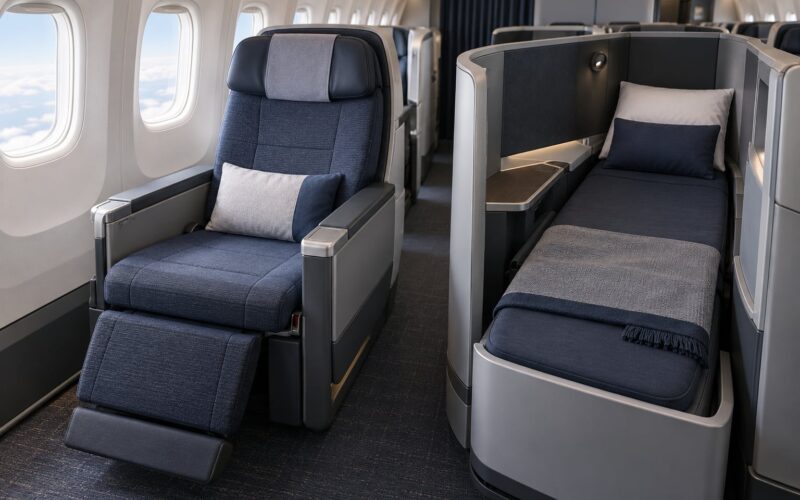
Lie-flat means the seat reaches horizontal and the seat back and leg rest meet in a continuous surface. Beds on true suites commonly run 77 to 80 inches, and Delta’s One suites are described at 77 to 80 inches depending on the aircraft type. Anything noticeably shorter than that is a problem for tall passengers, and bed length is one of the most useful numbers to check before you book.
Bed dimensions that actually matter
Two numbers decide whether you will sleep well: length and width. A 78 inch bed suits most adults. A bed under about 76 inches fits a tall passenger badly, with their feet against the divider. Width decides whether sleeping next to a partner is pleasant or a contest, and whether two centre suites combined into a double bed genuinely fits two adults.
Storage, power and controls
A suite usually has a dedicated side console with a cubby for a backpack, a fold-out surface, a power outlet and sometimes a small shelf for a drink. Controls sit on a touchscreen or a handset arm: bed mode, recline, lumbar, massage and lighting. Reviewers repeatedly list storage and power among the practical details that separate a satisfying suite from a disappointing one.
Larger personal screens
Suite screens are typically larger than standard business class screens, often in the 15 to 22 inch range on a 4K or near-4K panel. The extra inches matter more than the resolution, since you are watching from bed distance with the screen on an arm.
Dedicated service
Crew on a suite cabin usually outnumber passengers more generously than in standard business class, and meals tend to arrive on real tableware rather than a tray. On long-haul routes this shows up as more course pacing, more willingness to top up drinks, and sometimes a made bed before lights out.
How Do Business Class Suites Work?
Boarding feels familiar, with priority check-in, priority security and a dedicated cabin line. The suite itself is where the difference lives. You scan your boarding pass at the door, slide in, and the first job is learning the control panel.
From there the pattern repeats. The seat reclines through lounge positions into bed mode, the side console lights up, and the door slides shut. Ambient lighting dims, screens come out of their housings, and service starts with a drink and a multi-course meal. On a night flight the crew may turn the seat down for you while you are at the lavatory.
Sleeping is the real test. You lie flat, close the door, and the noise of the cabin drops to a hum. Movement from the aisle is the thing you stop noticing, which is the practical payoff of the enclosure.
Working is simpler than in any other cabin class. The tray table opens flat across your lap or the bed, the screen is on an arm, and the power outlet is next to you. The practical limit is bandwidth rather than furniture, since connectivity varies a lot by route and by cabin.
Airlines differ sharply here, and so do aircraft. Some suites have a fixed ottoman and a bed that runs lengthwise. Others convert with the seat reclining and the footrest rising into a footwell. The result feels different, and so does the noise: an enclosed pod muffles the cabin, while an open seat does not.
Which Business Class Suite Layout Is Best?
Layout decides how private a suite really is, and it is the part most people skim past. Two numbers describe it: how many seats each row has, and how they are arranged.
1-2-1 layout
One window seat, two centre seats, one aisle seat. Every seat has a direct aisle door, and the middle pair can often be joined into a double bed, which is the arrangement used by Qatar Airways and by Delta’s One cabin. This is the most common modern layout, and the one most travellers mean when they say they want a suite.
1-1-1 layout
Every seat is alone, with a window and an aisle door on both sides. Privacy is the best available, since no neighbour shares a console. The cost is cabin width, which means fewer seats and a lower-density cabin. Some carriers also charge a supplement for the aisle seat in this layout.
Herringbone and reverse herringbone
Herringbone means the seat backs zigzag across the cabin, alternating forward and rear facing, so staggered seats slide past each other like roof tiles. Reverse herringbone flips the direction, so the seat back sits higher than the seat in front of it. That single change gives the passenger behind a better forward view of the screen instead of a wall. Several well-reviewed suites use this pattern.
Alternating forward and rear facing
In a mixed-facing cabin, half the rows point forward and half point backward. This gives the rear-facing passengers a proper view out of the window and away from the seat in front. Plenty of frequent flyers ask for a rear-facing herringbone seat on purpose.
Which seat should you pick?
Window or aisle depends on what you need. A window suite gives you light and a wall on one side. An aisle suite gives you the fastest escape and easier access to the lavatory, and in a 1-1-1 layout both are available. Centre suites, by contrast, suit couples who want the double bed and avoid anyone who wants complete separation, since the dividers between centre seats are adjustable rather than solid.
On a night flight, privacy and bed length beat anything else. On a daytime flight where you plan to work, a rear-facing herringbone seat with a solid surface and good light wins. On a short route, pick whichever is cheapest and get the lounge.
What Amenities Are Usually Included?
Most suite cabins include a core set of items, and then airlines add extras. It helps to know which is which.
Usually standard in a suite:
- A mattress pad, memory foam cushioning, a large pillow, a duvet and a second smaller pillow
- Multi-course dining, with breakfast served at your seat on many routes
- A drink before the meal, wine throughout it, and a bar service afterwards
- Noise-cancelling headphones, though the seat’s own shell muffles a good amount of cabin noise
- A large in-flight entertainment screen with seat-back or arm-mounted controls
- Power outlets, usually including USB-C, plus dimmable mood lighting
- An amenity kit with toiletries, slippers and a sleep mask
- Priority boarding, dedicated cabin bins and lounge access before departure
Often airline-specific or route-specific instead:
- A private suite lounge in the departure airport, as Delta One passengers have
- A double bed made up by the crew for centre suites
- Recycled bedding made from rPET bottles, which Delta has published figures for
- Chaise lounge or lounge-style seating in newer premium cabins
- Tableware and plated service rather than tray service on some carriers
One more thing to check: amenity and bedding lists change with the aircraft, not just the airline. Two business class products on the same airline can arrive with different bedding and different service. That inconsistency, more than anything else, is why reviews of a suite read so differently from one trip to the next.
How to Choose a Business Class Suite for Your Trip
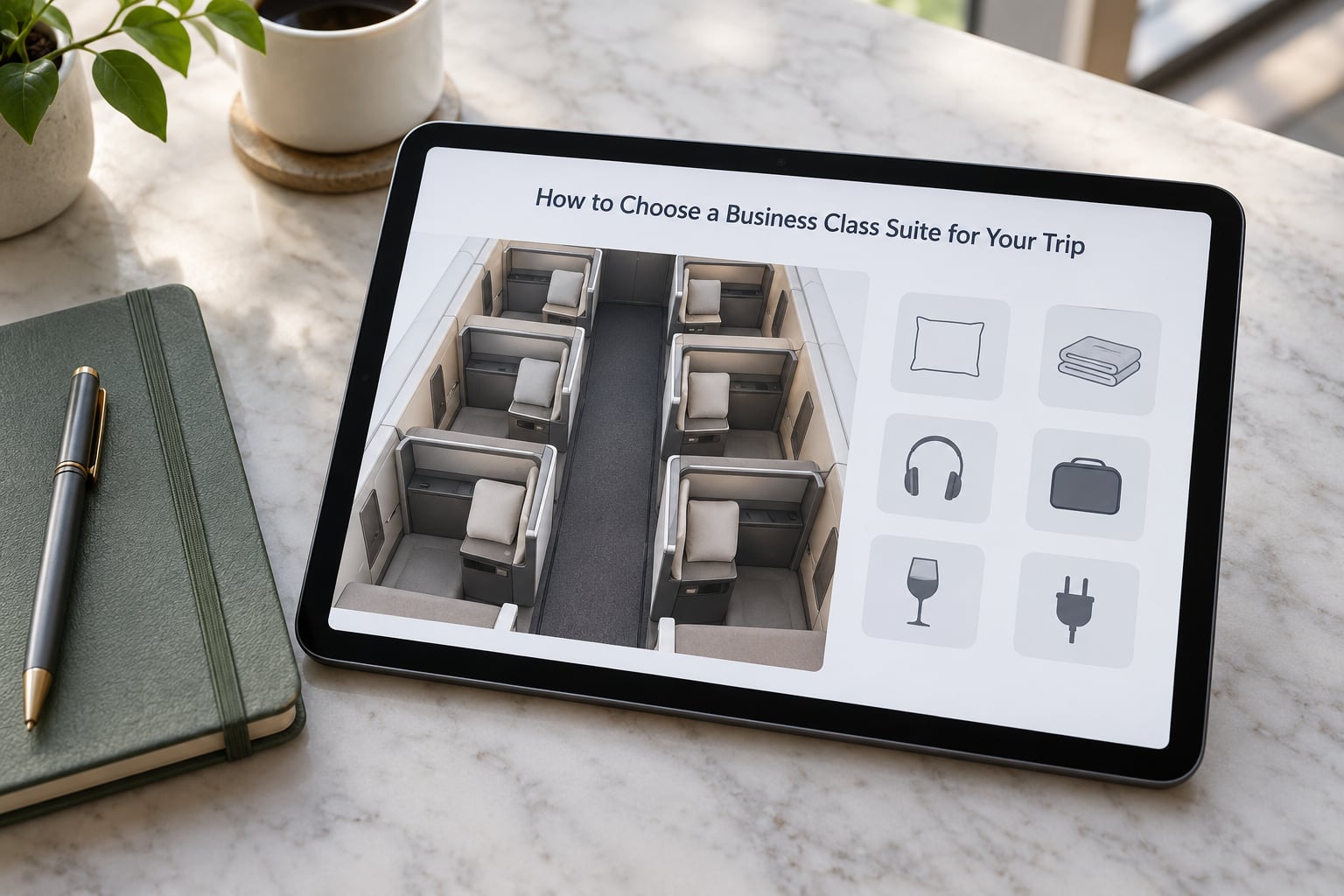
Most disappointments come from checking the airline name and not the aircraft. A nine-step habit fixes most of that.
- Check the aircraft, not the cabin. Look up the specific flight number and aircraft type before you book. Airlines swap equipment seasonally, and several have not finished retrofitting every plane in a premium cabin.
- Read the seat map for that aircraft. The map shows whether the row is 1-2-1 or 1-1-1, where the doors sit, and which rows are missing because of galleys or exit rows.
- Find the real bed length. Reviews and detailed seat guides list bed dimensions per aircraft. Anything under roughly 76 inches is tight for a tall passenger.
- Judge the privacy honestly. Look for photographs of the door open and closed, and for comments on wall height. Thin doors are a known issue on some suites.
- Decide whether you want a door or a wall. A fixed partition is quieter and cannot slide open, but no centre pair can be joined. Most travellers prefer the door.
- Think about your flight length. Under about five hours, a suite is mostly a wide seat with good service. Six hours and up, the bed and the door start to earn their cost.
- Read the fare rules before committing. Some carriers charge extra for the aisle seat in 1-1-1 cabins, and seat selection rules differ on partner or codeshare flights.
- Use your status and points. Most premium cabins release inventory to elites and to points holders days before general sales, and awards often open 330 to 355 days out.
- Match the seat to who is travelling. A solo passenger who wants seclusion should take a window or aisle suite. A couple who wants to share a bed should take the centre pair and confirm the combined width.
Add the mundane checks that reviewers mention most: is there room for your bag, is there a power outlet by the seat, and does the suite come with the bedding you need. These small things decide whether a flight feels premium or merely expensive.
Frequently Asked Questions
Are business class suites actually private?
Mostly, but not completely. The door and high walls block the aisle view, most movement and a lot of noise. What they do not block is everything. Passengers have described walls that are not especially tall and doors that feel thin, and centre suites share adjustable dividers with a neighbouring seat. A window or aisle suite in a 1-1-1 layout is the most private you can book.
Can you sleep flat in a business class suite?
Yes, that is what the bed is for, and on a long night flight most passengers use it. A lie-flat suite reaches horizontal with a continuous mattress surface, usually 77 to 80 inches long, so you do not slide forward asleep the way you do in a recliner. Sleep quality depends on length, a closed door, dimmed lighting and bedding. On short daytime flights the bed is rarely used.
Which airlines offer business class suites?
Qatar Airways markets its enclosed suites with sliding doors and a 79-inch bed on the 787-9. Delta’s One cabins use fully enclosed suites with doors. Others sell premium cabins built around a suite concept, including Cathay Pacific’s newer Aria product, ITA Airways’ THE Room FX, Korean Air’s Premium Class and Air France’s La Première at the top end. Availability depends entirely on the aircraft operating your route.
Do all business class flights have suites?
No. Many aircraft still carry angled recliners or non-flat seats marketed as business class, and airlines with excellent suites on one plane may fly a different plane on your route. Seat maps and reviews show the difference, but schedules change. Always check the specific flight and aircraft before paying for a product that is named after a suite.
Is a suite worth it on a shorter flight?
On a flight under five hours, usually not in bed terms. You will use the width, the storage, the service and the lounge, but the lie-flat feature rarely gets used in daylight. On six hours and above, particularly overnight, the door and the flat bed change the trip. Frequent flyers note that suites can feel wasted on short sectors, so if the route is short, put the money into a better cabin on a longer flight.
Conclusion
A business class suite is defined by three things: a private enclosure, direct aisle access and a fully flat bed. Get those and you have a small room that works for sleeping and working on a long-haul flight. Miss any one of them and the product is closer to a wide recliner than to a suite.
Before you choose, check the exact aircraft, read the bed length for that plane, look hard at the door and wall height, and decide whether you are travelling solo or in a pair. Those four checks prevent nearly every complaint people end up posting about premium cabins.