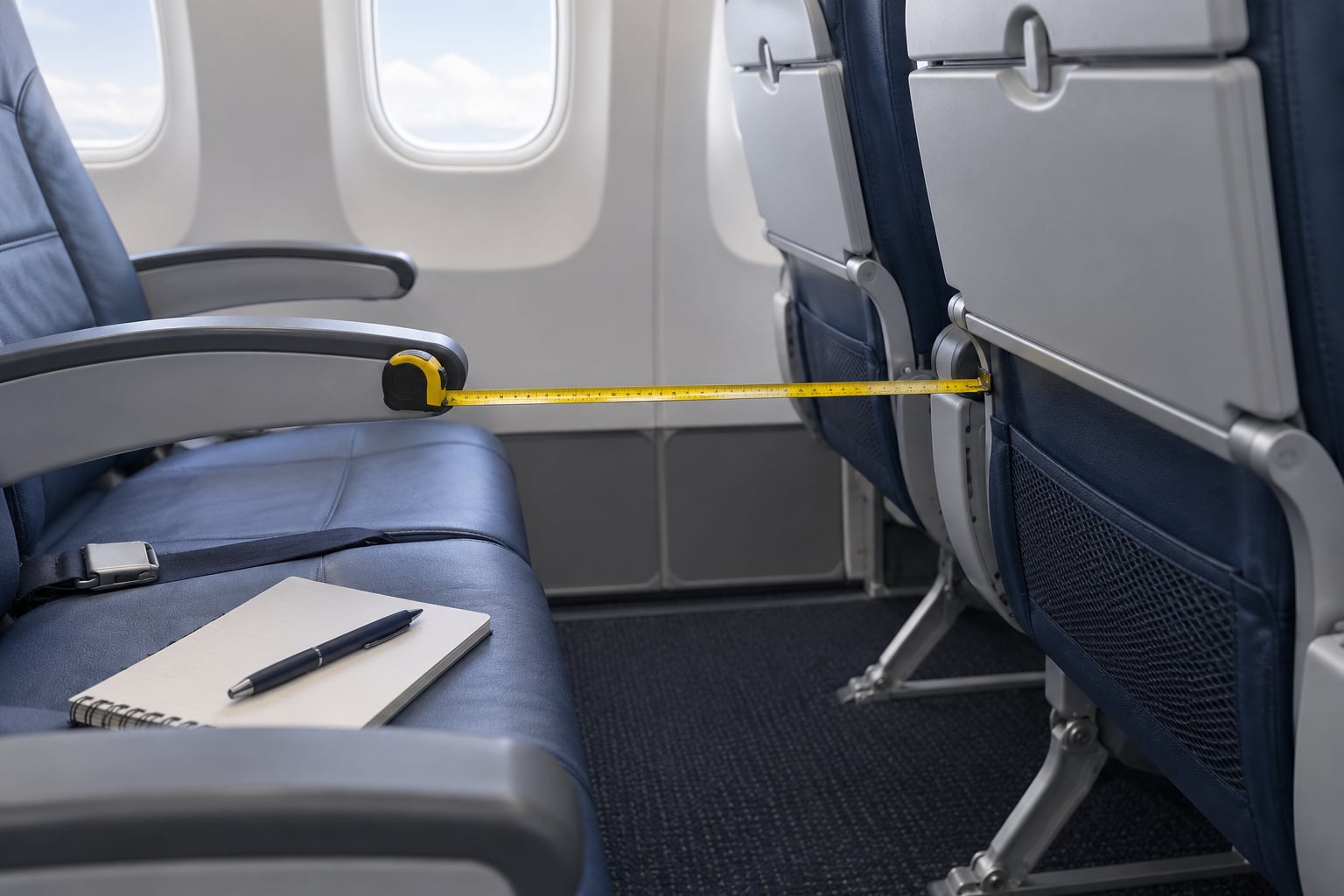
Legroom on a plane is the space between your seat and the seat in front of you, and the only standardized measurement of it is seat pitch: the straight-line distance from a given point on one seat to that exact same point on the seat directly ahead, expressed in inches or centimeters. You can check the published figure, measure it with a tape, test it with your knees, or compare it against a consistent seat-rating system. The whole process takes about ten minutes before you book and two minutes once you’re on board.
The catch is that published pitch and the legroom you actually feel are rarely the same number. That gap is where most disappointing flights come from, and it’s also where a few minutes of measuring pay off. Here’s what to gather and how to use it.
Table of Contents
- What You Need
- Step-by-Step: How to Measure Legroom on a Plane
- 1. Check the Aircraft’s Seat-Pitch Specifications
- 2. Measure the Distance Between Seatbacks
- 3. Use the Seat-Map and Cabin-Layout Details
- 4. Compare a Consistent Seat-Rating Method
- Common Mistakes
- Frequently Asked Questions
- Is seat pitch the same as legroom?
- What is considered good legroom on a plane?
- How many inches of seat pitch do I need for a long flight?
- Can I measure legroom before buying a plane ticket?
- Does business or first class always have the same legroom on every airline?
- Why can two seats with the same listed pitch feel different?
- Conclusion
What You Need
Most of this list is free. The only real purchase is a cheap tape measure, and you can skip that if you have a rigid card or a phone with a centimeter toggle.
- The aircraft type and cabin layout for your specific flight, not just the airline. The same plane type flies with several cabin configurations, and the pitch changes between them.
- Published pitch figures for that aircraft and cabin, in inches or centimeters.
- A tape measure, a rigid card, or a phone set to centimeters if you want to work in metric.
- Your own height and the length of the flight. Both change what counts as good.
- Ten minutes before you book, plus a willingness to ask a flight attendant a direct question once you’re on board.
One thing worth adding: the seat in front of you reclines, and that single fact changes your usable space more than a couple of inches of nominal pitch does. Keep it in mind for every method below.
Step-by-Step: How to Measure Legroom on a Plane
1. Check the Aircraft’s Seat-Pitch Specifications
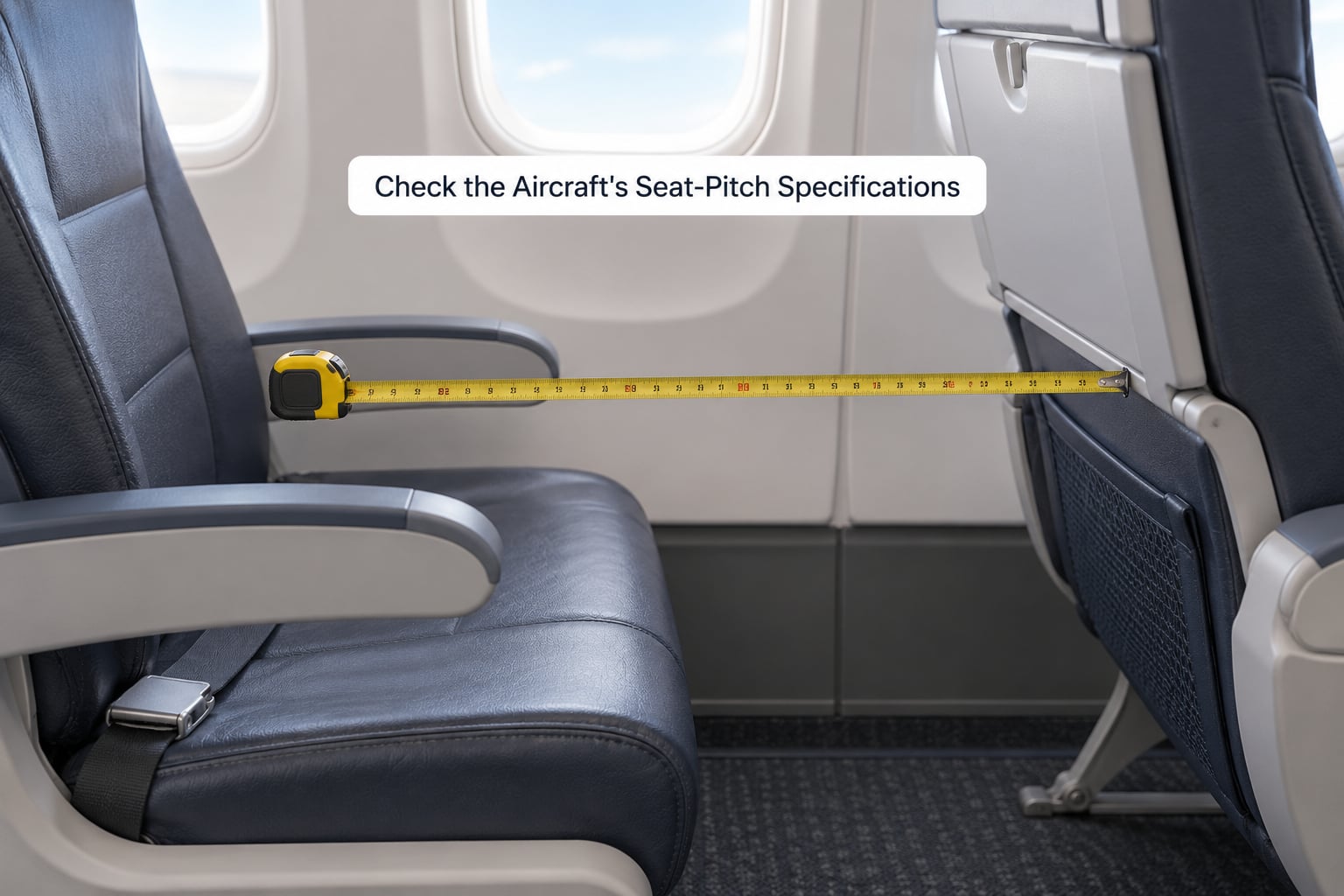
Start here, because it takes the least effort and sets your baseline. Seat pitch is measured from one consistent point on a seat to the identical point on the seat ahead, usually the front edge of the cushion or the top of the backrest. Seat map tools publish this figure for nearly every aircraft type and cabin, and it is the number airlines themselves sell against.
It is useful, but it is a promise about row spacing rather than a measurement of your knees. A thick seatback, a deep literature pocket and a shallow cushion all eat into that same figure without changing it by a single inch.
Most of these numbers are published in centimeters outside the US, so here is the conversion that comes up most often when you search:
| Seat pitch (cm) | Seat pitch (inches) | What it usually means |
|---|---|---|
| 76 cm | 29.9 inches | Tight; fine under two hours, punishing beyond five |
| 79 cm | 31.1 inches | Standard US domestic economy |
| 81 cm | 31.9 inches | Upper end of typical economy |
| 84 cm | 33.1 inches | Comfortable; what most people call good |
| 86 cm | 33.9 inches | Genuinely roomy for economy |
Worth knowing before you read too much into any single figure: the FAA does not set a minimum seat pitch, and news coverage from 2018 tied the debate to the 90-second evacuation certification standard rather than to comfort rules. No rule has changed since then, which is why the number you get is whatever the airline decided it wanted.
2. Measure the Distance Between Seatbacks
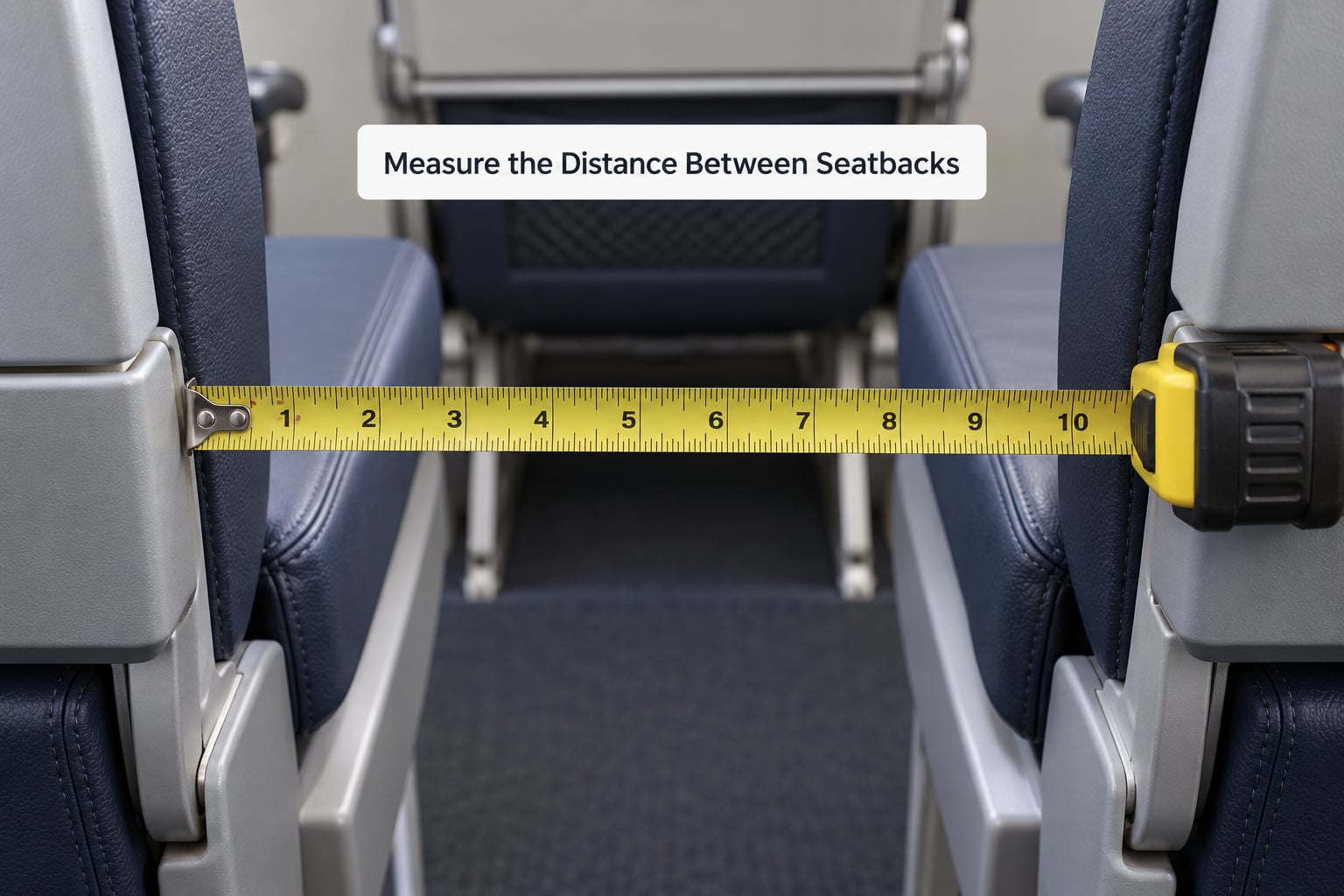
This is the method travelers on r/Flights and the FlyerTalk forums treat as the gold standard, and it’s straightforward. Sit upright against your seatback, run the tape from the front edge of the seat cushion in front of you to the front edge of your own cushion, and read the number at cushion level. Do it before the seat in front reclines, and again after, because the difference between those two readings is the pitch you actually lose in practice.
No tape measure? You have three decent substitutes. Hold your hands together end to end across your thigh; a hand is roughly four inches. Stack your forearms along the gap and count them; a forearm is about six inches wide end to end. Or use a rigid card, which you can bend into the curve of the gap and mark off the depth.
The third method is the one that actually answers the question you care about. Sit back into a neutral upright position, not slouched, and measure from your kneecap to the closest point on the seat in front. One user on r/Flights described exactly this process against a hard-backed chair and landed on 30 inches, then asked whether the seated-to-kneecap number was trustworthy. It is, with a caveat: it’s a measurement of your clearance, not of the seat, so it changes with your height and how you sit.
That’s its value. Published pitch tells you about the aircraft; knee clearance tells you about you.
3. Use the Seat-Map and Cabin-Layout Details
Seat maps carry more information than most people read off them, and the layout itself changes how a row feels. A 3-3-3 cabin on a narrowbody gives everyone a window or aisle and a short hop across the aisle. A 2-4-2 layout puts four people behind two, which means a middle seat in the four is worse even at an identical pitch number.
Match three things before you trust any figure: the airline, the specific aircraft variant, and the cabin. Skip one of those and your number describes a different flight. A 777-200 and a 777-300ER are different aircraft, and a single airline routinely sells the same model with more or less rows installed, which shifts pitch by an inch or more across the cabin.
Red flags in a listing: a pitch figure given for the airline rather than the aircraft, a single number covering every cabin, no date on the data, or a page that never mentions seat width. Travelers complain constantly that seat maps show no hard pitch numbers at all, so treat any figure without a source or a date as a starting point, not an answer.
4. Compare a Consistent Seat-Rating Method
Seat databases such as SeatGuru and ExpertFlyer grade individual seats with a consistent color code, generally green for extra room, yellow for average, and red for known tight rows. The value is not the letter. It is the consistency: the same reviewer method applied across hundreds of aircraft, which is something an airline’s marketing figure never gives you.
Before you rely on one, check what it actually measured. A seat rated green on pitch but with a wall-mounted literature pocket at knee height deserves a downgrade. Look for reviews dated within the last year, check whether the reviewer mentioned seatback thickness or cushion depth, and see whether the aircraft version matches the one on your boarding pass.
Here is the benchmark most people argue about, with flight length folded in:
| Seat pitch | Rating | Short haul (under 3 hours) | Long haul (over 8 hours) |
|---|---|---|---|
| Under 30 inches | Cramped | Survivable | Genuinely unpleasant, especially above 6 feet |
| 30-32 inches | Average | Comfortable | Fine under 6 feet; a real squeeze above 6’2″ |
| 33-34 inches | Good | Roomy | Comfortable for most heights |
| 35-38 inches | Very good | Effectively unlimited | The point where long-haul stops being a test |
Premium economy commonly sits between 34 and 38 inches, business runs from about 39 up past 70 on lie-flat products, and first runs from roughly 60 to 80. Those ranges matter mostly as context: the gap between 30 and 34 inches is the gap between a flight you think about and one you don’t.
Common Mistakes
Treating pitch as legroom. Pitch measures row spacing, and part of that space belongs to the cushion, the seatback and the seat pocket rather than to your legs. A slimline seat on an older aircraft can deliver better knee room at 31 inches than a thick new seat at 32.
Measuring from mismatched points. Cushion front to cushion front is the standard. Seatback top to seatback top gives a larger and less useful number, and comparing one person’s cushion reading to another person’s backrest reading produces nonsense.
Assuming every row is identical. Rows near galleys and lavatories trade space or get a bulkhead in front. Exit rows add depth and often come with a recline limiter that removes usable pitch when the seat ahead goes back. A 30-inch row and a 32-inch row can sit three rows apart.
Trusting one airline-wide figure. On US domestics, United, American and Delta all sit at roughly 30 to 31 inches in standard economy, so airline choice barely moves the number. Aircraft variation matters far more than the brand.
Ignoring seatback thickness and cushion depth. These are never published. Read them in reviews, or judge them in the cabin by checking where your knees land when the seat ahead reclines.
Two habits cover most of this. Measure before the seat in front reclines and after, because the second number is the one you live with. And if you want a straight answer rather than a measurement, ask the flight attendant outright what the pitch is in your row. Agents answer pitch questions routinely; they just rarely volunteer it.
Frequently Asked Questions
Is seat pitch the same as legroom?
No. Seat pitch is the standardized straight-line distance from one point on a seat to the same point on the seat ahead, so it measures row spacing rather than knee clearance. Part of that space belongs to the seat cushion, the thickness of the seatback and the literature pocket, none of which your knees touch. A slim 31-inch seat can give more usable room than a bulky 32-inch one.
What is considered good legroom on a plane?
In economy, 31 to 32 inches is average, 33 to 34 inches is generally called good, and anything from 35 to 38 inches is roomy enough to sleep in. The bar rises with flight length: 30 inches is uncomfortable on a two-hour hop and miserable on a ten-hour one. Premium economy usually starts around 34 inches.
How many inches of seat pitch do I need for a long flight?
For flights over eight hours, most people want at least 33 inches, and anyone above six feet two tends to need 34 or more. Under six feet, 31 inches usually works if the seat in front is well behaved. Tall flyers have reported that 32 inches is not enough on an eight-to-ten-hour flight, regardless of how the aircraft is marketed.
Can I measure legroom before buying a plane ticket?
Yes, and it is the smarter way to measure. Find your aircraft type, match it to a seat map for that specific variant and cabin, and read the published pitch. Confirm the aircraft on the airline’s booking page before you pay, since schedules and sub-fleet assignments change. You can only measure with a tape once you are physically in the cabin.
Does business or first class always have the same legroom on every airline?
No. Business runs from about 39 inches on a standard lie-flat product to past 70 inches on a fully flat bed, and first runs roughly 60 to 80 inches. Airlines also update cabins mid-life, swapping in newer seats with different pitch. Check the specific aircraft rather than assuming a cabin name guarantees a number.
Why can two seats with the same listed pitch feel different?
Seat pitch is one number applied to a whole cabin, and it leaves out everything that varies: seatback thickness, cushion depth, the position of the literature pocket, whether the row in front reclines freely, and where the row sits in relation to a galley or lavatory. Cabin layout matters too, since a middle seat in a four-across block has a passenger on one side and the aisle on the other.
Conclusion
The quickest reliable process takes about ten minutes. Confirm the exact aircraft and cabin for your flight, match it to a seat map, and read the published seat pitch in inches or centimeters. Compare that number against the benchmark for your flight length and your height. If the flight is long or you are tall, confirm it once more with a knee-to-kneecap check in the cabin before you settle in. That last step takes two minutes and tells you what the pitch number never could.
As of 2026, nothing about this process has changed, and no regulator sets a minimum. Knowing how to measure legroom on a plane is simply the difference between choosing your seat and discovering your seat.