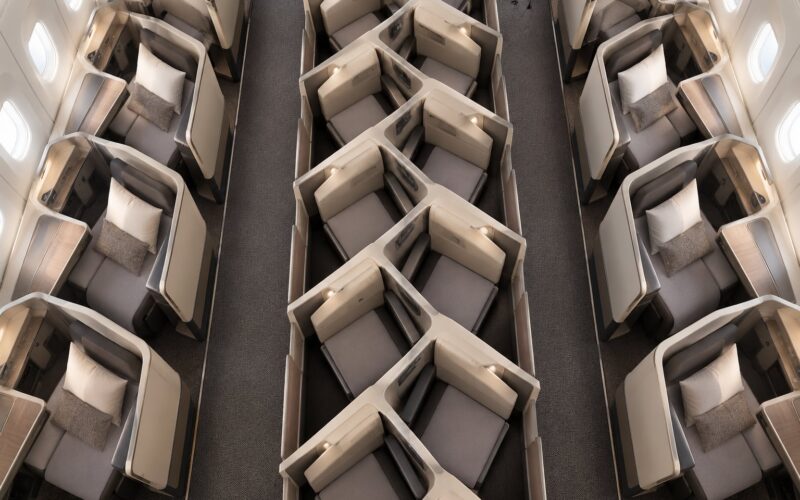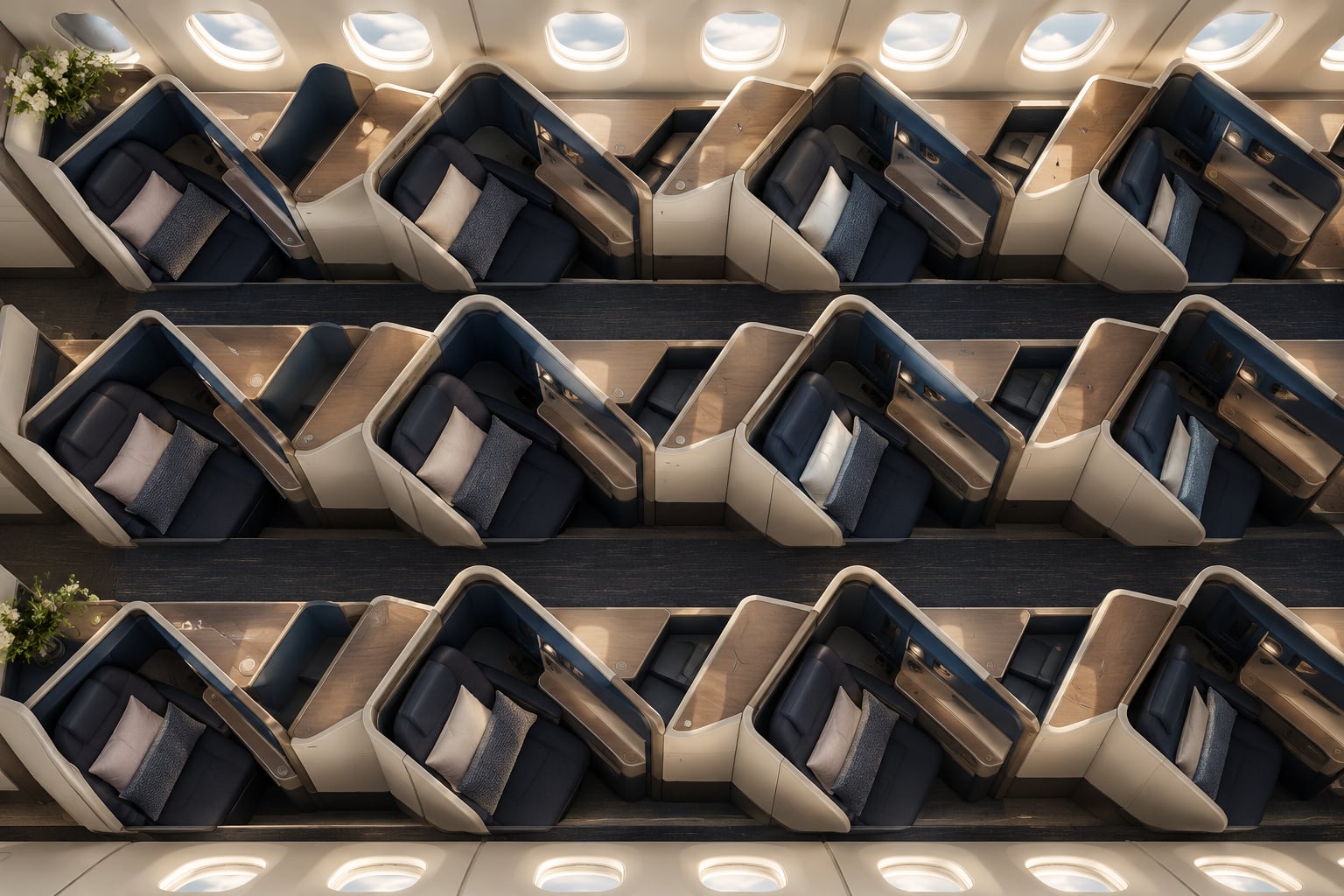
A reverse herringbone seat is a lie-flat business class seat angled toward the cabin window rather than toward the aisle, usually arranged in a 1-2-1 configuration so every passenger has direct aisle access. The seats sit diagonally across the cabin, which is where the fish-bone name comes from. In short, if you have ever settled into a modern premium-cabin seat and found your own window without crawling past a stranger, you were sitting in one.
One quick note before we go further: you will also see the phrase herringbone seating used for classroom floor plans, where rows zig-zag across a room. Different thing entirely. Here we mean the airline cabin layout.
Table of Contents
- What Is a Reverse Herringbone Seat?
- Reverse herringbone at a glance
- How Does the Herringbone Layout Work?
- Reverse Herringbone vs. Standard Seating
- What Are the Benefits of Reverse Herringbone Seats?
- What Are the Drawbacks for Passengers?
- Is a Reverse Herringbone Seat More Comfortable?
- Which Seat Positions Work Best in a Herringbone Cabin?
- Window-side pair
- Aisle-side pair
- The centre pair
- How to Check the Layout Before You Book
- Frequently Asked Questions
- Is reverse herringbone the same as staggered seating?
- Are reverse herringbone seats always more spacious than standard seats?
- Are reverse herringbone seats suitable for families traveling together?
- Does a reverse herringbone seat face forward?
- How can I tell whether a flight has reverse herringbone seats?
- Is reverse herringbone the same as a lie-flat seat?
- Conclusion
What Is a Reverse Herringbone Seat?
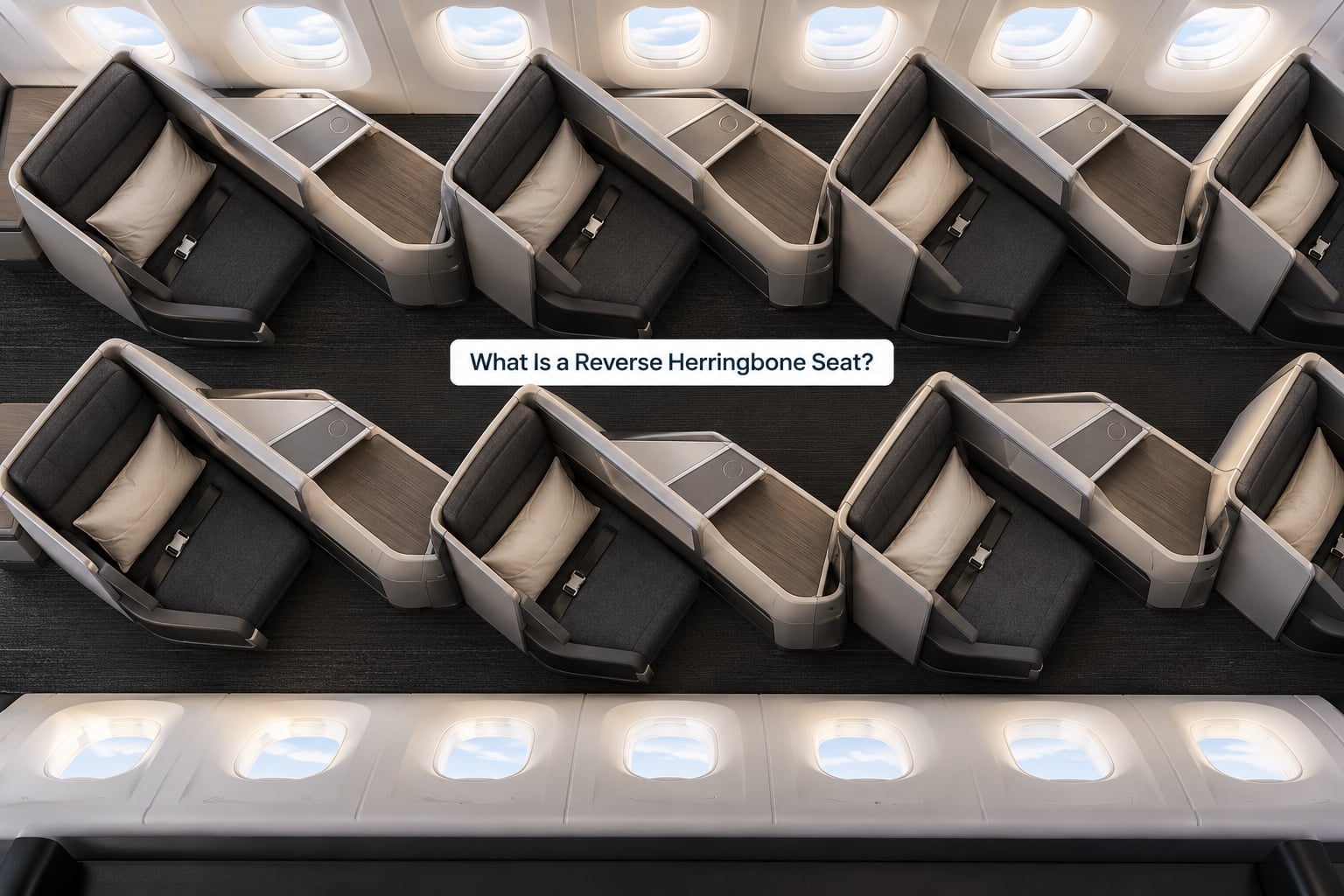
Reverse herringbone seating is similar to herringbone, but with passengers angled toward the cabin windows rather than the aisle. Each seat sits on a diagonal, so the seatback of one row ends up beside the ottoman of the row in front of it. Every passenger in the cabin gets a window and a walk-up aisle without crossing anyone.
The name works backwards from the original. Classic herringbone pointed seats inward at the aisle, which left the window seats with a wall of seatback in front of them and no view. Flipping the angle solved both problems at once, and it is now the layout most new widebody business class cabins are built around.
Reverse herringbone at a glance
| Question | Answer |
|---|---|
| Which way do passengers face? | Toward the cabin window |
| Typical cabin configuration | 1-2-1 on widebodies, sometimes 1-1-1 |
| Direct aisle access | Yes, every seat has it |
| Window view | Every seat sits next to a window |
| Privacy | High seat shell plus a divider between the centre pair |
| Bed mode | Lie-flat, with a diagonal mattress over the footwell and ottoman |
| Best for | Solo travellers who want privacy and a view |
How Does the Herringbone Layout Work?
Think of the rows as chevrons pointing outward. On the left side of the cabin the seats angle toward the left windows, and on the right side they angle toward the right windows. The centre pair points forward and back, split by a divider.
That geometry is what produces direct aisle access. Because each seat sits on the diagonal, the aisle runs clear along both sides of the cabin. Nobody has to climb over a neighbour to get out, and nobody has to ask permission to use the lavatory.
The diagonal also explains the odd sightlines. Looking forward, your view runs along the seatbacks of the row ahead rather than straight at one. Turning your head gets you the window, though tall shells sometimes mean leaning forward to see out of it. That trips people up more than anything else about the layout.
On narrowbodies, the word herringbone gets reused for a 2-2-2 arrangement where seats point in opposing diagonal pairs. Same visual idea, far less space per passenger.
Reverse Herringbone vs. Standard Seating
Standard seating means straight rows facing forward, the way most economy cabins are built. Comparing that against a conventional straight-row premium cabin is fair, but the comparison people actually want is between the three angled layouts.
| Layout | Seat direction | Aisle access | Window view | Privacy | Storage | Couples |
|---|---|---|---|---|---|---|
| Straight rows | All forward | Only window and aisle seats | Window seats only | Moderate | Good | Easy |
| Herringbone (classic) | Toward the aisle | Every seat | Poor for window seats | Moderate to high | Limited | Difficult |
| Reverse herringbone | Toward the window | Every seat | Every seat | High | Limited | Centre pair sits apart |
| Staggered | Forward or aft | Only some seats | Good | High | Good | Best side by side |
The pattern most flyers settle on: solo travellers prefer herringbone angles, couples prefer staggered, and airlines prefer herringbone because it packs more revenue seats between two doors. That trade-off explains why the layout looks the way it does.
What Are the Benefits of Reverse Herringbone Seats?
Direct aisle access is the headline. You get up whenever you want, whenever your row is called, and whenever someone needs the bathroom.
A window at every seat is close behind. On a traditional cabin only two seats per row have a view; here, every single one does, including the centre pair looking diagonally out toward the nearest window.
Privacy holds up well too. The tall shell between you and the aisle, plus a divider between the centre seats, creates a small room rather than a seat. FlyerTalk and r/aviation regulars both treat that as the main reason to choose the layout.
There is no bad seat. In a 2-2-2 cabin two of the four seats have no window, and in a staggered cabin some rows have no aisle access. In a 1-2-1 reverse herringbone cabin every seat offers the same package, which is why frequent flyers say the only real decision is window or aisle.
Crew also like it. A clear aisle means service happens without squeezing past paying passengers.
What Are the Drawbacks for Passengers?
Footwell space is the most repeated complaint, and it comes straight from the diagonal. When the seat flattens, your legs run diagonally across the space where a forward-facing seat has a straight footwell. Wider passengers report the bed surface feels narrow for curling into a comfortable position.
Newer seats have improved this. Passengers on r/awardtravel comparing recent Collins Aerospace products against older reverse herringbone models frequently conclude the criticism is overstated on the current generation.
The centre pair is the other sticking point. The two seats face each other across a divider rather than sitting shoulder to shoulder, and the divider height varies by airline. On some you talk over a chest-high panel; on others with a full-height partition the seats barely acknowledge each other. Neither helps a couple who wants to share a laptop or watch something together.
In bed mode your head ends up toward the aisle on many of these seats, so galley noise and the cabin’s general chatter land right where you are trying to sleep.
The window view also needs a reality check. Angled toward a window does not mean an unobstructed one. Seats in the middle of a cabin can look at a wall of seat shell, and you may have to lean forward to see anything at all.
Storage tends to be modest. A side console, a small shelf, then the overhead bin. Older models left laptops with nowhere sensible to go.
Finally, angled seats point neither straight ahead nor straight back. On r/aviation, flyers who weigh crash survivability point out that forward- or aft-facing is preferred, and that staggered seats are both wider and roomier at the feet. Nobody expects a modern cabin to be aligned perfectly, but it is worth knowing the trade exists.
Is a Reverse Herringbone Seat More Comfortable?
It depends on whether you mean the seat or the cabin around it. As a private, walkable space, a reverse herringbone seat usually wins. As a bed, it depends heavily on which generation you get.
The label spans nearly two decades of hardware. The 2009-era pods that first popularised the layout feel tight when flat, with a short footwell and a wall in front of the bed. Recent seats with larger footwells, better mattress foam and sliding doors feel like a different product entirely. Flyers argue about the category name precisely because it hides that range.
Perceived spaciousness often surprises people in the good direction. Once the door closes and the aisle is out of sight, a well-built pod feels more generous than a wider straight-row seat with no walls at all.
And if you sleep badly in an angled position, no amount of footwell fixes it. Some people simply need a back that matches their spine at an angle they can hold for eight hours.
Which Seat Positions Work Best in a Herringbone Cabin?
Start with who you are travelling with, because the geometry sets the options.
Window-side pair
These seats give you the wall on your outside shoulder and the clearest view of the wing or engine. Pick one next to a fuselage curve rather than a straight sidewall if privacy is the priority, because a curved wall gives the passenger behind a surface to look at instead of your seatback.
Aisle-side pair
Faster boarding and deplaning, and often the preferred seat for anyone who plans to get up during the flight. You give up a little privacy because people walk past.
The centre pair
Best for solo travellers who want to be in the middle of the cabin, worst for anyone hoping to sit shoulder to shoulder. One seat has a console in the middle, the other does not, and the divider treatment decides how separate you feel.
No single position wins across airlines. Seat generation, cabin size on the specific aircraft, and how far forward or aft you sit all change the feel, which is why checking the exact aircraft matters more than the layout name.
How to Check the Layout Before You Book
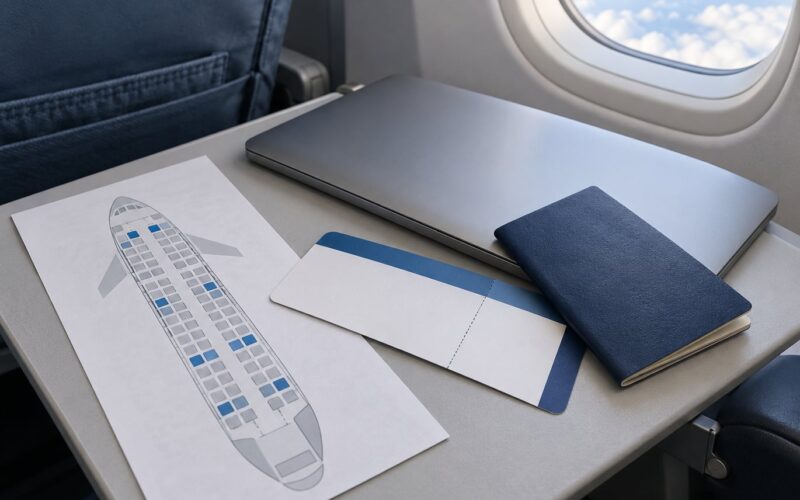
Airline marketing rarely prints the word herringbone, so you read the map instead. Look for a cabin diagram showing one seat, two seats, one seat repeated down the fuselage. If the outer seats sit at an angle to the aisle and each carries a window icon, that is a reverse herringbone cabin.
Seat letters help. Suites in a 1-2-1 layout are usually lettered A, then D and E, then K, which leaves the alphabetic gaps between seats a physical gap in the cabin. Window-side letters near the fuselage confirm the outside seats, and in most 1-2-1 cabins the highest and lowest letters are the window pairs.
Check the aircraft type, not just the route. Airlines mix layouts on the same route, so the same flight number can have reverse herringbone on one aircraft and staggered on another.
Then read the seat description rather than the review headline. Look for a stated bed length, a footwell figure, whether there is a door, and whether the centre divider is full height. Those four details tell you more about comfort than any rating.
Look at cabin photos taken by passengers rather than airline renders. A pod that looks enormous in a brochure is often narrower in bed mode, and passenger shots from the footwell show it plainly.
Finally, check whether advance seat selection is even offered on that fare. Some carriers sell it separately, which changes the economics of a longer booking window.
Frequently Asked Questions
Is reverse herringbone the same as staggered seating?
No. Reverse herringbone seats angle toward the windows in a 1-2-1 layout, so every passenger has direct aisle access and a window. Staggered seats stay closer to forward or aft facing, which usually means a longer straight footwell and better storage, but only some seats get aisle access. Couples generally prefer staggered for side-by-side sitting.
Are reverse herringbone seats always more spacious than standard seats?
Not always. They usually feel more private because every seat has a shell around it and none is a bad seat, but the diagonal bed surface can feel narrow for larger passengers, and storage is often modest. Whether a given seat feels roomy depends heavily on the seat generation and the footwell figure the airline publishes.
Are reverse herringbone seats suitable for families traveling together?
Only partly. In a 1-2-1 cabin the two centre seats face each other across a divider rather than sitting beside each other, which works fine for solo travellers but poorly for parents and children who want to share a screen or talk easily. Some carriers offer double seats in certain cabins, so check the specific aircraft before booking.
Does a reverse herringbone seat face forward?
No. It is angled diagonally toward the nearest cabin window, with the row ahead sitting off to the side rather than straight ahead. That is what gives every seat a window and a direct path to the aisle. Some flyers who dislike sleeping at an angle prefer staggered forward or aft facing seats for that reason.
How can I tell whether a flight has reverse herringbone seats?
Open the seat map and look for a repeating one-two-one pattern down the cabin, with the outer seats angled toward the fuselage and an icon marking aisle access on every seat. Seat lettering also gives it away, since A and K are usually the window pairs with D and E in the middle. Always confirm the aircraft type, since airlines mix layouts on the same route.
Is reverse herringbone the same as a lie-flat seat?
No, they describe different things. Lie-flat refers to the seat itself, which reclines into a bed. Reverse herringbone describes how seats are arranged and angled in the cabin. Many lie-flat seats use a reverse herringbone layout, but some use staggered, 2-2-2 or straight-row arrangements, and an angled seat is not automatically a good bed.
Conclusion
What is a reverse herringbone seat, in one line: a lie-flat business class seat angled toward the window so every passenger gets a view and direct aisle access.
The layout wins on privacy and freedom of movement, and it loses on footwell length and on sitting next to someone. Start by confirming the aircraft type on your exact flight, then read the seat description for the bed length and whether there is a door. If you are flying alone, pick the position you like for the view or the aisle, because in this cabin there is no bad choice between them.