Airline seat recline is measured in degrees and in inches, and airlines use whichever is more convenient rather than one agreed standard. If you have been comparing a 114 degree spec against a 6 inch spec and trying to work out which seat reclines further, the short version is that you cannot compare them without knowing what each one was measured against.
This page explains both measurements, where the reference points come from, how to convert one into the other, and which published recline figures you can actually rely on in 2026.
Table of Contents
- What Is Seat Recline Measured In?
- How Airline Recline Angle Is Measured
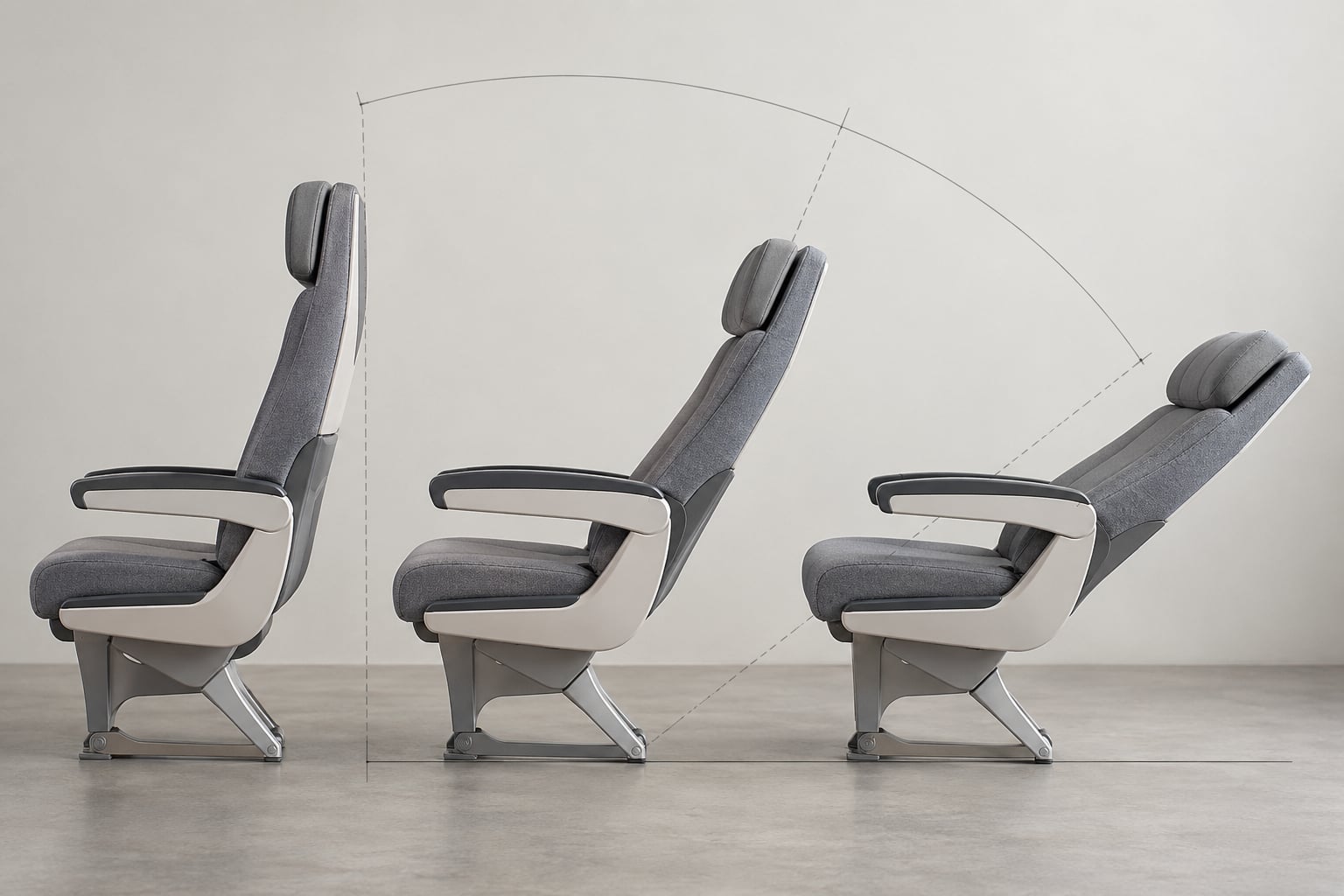
- Measured from vertical, the seat back angle starts at zero
- Measured from horizontal, a flat seat reads as 180 degrees
- Measured from the take-off position, the baseline is where the seat locked upright
- A 180 degree recline is not automatically a flat bed
- How Seat Recline Is Measured in Inches
- What is seat recline measured in inches? It misses the seat back height
- What a recline measured in inches actually tells you
- Typical Airline Seat Recline Angles and Distances
- How to Convert Between Recline Angle and Inches
- Why Recline Measurements Are Not Directly Comparable
- The datum is usually missing from the spec
- Advertised specs and delivered hardware drift apart
- Third-party seat charts go stale
- Recline is not pitch, width or bed length
- Some seats do not recline at all
- The airline, the route and the fare can all differ
- What Recline Number Is Most Comfortable?
- Frequently Asked Questions
- Is airplane seat recline measured in degrees or inches?
- Why do two airline seats with the same recline angle feel different?
- Is a 30-degree airline seat recline comfortable?
- Does a higher recline angle always mean more legroom?
- Can airline seats recline on short-haul flights?
- How can I find the recline angle for my flight?
- Conclusion
What Is Seat Recline Measured In?
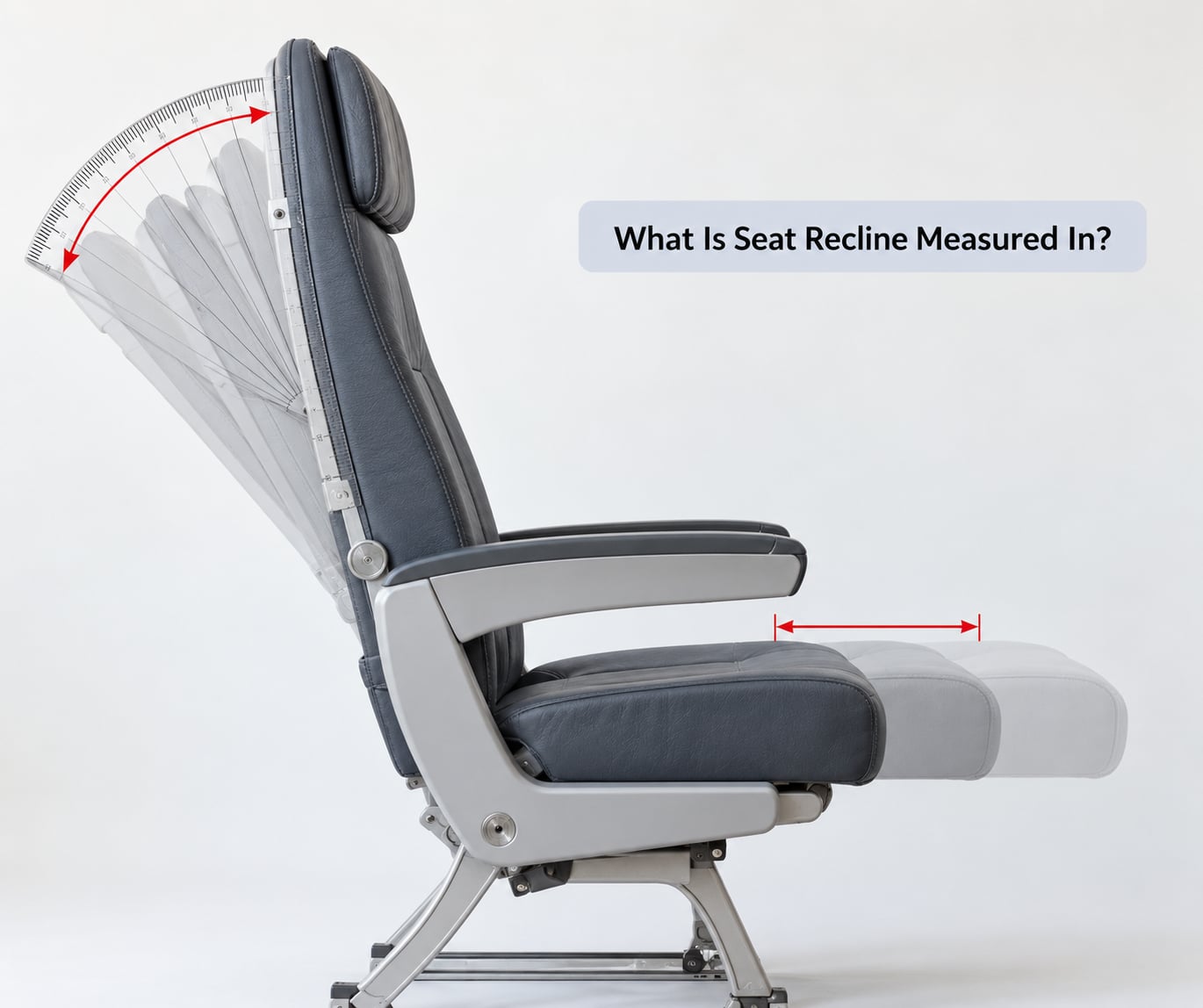
Seat recline is measured in two ways. Inches describe how far the seat back travels backwards from its upright position. Degrees describe the angle the seat back makes when it reaches that position. Both are legitimate measurements of the same movement, and both are in regular use by airlines today.
The difference matters because neither figure is self-explanatory. An inch figure means very little on its own, since the same six inches of travel on a tall seat back produces a much shallower angle than it does on a short one. A degree figure means little without knowing whether it was measured from the vertical, from the horizontal, or from the take-off position.
| Measurement | What it records | What it depends on | Published example |
|---|---|---|---|
| Inches | Linear travel of the seat back away from upright | The height of the seat back it is measured against | Delta reported coach recline cut from 4 inches to 2 inches |
| Degrees | The angle the seat back reaches | The datum: vertical, horizontal or take-off | Business Traveller listed economy A330-200 and B777-300ER seats at 29 degrees |
Neither is more accurate than the other. They describe the same hinge movement in a different coordinate system, and the only fair way to compare two seats is to convert both figures onto the same basis first.
How Airline Recline Angle Is Measured
A degree measurement needs a starting line. The Business Traveller airline survey publishes one of the few clear explanations of this anywhere: seat recline can be measured from a horizontal position, from a 90 degree position, or from the take-off position, and it is reported in either degrees or inches.
Those three reference points are the whole source of the confusion in this topic, so it is worth knowing each one.
Measured from vertical, the seat back angle starts at zero
Under this convention an upright seat is 0 degrees and a seat tilted back 30 degrees reads as 30. It is the most intuitive way to describe a shallow economy recline, and it is how the Business Traveller tables report their 29 degree economy figure. It is also the convention that makes the biggest numbers look least impressive, since nothing in economy will ever reach 90 degrees under this system.
Measured from horizontal, a flat seat reads as 180 degrees
Here the seat back is measured against the floor, so a flat bed is 180 degrees and an upright seat is 90. This is the convention used by cabin product marketing, which is why a seat described as having a 155 degree recline may still be nowhere near flat. Note the arithmetic: 180 minus 155 gives you 25 degrees back from upright, which is a modest movement.
Measured from the take-off position, the baseline is where the seat locked upright
Many seats sit at a small forward angle rather than truly vertical during taxi and take-off. Measuring from that locked position makes the quoted range a movement figure rather than an absolute angle, so it is closer to the inch measurement than to the other two.
A 180 degree recline is not automatically a flat bed
This is the most common misreading of a recline spec. A seat can reach 180 degrees against the horizontal reference and still be unusable for sleeping if the seat pan does not extend, if a footrest is missing, or if the shell curves upward at the ends. Angle alone does not tell you whether the seat lies flat. Look for the length of the sleeping surface instead, and whether the seat is described as fully flat or as angled lie-flat.
How Seat Recline Is Measured in Inches
Inch figures describe travel: the distance the top of the seat back moves away from its upright position, usually measured at the top edge where a passenger’s head and shoulders sit. It is a linear measurement, so it is easy to read and easy for airlines to quote, which is why mainstream consumer reporting tends to use it.
CBS News reported in 2019 that Delta was reducing recline on some aircraft, cutting coach travel from 4 inches to 2 inches and first class from 5.5 inches to 3.5 inches. Note that this was an airline reducing its own product, which is exactly the kind of change that quietly invalidates older seat guides.
What is seat recline measured in inches? It misses the seat back height
It is missing the seat back height the travel was measured against. If a 6 inch figure comes from a 36 inch seat back and another comes from a 28 inch seat back, the resulting angles differ by a wide margin. Any inch figure quoted without that context is half a number.
What a recline measured in inches actually tells you
It tells you the size of the movement, not the angle. Two seats can both recline 6 inches and behave completely differently, because the seat back is the radius of the arc. Passengers on r/tall describe exactly this problem, reporting that a shallow recline by the person in front leaves them with nowhere to put their legs no matter how politely they sit.
Worse, the same product name can carry different inch figures on different aircraft. A Tripadvisor seat forum thread records United economy plus seats quoted at 5 inches on the A320 family and about 3 inches on the 737. Same name, same airline, different hardware.
Typical Airline Seat Recline Angles and Distances
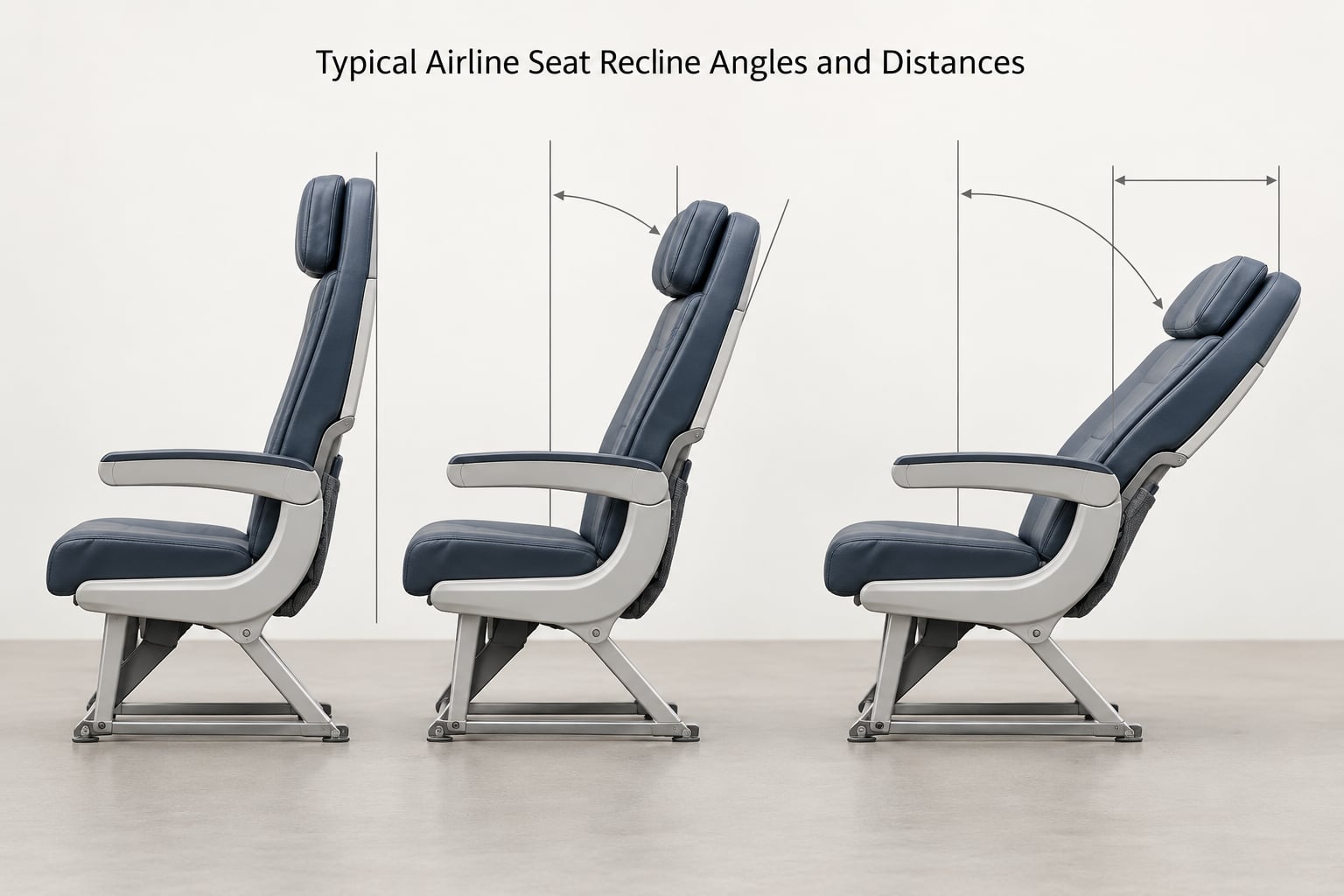
These are the figures that appear most often in airline material and seat comparisons. Treat them as typical ranges rather than guaranteed specifications, because the same airline can quote two different numbers for two aircraft types and because the reference position is rarely stated alongside the number.
| Seat type | Typical angle range | Typical travel | What to watch |
|---|---|---|---|
| Economy, narrow body | About 25 to 32 degrees from vertical | Roughly 4 to 6 inches | Shallow by design; bulkhead rows lack the seat in front |
| Economy, wide body | About 28 to 33 degrees from vertical | Roughly 5 to 7 inches | Business Traveller lists 29 degrees for A330-200 and B777-300ER economy |
| Premium economy | About 35 to 45 degrees from vertical | Roughly 6 to 9 inches | The extra angle is often modest; forum users on a BA flight called it no comfier than standard economy |
| Business class, angled | About 130 to 155 degrees from horizontal | Roughly 10 to 16 inches | An angled lie-flat is not a flat bed; check sleeping surface length |
| Business class, fully flat | About 170 to 180 degrees from horizontal | Roughly 18 to 22 inches | Check direct aisle access and door alignment before booking |
| First class | About 170 to 180 degrees from horizontal | Roughly 18 to 24 inches | Often a private suite, where privacy panels reduce usable width |
Four things change what those numbers feel like in practice: the seat pitch in front of you, the shell design, whether you are on a bulkhead, and the seat width. A deeper recline on a seat with 30 inches of pitch takes the room out of your knees. A curved shell that slides forward can give a surprisingly large angle in a small footprint. A bulkhead row has no seat in front to recline into, which is a genuine bonus. And a wider seat gives your hips room to angle away from a reclining stranger, which passengers on r/tall rate as the practical comfort difference.
How to Convert Between Recline Angle and Inches
The relationship is a piece of elementary trigonometry, and you need one extra number: the height of the seat back measured from the hinge point to the point you are tracking.
- Measure the seat back height. From the hinge at the base of the seat back to the top edge. A typical economy seat back is in the region of 28 to 36 inches; you need this figure or a close estimate of it.
- Get the angle from the upright position. If a figure is quoted from the horizontal, subtract it from 180 to get the tilt from upright. A 150 degree figure becomes 30 degrees of travel.
- Multiply height by the sine of the angle. That gives you the geometric arc at the top edge. With a 36 inch seat back at 30 degrees, that is 36 times 0.5, or 18 inches, which is obviously wrong for an economy seat. The reason is instructive.
Your torso is not rigid with the seat back. It slides and the cushion compresses, so the passenger-facing travel is far shorter than the geometric arc of the back itself. That is why a seat back 36 inches tall cannot produce anything like 18 inches of usable head travel in economy. A rough rule that fits real seats better is to take that geometric result and cut it to roughly a sixth, easing towards a fifth as the angle passes 40 degrees. The table below uses that adjustment.
To make this concrete, here is the approximation table most seat comparisons are really working from. It follows the hand conversion a forum user worked through on the same seat back heights, and it is rough by design.
| Angle from vertical | Approximate travel, 36 inch seat back | Approximate travel, 28 inch seat back |
|---|---|---|
| 15 degrees | About 1.5 inches | About 1.2 inches |
| 20 degrees | About 2 inches | About 1.5 inches |
| 25 degrees | About 2.5 inches | About 2 inches |
| 30 degrees | About 3 inches | About 2.5 inches |
| 40 degrees | About 4 inches | About 3 inches |
| 45 degrees | About 5 inches | About 3.5 inches |
| 60 degrees | About 7 inches | About 5 inches |
Use this to sanity check a figure, not to plan a nap. On a 36 inch seat back, a quoted 5 inch recline corresponds to roughly 45 degrees, which is a shallow, workable economy recline rather than the generous lie-back the number suggests.
Why Recline Measurements Are Not Directly Comparable
The datum is usually missing from the spec
Most published figures do not say where the angle starts. A number read from the horizontal and a number read from the vertical differ by roughly 90 degrees, and they get compared as if they were the same thing on a regular basis. Always look for the word fully flat, lie-flat, or the stated range before trusting an angle.
Advertised specs and delivered hardware drift apart
A widely shared reply in that same Tripadvisor thread puts it plainly: the recline of the seat is not a function of the airline but a function of the hardware, and hardware changes from day to day. Airlines retire seats, swap cabins on the same aircraft type, and roll out revised products gradually, so a seat map written two years ago can describe a cabin that no longer exists on that route.
Third-party seat charts go stale
Seat comparison databases were widely used for years and have stopped being maintained, which the same forum thread flags. A chart that has not been updated since a period of rapid fleet change is worse than no chart, because it looks authoritative. Prefer the airline’s own seat map, which reflects the specific aircraft on your booking, and treat third-party data as a starting point at best.
Recline is not pitch, width or bed length
These four numbers get quoted together and then confused. Pitch is the distance from a fixed point on one seat to the same point on the seat in front, which is why 32 and 34 inch pitch figures describe legroom rather than back movement. Width is the seat width at its widest point. Bed length is the usable length of a flat sleeping surface. Recline is only the back movement. A seat can have a generous recline and cramped pitch, which is common in budget carriers.
Some seats do not recline at all
Measurement does not apply to them, but they matter enormously if recline is your goal. Exit row seats on many aircraft have a fixed seatback that cannot recline. Rows facing a bulkhead with no seat in front of them may have a restricted or pre-set recline angle. Rows behind a non-reclining seat inherit a limited range from the passenger in front. Sliding shell seats are pre-reclined to a fixed position rather than adjustable. Check the seat map legend before paying extra for a specific row.
The airline, the route and the fare can all differ
Cabin layouts are not standard across an airline’s fleet, and the same seat number can be a reclining seat on one aircraft and a fixed one on another. Premium economy branding is also used inconsistently, with some economy plus products marketed under similar names, which makes spec comparison harder than it should be.
What Recline Number Is Most Comfortable?
There is no single ideal figure, because comfort comes from how the recline interacts with pitch, seat width and how long you are in the air. As a practical guide: in economy, anything past about 30 degrees from vertical is worth having, because that is the difference between resting and staying rigidly upright. For napping on an overnight, a premium economy seat in the 35 to 45 degree band is the practical step up, though forum reports suggest some premium economy seats deliver little more movement than standard economy, so check the angle for your aircraft rather than the cabin label.
In business class, the question changes from angle to construction. A fully flat sleeping surface, direct aisle access and a reasonable bed length matter far more than whether the spec says 170 or 180 degrees. First class suites are usually fully flat as standard, and at that point the differentiator is width and privacy rather than extra recline.
The trade-off runs the other way too. A deeper recline takes the room out of the knees of the row behind, which is why passengers on r/tall and in r/frontierairlines often choose not to recline at all on short sectors. Etiquette guidance generally recommends reclining slowly and checking first, a point covered in detail on our reclining etiquette guide.
Before you commit to a seat, check three things: the seat map for your exact aircraft and cabin, whether your row reclines at all, and what happens to the seat in front of you when it does. Half-empty flights change the experience as much as the specification does.
Frequently Asked Questions
Is airplane seat recline measured in degrees or inches?
Both. Airlines publish recline either as a linear figure in inches, which is how far the seat back travels from the upright position, or as an angle in degrees, which is how far it tilts from a reference line. Neither is more accurate than the other, and neither means much without knowing what it was measured against.
Why do two airline seats with the same recline angle feel different?
The angle is only one input. Seat pitch, seat width, shell shape and cushion firmness all change how a recline feels, and an inch figure depends on the height of the seat back it was measured from. Two seats at 30 degrees from vertical on a 32 inch pitch will feel nothing like the same angle on a 40 inch pitch.
Is a 30-degree airline seat recline comfortable?
For economy, a 30 degree recline from the upright position is about as much as a standard seat gives you, and it is generally enough to rest rather than sit at attention. It is nowhere near enough to lie back and sleep. If sleeping is the goal, you want business class or a seat with a fully flat sleeping surface.
Does a higher recline angle always mean more legroom?
No. Legroom comes from seat pitch, the distance between matching points on your seat and the one in front. Recline moves the seat back backwards and often consumes the same space. A seat can have a generous recline and cramped pitch at the same time, so judge the two measurements separately.
Can airline seats recline on short-haul flights?
Yes, most seats do, but the angle and range are usually shallower than on long-haul equipment, and some carriers block full recline on short sectors to keep the cabin upright for service. Exit row and bulkhead rows may not recline at all. If it matters to you, check the seat map for the aircraft on your specific flight.
How can I find the recline angle for my flight?
Start with the airline’s own seat map for your booking, which reflects the aircraft actually assigned to your route, and look for the legend describing the seat type. Ask the airline directly for the recline range in both degrees and the reference position. Treat third-party seat charts as a rough guide, because many are no longer being maintained.
Conclusion
What is seat recline measured in? In inches and in degrees, sometimes both in the same sentence, with no agreed standard between airlines. Inches describe how far the seat back travels and only mean something alongside the seat back height. Degrees describe the angle the seat back reaches and only mean something alongside the reference position it was measured from.
When you compare seats, check three things first: the recline range for your exact aircraft and cabin from the airline’s own seat map, the legroom in inches listed as seat pitch, and whether your row reclines at all. Then ask which reference position the angle is quoted from, and you will be comparing like with like.