Is domestic first class worth it? On flights of four hours or more, often yes, especially when the fare gap stays under roughly 200 dollars for the whole trip. On a short hop the answer is usually no, because the front cabin on a narrowbody is a premium-economy recliner with priority boarding attached, not the enclosed suite most people picture when they hear first class.
So the honest answer is conditional. Flight length, aircraft type, the size of the fare gap and your own body all matter more than the cabin name. Here is how the math works.
Table of Contents
- Is Domestic First Class Worth It at a Glance
- What Does Domestic First Class Usually Include?
- Domestic first class by airline
- Does domestic first class include lounge access?
- How Much More Does Domestic First Class Cost?
- Cash, points or an upgrade certificate
- Which Domestic Routes Benefit Most From First Class?
- Is domestic first class worth it on a 90-minute hop?
- Is First Class More Comfortable Than Business Class on Domestic Flights?
- Is Domestic First Class Worth It for Different Travelers?
- How Can You Make First Class More Affordable?
- How Do You Book Domestic First Class?
- What Should You Check Before Choosing a First-Class Seat?
- Frequently Asked Questions
- Is first class worth it on a 2 hour flight?
- Does domestic first class include lounge access?
- Do all first class seats recline?
- Is it better to buy first class outright or use miles to upgrade?
- What is poor man’s first class?
- Is first class flying better than business class?
- Conclusion: Decide by Trip, Not by Cabin Name
Is Domestic First Class Worth It at a Glance
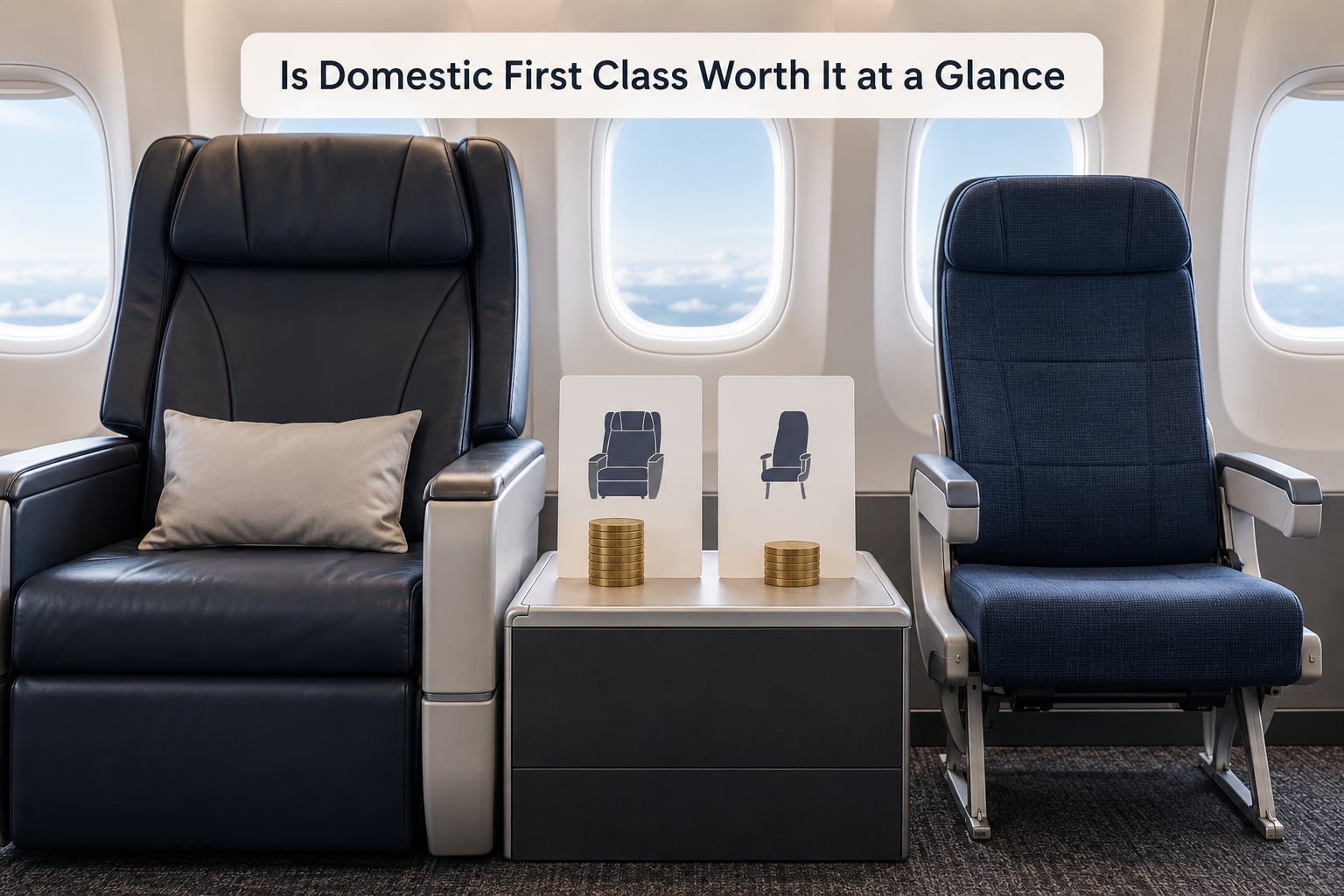
The short version: the longer the flight and the smaller the upgrade price, the more it pays off. A comfortable recliner earns its keep on hour four and stops feeling special somewhere around hour seven, when sleep replaces posture as the problem.
| Trip type | What you gain over main cabin | Typical fare gap | Verdict |
|---|---|---|---|
| Under 2 hours | A few extra inches of legroom, priority boarding | Often 150 to 400 dollars | Not worth it |
| 2 to 3 hours | Wider recliner, quieter forward cabin | Around 150 to 350 dollars | Depends on the fare |
| 3 to 5 hours transcontinental | Flat-ish recline, meal service, priority security | Around 200 to 500 dollars | Worth it for many travelers |
| 5 hours or more | Real rest, extra space, fewer people moving past | Around 300 to 900 dollars | Strongest case |
| Widebody domestic route | Bigger seat, more service, often a door | Widest spread of the four | Check the seat map first |
Those gaps are typical U.S. ranges rather than quoted fares. They move with demand, season, how far ahead you book and which fare bucket you land in.
What Does Domestic First Class Usually Include?
Domestic first class is the front cabin on a U.S. domestic flight. Airlines sell it as a separate cabin ahead of main cabin, and almost every one of them markets the same short list of things.
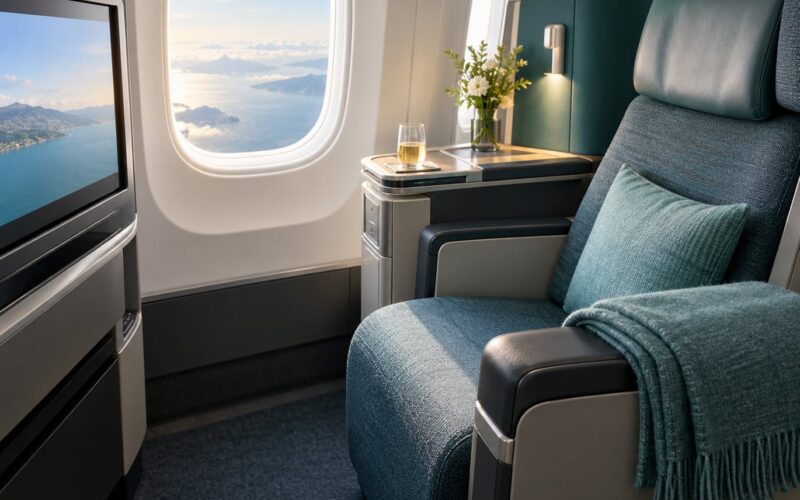
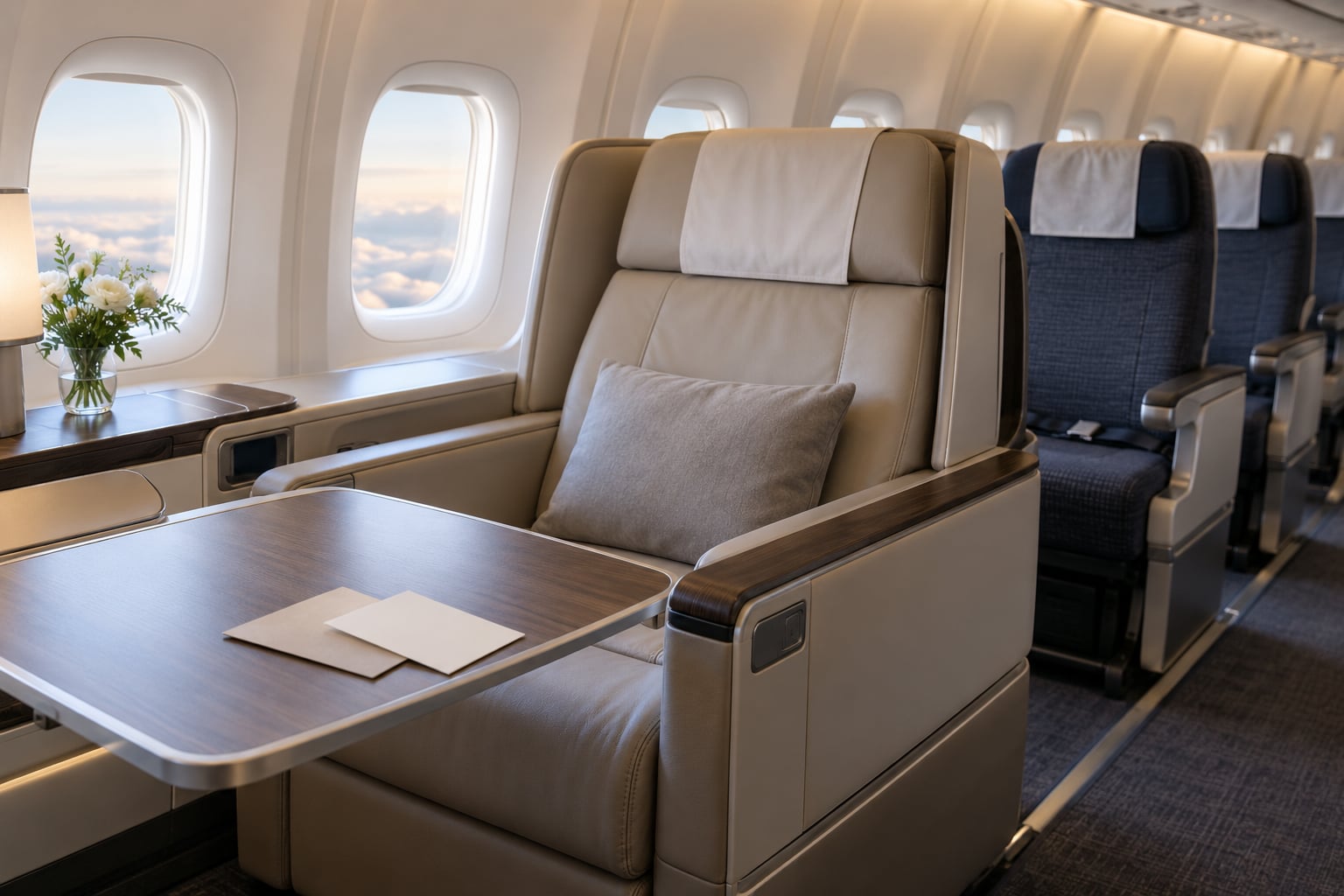
The seat is the point. On a narrowbody you get a wider recliner with a deeper seat cushion, more pitch (roughly five to eight inches more than main cabin on most narrowbodies) and a footwell that stops feeling like a footwell. Some carriers add a small screen or a powered outlet at every seat in the cabin, which on a regional jet with two rows of first is a genuine upgrade.
The rest of the list is service and logistics: priority security and boarding, deplaning ahead of the main cabin, a free checked bag on most carriers, complimentary drinks including an alcohol option, and a hot meal on longer segments. Legroom and seat width vary more by aircraft than by airline.
| Perk | Economy | Premium economy | Domestic first |
|---|---|---|---|
| Seat width | Standard | Wider | Widest on the aircraft |
| Seat recline | Shallow | Deeper recline | Full recliner or near-flat |
| Checked bag | Usually paid | Often free | Free on most carriers |
| Boarding group | Main cabin | Earlier than main | First out of the jet bridge |
| Food | Snack or buy-on-board | Snack or light meal | Hot meal on longer segments |
| Wi-Fi and power | Varies, often paid | Often included | Usually included |
| Lounge access | Only with status or a pass | Varies by carrier | Not automatic on most routes |
One assumption worth killing early: a domestic first ticket does not hand you a lounge. Access depends on the carrier, the airport, the specific lounge and your status, and several airlines restrict it to particular products or require the trip to originate at that hub. Flyers on the Tripadvisor Air Travel Forum say it plainly: you do not get automatic lounge access with a domestic first ticket.
JetBlue’s Blue First is the leanest of them. r/jetblue notes it has lower specs than the airline’s own premium main cabin seats and less upgrade availability, so on that airline the premium row can be the better deal. The naming is marketing; the product is much closer across the board than the brochures suggest.
Domestic first class by airline
| Airline | Front-cabin name | Best domestic route for it | Watch out for |
|---|---|---|---|
| American | Flagship First | Transcontinental on a widebody | Availability varies by aircraft |
| Delta | First (Delta One is international) | Hub long-haul transcons | Older 767-300 reports of seats that will not recline |
| United | First with signature recliner | 737 MAX and widebody routes | Narrowbody recliner is comfortable but not flat |
| Alaska | First Class | West Coast and Pacific Northwest | Smaller cabin, service varies with crew size |
| JetBlue | Blue First | Leisure coastal routes | Lower spec and fewer upgrade slots than main cabin |
Two recurring themes when travelers compare them: cabin size drives the service you get, and a two-row cabin on a regional or small aircraft can beat a four-row cabin on a big one. Nobody in the award-travel crowd argues that any domestic first class product is worth its price tag without knowing the aircraft.
Does domestic first class include lounge access?
Not by default. Some airline first-class fares on hub routes do include lounge access, some include only a discounted or single-visit pass, and some include nothing. Check the fare rules for the exact itinerary before you build a plan around a lounge, because lounges that are not part of the ticket are where the value quietly disappears.
How Much More Does Domestic First Class Cost?
The gap between a main cabin and a domestic first fare on the same flight is usually somewhere between 150 and 900 dollars one way, depending on the route, how full the flight is and how late you book. That range is wide because the same seat costs three different amounts on a Tuesday in February and a Friday before a holiday.
Five things move that number more than anything else.
- Demand. A full flight and a discounted cabin next to it is the best case. An empty premium cabin next to expensive main cabin is the worst.
- Booking window. Premium cabins on domestic routes rarely sell out the way transatlantic premium does, which means waiting often helps. Check-in upgrade offers usually land 48 to 72 hours before departure.
- Fare class. Basic economy and some discounted buckets cannot be upgraded at all. A fully flexible main cabin fare can usually be upgraded at check-in for much less than buying first outright.
- Status and certificates. A systemwide upgrade certificate or an elite benefit can take the out-of-pocket cost to zero, which changes the arithmetic completely.
- Bag fees. Two round-trip checked bags can run 160 dollars or more on the major carriers. On a short trip with heavy bags, that alone can justify a fare difference of similar size.
The break-even question is simple. If the upgrade costs more per flight hour than you would spend on a decent dinner, a better hotel night or an extra day somewhere, spend it somewhere else instead. Most people land somewhere between 40 and 60 dollars an hour as their ceiling, and the flights that clear that bar are the four-hour-plus ones.
Run the numbers on a five-hour transcon and the case writes itself. An upgrade of 250 dollars works out to 50 dollars an hour, with a free checked bag, priority security and a seat you can actually sleep in folded up. The same 250 dollars on a 90-minute flight is closer to 165 dollars an hour for extra pitch you will barely notice. The aircraft decides the rest of it.
Cash, points or an upgrade certificate
Three ways to pay, three different economics.
- Cash on the airline’s site. Most expensive per trip, cheapest in points. Best for a one-off when the fare gap is under roughly 250 dollars.
- Systemwide upgrade certificate. Converts a flexible main cabin fare into first for a flat cash cost, which usually lands well below the fare gap. Highest-value option if you have one.
- Miles. A poor deal on domestic first specifically, because the award charts price a narrowbody recliner like it were worth a transatlantic lie-flat seat. Use miles for international.
Bonus points from status or a card are worth more than miles here, since they apply to whichever fare you book and they stack with a certificate.
Which Domestic Routes Benefit Most From First Class?
Longer and wider is the pattern. A domestic first seat on a widebody, such as the routes between the West Coast and Hawaii or a Northeast to West Coast run on a large aircraft, is a different product from the same cabin on a 737.
Transcontinental flights of five to six hours between the Northeast and California are the sweet spot. Long enough that posture matters, short enough that you still board and land in daylight. Premium transcontinental fares sometimes carry a door, a larger seat and a more complete meal service, and that is a real jump rather than a re-labeled economy row.
Red-eyes work differently. A wider seat helps, but what you actually want is a lie-flat position, and most domestic recliners do not deliver one. Check the seat type before assuming an overnight first class ticket solves the problem.
Is domestic first class worth it on a 90-minute hop?
Almost never, unless you are traveling with a small child, need priority boarding badly, or have a back or knee condition that makes the extra pitch worth more than the fare gap. On a Burbank to Denver run, people on r/unitedairlines say the domestic product on the older planes is not worth it and suggest the premium economy row instead. Same answer for most regional hops.
Aircraft matters here. A 737 MAX recliner, an A321neo recliner and a widebody seat in the same cabin are three different experiences. That is the single most useful thing to check before paying.
Is First Class More Comfortable Than Business Class on Domestic Flights?
Most U.S. carriers do not sell a separate business class on domestic flights; the front cabin is called first class and it is roughly what premium economy is on an international aircraft. So the fair comparison is against international products, not against a domestic business cabin that does not really exist.
| Feature | Domestic first | International business | International first |
|---|---|---|---|
| Seat | Narrowbody recliner, rarely fully flat | Widebody recliner, often flat or near-flat | Suite or enclosed pod |
| Privacy | Open cabin, no doors | Modest partitions on many airlines | Door or full-height shell |
| Service | Shared cart service | Dedicated attendant on long routes | Full cabin crew, sometimes two per row area |
| Food | Hot meal on longer segments | Multi-course, often table service | Multi-course with more choices |
| Cost | Moderate premium | Large premium | Several times a domestic first fare |
The gap between domestic first and real business class is large enough that buying a domestic first ticket to simulate an international experience is a common mistake. If you want the real product, book a real long-haul itinerary or buy a short one in business and accept the price.
Is Domestic First Class Worth It for Different Travelers?
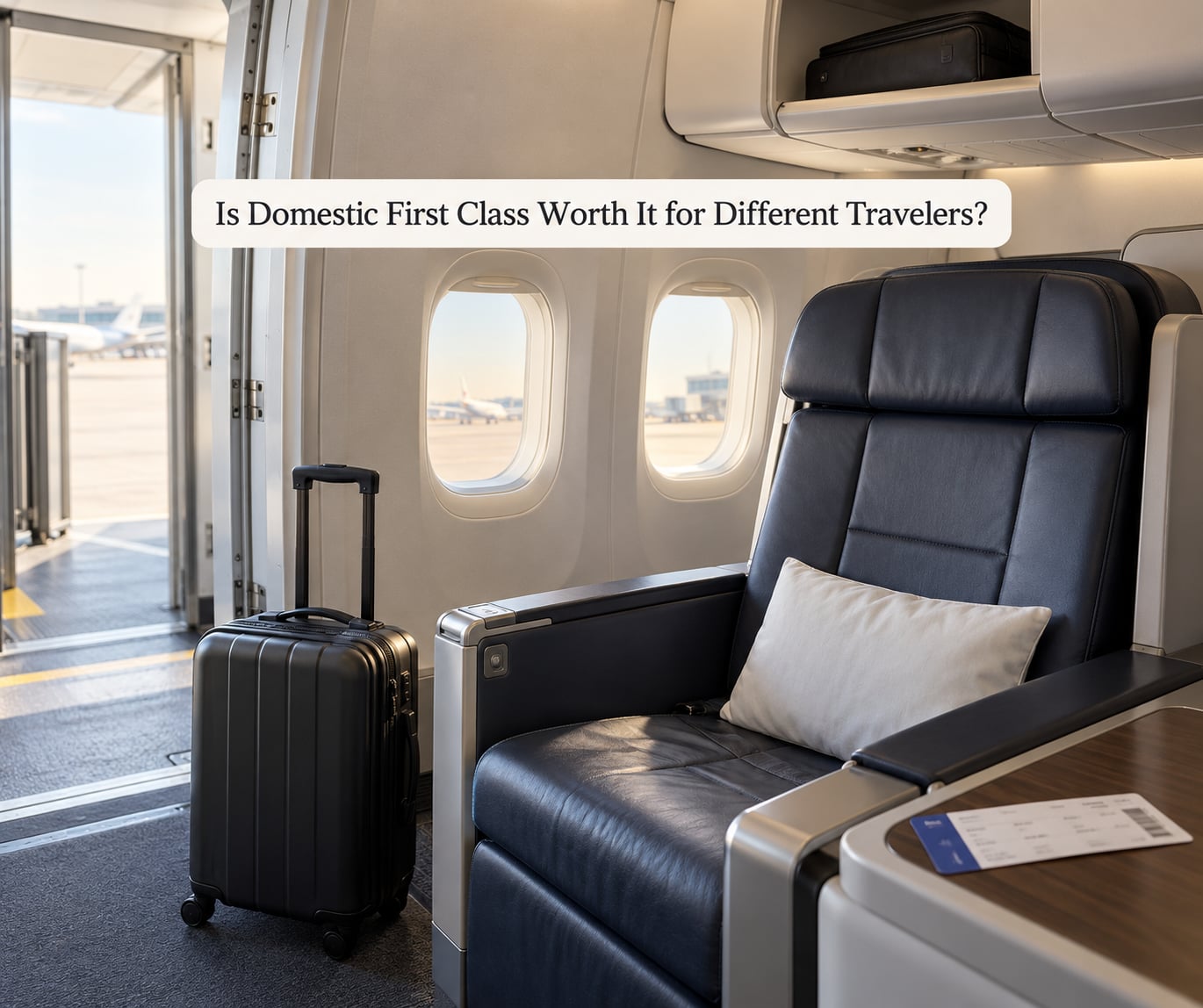
Same fare, different value. Who you are changes the answer more than the route does.
- Business travelers on employer-subsidized fares. If your company pays the difference, buy it. Priority security and early deplaning save real minutes on a tight schedule.
- Families with young children. Overhead bins and fewer bags matter more than seat width. Value depends on whether your airline includes free checked bags in first, which most do.
- Older travelers and anyone with mobility limits. Extra pitch, a step-free path to the seat and less time standing in the aisle are the strongest reasons to upgrade. This is not luxury spending.
- Tall travelers. A few extra inches changes the trip. Taller passengers get more out of a premium recliner than most people do.
- Frequent flyers with status. If the upgrade is free, take it every time. If it costs a full fare difference, treat it as a purchase and apply the same test as anyone else.
- Price-sensitive leisure travelers. This is the group that usually should stay in main cabin and buy an empty middle seat instead when the three of you fly together.
How Can You Make First Class More Affordable?
Most of the levers are timing and eligibility rather than shopping harder.
- Compare adjacent departure times. The 10:40 flight and the 1:15 flight can sit in different fare buckets with a large gap between their first-class fares on the same route.
- Wait for the check-in offer. Airlines price unsold premium inventory down 48 to 72 hours out. Set a reminder and look on the airline’s own site, which is where those offers appear.
- Check your upgrade eligibility before you fly. Elite status, a co-branded card and systemwide upgrade certificates are the three usual paths.
- Use companion certificates where you have them. Some bank programs issue certificates that cover a second traveler on an award or paid first-class itinerary, which halves the cost of a milestone trip.
- Watch for targeted promotions. Airlines email upgrade offers to specific segments of their list, and those are separate from the general check-in deal.
- Buy the empty seat instead. On a full flight, a blocked middle seat in main cabin gets you the same nap on a cheap flight and it costs less than the first-class upgrade on most itineraries.
One caution on points. Domestic first is usually a poor use of a large points balance. A transcontinental business award may eat more miles but buys a real lie-flat seat. If your goal is comfort and you have miles, the international award is often the smarter redemption.
How Do You Book Domestic First Class?
The booking process is ordinary, with four checks that matter.
- Compare the two fare buckets on the same flight. Price the main cabin and the front cabin side by side, including seat selection fees and bag fees, before you look anywhere else.
- Read the fare rules. Basic economy and heavily discounted buckets cannot be upgraded, and some fares are nonrefundable with change fees attached.
- Confirm the aircraft. Schedules change, and the same flight number can be operated by a narrowbody or a widebody on different days. Domestic first does not exist on every equipment type on a route.
- Pick the seat last. Front rows put you near the lavatories and the galley. Aisle seats in the second or third row of the cabin are usually the quietest available.
There is little to gain from a travel agent here. Domestic fares are the most transparent prices in the industry, and the upgrade inventory is the same on every channel.
What Should You Check Before Choosing a First-Class Seat?
Read the seat map, not the marketing. A few details decide whether the cabin is worth your money.
- Seat width and pitch on the specific aircraft you are booked on, not the airline’s best seat.
- Recline type. Recliner, recliner with footrest or a true lie-flat. On older aircraft some first-class seats have been reported not to recline at all, with attendants unable to fix them in flight.
- Row location. Bulkhead rows gain legroom but lose under-seat storage. Exit rows need an able-bodied passenger.
- Galley and lavatory proximity. The forward row on a 737 has engine noise behind it and a steady stream of lavatory traffic.
- Cabin size. Two rows of first beats four, and four beats eight. It is a reasonable proxy for how much service you will actually get.
- Screen and power. If you plan to work, confirm both at your seat rather than assuming.
Frequently Asked Questions
Is first class worth it on a 2 hour flight?
Usually not, because the fare gap on a two-hour domestic flight is often as large as the gap on a six-hour flight while the extra comfort you get is much smaller. Two extra inches of pitch and priority boarding are not much return on 300 dollars. The exceptions are travelers with back or knee problems, families who want overhead space and guaranteed cabin seats, and anyone whose employer covers the upgrade.
Does domestic first class include lounge access?
It depends entirely on the airline, the airport and the specific fare, and it is not automatic on most domestic itineraries. Some carriers include a lounge on hub routes or offer a discounted or single-visit pass, while others include nothing for a domestic first ticket. Check the fare rules for your exact booking, and remember that your own elite status often buys access regardless of cabin.
Do all first class seats recline?
No. Most domestic first-class seats are recliners that stop well short of flat, and older aircraft sometimes have seat mechanisms that do not recline at all. Flyers have reported a seat marketed as first on a 767-300 that would not recline and that attendants could not release in flight. Check the aircraft type and recent reviews of the specific seat before paying for a cabin you plan to sleep in.
Is it better to buy first class outright or use miles to upgrade?
If you fly this route often or hold elite status, miles and certificates usually win because the cash cost falls to zero or close to it. If it is a one-off trip, buying the first-class fare outright is usually cheaper in points than paying a large award chart for a narrowbody recliner. Reserve points for international business where the same miles buy an actual lie-flat seat.
What is poor man’s first class?
It means buying comfort by other means rather than by cabin name: paying for an empty middle seat or window, choosing a bulkhead row in main cabin, selecting a seat with a power outlet, or flying at an off-peak time for a wider layout. On a full aircraft the blocked middle seat costs far less than the first-class upgrade and delivers most of the same nap on a three-hour flight.
Is first class flying better than business class?
On a domestic flight you are usually comparing a narrowbody recliner against something that does not exist, because most U.S. carriers do not sell a separate domestic business cabin. Against an international product, business class wins on almost everything that matters: seat width, recline, privacy and service. International first adds suites and doors, but at a price most travelers will not pay more than once.
Conclusion: Decide by Trip, Not by Cabin Name
So, is domestic first class worth it? It pays off when the flight is long enough for the seat to matter, the fare gap is small enough that you are not trading a real experience for a label, and you genuinely need the room or the priority boarding. Everything else, a premium economy seat or a blocked middle seat, delivers most of the benefit for a lot less.
Check the seat map before you book, expect the gap to shrink if you wait until check-in, and remember that a domestic first ticket rarely includes the lounge or the lie-flat seat people are actually picturing.